
Most Japandi desk guides argue about wood. That question is already settled on this site, and it is the easy part anyway. The harder problem, the one that actually decides whether you regret the purchase, is fit: whether the desk is the right height for your body, deep enough for your screen, and the right format for your room. This guide covers those three, and links out for the material and styling that other guides here already handle.
The short answer: Choose a Japandi desk by fit, not looks. Get the height right for your body (most people need lower than the 29-inch standard), give the monitor enough depth to sit at arm's length, and pick the format that suits your room. Buy solid wood for daily use.
- Start with fit, not material
- Which desk should you choose?
- Getting the height right
- Depth and footprint: how big the desk needs to be
- The four desk formats, and which room each suits
- Japandi desks compared: the specifications that matter
- The Japandi executive desk
- Sit-stand desks in a Japandi room
- Matching the chair to the desk
- The screen-wall trick
- Which desk should you choose?
- What to check before you buy
- Frequently Asked Questions
- Closing
- Shop This Look
Start with fit, not material
Takeaway: The material rule is settled, buy solid wood for daily use, and it is covered in the dining table guide. This post is about the three things a photo hides: height, depth, and format.
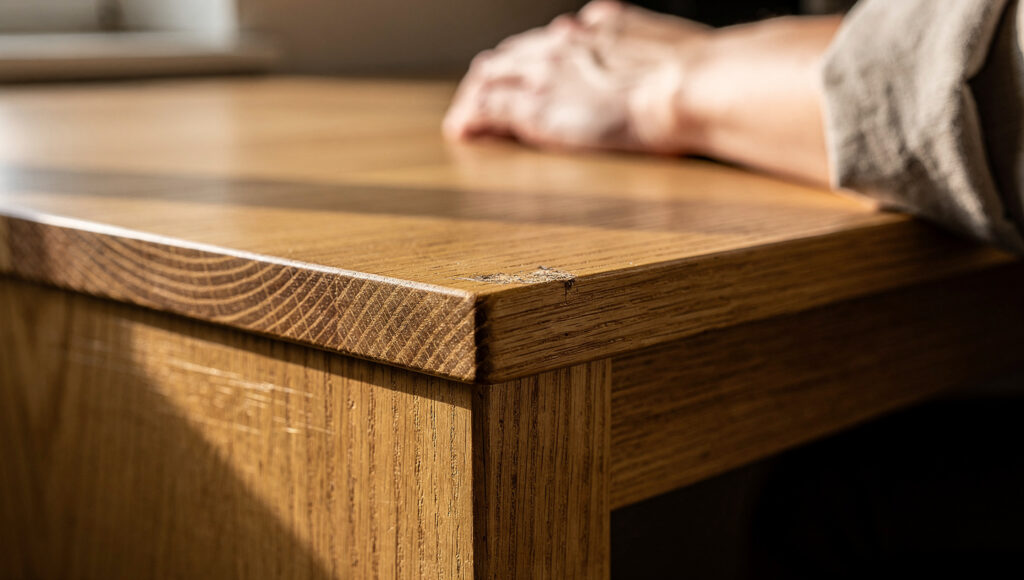
The material question is real, but it is covered in depth elsewhere on this site, and the rule is simple and consistent: for a desk you use daily, buy solid wood, not veneer over MDF or printed laminate, because those cannot be repaired and fail at the edge where your forearms sit. Our Japandi dining table guide works through wood species, finishes, and why MDF and laminate are rejected, and it applies to a desktop exactly as it does to a tabletop. For how the desk sits within the wider room, the biophilic home office and Japandi home office ideas guides cover the material and styling decisions around it.
What this guide adds is the part those posts do not: the dimensions. A desk can be solid oak, beautifully made, and genuinely Japandi, and still be the wrong desk for you because it is two inches too tall or eight inches too shallow. Fit is invisible in a photo and decides everything about how the desk feels to use.
Which desk should you choose?
| If you want… | Choose… |
|---|---|
| A daily home-office desk | Sit-stand frame in white + solid oak or bamboo top |
| A desk for a small or shared room | Slim writing desk, 40–47″, pale oak |
| A desk where floor space is tight | Wall-mounted fold-down in solid wood |
| A bedroom corner desk | Slim writing desk, one drawer, screen off the dark wall |
| A dual-monitor or paperwork setup | Corner desk, one wood, kept clear — only if you need the surface |
Getting the height right
Takeaway: Standard desks are built for tall people. Check that your forearms rest level with your elbows at 90 degrees, and expect to need a desk below the 29-inch standard, a footrest, or an adjustable frame if you are average height or shorter.
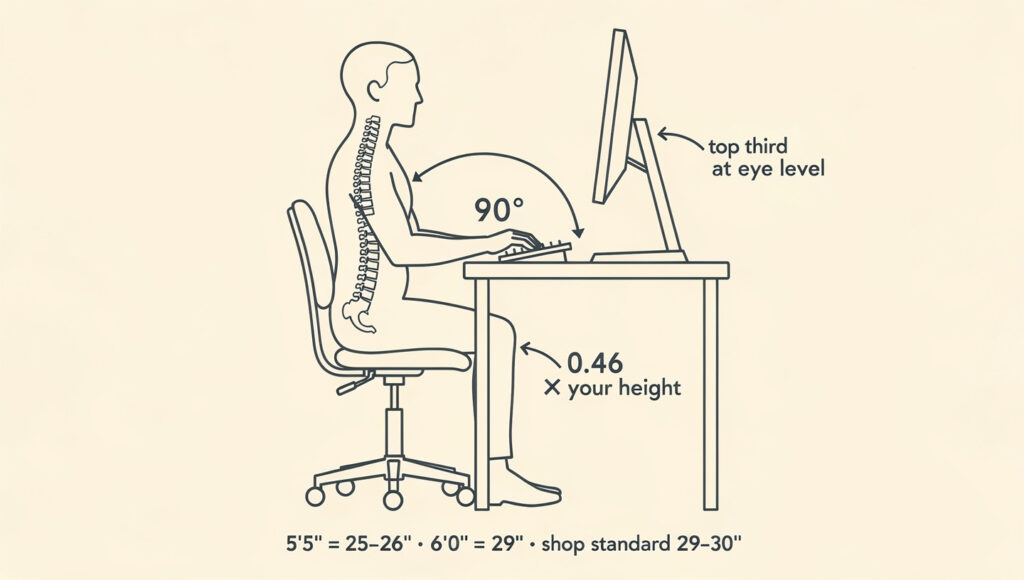
A beautiful desk at the wrong height will hurt your back within a week, and it is the single most common mistake people make. Most desks sold for seated work are 29 to 30 inches (74 to 76 cm) high. That standard is sized for someone around six feet tall, and for everyone shorter it is too high.
The test needs no tools. Sit with your feet flat and your upper arms relaxed at your sides, and rest your forearms on the surface. Your elbows should sit at roughly a 90-degree angle. If your shoulders hunch up to reach the desk, it is too high; if you lean down into it, it is too low.
For an estimate before you buy, a seated desk height of about 0.46 times your standing height fits most people. For someone 5 foot 5 (165 cm) that is roughly 25 to 26 inches, a good three inches below the shop standard. For someone 6 foot (183 cm) it is about 29 inches, which is why the standard suits tall people and nobody else. Measure in the shoes you actually wear at the desk, because thick soles shift the number by up to an inch.
If you fall for a fixed-height desk that turns out slightly too tall, a footrest is the honest fix. Raising your feet restores the elbow angle and takes the strain off your shoulders, and a low solid-wood footrest sits perfectly within the aesthetic. What a footrest cannot fix is a desk that is far too tall, so check the number before you buy rather than hoping to correct it after.
The other route is an adjustable sit-stand frame, which removes the height question entirely and lets more than one person share the desk. More on that below.
Depth and footprint: how big the desk needs to be
Takeaway: Depth matters as much as height. Allow 28 to 30 inches of depth to sit a monitor at arm's length, or use a monitor arm to reclaim space on a shallow desk. Match the width to your actual work, not the size of the room.
Height gets attention; depth gets ignored, and it is what makes a desk usable. Your monitor should sit about an arm’s length from your eyes, roughly 20 to 28 inches (50 to 71 cm) back. Put a monitor on a shallow desk and it ends up too close, which strains your eyes and forces you to sit back awkwardly.
For a desk with a monitor and a keyboard in front of it, aim for a depth of about 28 to 30 inches (71 to 76 cm). A laptop-only setup can work shallower, around 24 inches, because there is no separate screen to push back. If you use a monitor arm, it buys you a few inches by floating the screen out over the desk edge, which is the single most useful accessory for a shallow desk and for switching between sitting and standing.
Width is about your work, not the room. A writing or laptop desk is comfortable at 40 to 47 inches (100 to 120 cm). A dual-monitor or paperwork-heavy setup wants 55 to 63 inches (140 to 160 cm). Buy the width you need and no more, because an oversized empty desk invites the clutter that the whole style is trying to avoid.
The four desk formats, and which room each suits
Takeaway: Slim writing desk for most rooms and small spaces, sit-stand for long hours, wall-mounted fold-down where floor space is tight, and a corner desk only if you truly need the surface and will keep it clear.
Once the dimensions are right, the format is the real choice, and there are four that work in a Japandi room.
The slim writing desk is the default. A shallow solid-wood desk, 40 to 47 inches wide, with one or two drawers or none, in pale oak or ash. It keeps a small room feeling light and it is the most naturally Japandi format, because it reads as a quiet horizontal plane. Choose this for a bedroom corner, a shared room, or any space where the desk should recede.
The sit-stand desk suits daily and creative work, and it takes some care to keep Japandi, covered in the next section. Choose it if you work long hours or want to alternate sitting and standing.
The wall-mounted fold-down desk is the small-space answer. A solid-wood surface that folds flat to the wall when not in use, giving you a real desk in a room that has no floor space for one. It is a genuinely Japandi-friendly option, and it pairs with the other small-space moves in our small Japandi living room guide.
The L-shaped or corner desk is the one to approach with caution. It gives you the most surface and suits dual monitors or heavy paperwork, but its bulk fights the minimal, low-clutter look, and a large empty corner of desk is a clutter magnet. Choose it only if you genuinely need the surface, and keep it in one consistent wood with a clear top.
Japandi desks compared: the specifications that matter
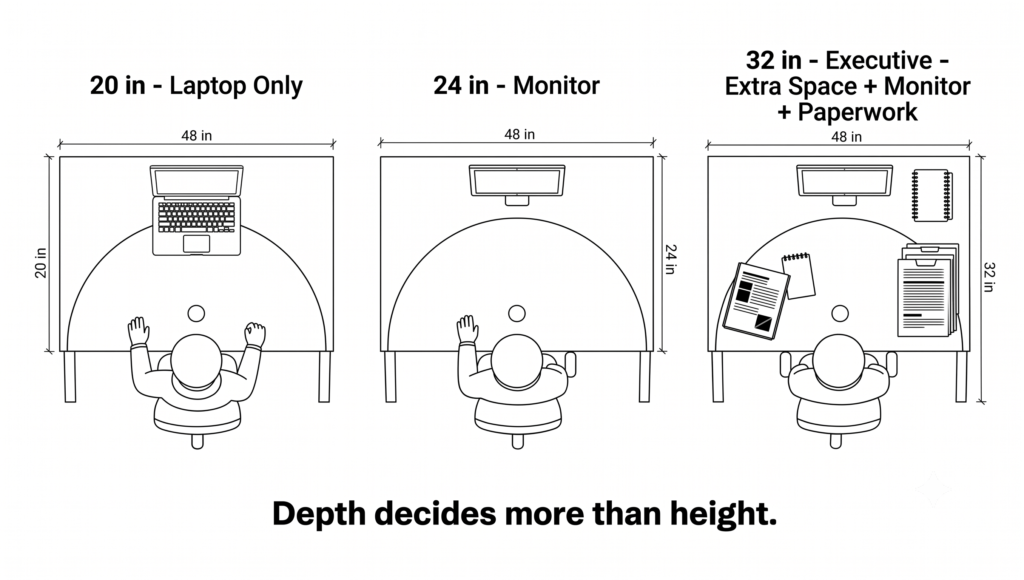
Takeaway: Depth decides more than height. Twenty inches is laptop-only; twenty-four is the monitor minimum; executive desks run thirty to thirty-six. On a sit-stand, buy a dual-motor frame and pair it with a solid top rather than accepting the bundled laminate.
Most desk listings tell you the color and the assembly time. Here are the numbers that actually decide whether the desk works.
| Desk type | Typical height | Depth | Surface material | Best for |
|---|---|---|---|---|
| Slim writing desk | 29–30 in fixed | 20–24 in | Solid oak, ash, or bamboo | Laptop-only work, shared rooms |
| Sit-stand, single motor | 28–47 in range | 24–30 in | Solid top on a separate frame | Long hours, one monitor |
| Sit-stand, dual motor | 25–51 in range | 24–30 in | Solid top on a separate frame | Long hours, dual monitor, heavier loads |
| Executive desk | 29–31 in fixed | 30–36 in | Solid hardwood or veneer over ply | Paperwork, dual monitor, meetings |
| Wall-mounted fold-down | Set at install | 16–20 in | Solid wood or bamboo | Tight rooms, occasional use |
| Corner or L-shape | 29–30 in fixed | 24–30 in per leg | Varies | Dual monitor, but check the material |
Three things to read from that table.
Depth is the constraint people discover late. A 20-inch desk fits a laptop and nothing else. A monitor needs the screen roughly an arm’s length away, which in practice means 24 inches minimum and 28 to 30 for comfort. Executive desks run 30 to 36 inches because they assume paper and a monitor at once.
On a sit-stand desk, buy the frame and the top separately. Bundled tops are almost always laminate over particleboard, which fails the material standard this guide sets and looks it within two years. A good dual-motor frame paired with a solid oak or bamboo top costs a little more and is a genuinely different piece of furniture.
Single versus dual motor matters more than the height range. Dual-motor frames lift faster, run quieter, and carry meaningfully more weight without wobble at full extension. If the desk holds two monitors and a laptop stand, single motor will feel unstable standing.
The Japandi executive desk
Takeaway: A Japandi executive desk keeps the scale and loses the weight: 60 to 72 inches wide, 30 to 36 deep, solid or quality veneer over ply, slim legs with the floor visible, one or two shallow drawers, no carving or gloss. Float it if the room allows.
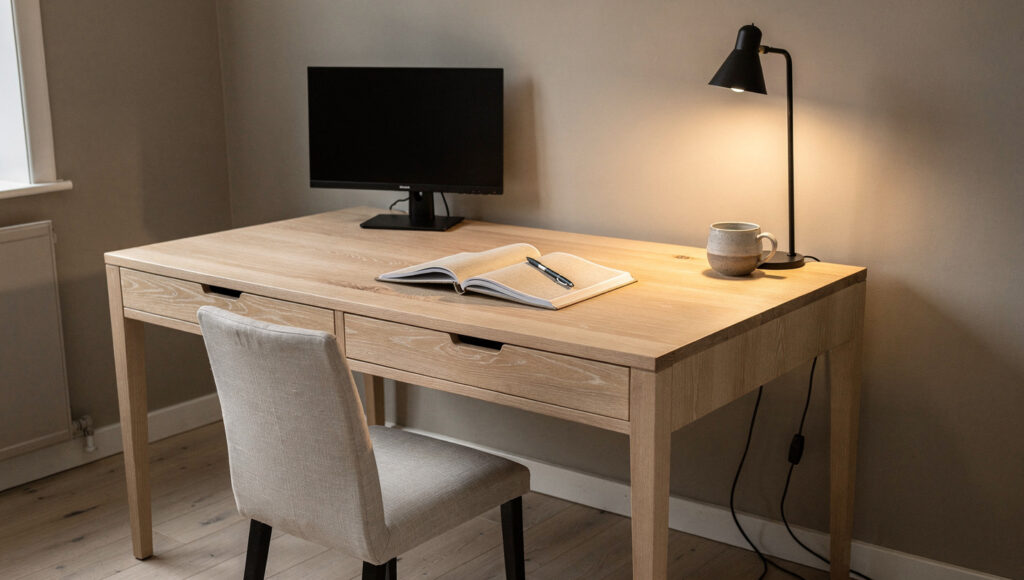
An executive desk is a different object from a writing desk, and the difference is not prestige. It is a larger work surface, more storage, and a footprint that assumes the room is a study rather than a corner of a living room.
That creates a genuine tension with this style. Traditional executive desks are heavy, dark, often ornate, frequently on a solid plinth with carved detail, and none of that belongs here. The Japandi version keeps the scale and drops the weight.
What to look for. A solid hardwood top in oak, ash, or walnut with a matte oiled finish, sized 60 to 72 inches wide and 30 to 36 deep. Slim legs or a light frame rather than a full pedestal base, so the floor stays visible underneath. Storage limited to one or two shallow drawers rather than a bank on both sides. Routed finger-pulls or small matte black hardware. Nothing carved, nothing glossy, no leather inlay.
What disqualifies it. High-gloss lacquer, veneer over particleboard on a piece this large, carved or moulded edges, brass ornamentation, and the double-pedestal form, which reads as corporate rather than calm.
The material qualification. At 60 inches and up, a solid hardwood top is heavy and expensive, and a quality veneer over a stable plywood core is a legitimate choice at this size — the same distinction our [Japandi kitchen cabinets →/japandi-kitchen-cabinets/] guide makes between casework and freestanding furniture. What is not acceptable at any size is veneer over particleboard, which sags across a long unsupported span.
Placement. An executive desk is large enough to define the room, so float it rather than pushing it against a wall if the space allows, with the chair facing the door. Leave at least 36 inches behind it for the chair to move.
Sit-stand desks in a Japandi room
Takeaway: Buy the frame and the wood top separately, choose a slim white frame over black, and plan cable management from the start. The wood carries the style; the frame just moves.
Japandi and standing desks seem to conflict, because most sit-stand desks are black-framed engineering objects with chunky motors, the opposite of a quiet wooden plane. The tension is real and it is solvable.
Separate the frame from the top. Buy a plain adjustable frame, ideally in white or a warm off-white rather than black, and pair it with a solid wood or bamboo top, either the frame maker’s own or a separate board. The wood carries the character and the frame recedes. A matte oak or bamboo top on a slim white frame reads far calmer than a wood-effect top on a black one. Avoid the all-in-one glossy sit-stand desks with visible cable channels and plastic trim, because no styling hides them.
The Japandi-specific rule for a standing desk is cable discipline. A height-adjustable desk moves its wires every time it changes position, and the whole look collapses under a visible tangle. Budget from the start for a cable tray under the top and a single routed channel down one leg, so the desk stays clean sitting and standing.
Matching the chair to the desk
Takeaway: Set the chair to the desk, not the reverse, and check that the armrests actually clear the underside of the desk before you buy. A drawer often eats that clearance.
The wooden-chair-versus-ergonomic-chair question, the one that trips up every Japandi office, is covered fully in our Japandi home office ideas guide, and the seat-height math is in the Japandi dining chairs guide, which applies to a desk chair the same way. Two dimensional points are worth adding here, because they connect the chair to the desk you just chose.
First, match the chair to the desk height, not the other way round. Once your desk is at the right height for your elbows, set the chair so your feet stay flat and your thighs sit parallel to the floor. If the desk is fixed and slightly high, this is where the footrest comes back in.
Second, check armrest clearance, the spec nobody lists. If your chair has armrests, they need to slide under the desk when you are not using them, or you cannot pull the chair in and the desk effectively becomes deeper and further away. Measure the height from the floor to the top of the armrests, and the height from the floor to the underside of the desk apron. The apron has to clear the armrests. On a desk with a drawer, the drawer box often steals that clearance, which is a common and frustrating mismatch.
As a quick rule on which chair, under two hours a day a wooden Japandi chair is fine and completes the room; full working days need genuine ergonomic support, chosen in the quietest warm-neutral form you can find. The full trade-off is in the home office guide.
The screen-wall trick
Takeaway: Face the screen toward the lightest wall or perpendicular to the window, and add a bias light behind the monitor if the wall is dark. The contrast between a bright screen and a dark wall is what tires your eyes, not the desk.
One placement decision changes how a desk feels, and it comes from paint rather than furniture. A bright monitor against a dark wall forces your eyes to keep resolving the contrast between the two, which is genuinely tiring over a full day.
So place the desk with the screen against the lightest available wall, or perpendicular to the window, rather than facing a dark one. If your office is painted in a deeper warm tone, add a small bias light behind the monitor, a warm strip or a low lamp throwing light onto the wall behind the screen, which lifts that surface closer to the screen’s brightness and removes the strain. The right paint depth for a working room is worked through in our dark Japandi living room guide, which applies to an office wall directly.
Which desk should you choose?
The format follows how you work and the room you have.
A dedicated home office, daily use. A sit-stand frame in white with a solid oak or bamboo top, at the right height or adjustable, plus a real ergonomic chair. This is the desk you will use most, so it justifies the spend.
A small apartment or shared room. A slim writing desk in pale oak, 40 to 47 inches wide, or a wall-mounted fold-down where floor space is genuinely tight. Keep it shallow and light.
A bedroom corner. A slim writing desk with one drawer, in a wood that matches or complements the bed, positioned so the screen does not face a dark wall.
A paperwork or dual-monitor setup. A corner desk only if you truly need the surface, in one consistent wood, kept deliberately clear.
Whatever the format, the desk is one piece of a whole workspace. The lighting, storage, and layout around it are in our Japandi home office ideas guide.
What to check before you buy
A short dimensional checklist, since the material rule is covered in the dining table guide.
- Height that fits you, checked against the elbow rule, or an adjustable frame.
- Depth of at least 28 inches if you use a separate monitor, or a monitor arm to make up for less.
- Width matched to your work, not the room, to avoid an empty clutter-magnet surface.
- Armrest clearance under the desk apron, checked against your chair.
- Solid wood for daily use, stated as “solid oak,” not “oak finish.”
- Minimal, concealed storage, or none with a separate low cabinet nearby.
- A slim white frame if it is a sit-stand, not black, plus a plan for the cables.
Frequently Asked Questions
What height should a Japandi desk be?
The right height depends on your body, not a standard. Most desks sold for seated work are 29 to 30 inches high, which suits someone around six feet tall and is too high for many people. Sit with your feet flat and your forearms on the surface, elbows at about 90 degrees; if your shoulders hunch, the desk is too high. As an estimate, a seated height of roughly 0.46 times your standing height works for most people, putting someone 5 foot 5 nearer 25 to 26 inches. If a fixed desk is slightly too tall, a footrest restores the angle; if more than one person shares it, an adjustable sit-stand frame solves it outright.
How deep should a desk be for a monitor?
Aim for a depth of about 28 to 30 inches if you use a separate monitor and keyboard, so the screen can sit roughly an arm’s length from your eyes, around 20 to 28 inches back. A shallower desk pushes the monitor too close, which strains your eyes and makes you sit back awkwardly. A laptop-only setup can work at around 24 inches deep, because there is no separate screen to place. If you are stuck with a shallow desk, a monitor arm is the best fix: it floats the screen out over the back edge and lets you set the exact distance, and it doubles as the way to keep the screen at eye level when you switch between sitting and standing.
Can a standing desk look Japandi?
Yes, if you separate the frame from the top. Most sit-stand desks look wrong in a Japandi room because they are black-framed engineering objects, so buy a plain adjustable frame in white or warm off-white and pair it with a solid oak or bamboo top. The wood carries the Japandi character and the frame recedes. Avoid all-in-one glossy sit-stand desks with visible cable channels and plastic trim, which no styling hides. Plan cable management from the start, with a tray under the top and one routed channel down a leg, because a height-adjustable desk moves the wires every time it changes position and a visible tangle breaks the whole look.
What size desk is best for a small room?
For a small room, choose a slim writing desk 40 to 47 inches wide and as shallow as your setup allows, in pale oak or ash to keep the corner feeling light, with one or two drawers or none. Where floor space is genuinely tight, a wall-mounted fold-down desk in solid wood gives you a real work surface that folds flat against the wall when you are done, which is one of the most useful small-space moves in the style. Avoid corner and L-shaped desks in small rooms, because their bulk fights the light, minimal look and the large surface tends to collect clutter, which is the opposite of what the space needs.
Should the desk face the window or the wall?
Ideally, place the desk so your monitor sits against the lightest available wall, or perpendicular to the window, rather than facing a dark wall or straight into the window. A bright screen against a dark wall forces your eyes to keep adjusting to the contrast, which is tiring over a full day, and facing directly into a window puts glare behind the screen. If the room is painted a deeper tone and the screen has to sit against it, add a small bias light behind the monitor to lift the wall closer to the screen’s brightness. Perpendicular to the window is often the best compromise, giving you natural light across the desk without glare on the screen.
What size should a Japandi executive desk be?
Between 60 and 72 inches wide and 30 to 36 inches deep for most home studies, which is considerably larger than a writing desk at 20 to 24 inches deep. The extra depth exists because an executive desk assumes a monitor and paperwork occupying the surface at the same time, and a monitor needs roughly an arm’s length of viewing distance to be comfortable. Height stays conventional at 29 to 31 inches unless you are sizing it to your own body using the elbow test above. Leave at least 36 inches of clearance behind the desk for the chair, and float it away from the wall if the room is large enough, since a desk this size defines the space around it.
Is a sit-stand desk right for a Japandi room?
Yes, with one condition: buy the frame and the top separately. Bundled sit-stand desks almost always ship with a laminate or melamine top over particleboard, which fails the material standard this style depends on and shows wear at the edges within a couple of years. A good dual-motor frame paired with a solid oak, ash, or bamboo top gives you the adjustability without the compromise. Choose dual motor over single if the desk will carry two monitors, since single-motor frames develop noticeable wobble at full standing extension under load. Keep the frame finish matte black or white rather than silver.
Closing
A Japandi desk is easy to buy well once you stop shopping by photo and start with fit. Get the height right for your body, give the monitor the depth it needs, choose the format that suits your room, and match the chair to the desk. The material rule, buy solid wood for daily use, is covered in the dining table guide, and the room around the desk is in the home office guide. Get the dimensions right and the desk will feel as good as it looks, which is the whole point of the style.
Shop This Look
Every item below supports the specifications set out above: a work surface at the right height for your body, a solid top rather than board with a printed face, and a setup that stays visually calm while you actually work at it.
The solid-top writing desk — solid wood writing desk with slim legs · Read the listing for the word solid rather than engineered, and check the stated height against the elbow test above rather than assuming the standard is right for you.
The bamboo desk — solid bamboo desktop, adjustable base · The most affordable genuinely solid-surface option. Bamboo is a legitimate material in this style rather than a compromise, and it takes an oil finish well.
The sit-stand base — electric standing desk frame, matte black or white · If you work long hours, buy a good frame and pair it with a solid top rather than accepting whatever laminate surface comes bundled with it.
Monitor riser in solid wood — wood monitor stand · Gets the screen to eye level and lifts the visual line of the desk. The gap underneath absorbs the small objects that would otherwise sit on the surface.
Under-desk cable tray — under-desk cable management tray · The single highest-impact purchase on this list for how the room reads. A desk in an open living space is judged on what hangs beneath it more than what sits on it.
Adhesive cable channels — cable raceway kit, paintable · For the run between the desk and the wall outlet. Paintable versions disappear entirely against a warm neutral wall.
Warm task lamp, 2700K to 3000K — adjustable desk lamp in matte black or brass · Check the stated color temperature and CRI. Cool white task lighting undoes the entire palette after dark, which is when a home office is most used.
Felt or leather desk mat — large felt desk pad in warm neutral · Protects a solid wood top from a keyboard and mouse, and reads as material rather than as an accessory.
Wood care oil — hardwax oil or furniture conditioner · A desk takes more forearm contact than any other surface in the house. Re-oiling once a year is what keeps an oiled top developing patina instead of drying out.
Felt floor protectors — heavy-duty felt pads for wood legs · A desk chair moves constantly around a fixed desk; the desk legs still mark the floor over a year.

