
This post contains a couple of affiliate links. If you buy through them, Homeoration earns a small commission at no extra cost to you.
Every comparison of these two styles starts from the same assumption: that they are opposites. Mid-century modern is bold, retro, and colorful. Japandi is calm, muted, and restrained. Pick one.
That framing is wrong, and it is why the advice built on top of it never quite works. These styles are not opposites. They are relatives, and they share a specific common ancestor that most guides never mention. Once you know where they diverged, the choice between them stops being a matter of mood and becomes a set of six decisions you can actually check.
The proof is sitting in half the Japandi rooms on Pinterest. The Wishbone Chair is a mid-century Danish design from 1949, drawn by Hans Wegner after studying portraits of Danish merchants seated in Ming dynasty Chinese chairs. It is simultaneously the most-pinned Japandi chair on the internet and a canonical mid-century piece. It has not changed. Only the label has.
The Short Answer
Mid-century modern and Japandi share a common ancestor in Danish Modern furniture of the 1950s, which is why so many pieces read as both. They diverge on six checkable points: leg angle, wood species, color saturation, finish sheen, metal, and how much a room is allowed to hold. Mid-century splays its legs, uses teak and walnut, adds saturated accent color, and permits brass and lacquer. Japandi keeps legs vertical, uses pale oak and ash, refuses saturated accents, and permits neither.
- Which One Fits You? Quick Answer
- They Share an Ancestor, and That Changes the Comparison
- The Six Real Differences at a Glance
- Difference 1: Leg Angle Is the Fastest Tell
- Difference 2: Teak and Walnut Against Oak and Ash
- Difference 3: Where Mid-Century Adds Color and Japandi Refuses
- Difference 4: Lacquer That Stays Perfect, Oil That Does Not
- Difference 5: Brass, Chrome, and Nothing
- Difference 6: How Much the Room Is Allowed to Hold
- Can You Mix Them? The 70/30 Rule
- Which Should You Choose? By Situation
- Frequently Asked Questions
- The Honest Answer
Two chairs from the same decade and the same country. One is filed under mid-century, the other under Japandi, and the difference is smaller than the labels suggest.
If you already own mid-century pieces and want a calmer room, you are not starting over. You are adjusting six variables, and most of them are cheaper than replacing furniture.
Which One Fits You? Quick Answer
| If you want… | Choose… |
|---|---|
| Warmth from color | Mid-century modern |
| Warmth from material | Japandi |
| A room with personality and wit | Mid-century modern |
| A room that lowers your pulse | Japandi |
| Dark wood: teak, walnut, rosewood | Mid-century modern |
| Pale wood: white oak, ash | Japandi |
| Furniture as sculpture | Mid-century modern |
| Furniture as background | Japandi |
| To collect and display | Mid-century modern |
| To edit and remove | Japandi |
| Vintage hunting as a hobby | Mid-century modern |
| One considered purchase at a time | Japandi |
| Brass, chrome, and hairpin legs | Mid-century modern |
| No visible metal at all | Japandi |
The deeper palette mechanics behind the Japandi column are worked out in the Japandi color palette guide.
They Share an Ancestor, and That Changes the Comparison
Takeaway: Mid-century modern is not one style. Its American branch and its Danish branch went different ways, and Japandi descends from the Danish one.
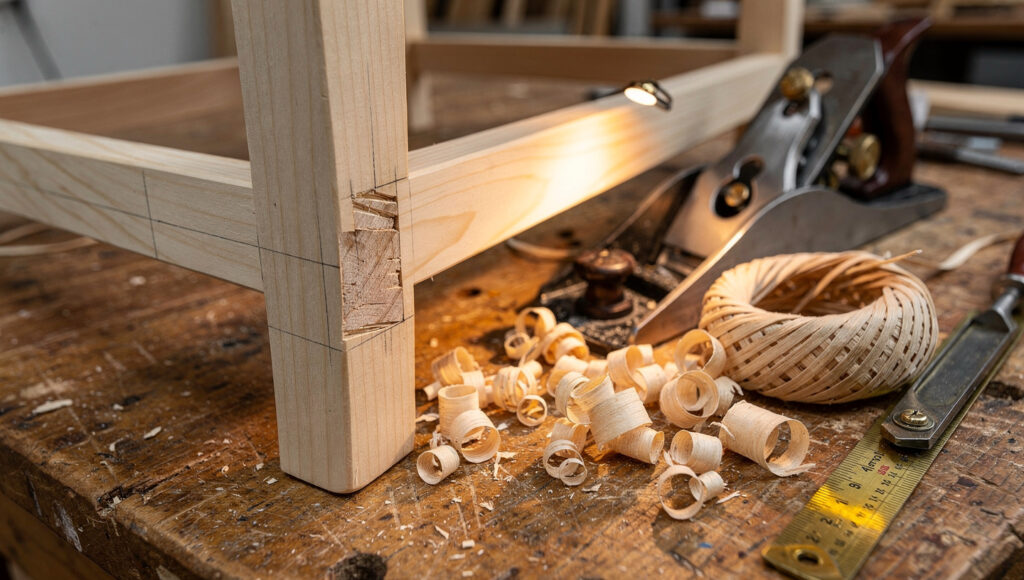
Danish Modern is the node both styles descend from. Everything filed under “mid-century” in a Copenhagen workshop in 1955 is also the furniture vocabulary Japandi was built on.
Mid-century modern is usually treated as a single style running roughly from 1945 to 1969. It is more accurate to treat it as two branches that shared a period.
The American branch is the one most people picture. Charles and Ray Eames, Eero Saarinen, George Nelson, Herman Miller and Knoll as manufacturers. Molded plywood and fiberglass, tubular steel, saturated color, and a genuine optimism about industrial production. This branch is playful, technological, and confident. The Eames Lounge Chair of 1956 and the Saarinen Tulip chair of the same year both belong to it.
The Danish branch ran in parallel and answered a different question. Hans Wegner, Børge Mogensen, Finn Juhl, and Arne Jacobsen were working in a craft tradition under Kaare Klint’s teaching at the Royal Danish Academy, which was preoccupied with proportion, joinery, and the human body rather than with new materials. Danish Modern produced solid timber furniture with visible joints, woven paper cord, and a restraint the American branch never aimed for.
Japandi descends from the Danish branch. Not loosely, and not as an influence. The furniture vocabulary Japandi uses is Danish Modern vocabulary, filtered through Japanese spatial ideas. The Scandinavian vs Japandi comparison works through what the Japanese half adds, which is negative space and the acceptance of wear.
There is a second connection running the other way, and it is worth knowing because it disarms the whole opposites framing. Japanese design was already inside mid-century modernism. The Noguchi coffee table, designed by Isamu Noguchi in 1947 and still one of the most recognizable mid-century objects in existence, came from a Japanese-American sculptor working with Japanese formal ideas. George Nakashima, a Japanese-American woodworker of the same period, built a career on live-edge timber, visible butterfly joints, and an acceptance of the flaw in the wood that reads today as textbook wabi-sabi.
So the honest history is this. A Danish designer looked at Ming dynasty chairs and drew the Wishbone. A Japanese-American sculptor designed the defining mid-century table. Japandi arrived seventy years later and formalized a conversation that had been running since the 1940s.
What that means practically: if you own good Danish mid-century pieces, you are closer to a Japandi room than someone starting from scratch. If you own American mid-century pieces, the distance is real but it is measurable, and the next six sections measure it.
The Six Real Differences at a Glance
Read the right column as a set of refusals rather than a muted version of the left. Japandi is not mid-century with the color turned down.
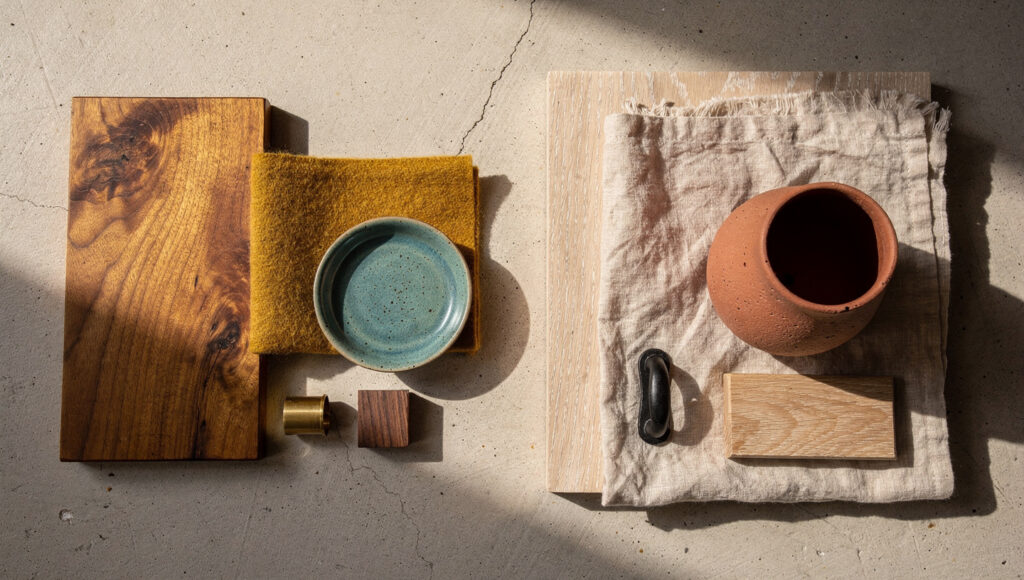
| Mid-Century Modern | Japandi | |
|---|---|---|
| Leg angle | Splayed outward, tapered, often round | Vertical or barely tapered, square section |
| Wood | Teak, walnut, rosewood, dark and figured | White oak, ash, pale and quiet |
| Color | Saturated accents: mustard, teal, burnt orange | No saturated accents; earth tones only |
| Finish | Lacquer and sheen, surfaces stay pristine | Penetrating oil, matte, surfaces age |
| Metal | Brass, chrome, hairpin legs, visible fixings | None visible |
| Density | Collected, layered, objects on display | Edited, sparse, space between things |
One line: mid-century adds until the room has character. Japandi removes until the room has calm.
Difference 1: Leg Angle Is the Fastest Tell
Takeaway: A mid-century leg splays outward roughly 8 to 15 degrees. A Japandi leg drops vertically. Stand back and look at the feet before you look at anything else.
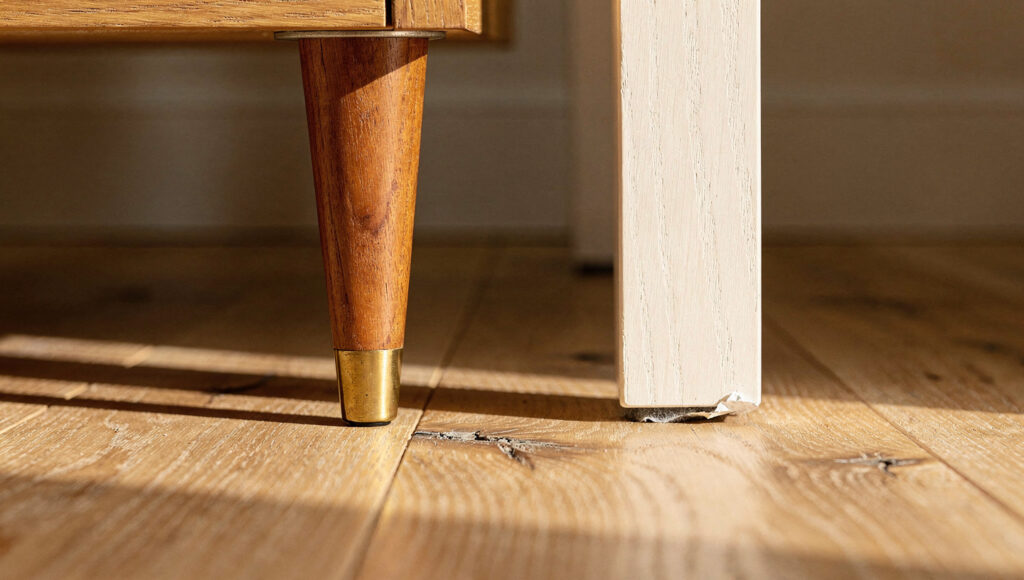
Look at where the foot lands relative to the seat edge. Outside it is mid-century. Directly under it is Japandi.
Furniture height is a different question and the Scandinavian vs Japandi guide works it through in detail. This is about angle, and angle is what makes a mid-century silhouette instantly recognizable from across a room.
A mid-century leg leans out. Typically a round or oval dowel, tapered toward the foot, splayed somewhere between eight and fifteen degrees off vertical, often finished with a brass ferrule at the tip. The splay is doing deliberate work. It widens the visual base, gives the piece a sense of lift and forward motion, and creates a triangle of shadow underneath that reads as energetic.
A Japandi leg drops straight down. Square or rectangular in section, minimal or no taper, no ferrule, and the foot lands directly beneath the corner of the piece it supports. Where a mid-century sideboard appears to be standing up, a Japandi sideboard appears to be sitting down.
The test costs nothing. Stand in the doorway and look at where each foot meets the floor relative to the edge of the piece above it. Outside that edge, mid-century. Directly under it, Japandi.
This is also the cheapest single conversion available, and it is why so many mid-century-to-Japandi projects succeed. A splayed-leg sideboard becomes a Japandi sideboard when the legs are swapped for straight square ones, and the carcass never changes. Check the mounting plate angle before ordering, since angled plates and straight plates are not interchangeable and this is the mistake people make.
Difference 2: Teak and Walnut Against Oak and Ash
Takeaway: Mid-century wood is dark and figured and asks for attention. Japandi wood is pale and quiet and stays in the background.
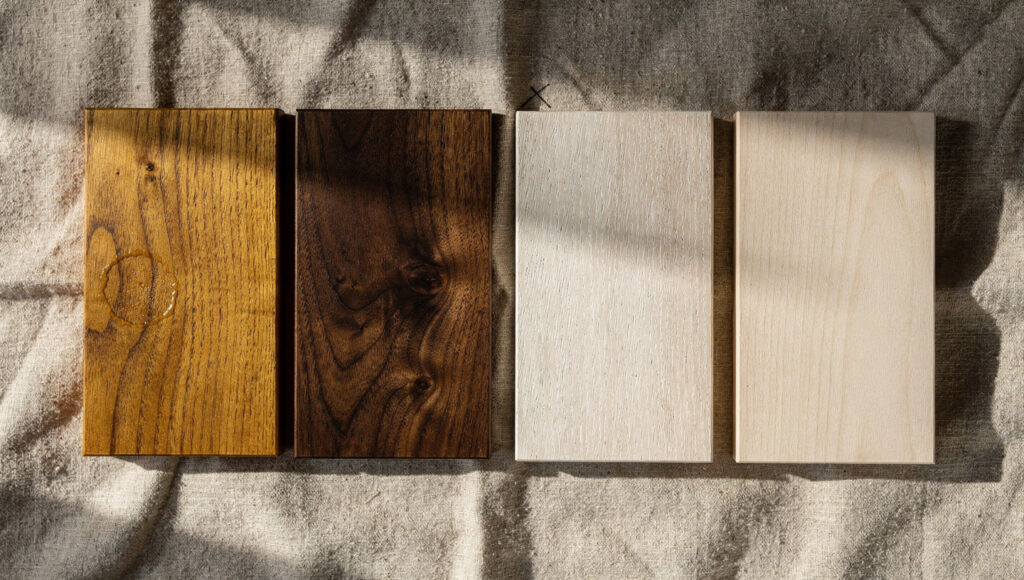
Teak reads gold-brown and grows richer with light. White oak stays quiet. Both are warm; only one wants to be looked at.
The Japandi dining table guide covers species hardness and finish chemistry in full, so this section stays on what separates the two styles specifically.
Mid-century modern is a teak style before it is anything else. Danish workshops imported Burmese teak heavily through the 1950s and 1960s, and it defined the period look: a warm gold-brown that deepens toward amber with light exposure, with a natural oiliness that made it durable and easy to finish. Walnut carried the American branch, darker and more dramatically figured. Brazilian rosewood appeared on the highest-end pieces until international trade restrictions ended its commercial use.
All three are dark, all three are figured, and all three are meant to be noticed. A teak credenza is the focal point of the wall it stands against, and it was designed to be.
Japandi wants the opposite relationship. White oak and ash, pale and straight-grained, finished so the grain reads as texture rather than as pattern. The wood is the background the room is built on, not the object in it. A Japandi room with a teak credenza has a mid-century room’s focal point sitting inside it.
This does not mean dark wood is forbidden in Japandi. A single dark piece doing structural work is a Japandi move, and the Scandinavian comparison covers why. The difference is quantity and intent. Mid-century fills a room with figured dark timber. Japandi allows one piece of it, surrounded by pale.
If you own teak and want a calmer room, the answer is subtraction rather than replacement. Keep the best piece, move the others out, and let pale walls and pale textiles carry everything around it.
Difference 3: Where Mid-Century Adds Color and Japandi Refuses
Takeaway: Mid-century gets its warmth from saturated accent color. Japandi gets its warmth from material. Add a mustard cushion to a Japandi room and it becomes a mid-century room.
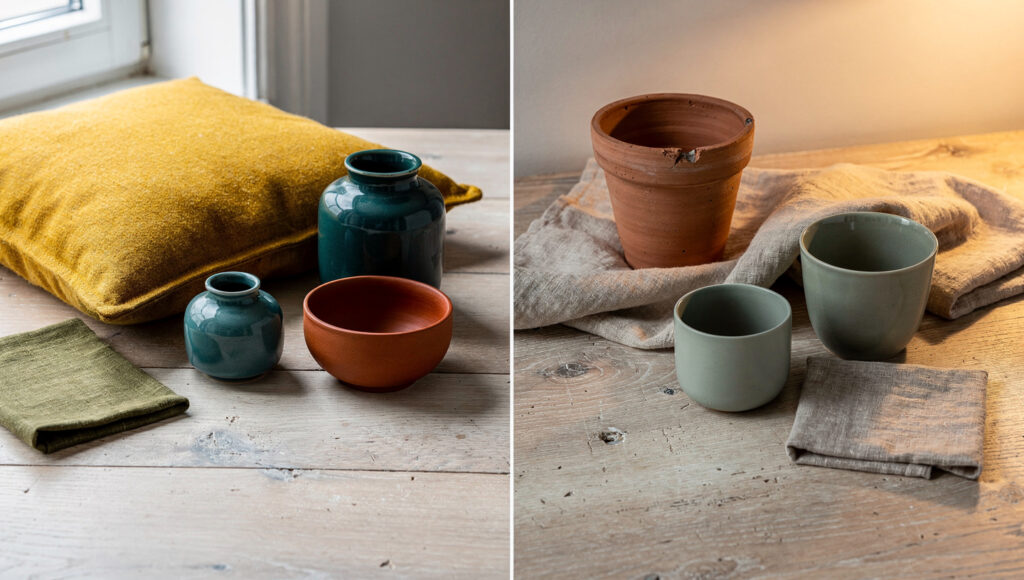
Mustard, teal, and burnt orange are period-correct mid-century. Japandi will take the terracotta and reject the other two.
This is the difference people feel immediately and describe badly.
Mid-century modern uses saturated accent color as a structural element, not as decoration. Mustard and harvest gold, teal and petrol blue, burnt orange, avocado, and olive against a neutral base of white, oatmeal, or wood tone. The color is period-correct and it is the reason a mid-century room reads as cheerful rather than austere. Remove it and you have a room of nice wooden furniture with nothing holding it together.
Japandi refuses saturated color entirely. It runs on earth tones that read as materials rather than as pigments: terracotta, clay, sage, muted rust, warm greige, charcoal. There is real overlap at the earthy end, and burnt orange sits close to terracotta on a color wheel. The difference is saturation, not hue. Mid-century burnt orange is a color. Japandi terracotta is the color of fired clay, which is a different claim about where the color came from.
The verified codes for the Japandi column sit in the Japandi paint colors hub, and the muted greens that do the most work across both styles are compared in the sage green guide. Whichever direction you go, test the color in your own light rather than trusting a chip. Peel-and-stick paint samples let you move the real color around the room and check it at the hours you actually use the space.
Here is the practical rule. One saturated accent will not shift a room. Three will. If your Japandi room feels slightly off and you cannot say why, count the saturated objects. If the answer is more than one, that is the answer.
Difference 4: Lacquer That Stays Perfect, Oil That Does Not
The mid-century surface is sealed and holds a sheen. The Japandi surface takes the mark and keeps it.
Takeaway: Mid-century treats a mark as damage. Japandi treats it as record. That single disagreement decides which finish each style uses.
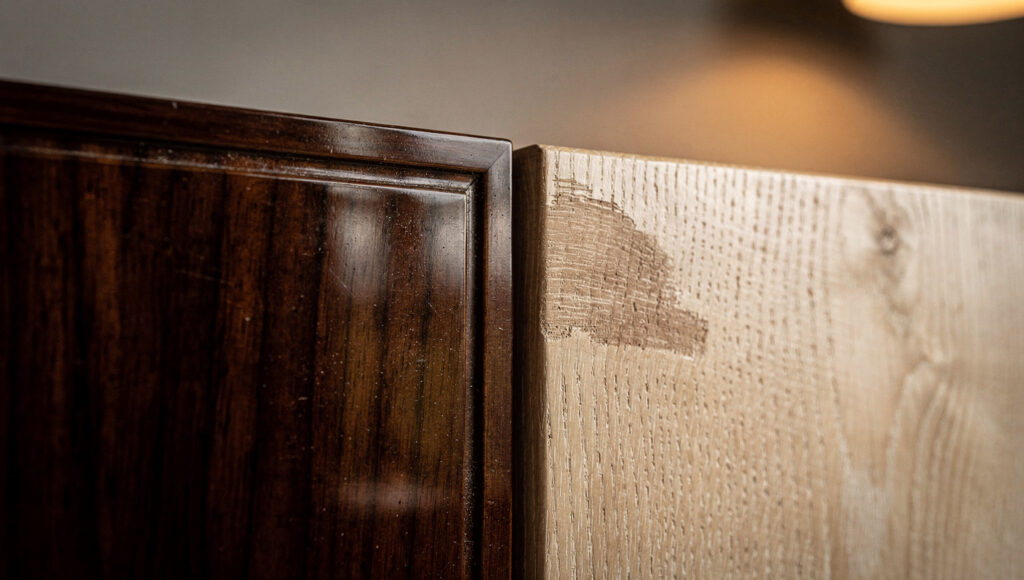
Mid-century furniture was typically finished in lacquer or a sealed topcoat, sitting on the surface of the wood with a visible sheen. It resists rings and spills, it keeps the piece looking as it did in the showroom, and when it fails it fails all at once and needs professional refinishing. The intent is preservation.
Japandi wants a penetrating oil that soaks into the timber, leaves no film, reads matte, and can be repaired at home with more oil and a cloth. It marks, it darkens with handling, and it changes over years. The intent is accumulation.
That is a philosophical disagreement, not a maintenance preference. Mid-century modernism came out of postwar optimism about newness and progress. Wabi-sabi, which the Japanese half of Japandi imports, holds that the mark of use is where the value is. One style wants the object preserved and the other wants it recorded.
For a room, the consequence is visible before it is intellectual. A lacquered surface under a lamp produces a bright specular reflection. An oiled surface under the same lamp shows grain. In a room organized around calm, the second is doing what you want.
Difference 5: Brass, Chrome, and Nothing
Mid-century celebrates its metal. Japandi hides its fixings entirely, which is why a chrome leg is the single most disruptive object you can put in a Japandi room.
Takeaway: Mid-century uses visible metal as jewelry. Japandi uses none. This is the least negotiable difference of the six.
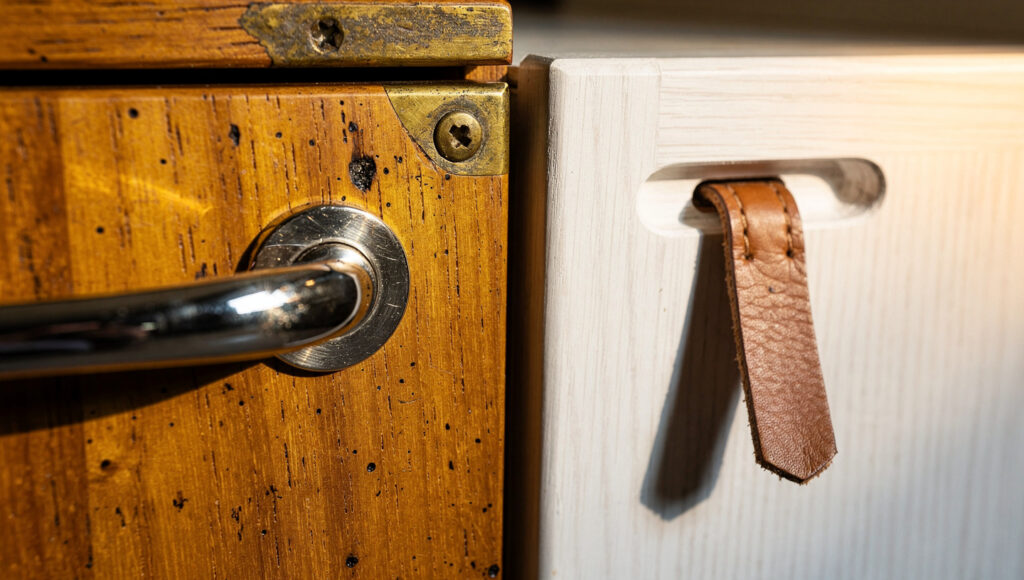
Mid-century modern likes metal and shows it. Brass ferrules on chair legs, hairpin legs in black or chrome, tubular steel frames, chrome pulls, spun aluminum lighting. The metal is deliberate and it is often the thing that dates a piece accurately to the period.
Japandi eliminates visible metal. Drawer pulls become routed finger notches or leather tabs. Joints are cut rather than bracketed. Where hardware is unavoidable it goes matte black or blackened brass and stays small. The Japandi dining chairs guide lists chrome legs first among its disqualifiers, and that is not an aesthetic preference so much as a structural rule.
If you are converting mid-century pieces, this is the difference to address after leg angle. Brass ferrules can be removed or painted. Chrome pulls can be swapped for leather. Neither requires replacing furniture.
Difference 6: How Much the Room Is Allowed to Hold
The same credenza, styled two ways. Mid-century wants the collection visible. Japandi wants the space between things visible.
Takeaway: Mid-century is a collecting style. Japandi is an editing style. That is a difference in how you live, not in what you buy.
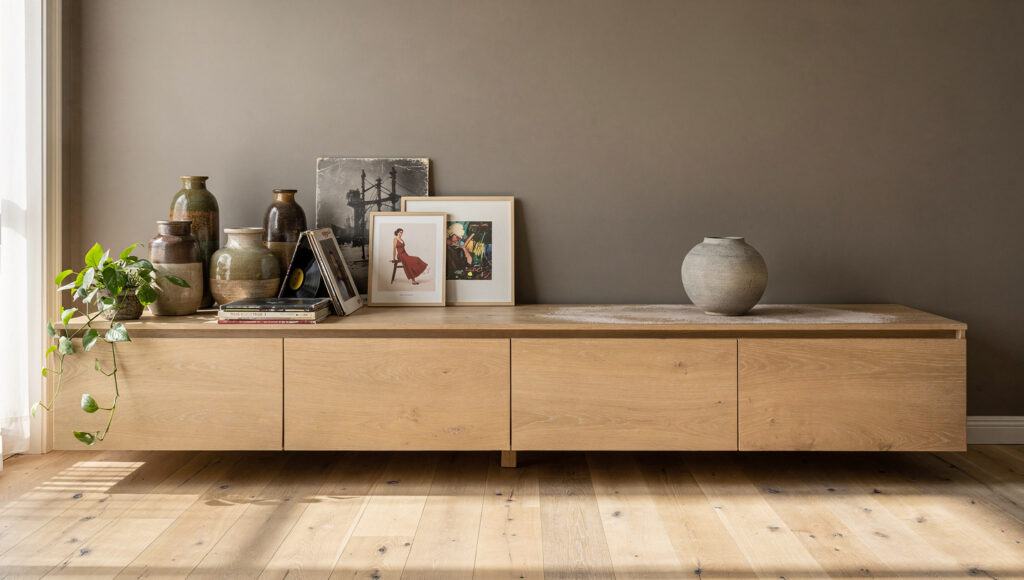
Mid-century modern is a collecting culture. Vintage hunting, ceramics on the credenza, a wall of framed prints, a record collection on display, a bar cart. The style rewards accumulation because each piece has personality and the pleasure is in the assembly.
Japandi is an editing discipline. Bare surfaces, one object where mid-century would put six, and large stretches of visible wall and floor. The space between things is the content.
This is the difference that outlasts the furniture, and it is the one to be honest with yourself about. Leg angle and finish are purchases. Density is a habit. A person who enjoys hunting for objects and arranging them will find Japandi a constant fight, and a person who finds accumulation stressful will find a mid-century room noisy no matter how good the pieces are. What the bare wall above low furniture is actually for is worked through in the Japandi living room wall decor guide.
Can You Mix Them? The 70/30 Rule
A Japandi base with one mid-century piece allowed to be the focal point. The ratio is what keeps it from reading as neither.
Takeaway: Pick one style for the base and let the other supply one or two pieces. Half and half reads as neither. This is the same failure the Scandinavian mix produces.
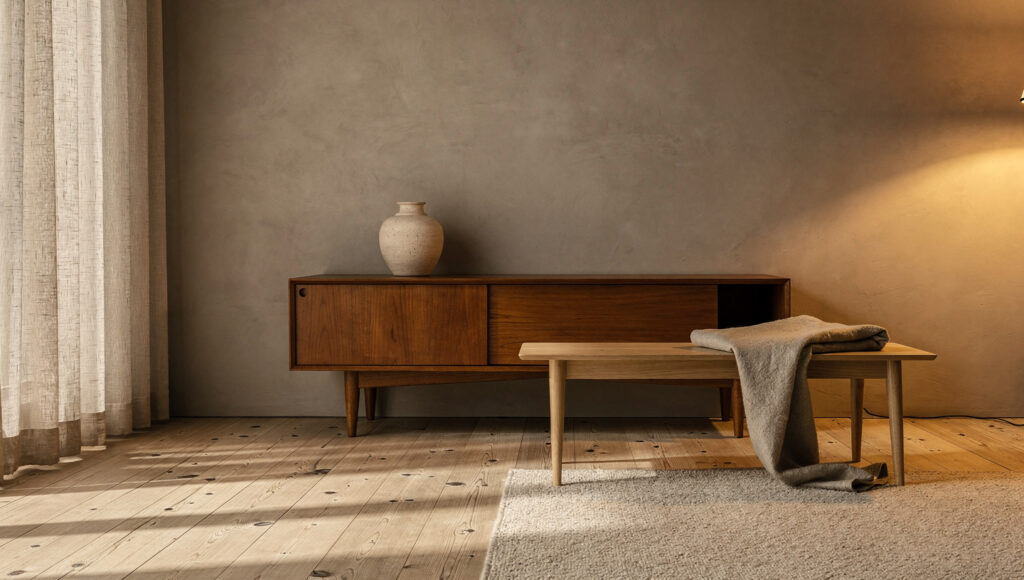
Yes, and this pairing mixes better than most, for the historical reason set out above. You are not combining unrelated vocabularies. You are adjusting the ratio between two descendants of the same furniture tradition.
The rule that works is roughly seventy thirty. Choose one style to govern the room and let the other supply one or two pieces that are allowed to be the focal point.
Japandi base, mid-century accent. Pale oak floors, warm greige walls, low furniture, restrained textiles, and then one genuinely good teak or walnut mid-century piece doing all the visual work. A credenza is the ideal candidate because it is large enough to matter and low enough to sit correctly. In a smaller room the same logic applies with a single chair instead, and the small Japandi living room guide covers how far you can push it. This is the version most people should build, and it lets a single inherited or vintage piece carry real meaning.
Mid-century base, Japandi discipline. Keep the teak, the splayed legs, and the color, but strip the density. One accent color instead of four. Bare walls where you would have hung a gallery. Fewer objects on every surface. The room stays warm and characterful and stops being busy.
What fails is fifty fifty. Medium wood tone, one muted accent, some metal, moderate density. That reads as a furniture showroom rather than a home, which is the same failure mode the Scandinavian and Japandi mix produces when every decision is made halfway.
The rule that keeps it coherent: decide which style owns your walls and your floor. Everything else is negotiable. A room with mid-century walls and Japandi furniture is confused. A room with Japandi walls and one mid-century object is composed.
Which Should You Choose? By Situation
Look at what you already own before you look at what you want. The cheaper path is almost always the one that starts from your existing pieces.
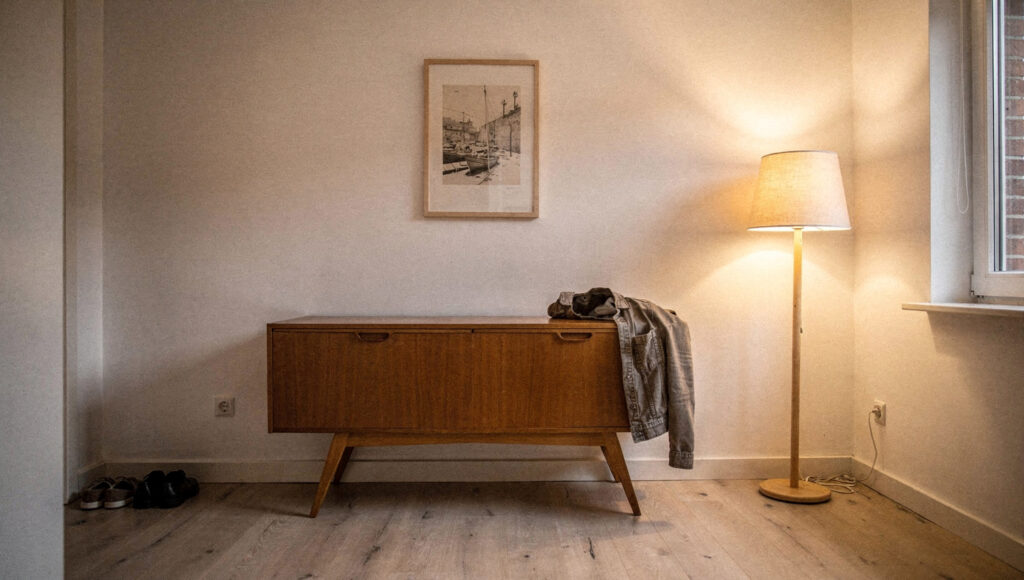
If you already own mid-century pieces. Do not start over. Go Japandi base with mid-century accent, keep the best one or two pieces, and put the effort into walls, textiles, and density. This is the cheapest good outcome available in this entire comparison.
If you rent. Either works, but mid-century is more forgiving, since it lives in furniture and objects rather than in wall treatments and negative space. Japandi in a rental depends on discipline rather than construction, which is free but demanding.
If you have a small apartment. Japandi, in most cases. Mid-century’s collected density fills a small room quickly, and the splayed legs eat floor area that a small space cannot spare. Japandi’s low furniture and bare walls buy back perceived volume.
If your room is dark or north-facing. Mid-century, or a very pale Japandi. Teak and walnut in a dim room absorb what little light there is, but mid-century’s saturated accent color survives poor light better than Japandi’s earth tones, which go muddy. If you want Japandi in a dark room, take it toward the pale end and skip the dark anchor.
If you have children or pets. Mid-century. Lacquered surfaces wipe clean, the collected density hides disorder, and a mark on a sealed teak top is a repair rather than a permanent record. Japandi’s oiled surfaces and bare planes show everything.
If you enjoy hunting for things. Mid-century, without question. The style is built on the pleasure of finding the right vintage piece, and Japandi offers no equivalent satisfaction. Choosing Japandi when you enjoy collecting is choosing a style that fights you every weekend.
If clutter makes you anxious. Japandi. The whole discipline is aimed at exactly that, and mid-century’s charm depends on a density that will not feel charming to you.
My honest recommendation: most people arriving at this comparison already own some mid-century, are tired of how busy the room feels, and think the answer is replacing furniture. It usually is not. Swap the legs on one piece, remove two of the three accent colors, clear the credenza top, and stop hanging things on one wall. Four changes, almost no money, and the room moves most of the distance.
Frequently Asked Questions
Is Japandi the same as mid-century modern?
No, but they are more closely related than most comparisons admit. Both descend from the same Danish Modern furniture tradition of the 1950s, which is why so many individual pieces read as belonging to either style. The Wishbone Chair, designed by Hans Wegner in 1949, is a canonical mid-century Danish design and also the most widely used chair in Japandi interiors. The styles diverge on six checkable points: leg angle, wood species, color saturation, finish sheen, visible metal, and how many objects a room is allowed to hold. Mid-century splays its legs, uses dark figured timber, adds saturated accent color, and permits brass and lacquer. Japandi does none of those things.
Can mid-century furniture work in a Japandi room?
Yes, and it often works better than furniture bought specifically as Japandi. The rule is roughly seventy thirty. Let Japandi govern the room through pale walls, restrained textiles, and low density, then allow one or two mid-century pieces to be the focal point. A teak or walnut credenza is the ideal candidate, since it is large enough to matter visually and low enough to sit correctly against a bare wall. What fails is an even split, where medium wood tones and moderate density produce a room that reads as neither style rather than as a considered blend of both. Decide which style owns your walls and your floor, and treat everything else as negotiable.
What wood is mid-century modern furniture made from?
Teak dominates the Danish branch, imported heavily through the 1950s and 1960s, and it reads as a warm gold-brown that deepens toward amber with light exposure. Walnut carried the American branch and is darker with more dramatic figuring. Brazilian rosewood appeared on high-end pieces of the period until international trade restrictions ended its commercial use. All three are dark and figured and were intended to be noticed, which is the opposite relationship to the one Japandi wants from wood. Japandi uses pale white oak and ash so the timber reads as background texture rather than as the focal point of the wall.
How do I make my mid-century room feel calmer?
Work in this order, because it runs cheapest to most expensive. Remove saturated accent colors until only one remains. Clear the tops of your largest pieces and leave them clear. Take everything off one wall and leave that wall bare. Then, if you want to go further, swap the splayed legs on one large piece for straight square ones, which changes the silhouette without touching the carcass. Those four changes cost very little and move a mid-century room most of the way toward Japandi. Replacing teak furniture is the last resort rather than the first step, and most rooms never need to get that far. Live with the first three changes for two weeks before deciding whether the fourth is necessary.
Which style is more expensive?
Mid-century is cheaper to start and harder to finish well, because reproductions are widely available at every price and authentic period pieces command real money. Japandi is more expensive per object and cheaper overall, since the style demands fewer things but punishes a poor one. A mid-century room can absorb a mixed-quality piece inside a collection. A Japandi room puts every remaining object on display, so each has to hold up alone. Solid oiled hardwood, which the style depends on, is rarely inexpensive, but you need far less of it. The honest comparison is not price per piece but total spend across a finished room, and on that measure the two styles land closer together than they appear.
The Honest Answer
These styles are cousins, not opposites, and the comparison is more useful once you stop treating it as a choice between eras.
Mid-century modern is a collecting style with a sense of humor, built from dark figured timber, splayed legs, saturated color, and visible metal, and it rewards you for finding things. Japandi is an editing discipline built from pale quiet timber, vertical legs, earth tones, and no metal at all, and it rewards you for removing things.
The six differences are all checkable, and five of the six can be adjusted without replacing furniture. If you already own mid-century pieces and want a calmer room, that is the good news: you are much closer than you think, and the cheapest changes are the ones that move the room furthest.

