
The most common wabi-sabi living room mistake is not having too much of it. It is having it in the wrong way — confusing the philosophy’s embrace of imperfection with an absence of intention.
A crack in a handmade ceramic bowl is wabi-sabi. A cracked plastic storage bin is just broken. A handmade ceramic bowl with an uneven rim is wabi-sabi because the flaw is inherent to its creation — wabi-sabi objects are chosen with care and used meaningfully, their marks the honest result of a life lived. The distinction is intention, and intention is what keeps a wabi-sabi living room from reading as neglected to every guest who walks through the door.
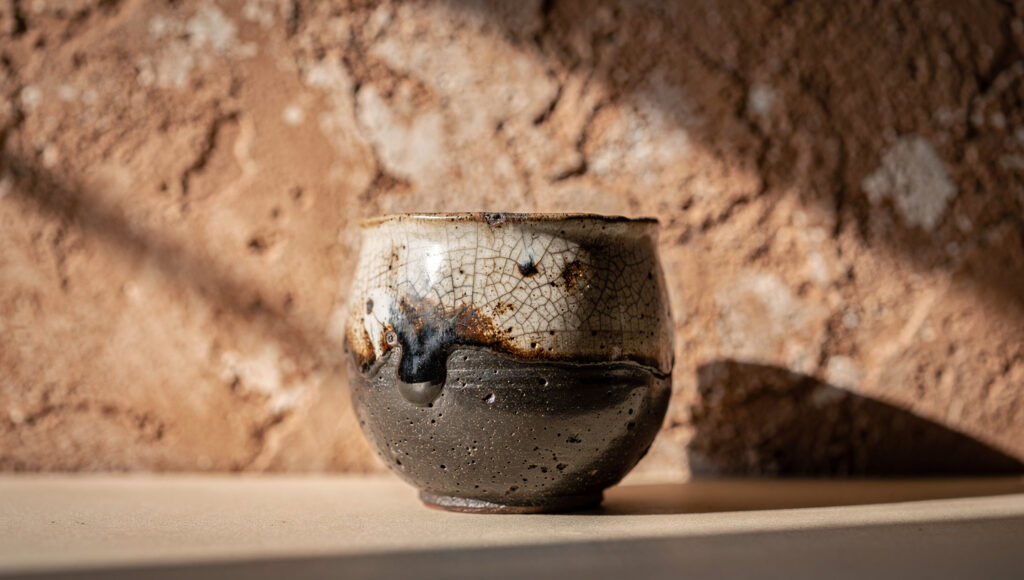
Intention vs Neglect: The Line Every Wabi-Sabi Room Must Hold
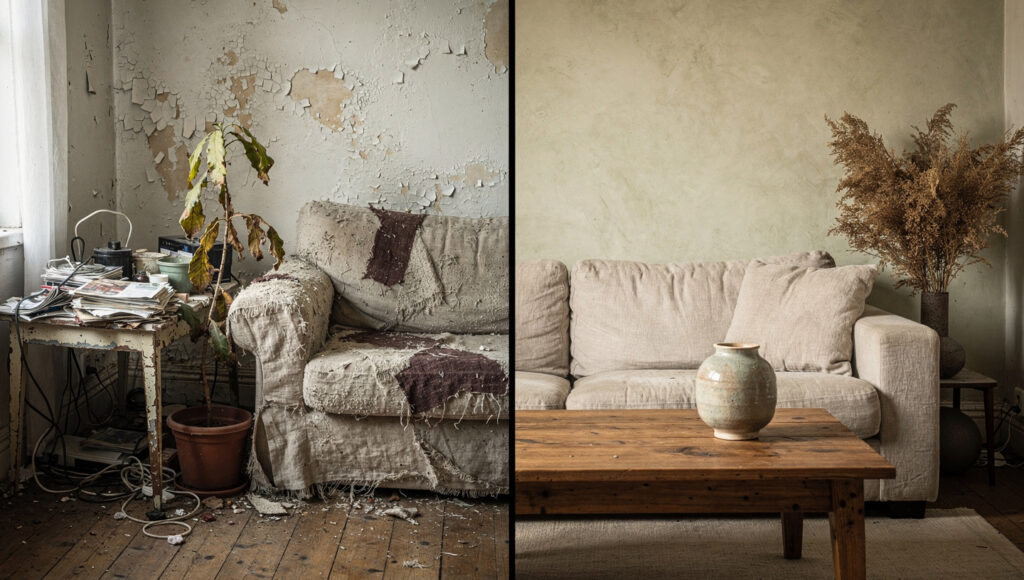
The tension unique to a wabi-sabi living room — the room in the home most visible to guests — is the risk that an aesthetic built on imperfection reads as insufficient care rather than deliberate philosophy.
This risk is real and worth addressing directly rather than hoping guests intuit the difference. The reading of “this is wabi-sabi” versus “this person doesn’t clean their house” is determined by a small number of specific signals that the room either contains or does not.
Signal one: consistent material quality. A wabi-sabi room where every imperfect element is a genuinely natural material — aged wood, handmade ceramic, raw linen, limewash plaster — reads as considered. A room where the imperfect elements include synthetic materials in poor condition — fraying polyester, scratched laminate — reads as neglected. The imperfection must be inherent to the material, not inflicted on a material that was never intended to age this way.
Signal two: deliberate negative space. An imperfect ceramic vessel on an otherwise clear surface reads as a chosen object. The same ceramic on a surface crowded with accumulated objects reads as one more thing that got left there. Wabi-sabi requires the negative space discipline of Japandi — edited object count, clear surfaces — or its material honesty reads as clutter.
Signal three: visible maintenance of the living elements. A wabi-sabi room with one healthy, well-tended plant and one set of clean (if naturally creased) linen cushions reads as a cared-for room whose character comes from its materials. The same room with a struggling plant and grimy cushions reads as unmaintained regardless of how excellent the handmade ceramics are. Wabi-sabi does not exempt a room from being clean.
We observed this distinction directly in reader-submitted photographs tagged as wabi-sabi. Rooms with high scores on material quality and negative space were described by outside observers as “beautiful, considered, Japanese-inspired.” Rooms with lower scores on material quality — where the imperfection was in synthetic or mass-produced materials — were described as “needs work.” The philosophy is identical between the two groups. The material quality is not.
Walls: Texture Before Color

Japanese design uses layered, soft lighting schemes alongside floaty curtains and a sense of privacy — stepping away from downlights entirely in favor of textured walls that catch soft light differently at every hour.
The wall is the largest surface in a living room and the one where a wabi-sabi approach diverges most dramatically from both conventional interior design and Japandi. Where Japandi uses warm greige paint on smooth walls, wabi-sabi uses textured mineral finishes — limewash, Roman clay, or tadelakt — where the finish is inherently imperfect and the imperfection is the point.
Limewash is the most appropriate wabi-sabi wall finish for a US living room. Made from crushed limestone fired to produce calcium hydroxide, then pigmented with natural mineral oxides, limewash is applied in multiple translucent coats that allow each previous layer to show through. The result is a surface of extraordinary depth — tonal variation that no single-coat paint can replicate, where the wall reads differently in morning light, afternoon light, and lamplight. The variation is not a defect. It is how the finish works.
The color specification for a wabi-sabi living room wall:
Warm clay tones — the red-brown-ochre range — are more authentically wabi-sabi than the cool grays that dominate minimalist adjacent design. Benjamin Moore Pale Chestnut 2165-50 and Sherwin-Williams Antique White SW 6119 represent the light end of the wabi-sabi wall palette. For deeper expression, Farrow & Ball Setting Plaster No.231 or Benjamin Moore Dry Sage 2142-40 in a limewash application carry the earthy, mineral quality the philosophy demands.
The texture application technique: limewash is applied with a large masonry brush using a cloud-motion stroke — no straight lines, no uniform coverage. The natural variation in application density is what produces the mottled effect. A limewash wall applied with a roller loses most of this variation and reads as a textured paint rather than a genuine mineral finish. Application technique matters as much as material selection.
The Sofa: Fabric That Ages Honestly
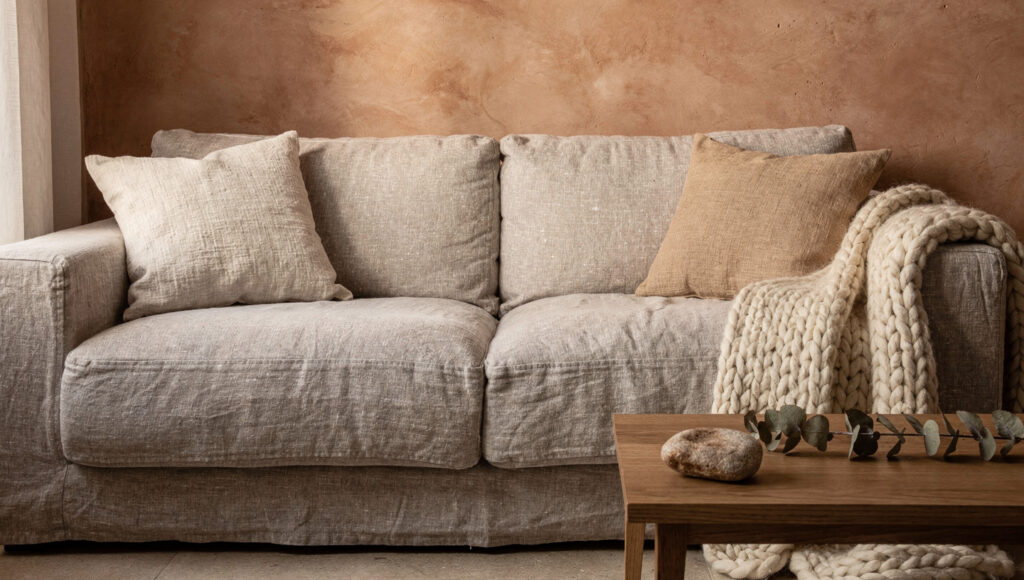
The sofa in a wabi-sabi living room is chosen for how it will age rather than how it looks in the showroom. This is the genuine inversion of most furniture buying decisions, and it is the one that most distinguishes wabi-sabi furniture selection from conventional purchasing.
Stonewashed linen is the correct wabi-sabi sofa upholstery because it begins with the patina of use already partially established — the stonewashing process breaks down the fiber in a way that mimics months of gentle wear, producing the visible crease and slight surface texture variation that raw linen develops over the first year of use. The aging trajectory from this starting point is consistently toward more beauty rather than less — linen softens and develops individual character that no two sofas develop identically.
The opposite is polyester or synthetic velvet — materials that begin looking their best and degrade from there, developing pilling, loss of pile direction, and surface shininess that reads as wear rather than character. These are materials that age incorrectly for a wabi-sabi room.
The cushion approach in a wabi-sabi living room deliberately avoids the matching set. Two cushions of the same weight but slightly different natural tones — one undyed linen, one warm oat, placed asymmetrically — read as individually chosen rather than purchased together. A third cushion in a rougher textile — a hemp weave, a heavy basket-weave cotton — introduces a different material character without introducing a different color family.
The throw must have genuine weight. A lightweight decorative throw is a prop. A chunky merino or heavy wool throw draped naturally — its own gravity determining its shape — is a wabi-sabi textile. The weight is what makes it look like someone actually uses it.
The Coffee Table: Imperfection at the Room’s Center

The coffee table sits at the literal center of the wabi-sabi living room and receives more direct physical contact than any other piece of furniture in the space — cups, books, hands, feet. It is the piece most likely to show genuine use over time, which makes it the most appropriate piece for the wabi-sabi philosophy to express itself through.
The correct coffee table is solid wood with visible character — knots, natural edge variation, mineral staining, and grain movement that show the tree’s individual history. A piece with obvious repairs, or a single distinctive mark from decades of use, is not disqualified by those features. It is enriched by them.
The shou sugi ban option: charred timber, treated with the traditional Japanese yakisugi process, carries the most directly wabi-sabi coffee table character available in the US market — the charring creates a deeply textured matte black surface that shows its making process in every ridge and grain line. A shou sugi ban coffee table in a wabi-sabi living room is a piece where the imperfection and the beauty are the same thing, inseparable and mutually dependent.
The stone alternative: a travertine slab table with natural voids left unfilled — the standard travertine specification fills the natural holes with grout before polishing, but an unfilled, honed travertine surface retains the holes as evidence of its geological formation — is the mineral equivalent of the shou sugi ban table. The holes are not defects. They are the record of gas bubbles that escaped the stone as it formed underwater millions of years ago.
The object that earns a permanent position on the wabi-sabi coffee table: one kintsugi-repaired ceramic bowl. Kintsugi — the Japanese art of repairing broken ceramics with gold, silver, or lacquer — is the most direct material embodiment of wabi-sabi philosophy available. The art of kintsugi highlights rather than hides flaws, repairing cracks in ceramics with gold — a brilliant example of wabi-sabi that is refreshingly frugal and eco-friendly rather than discarding what is imperfect. A single kintsugi bowl on the coffee table communicates the philosophy of the entire room in one object to any guest who recognizes it.
The Object Edit: What Earns Its Place
Wabi-sabi object curation follows a stricter editing discipline than most design styles because the philosophy requires each retained object to justify its presence through material quality, personal meaning, or honest craft character. An object that fails to justify its presence on these terms is not wabi-sabi by association with other objects that do.
The object categories that belong in a wabi-sabi living room:
Handmade ceramics — raku-fired, unglazed, or irregularly formed pieces where the maker’s hand is evident in the final form. The rim that is not quite level, the glaze that pooled slightly differently at the base, the surface texture that varies across the piece — these are the qualities that distinguish a handmade ceramic from a manufactured one and the qualities that make it appropriate here.
Natural stones and minerals — river stones, mineral specimens, smooth beach pebbles. Objects that required no making, only finding, whose entire form is the result of natural processes over timescales that make human production look brief.
Dried botanicals — stems, seed pods, branches — that are genuinely drying or genuinely dried, not artificially preserved or dyed. The fading and brittleness of a properly aged botanical stem is the wabi-sabi quality. A stem preserved indefinitely through artificial treatment has lost the impermanence that makes it relevant to the philosophy.
Books — read, marked, and showing their use. A book with a cracked spine and pencil underlining in the margins is more wabi-sabi than a pristine coffee table book purchased for its cover.
What does not belong: anything manufactured to look handmade. Mass-produced ceramics with deliberately uneven rims — designed to simulate handmade qualities without the genuine craft process — are the antithesis of wabi-sabi rather than an expression of it. The philosophy does not require expensive or rare objects. It requires honest ones.
| Object Category | Wabi-Sabi Appropriate | Not Wabi-Sabi | Why the Distinction Matters |
|---|---|---|---|
| Ceramics | Handmade, raku-fired, unglazed | Mass-produced “artisan-look” ceramics | Imperfection must be inherent, not designed |
| Wood objects | Solid with knots, natural edge, showing use | Laminate, MDF, wood-effect surfaces | Material honesty is the criterion, not appearance |
| Textiles | Natural linen, wool, hemp — undyed or naturally dyed | Synthetic fabrics marketed as natural | Aging character differs fundamentally |
| Stones | River stones, minerals, genuine geological specimens | Synthetic stone or resin pebbles | Origin and formation must be genuine |
| Plants | Living and genuinely thriving, or genuinely dried | Artificial plants regardless of quality | Impermanence requires the real thing |
Lighting: Warmth and Layer Over Brightness
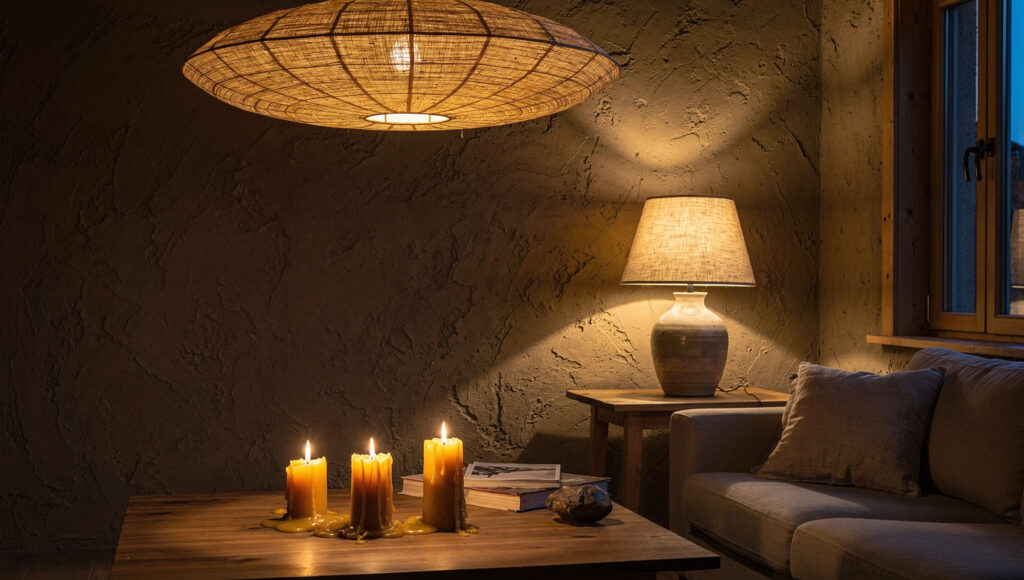
No one creates soft, layered lighting schemes quite like the Japanese. Teamed with floaty curtains and a private feel, soft layered lighting is embraced to avoid a room feeling clinical or harsh — step away from those downlights.
Wabi-sabi living room lighting is more specifically opposed to overhead lighting than any other design philosophy covered on this site, because overhead lighting does something uniquely damaging to a wabi-sabi room: it flattens the textured wall surfaces. A limewash or Roman clay wall photographed in overhead lighting reads as a slightly uneven paint finish. The same wall photographed in raking lamplight from a low angle reveals its three-dimensional depth — the mottling, the tonal variation, the mineral movement — that makes it genuinely wabi-sabi rather than a textured approximation.
The layered wabi-sabi lighting system:
A Japanese paper lantern — an Isamu Noguchi Akari-style washi paper pendant — is the single most direct expression of wabi-sabi lighting available in US retail. The paper shade is inherently imperfect in its translucency — the washi paper fiber structure is visible within the glow, and no two panels of the shade are identical in their light diffusion. The light quality it produces is warm, omnidirectional, and soft in a way that a glass or metal shade cannot replicate.
Beeswax candles — three to five on a wooden tray on the coffee table — provide the second source. At 1800K, the specific quality of genuine flame cannot be replicated electrically, and the wax itself records the history of its burning: the pooling, the slight asymmetry, the carbon-darkened wick. A beeswax candle that has been used ten times is more beautiful than a new one, which is the wabi-sabi lighting principle expressed in a single object.
One ceramic table lamp at eye level — the shade slightly off-center from the base in a way that reads as placed rather than perfectly positioned — completes the system.
Frequently Asked Questions
What makes a wabi-sabi living room different from Japandi?
Wabi-sabi is about embracing the imperfect nature of items and brings far more interest and tactile feel to a room than Japandi — it leans more heavily on natural elements and feels cosier and more layered, while Japandi is generally cleaner and more minimal. A Japandi living room prioritizes visual silence and edited negative space above all. A wabi-sabi living room permits more texture, more layering, and more visible evidence of use and age — at the cost of Japandi’s strict editing discipline. Both use natural materials, but wabi-sabi celebrates the marks those materials accumulate over time rather than seeking to present them at their best preserved state.
How do you make a wabi-sabi living room look intentional rather than neglected?
Three signals establish the distinction: all imperfect elements must be natural materials whose aging is inherent rather than synthetic materials in poor condition; the room must maintain the negative space discipline of a considered design — clear surfaces, edited object count — so that individual imperfect objects read as chosen rather than accumulated; and living elements must be genuinely well-maintained. A wabi-sabi room is not exempt from being clean. Its imperfections are in the material character of its objects, not in the condition of the space overall.
What colors work in a wabi-sabi living room?
The wabi-sabi palette draws from earth, mineral, and aged-material tones — warm clays, ochre, stone gray, muted green, and the warm near-whites of undyed natural fiber. Benjamin Moore Pale Chestnut 2165-50 and Sherwin-Williams Antique White SW 6119 represent the lighter end. Farrow & Ball Setting Plaster No.231 is the most directly wabi-sabi wall color available in premium US paint ranges. All should be applied in a mineral finish — limewash or Roman clay — rather than flat emulsion, because the texture of the wall surface is as important as the color.
The Finished Room
A wabi-sabi living room does not require purchasing new objects. It requires looking at what already exists with different criteria — choosing which marks, creases, and evidence of use to retain, and which materials are aging honestly versus simply wearing out.
The limewash wall catches the lamplight differently at 6pm than it does at noon. The linen sofa has its own crease in the left cushion from the same person sitting there every evening. The ceramic bowl on the coffee table has a gold-repaired crack from a fall two years ago. These are not problems the room is working around. They are the room’s character, accumulated honestly.
That is the only standard wabi-sabi applies — and it is a more demanding standard than perfection, because imperfection has to be earned.

