
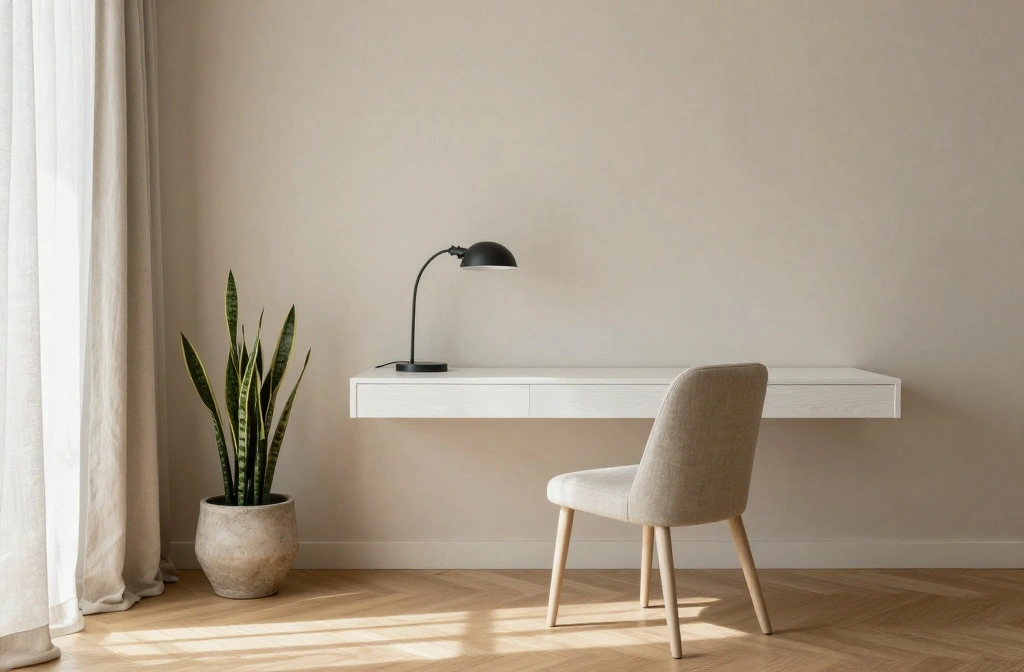
If your home office feels cluttered, chaotic, or visually noisy, your ability to do deep, focused work is already compromised.
Japandi design is the ultimate antidote to the modern, stressful workspace. By blending the Japanese philosophy of wabi-sabi (finding beauty in natural imperfection) with Scandinavian hygge (warmth and functional comfort), Japandi creates a room engineered for pure focus. It removes the visual noise and the unnecessary clutter, leaving just you, your work, and an environment that actively lowers your visual stress.
Instead of just talking about aesthetics, we are going to look at how to actually build a workspace that supports your day—from ergonomic seating that doesn’t ruin the vibe to hiding those awful cables once and for all.

The Command Center: Specifying the Right Desk
The desk is the structural anchor of your office. Because it is the largest piece of furniture in the room, it carries the most visual weight. It needs to ground the space without completely dominating your floor plan.
When you start sourcing your desk, the material is everything. You will want to limit your search to solid white oak, ash, or warm walnut. It is usually best to avoid high-gloss veneers, heavy metal frames, or glass tops entirely. Glossy finishes reflect light sharply and tend to read as corporate or sterile. Matte wood finishes, on the other hand, absorb the light. They feel tactile, organic, and inherently calm.
The silhouette of the desk matters just as much as the wood. Look for minimal legs, like tapered Scandinavian wooden pegs or a highly refined trestle base. If you are working with a tight bedroom corner or a small alcove, a wall-mounted floating desk is an amazing workaround. By keeping the floor entirely visible underneath the work surface, the room immediately feels wider and less constrained.
You can also skip the heavy corporate desks with bulky, built-in plastic cable trays. You want raw, clean lines, similar to what you would find from CB2, Article, or even a simple, custom-cut butcher block resting on matte steel brackets.
Once your desk is locked in, the next decision is the one where most minimalist setups completely fail—the chair.
Ergonomics vs. Aesthetics: The Seating Dilemma
Japandi refuses to sacrifice human comfort for the sake of aesthetics. This is where the Scandinavian dedication to function really shines, because a beautifully styled room doesn’t mean much if it wrecks your posture by 2 PM.
While a classic wooden Wishbone chair looks flawless on a Pinterest moodboard, it is an orthopedic nightmare for a full-time professional. If you are sitting at your desk for more than four hours a day, real ergonomics aren’t optional—your body will tell you eventually.
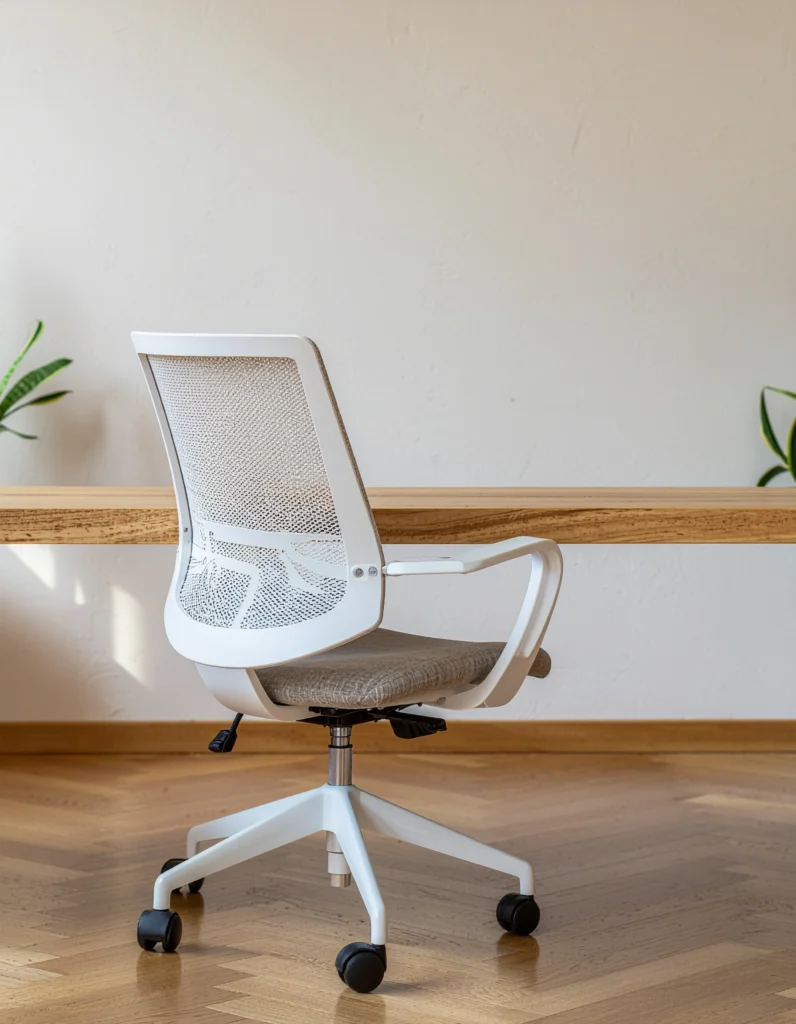
The good news is that you don’t have to settle for a monstrous, black-mesh corporate chair to protect your spine. High-end ergonomic brands have finally started making chairs that perfectly fit the muted Japandi color palette.
Take a look at the Herman Miller Sayl chair in “Studio White,” or the Cosm chair in their dipped, earth-toned “Canyon” colorway. These options give you world-class lumbar support while blending seamlessly into a calm, natural room.
If you prefer the feel of soft seating over engineered mesh, just bypass faux leather. Heavy linen, boucle, or thick, undyed cotton blends in oat or stone are exactly what you need to keep the space feeling warm and human.
But even the most beautiful desk and ergonomic chair will look chaotic if they are drowning in a mess of wires.
Zero-Visibility Cable Management: The Technical Execution
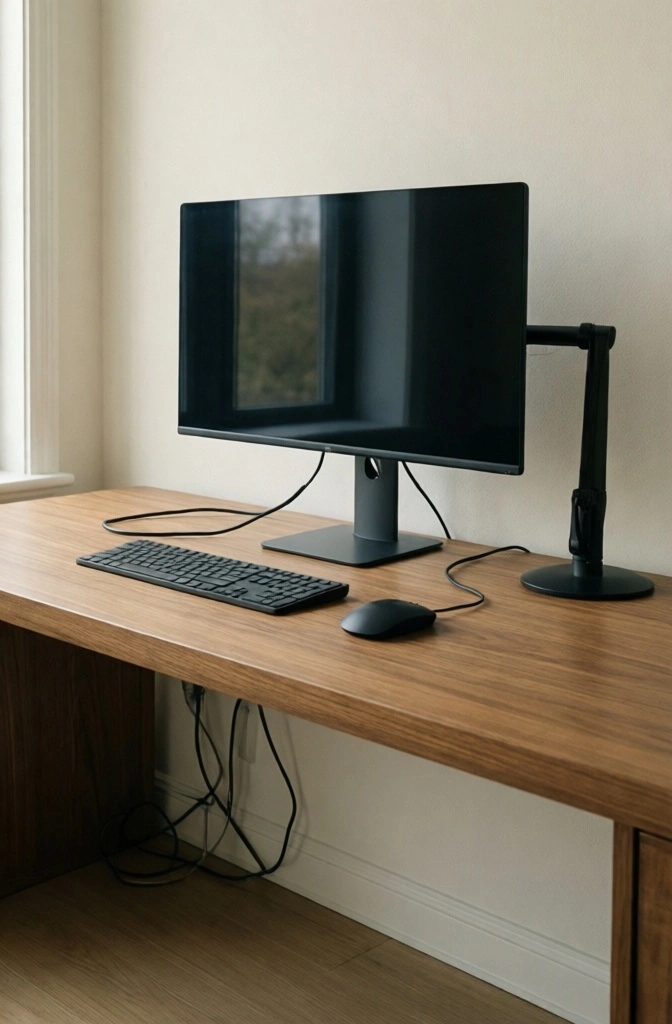
In a Japandi workspace, visual clutter translates directly to mental clutter. You can invest in a beautifully crafted white oak desk, but that aesthetic is immediately ruined if it’s tangled in a web of black power cords, monitor cables, and charging bricks.
The plant trick doesn’t work. You’ve tried it. The cable reappears within a week.
What actually works is treating your cable management like plumbing—hidden, permanent, and architectural. Hiding wires isn’t about stuffing them behind a drawer; it’s about routing them so they effectively disappear from the visual plane.
Start by getting your power supply entirely off the ground. When a power strip rests on the floor, it collects dust and draws the eye downward. Instead, use heavy-duty double-sided mounting tape to attach a high-quality surge protector directly to the underside of your desk. By doing this, all your device plugs terminate under the desk surface, keeping the floor clean and making vacuuming completely effortless.
For the cords running horizontally across your desk—like your monitor cables and lamp cords—install PVC J-channel raceways along the back, underside edge of the desk. These act as hidden gutters. You simply press the cables up into the channel, rendering them completely invisible from the front and sides of the room.
Inevitably, you will still have one thick power cord that needs to drop down to the wall outlet. Don’t let multiple cables dangle freely. Bundle your main power cord and your ethernet cable together and route them down the back of a single desk leg. A zip-up neoprene cable sleeve or a few adhesive cable clips will pin that bundle tight against the wood.
To the naked eye, the desk will appear entirely cordless. And with that visual clutter completely removed, you can finally focus on the one element that dictates how the room actually feels.
The Lighting Blueprint: Engineering Focus
Lighting is arguably the most underestimated element in home office design. Standard residential lighting—usually a single, harsh, ceiling-mounted bulb—creates heavy shadows and eye strain. It instantly destroys the restorative, calm atmosphere you are trying to build.
To engineer a workspace that actually supports long hours of focus, you want to move away from direct overheads and implement a layered lighting strategy.
It all starts with your color temperature. The biological impact of your office relies heavily on the Kelvin scale. Aim for bulbs in the 2700K to 3000K range across all the fixtures in your room. This specific temperature mimics the golden, circadian-friendly glow of late-afternoon sunlight. It brings out the rich undertones in your oak and walnut furniture without crossing into the harsh, clinical blue light (4000K and above) that induces headaches and screen fatigue.
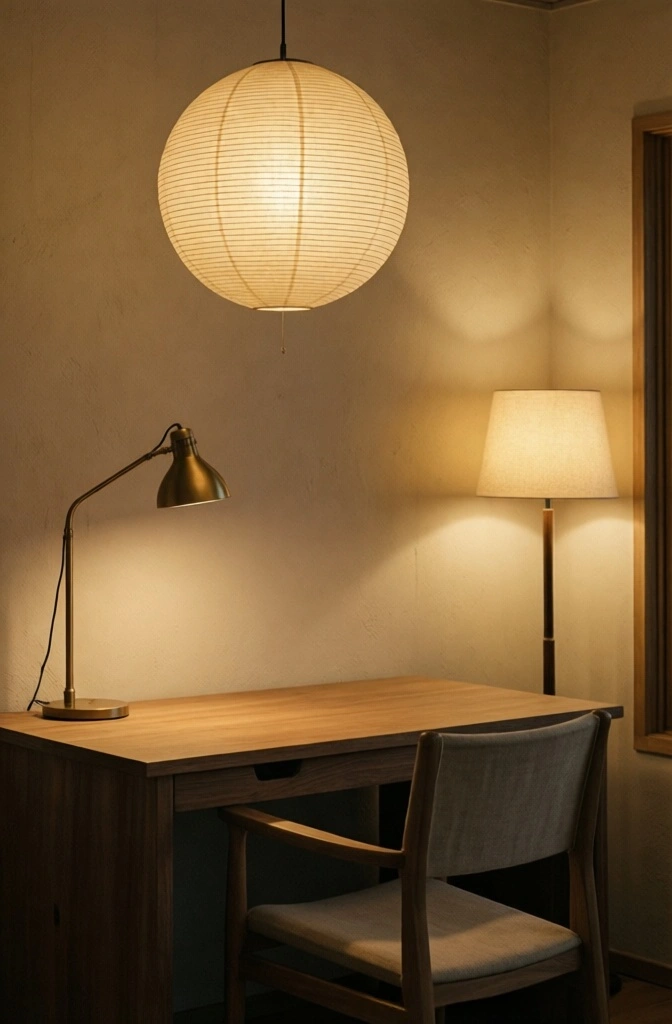
Once you have the right bulbs, start layering. Turn off the direct overhead spotlights and soften the room with diffused ambient lighting instead. A traditional Japanese washi paper lantern, like a Noguchi pendant, is the absolute pinnacle of Japandi design. It disperses a soft, glowing, omnidirectional light that eliminates those harsh shadows on your walls.
For your desk surface, you will still need dedicated, functional illumination. Look for a low-profile, architectural task lamp in a matte finish—black, raw brass, or warm ceramic all work beautifully. Position the lamp asymmetrically on your desk. This washes your workspace in light without reflecting directly off your monitor screens and blinding you.
Finally, if you have a window, let it dictate your entire layout. Natural light is your best asset, but placement is everything. Never place your desk with your back to the window. Not only does this cast shadows over your keyboard, but it creates terrible backlighting for your video calls. Instead, position your desk perpendicular to the window. This allows you to capitalize on soft, indirect natural light throughout the entire workday.
Once your lighting is dialed in, the final step is balancing the hard architecture of the room with soft, organic warmth.
The Restrained Color Palette: Formulating Calm
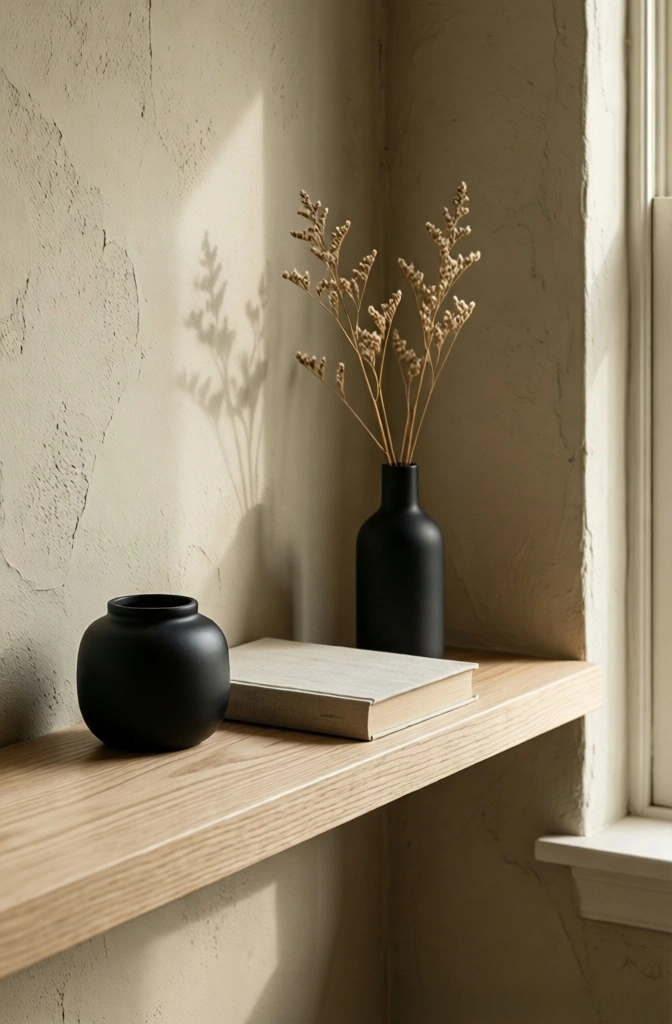
Color in a home office is much more than a decorative choice; it acts as a psychological tool. Bright, heavily saturated colors create visual noise that distracts the eye, while cool, sterile whites can make a room feel like a clinical holding cell.
The Japandi palette relies entirely on warm, earth-toned neutrals with specific light reflectance values. Your walls should feel like a long, slow exhale. Instead of pure titanium whites or cool-toned greys, look for paints with warm yellow or subtle green undertones. Soft ecru, pale clay, or a warm greige are perfect foundational bases. Architectural standards like Farrow & Ball’s Elephant’s Breath or Sherwin-Williams’ Accessible Beige are incredibly reliable choices for this aesthetic.
But a room composed entirely of beige will quickly look washed out. Japandi design requires “visual anchors” to give the space depth. Introduce high-contrast moments using matte black, deep charcoal, or even scorched wood. Use these dark tones sparingly—perhaps on a desk chair frame, a ceramic pen cup, or the base of your architectural lamp—just enough to ground the room.
When it comes to your wood tones, mixing too many species will quickly destroy the minimalist effect. Pick a maximum of two wood tones for the entire room. If your desk is white oak, your shelving should match. If you introduce a secondary wood, just ensure it shares the same visual temperature, like pairing a warm oak with a warm walnut, rather than a cool, grey-stained ash.
Once the hard architecture and colors are locked in, the room runs the slight risk of feeling too rigid. To prevent the office from feeling corporate, we have to introduce that beautiful Japanese concept of wabi-sabi.

Organic Layers: Softening the Architecture
Wabi-sabi is all about finding peace in natural, tactile imperfection. It softens the strict lines of the room and makes the space feel genuinely human.
Start by swapping out standard office accessories for raw, natural materials. You can replace a standard plastic mousepad with a heavy-weight linen or raw leather desk mat. Instead of a branded plastic cup for your pens, use a rough, hand-thrown ceramic tumbler. If your office has a window, consider hanging sheer, unbleached linen curtains rather than installing rigid plastic office blinds.
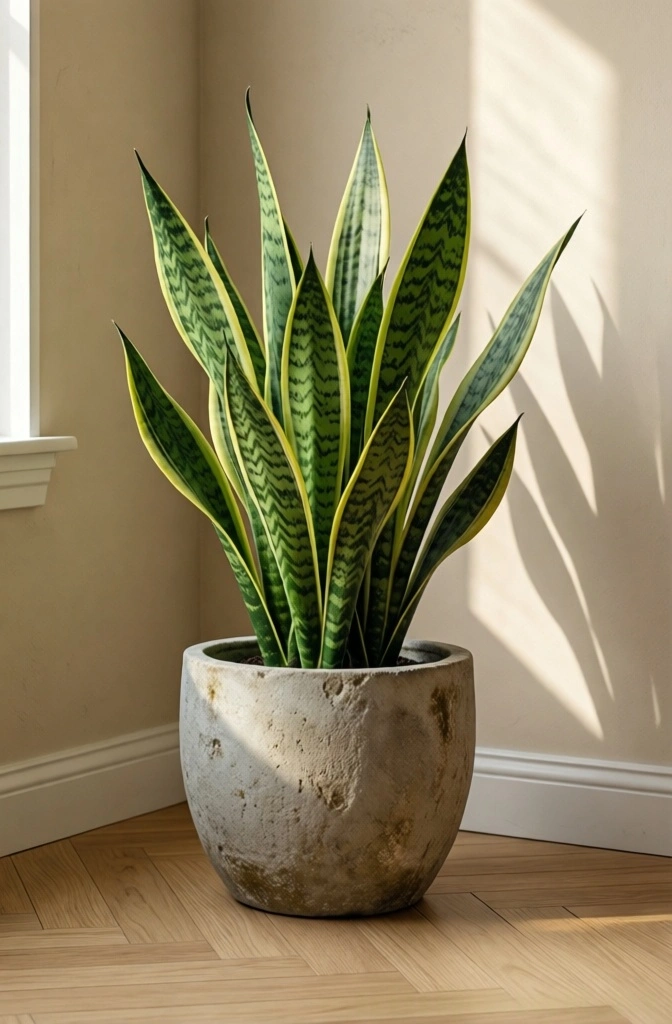
Plants are also essential to this softening process, but the Japandi approach to botany is highly disciplined. This isn’t about creating a maximalist jungle in your office. You really only want one or two considered plants, chosen specifically for their structural, architectural quality. A single Bonsai tree, an established Snake Plant, or a sculptural Rubber Plant placed in a raw stone vessel is far more powerful than a dozen small, cluttered pots competing for your attention.
All of these elements work beautifully together, even if your office is just a tiny corner carved out of a bedroom.
Small Office Mathematics
Japandi design actually thrives in small footprints because the core philosophy is rooted in essentialism. If your space is tight, you just need to mathematically manipulate the room to make it feel larger.
The human eye measures the size of a room primarily by how much floor space is visible. If you place heavy, blocky filing cabinets directly on the floor, the room instantly shrinks. Using floating, wall-mounted storage and floating desks keeps the floor line unbroken, creating an illusion of expansive space.
You also want to practice vertical discipline. Try to avoid wide, low bookcases that eat up your lateral square footage. Instead, drive your storage up the wall. Installing floating white oak shelves all the way to the ceiling allows you to utilize the upper third of the room for items you don’t need daily access to.
Finally, remember that open shelving is often a liability in a small office because everyday clutter remains constantly visible. Try following a strict 80/20 rule: keep 80% of your items—like chargers, tax files, and notebooks—hidden away behind solid cabinet doors or inside woven seagrass baskets. Leave only 20% of your items, perhaps a beautiful design book and a single plant, visible on your open surfaces.
The Finished Office: Where Function Becomes Philosophy
A Japandi home office isn’t built in a single afternoon. It comes together in layers — first the desk, then the chair, then the moment you finally tuck that last cable into its sleeve and step back and realise the room is actually quiet now. Not just tidy. Quiet.
That’s the thing most interior guides miss. Japandi isn’t a shopping list. It’s a decision to stop adding and start editing. Every object you remove from the surface, every cable you route out of sight, every harsh bulb you swap for a warm one — these are small acts of intention that compound into something that genuinely changes how you work.
You don’t need a bigger room. You don’t need a renovation. You need fewer things, chosen better, arranged with care.
Start with one change today. Clear your desk surface completely — everything off, nothing back unless it earns its place. See how it feels to work in that space for an hour. That single act is Japandi thinking in practice, and it costs nothing.
The rest will follow naturally.
Frequently Asked Questions
What is the best desk for a Japandi home office? The ideal desk features a matte finish, minimal legs, and is built from natural materials like solid white oak, ash, or warm walnut. It is best to avoid heavy corporate desks with built-in plastic cable trays, glass tops, or high-gloss veneers.
How do I hide cables in a minimalist workspace? To achieve a clean cable setup, mount your power strip directly to the underside of the desk. Route horizontal cords through PVC J-channel raceways attached to the back edge of the desk, and bundle vertical cords into a single neoprene sleeve strapped to one desk leg.
Can I use an ergonomic office chair in a Japandi room? Absolutely. Japandi prioritizes functional comfort, so an ergonomic chair is a smart choice for deep work. Instead of black mesh, look for high-end ergonomic chairs in muted, earthy tones (like stone, oat, or warm grey) or choose soft seating upholstered in heavy linen or undyed cotton.
Shop This Look
Everything recommended in this guide, curated in one place. All picks meet the Japandi brief — natural materials, matte finishes, clean lines.
The desk — ANFALLARE desk in bamboo · The most affordable solid-surface Japandi desk available. Pairs with any matte black or raw steel trestle legs.
The task lamp — BenQ ScreenBar Halo · Sits behind your monitor, casts zero glare on screen, warm colour temperature built in. Completely cordless look once mounted.
The desk mat — YSAGi Genuine full-grain leather desk mat in tan · Natural leather ages beautifully — pure wabi-sabi in practice. Far warmer than felt or plastic alternatives.
The pen holder — Mora Ceramic Large Latte Mug Set of 4 · Handmade irregularities are the point. Imperfection is the aesthetic.
The plant — Snake plant (Sansevieria) in matte stone pot · Low maintenance, architectural, air-purifying. Amazon Plants deliver across the global with the pot included.
The cable sleeve — D-Line neoprene cable tidy kit · Exactly what the cable management section recommends. Bundles down a single desk leg cleanly.
This post contains affiliate links. If you purchase through these links, Homeoration earns a small commission at no extra cost to you — it helps keep this content free. We only recommend products we would genuinely use.