
This post contains affiliate links. If you purchase through these links, Homeoration earns a small commission at no extra cost to you.
The dining chair is the most repeated object in any room. Four of them. Six of them. Sometimes eight. At that repetition, the wrong chair does not make one mistake — it makes it four, six, or eight times simultaneously.
This is why the dining chair decision carries more weight than the table decision. The table is one object. The chairs are the room’s dominant visual rhythm.
- What Disqualifies a Chair Before You Sit In It
- The Chair Typology: Four Forms That Work
- The Seat Height Formula
- Armchairs at the Dining Table: The Japandi Position
- The Chair-to-Table Proportion System
- Material Aging: What Happens to Each Chair Form Over Time
- The Mixed Chair Arrangement: When Breaking the Rule Is Correct
- Frequently Asked Questions
- The Finished Table: A Composition, Not a Set
What Disqualifies a Chair Before You Sit In It
The chair qualification process begins before comfort, before price, before availability.
Most dining chairs sold in the US market — including many marketed specifically as Japandi — fail on the first material specification. The frame is not solid wood. It is rubberwood, which is a plantation timber often sold as a solid wood alternative. Rubberwood is structurally adequate but lacks the grain character and aging quality of genuine oak, ash, or walnut. In a Japandi room where the material tells the story, rubberwood tells a thin one.
The four disqualifying characteristics — reject any chair that has them:
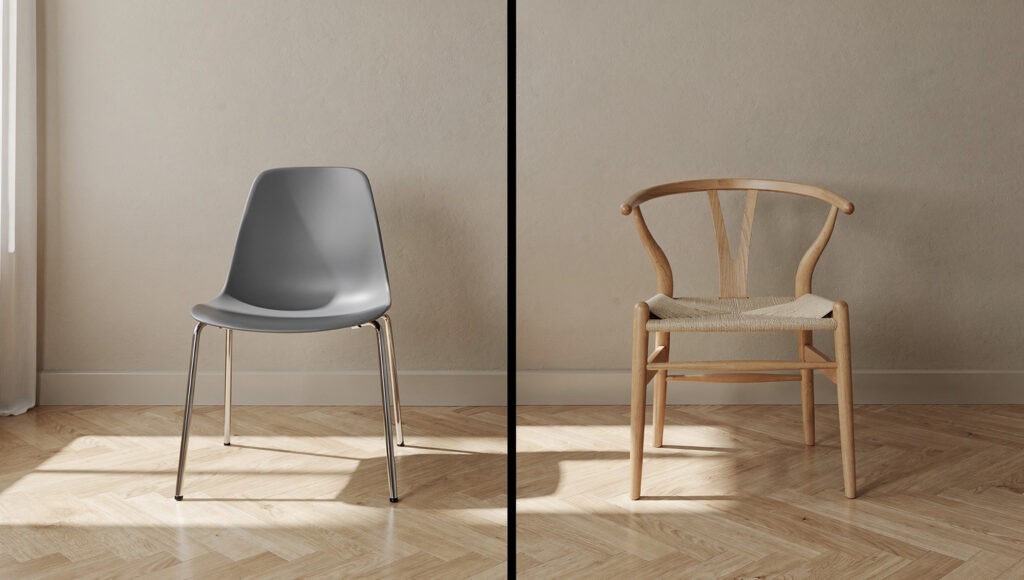
Chrome or metal legs. The cold reflective quality of chrome fights every warm material in a Japandi room simultaneously. No amount of correct upholstery or seat material compensates. The leg is the material foundation of the chair and it must be solid natural wood.
Molded plastic or resin seats. Plastic seats — including high-quality designer plastic — produce a visual sharpness that reads as synthetic in a room built on natural material warmth. The Hans Wegner Shell Chair is a celebrated exception, but its form and context are specific enough that it cannot be generalized.
Perfectly uniform machine finish. A Japandi chair should show evidence of its material. The grain variation in the wood, the slight irregularity in a woven cane panel, the honest texture of a natural linen upholstered seat. A chair with an absolutely uniform lacquered surface reads as manufactured rather than made.
Upholstery in synthetic fabric. Faux leather, synthetic velvet, polyester blends — these belong to a different design language. If the chair is upholstered, the fabric must be natural: linen, bouclé, wool, or cotton canvas.
The Chair Typology: Four Forms That Work
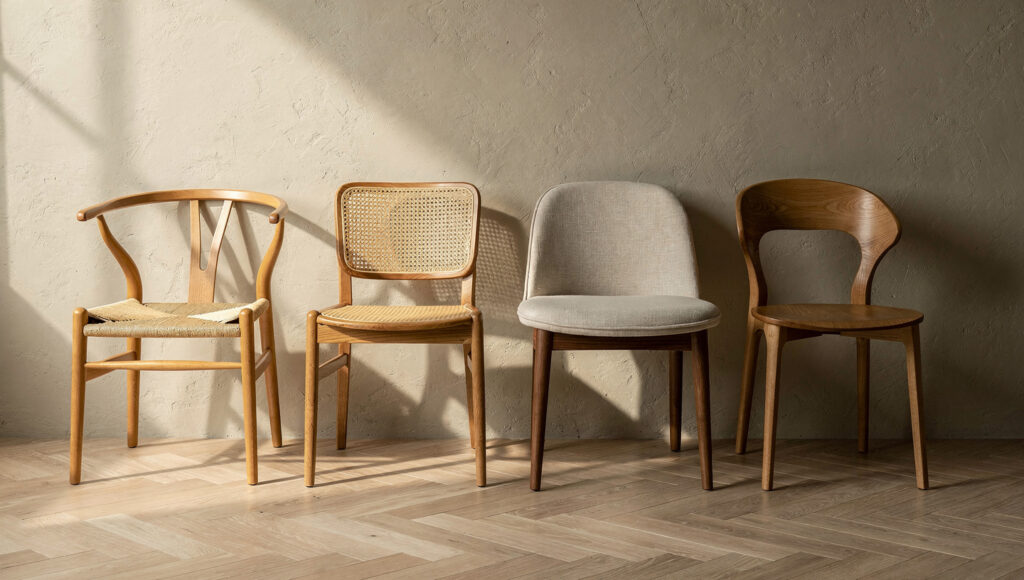
Four chair forms are architecturally compatible with Japandi dining rooms. Each makes a different compositional and material statement. Choosing between them is not a matter of preference — it is a matter of which form best serves the specific room.
Form 1 — The Wishbone Chair
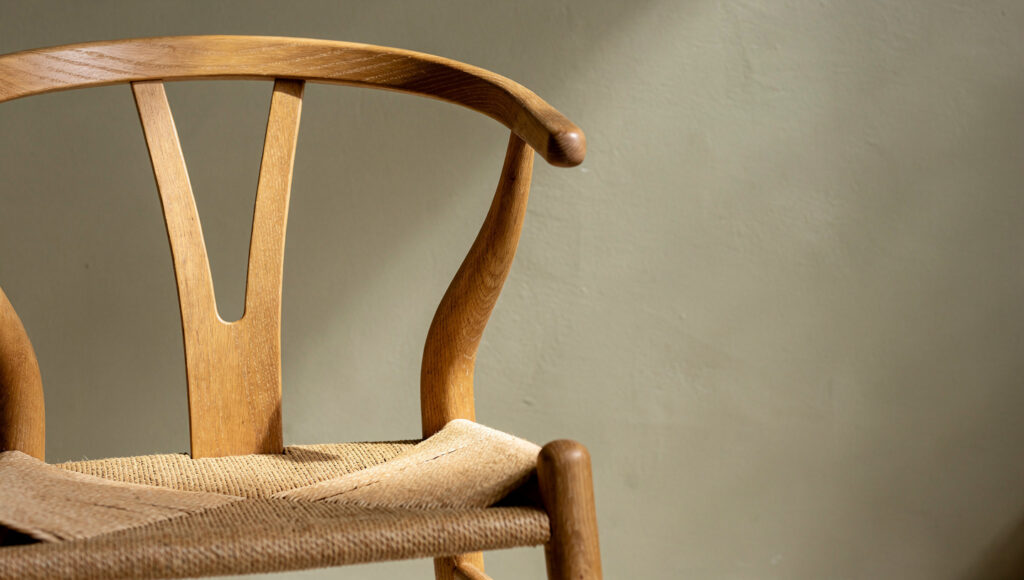
The most authentically Japandi dining chair form available. The Wegner CH24 Wishbone Chair — designed in 1949 — is the original, and it remains the standard against which every subsequent chair in this family is measured. The Y-form back, the woven paper cord seat, the solid wood frame in ash or oak: each element is honest to its material and function.
The Wishbone’s visual quality in a Japandi room is specific and irreproducible by other forms. The Y-back creates negative space within the chair itself — the wall behind the chair is visible through the back frame, which prevents the chair from reading as a solid visual block at the table. At a round oak dining table with four Wishbone chairs, the room reads as composed even when the table is empty, because the chairs themselves are architectural rather than merely functional.
The honest caveat: the Wishbone is not a comfortable chair for long meals. The paper cord seat firms up over years of use and the back angle is relatively upright. For households where the dining table doubles as a workspace or evening gathering point, a chair with more back support may serve the room better regardless of its aesthetic merit.
The CH24 original retails at approximately $600–$900 per chair through authorised retailers. Quality reproductions in solid wood — not rubberwood — are available at $150–$250 per chair. The distinction test: genuine solid ash or oak shows consistent grain direction across the full leg. Rubberwood shows irregular, short grain sections where pieces are laminated together.
Form 2 — The Cane Back Chair
Cane — the woven rattan material used for chair backs and seats — is the most Japanese of the four chair forms. It references traditional Japanese craft directly and produces a visual permeability similar to the Wishbone’s open back: the wall behind the chair is partially visible through the woven cane panel.
The practical advantage of cane over the Wishbone is back comfort. A cane back panel provides more support than the Y-wire of a Wishbone while maintaining the same visual openness. For households where the dining table sees extended use, cane back chairs represent a better ergonomic case than the Wishbone without sacrificing the Japandi material language.
The durability caveat: cane panels are the most vulnerable element in any cane chair. They absorb moisture in humid environments, can loosen at the frame joints over years of use, and are difficult to repair without specialist skill. In rooms with high humidity — open kitchens, coastal homes — cane deteriorates faster than solid wood alternatives. This is not a reason to avoid cane. It is a reason to budget for eventual panel replacement and to understand the chair as a material object that ages rather than a permanent fixture.
Form 3 — Upholstered with Solid Wood Frame
The most practical and most comfortable of the four forms. A solid wood frame — oak, ash, or walnut — with a seat and sometimes a back upholstered in natural linen, bouclé, or wool blend. This form prioritizes comfort without abandoning material authenticity.
The compositional trade-off is visual weight. Upholstered chairs read heavier than open-frame alternatives. At a round dining table, four upholstered chairs create a solid visual perimeter that can make the dining zone feel enclosed rather than light. The correct mitigation: choose upholstered chairs with slimmer frames and lighter upholstery tones — oat linen rather than dark charcoal bouclé — to maintain visual airiness at the table.
We have observed this trade-off directly in room settings. The same round oak table with four oat linen upholstered chairs reads as significantly calmer than the same table with four dark charcoal upholstered chairs, despite the dark chairs being individually more dramatic. The reason: at table scale, four dark upholstered chairs create a visual mass that overwhelms the table. Four light linen chairs allow the table surface to remain the primary visual element.
Form 4 — Solid Wood Sculptural
A solid wood chair without upholstery and without the Wishbone’s open back form — a chair where the wood itself is the entire design. These chairs require the most confidence in material selection because there is nothing to moderate the wood’s presence in the room. A beautiful piece of ash or walnut makes a beautiful chair. A poorly grained piece of rubberwood makes a disappointing one.
This form works best in Japandi rooms where the chair is intended as a design statement rather than a background element. One or two solid wood sculptural chairs at the ends of a rectangular table, flanking four Wishbone or cane chairs on the long sides, creates a hierarchy at the table that is Japanese in character — the host and guest positions distinguished by form rather than explicit designation.
The Seat Height Formula
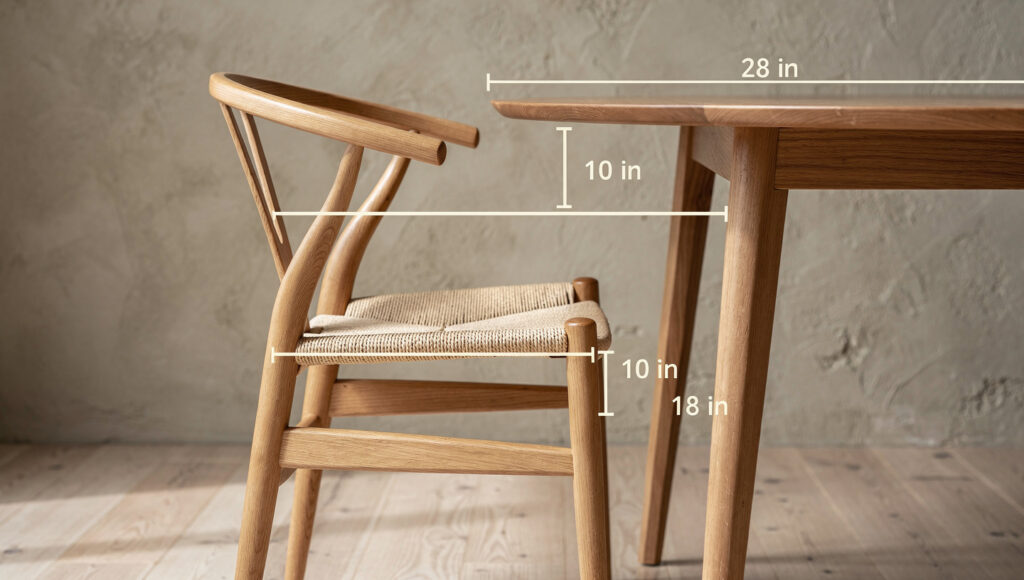
Every dining chair in a Japandi room must pass one technical specification before any aesthetic consideration. The seat height must be correct relative to the table height. A beautiful chair at the wrong height produces a dining experience that the room can never recover from, regardless of how considered everything else is.
The standard formula:
Table height in the US is typically 28–30 inches. The correct seat height for any chair at a 28–30 inch table is 17–19 inches from the floor. This provides 10–12 inches of clearance between the seat and the underside of the table — the minimum for comfortable seating without the knees contacting the table structure above.
Below 10 inches of clearance the seated position feels cramped. Above 14 inches of clearance the arms are too low relative to the table surface for comfortable eating posture. The 10–12 inch range is not a preference — it is an ergonomic specification.
The measurement check before purchasing:
Take the height of your dining table underside — not the table top surface but the lowest structural element above the seat, which is often the apron or table skirt. Subtract your intended seat height from this measurement. If the result is between 10 and 12 inches, the chair fits. If it is outside this range, the chair does not fit regardless of its aesthetic quality.
| Table Height | Correct Seat Height | Clearance Range | Comfort Rating |
|---|---|---|---|
| 28 inches | 16–17 inches | 11–12 inches | Optimal |
| 29 inches | 17–18 inches | 11–12 inches | Optimal |
| 30 inches | 17–19 inches | 11–13 inches | Optimal |
| 31 inches (counter height) | 19–21 inches | 10–12 inches | Acceptable |
| 36 inches (bar height) | 24–26 inches | 10–12 inches | Requires bar stool, not dining chair |
The Wishbone CH24 sits at 18.1 inches seat height — correct for tables between 28 and 30 inches. Most US market dining tables fall in this range. The CH24 fails only at counter-height tables (31–34 inches), where a taller version or a counter stool is required.
Armchairs at the Dining Table: The Japandi Position
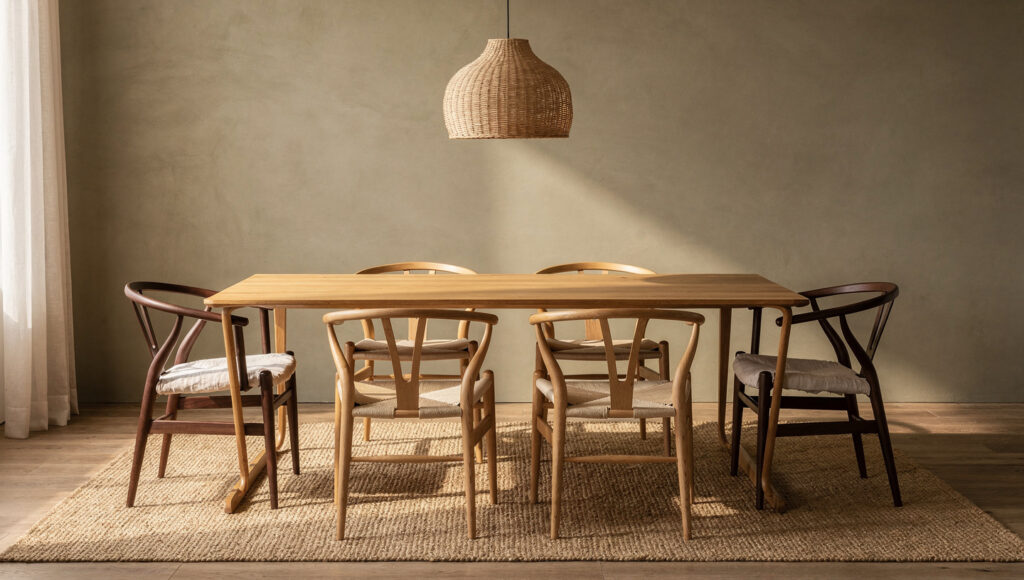
The question of whether armchairs belong at a Japandi dining table generates genuine disagreement among designers. The answer is not universal. It is contextual.
The Japanese dining tradition is almost entirely armchair-free at the dining table. Seating is low, often floor-level, and the chair form is a simple side chair or cushion. The armchair at the dining table is a Western convention.
The Scandinavian tradition is more permissive — armchairs at the table ends (the host and guest positions) flanked by side chairs along the long sides is common in Nordic dining rooms and produces a hierarchy that is both functional and visually resolved.
In practice, the correct Japandi answer is: armchairs at the table ends only, never along the sides. An armchair along a dining table’s long side extends into the circulation space on both sides and makes moving around the table functionally difficult. At the table ends, an armchair creates a modest visual hierarchy without compromising traffic flow.
The armchair must share the same frame material and finish as the side chairs. A walnut armchair at the ends of a table surrounded by ash side chairs is a mismatch that the room registers even if no individual person can name why. Same wood, same finish, same chair family — different form only.
If the household genuinely prefers armchairs at every position — as many US households do — then the round table is the correct table form. At a round table the distinction between end and side positions does not exist, and armchairs on all four sides read as a unified decision rather than a mixed arrangement.
The Chair-to-Table Proportion System
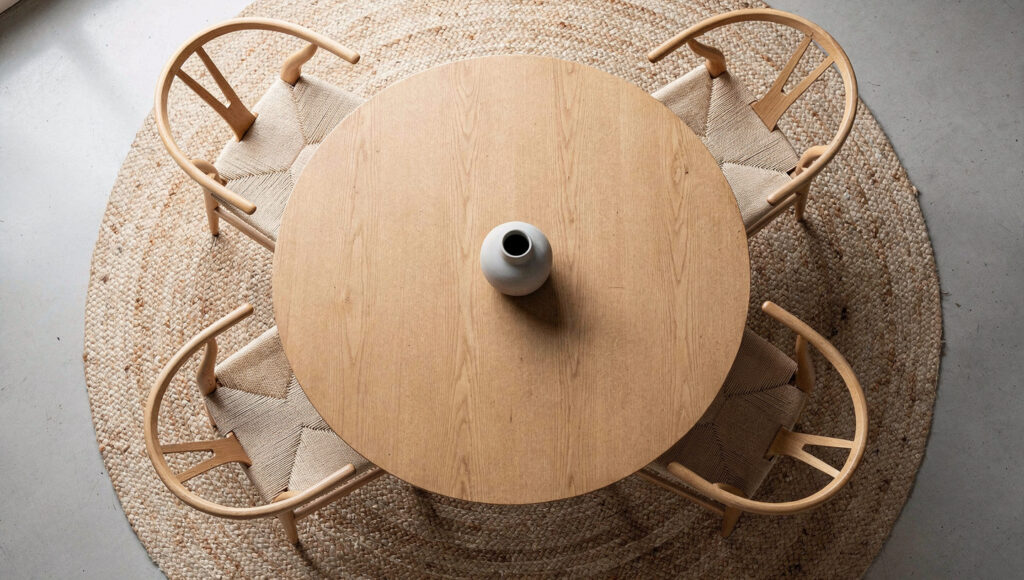
The number of chairs a table accommodates is not simply a function of how many chairs fit around it. It is a function of how many chairs allow each seated person the correct amount of space — and how many chairs produce a visually resolved composition when the table is unoccupied.
The seated spacing rule:
Each chair position at a dining table should have a minimum of 24 inches of table width and 6 inches of clearance to the adjacent chair when both are pushed in. Below 24 inches of table width per chair, elbows contact. Below 6 inches of chair-to-chair clearance, the dining experience feels institutional.
The round table capacity:
| Table Diameter | Comfortable Capacity | Maximum Capacity | Japandi Recommendation |
|---|---|---|---|
| 36 inches | 2 chairs | 3 chairs | 2 chairs — most intimate |
| 42 inches | 3 chairs | 4 chairs | 4 chairs — the Japandi standard |
| 48 inches | 4 chairs | 5 chairs | 4 chairs — preserve breathing room |
| 54 inches | 5 chairs | 6 chairs | 4–5 chairs |
| 60 inches | 6 chairs | 8 chairs | 6 chairs maximum |
The Japandi recommendation is always one chair fewer than the maximum capacity. A 48-inch round table can physically accommodate 5 chairs. It should have 4. The fifth chair would destroy the breathing room between chairs that gives the Japandi dining zone its composed quality.
The rectangular table capacity:
A rectangular dining table follows a different formula. The long sides accommodate one chair per 24 inches of table length. The short ends accommodate one chair each when the table is 36 inches or wider.
A 72×36 inch rectangular table: three chairs per long side (72 ÷ 24 = 3) plus one at each end = 8 chairs maximum. Japandi recommendation: two per long side plus one at each end = 6 chairs. The two empty positions at the table ends on each long side create the negative space that prevents the table from reading as full.
Material Aging: What Happens to Each Chair Form Over Time
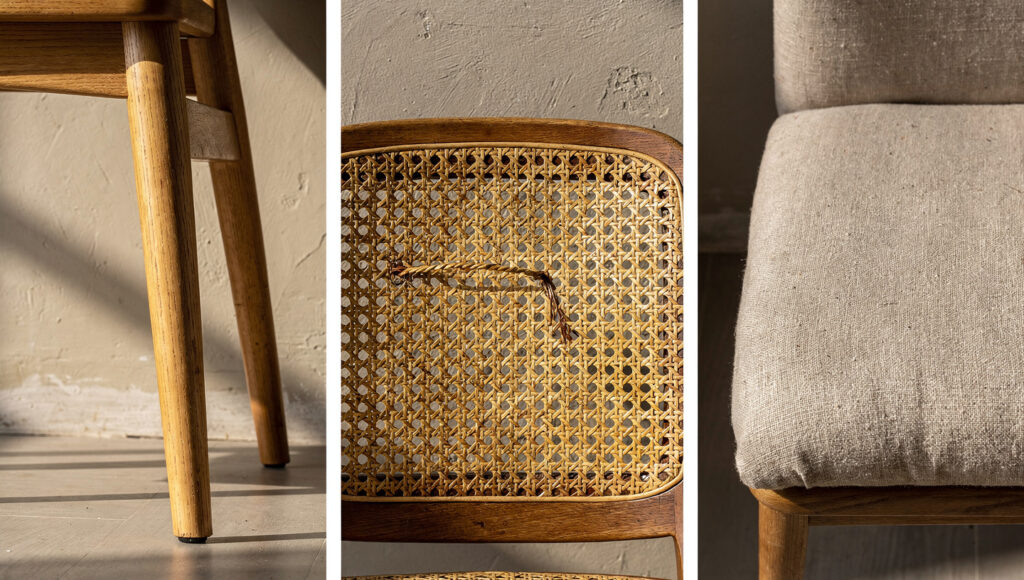
A Japandi dining chair is not a purchase. It is the beginning of a material relationship that develops over years of use. Understanding how each chair form ages determines which form is correct for each household.
Solid ash and oak deepen in color with age and light exposure. A pale ash Wishbone chair at purchase will be a medium warm honey tone within five years of daily use in a room with natural light. The grain becomes more pronounced as the surface oils naturally. This aging is the wabi-sabi quality of genuine solid wood — the chair becomes more beautiful as it becomes more used. No maintenance is required beyond occasional oiling with natural furniture oil.
Walnut follows the opposite trajectory. New walnut is its richest, darkest tone at purchase. It lightens slightly with UV exposure over years, moving from deep chocolate brown toward a warmer medium brown. The grain remains dramatic throughout. Walnut chairs in a room with strong natural light will be noticeably lighter in tone within three to five years.
Cane develops a warm golden patina as it ages and is exposed to natural light. New cane reads as pale natural. Aged cane reads as warm amber — a deeper, richer tone that actually harmonises more naturally with warm Japandi palettes than new cane does. The trade-off is structural: cane panels in high-use chairs may loosen at the frame joints after five to eight years. Annual application of cane seating oil significantly extends panel life.
Natural linen upholstery creases and softens with use in the way that all genuine linen does. The creases are the material’s honest record of being sat in — the wabi-sabi quality of a fabric that records its use rather than resisting it. The practical management: linen upholstery on dining chairs requires more active cleaning maintenance than solid wood or cane. A steam cleaner addresses most food marks without requiring professional cleaning.
The Mixed Chair Arrangement: When Breaking the Rule Is Correct
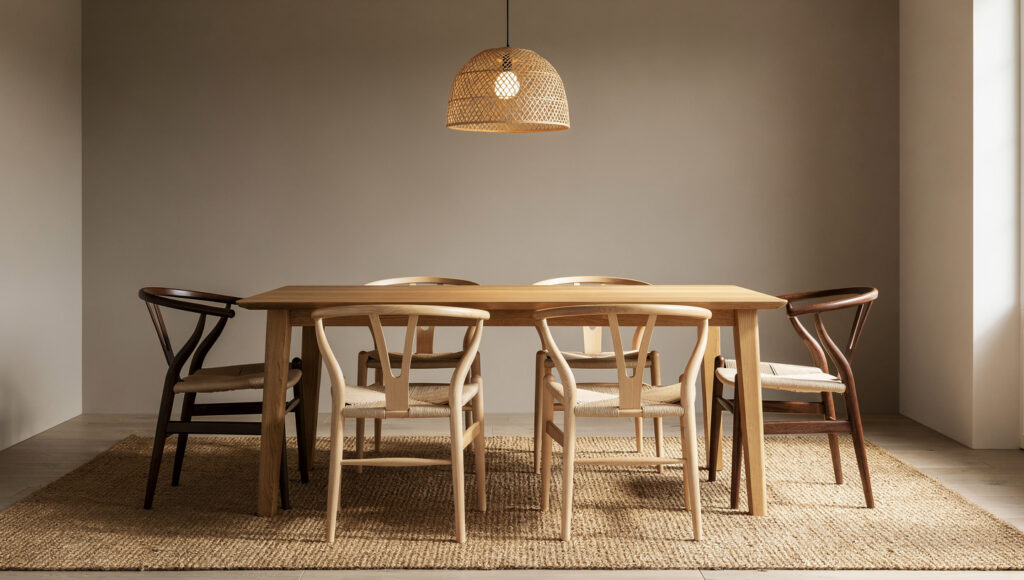
The standard Japandi rule is four matching chairs at a matching table. It is the most resolved and most commonly correct approach.
There is one exception that works: the deliberate mixed arrangement where chairs of the same family but different materials occupy different table positions. Two dark walnut Wishbone chairs at the table ends, four natural ash Wishbone chairs along the sides. Or two solid wood sculptural chairs at the ends, four cane back chairs along the sides.
The key word is deliberate. A mixed arrangement must read as a decision — the visual contrast between the end chairs and the side chairs must be clear enough that it registers as intentional. A subtle material difference — pale ash versus medium ash — reads as an error. A clear material difference — dark walnut versus natural ash — reads as a design decision.
This arrangement is rooted in Japanese hierarchical dining culture, where the seat of honour — traditionally facing the room’s focal point and away from the door — is distinguished from guest seating by material or form. In a Japandi room this hierarchy is expressed quietly, through material rather than through scale or ornament.
The arrangement only works on rectangular tables where the end positions are architecturally distinct from the side positions. On a round table there are no end positions and the mixed arrangement has no logical basis.
Frequently Asked Questions
What type of dining chair is most Japandi?
The Wegner CH24 Wishbone Chair in solid ash or oak is the most architecturally Japandi dining chair available — its Y-form back creates negative space within the chair itself, the woven paper cord seat references traditional Japanese craft, and the solid wood frame ages honestly over years of use. For households prioritizing comfort over pure form, a solid wood cane back chair provides the same visual openness and material authenticity with more back support. Both forms are correct. The chair form that is never correct in a Japandi room is one with chrome or metal legs, synthetic upholstery, or a machine-perfect lacquered surface.
How many dining chairs should a Japandi table have?
Always one fewer than the table’s maximum comfortable capacity. A 48-inch round table can seat five — a Japandi room has four. A 72-inch rectangular table can seat eight — a Japandi room has six. The empty position is not a missing chair. It is the negative space that allows the dining zone to breathe rather than read as fully occupied. This applies equally when the household does regularly seat at full capacity — the chair for the additional guest comes from elsewhere in the room when needed.
Can I mix different chair styles in a Japandi dining room?
Yes, under one condition: the mixed arrangement must read as a deliberate decision, not an accumulation. Two chairs at the table ends in one form or material, four chairs along the sides in a related but clearly different form — dark walnut ends with natural ash sides, for example. The material contrast must be unambiguous. A subtle variation reads as an error. A clear variation reads as a design decision rooted in the Japanese tradition of distinguishing the host position from the guest positions through material rather than scale.
The Finished Table: A Composition, Not a Set
A dining table without chairs is a surface. A dining table with the wrong chairs is a surface with objects around it that do not quite belong.
The correct chairs do something more specific. They make the table read as complete — each chair contributing to a composition where the negative space between chairs, the material relationship between chair and table, and the form dialog between open back and solid surface all resolve into something that looks as though it could not be any other way.
That resolution does not come from purchasing a matching set. It comes from understanding the specifications — seat height, form, material, proportion — and selecting each element against them rather than against a catalog photograph.
The room where the chairs are right is the room where no one notices the chairs. They simply sit in them.

