
This post contains affiliate links. If you purchase through these links, Homeoration earns a small commission at no extra cost to you — it helps keep this content free.
Most people who try warm minimalism end up with one of two rooms—a cold, empty space that looks like a furniture showroom, or a cluttered neutral room that looks like nothing at all. The difference between both failures and the room that actually works comes down to one decision most guides never address directly: the black accent.
Black in a warm minimalist room is not a color choice. It is an architectural decision—the ink that gives the room its edges, its weight, and its sense of completion.
- What Warm Minimalism Actually Is in 2026
- The Visual Power of Matte Black in a Warm Room
- The Warm Minimalist Color System
- The Furniture Edit: What Stays, What Goes, What Changes
- The Black Accent Placement System: Room by Room
- Lighting: The Architectural Decision Most People Skip
- Textile Layering: Where Warmth Actually Lives
- The Five Mistakes That Break Warm Minimalism
- Why Does a Minimalist Room Feel Cold?
- Frequently Asked Questions
- The Finished Room: Warm Before It Is Beautiful
- Shop This Look
What Warm Minimalism Actually Is in 2026
Warm minimalism is not a trend. It is the correction of a mistake.
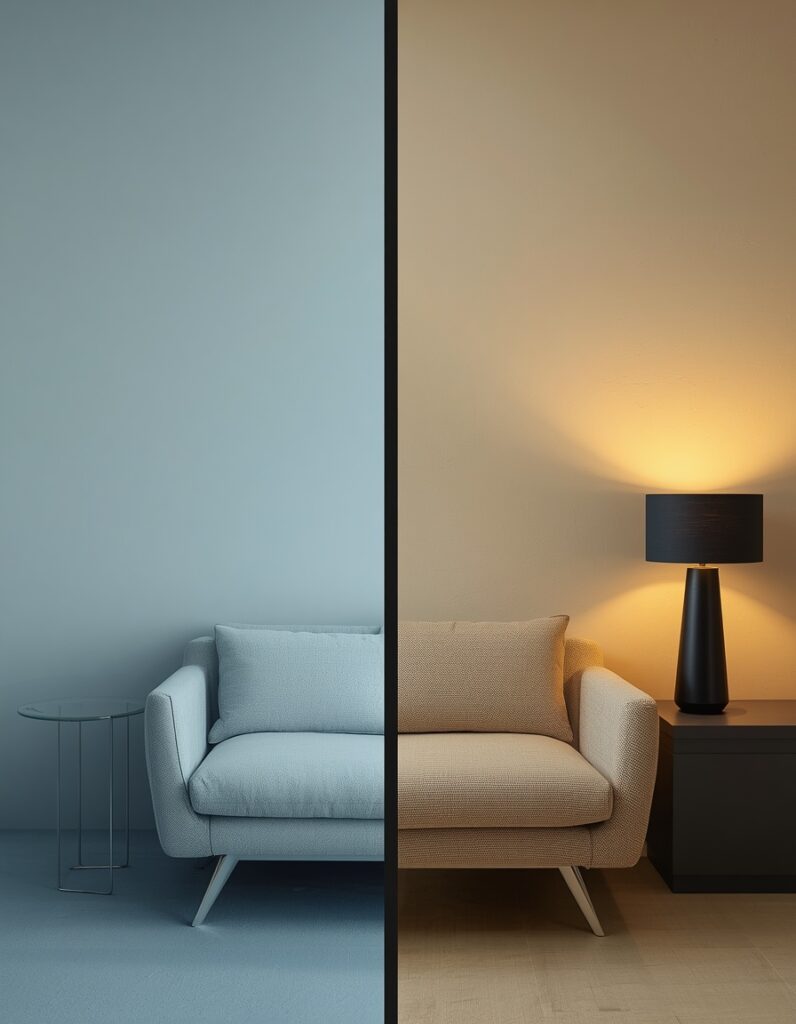
The minimalism of the 2010s—cool whites, gray walls, chrome hardware, and perfectly empty surfaces—produced rooms that looked exceptional in photographs and felt exhausting to live in. The visual silence was the wrong kind. Not a deep, restful calm. Just absence.
Warm minimalism restores what cold minimalism removed: the tactile warmth of natural materials, the depth of warm-undertone neutrals, and the psychological grounding that comes from having visual anchors—points where the eye can land, rest, and move on without scanning.
The three principles that define warm minimalism in 2026:
- Warmth through material, not color. The room stays neutral—greige, oat, warm white—but the materials produce tactile warmth that synthetic surfaces at any color cannot replicate. Linen creases. Oak grain catches light. Raw ceramic holds warmth differently than its surroundings.
- Editing through intention, not removal. A warm minimalist room is not empty. It contains exactly what it needs. The question is never “how little can I have”—it is “does this earn its place?”
- Grounding through contrast. This is where black accents enter. A room composed entirely of warm neutrals and natural materials is beautiful but unresolved—it floats. Matte black hardware, lamp bases, curtain rods, and furniture frames give the room its structure. They are the punctuation that makes the warm neutral palette readable.
The Visual Power of Matte Black in a Warm Room
Understanding why black works in a warm minimalist room requires understanding what black is doing at a visual level.
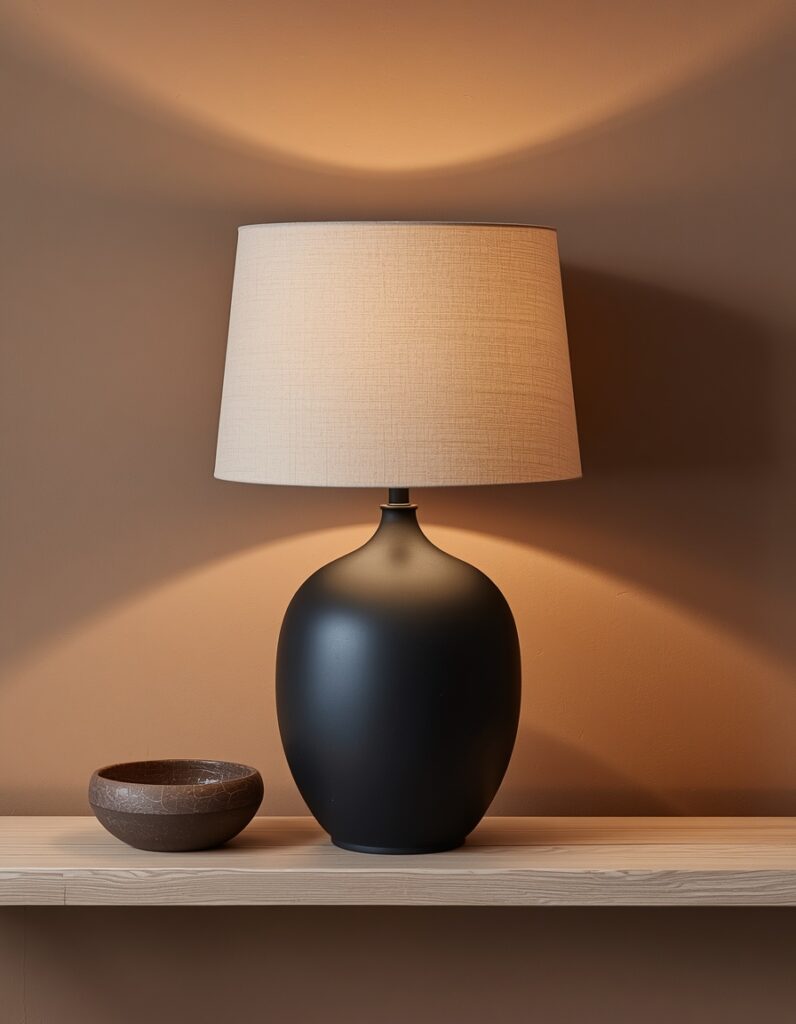
Matte black absorbs light. Every other element in a warm minimalist room is contributing light—the warm greige wall reflects it softly, the white oak catches it at the grain, the linen diffuses it. Matte black removes light from the composition. It creates a visual rest point—a place where the eye stops rather than being redirected.
This is why a matte black lamp base in a room of warm neutrals does not read as dark or cold. It reads as grounded. The room without it feels like a sentence without a period.
The critical distinction: matte versus gloss. Gloss black reflects light and creates visual noise—it draws attention to itself and fights the warm surfaces around it. Matte black disappears into its function. You register the lamp, the curtain rod, the cabinet pull—not the black itself. This is exactly what a grounding element should do.
The 10% rule for black accents: Never exceed 10% of the room’s visual surface area in black. At 10% the black grounds the palette. Beyond 10% it competes with it. In practice: hardware on cabinets and windows, one lamp base, one furniture frame. That is your 10%.
The Warm Minimalist Color System
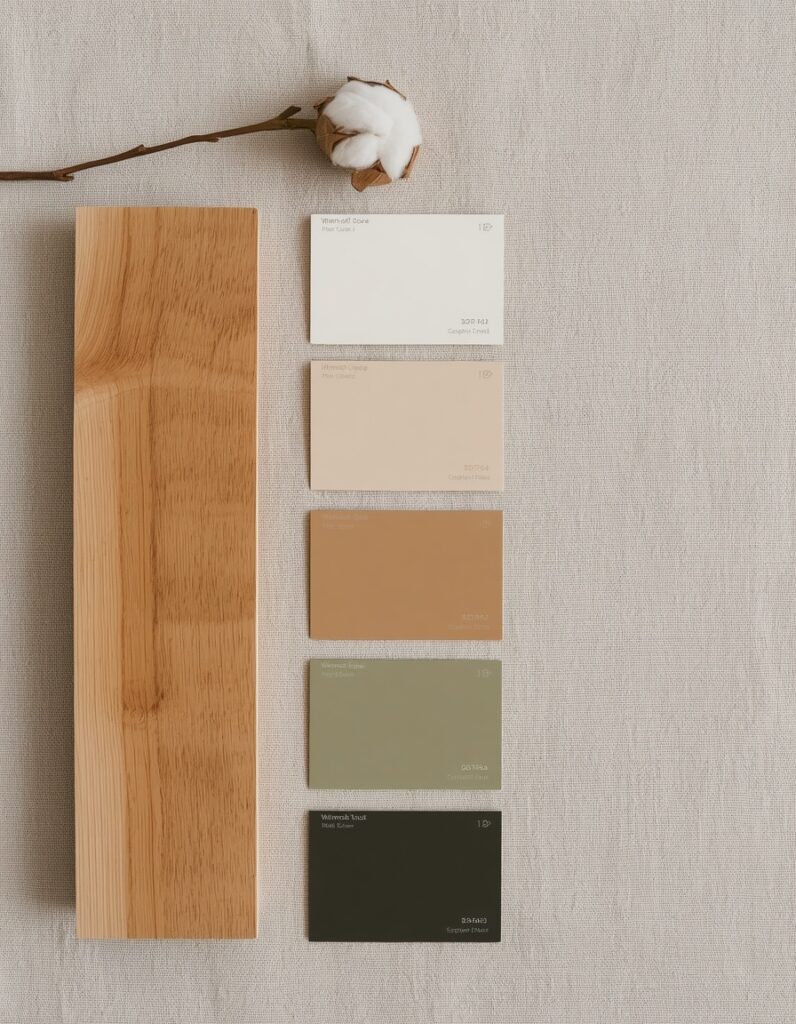
The color system in a warm minimalist room is built on one non-negotiable rule: every surface shares a warm undertone direction.
Warm undertones are yellow, green, or red-based—never blue, purple, or true cool gray. A wall with a blue-gray undertone against warm oak furniture creates a dissonance that most people cannot name but everyone feels. The oak looks too yellow. The wall looks cold. The room never settles.
The complete warm minimalist palette:
Base (walls and large surfaces):
- Benjamin Moore White Dove OC-17 — the most versatile warm white in the US market. Works in every light condition with every wood tone.
- Sherwin-Williams Accessible Beige SW 7036 — the definitive warm greige. Open-plan safe, virtually foolproof.
- Benjamin Moore Pale Oak OC-20 — one step warmer and deeper, ideal for bedrooms and color drenching.
Structure (wood tones):
- White oak — light, warm grain, the most Japandi-adjacent wood species.
- Walnut — deep, rich, for rooms that need more gravitas.
- Maximum two species per room — beyond two the eye loses its sense of calm.
Anchor (black accents — the 10%):
- Benjamin Moore Wrought Iron 2119-10 — a black with just enough warm blue to stay calm rather than harsh. For painted surfaces.
- Sherwin-Williams Tricorn Black SW 6258 — the cleanest matte black for hardware and furniture frames.
- All black elements in matte finish only — gloss black breaks the palette immediately.
Accent (one per room, 10% of visual surface):
- Benjamin Moore Saybrook Sage HC-114 — muted sage green that functions as a warm neutral.
- Sherwin-Williams Cavern Clay SW 7701 — warm terracotta for rooms that need more human warmth.
The Furniture Edit: What Stays, What Goes, What Changes
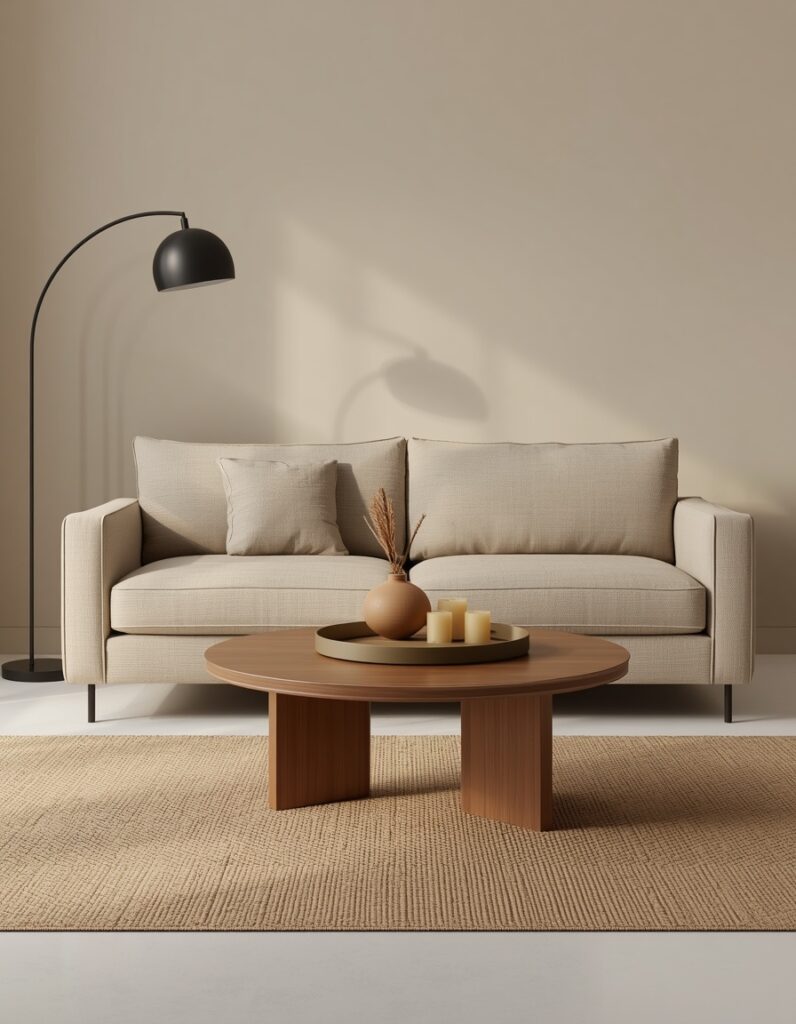
Warm minimalism asks a harder furniture question than most design styles. Not “what should I buy”—”what should I remove.”
The furniture edit framework: Every piece in a warm minimalist room must answer yes to at least two of these three questions:
- Does it serve a genuine daily function?
- Is it beautiful in its material—the honest grain, the natural imperfection, the warmth of the surface?
- Does it create comfort—physical, visual, or both?
Anything that answers yes to only one gets replaced or removed.
The pieces that stay in every warm minimalist room:
- A sofa in linen or bouclé—deep-seated, low-profile, natural fabric. Not synthetic velvet, not faux leather. The material must age visibly and beautifully.
- A coffee table in solid wood—round or oval, 14–16 inches height, no glass. Lower than you think, round rather than rectangular.
- One armchair—the best seat in the room. Upholstered in bouclé or wool. Wooden arms in natural oak.
- A natural fiber rug—larger than you think. Front legs of every seating piece on the rug.
The pieces that leave:
- The decorative items that arrived without a decision—the throw pillow that matched nothing, the side table that holds only charging cables, the bookshelf that became storage for things that have no other home.
The black anchor pieces:
- One matte black lamp base—arc floor lamp or table lamp, one per primary seating zone. The black frame of a mirror. The pulls on the media console. These are your 10%.
The Black Accent Placement System: Room by Room
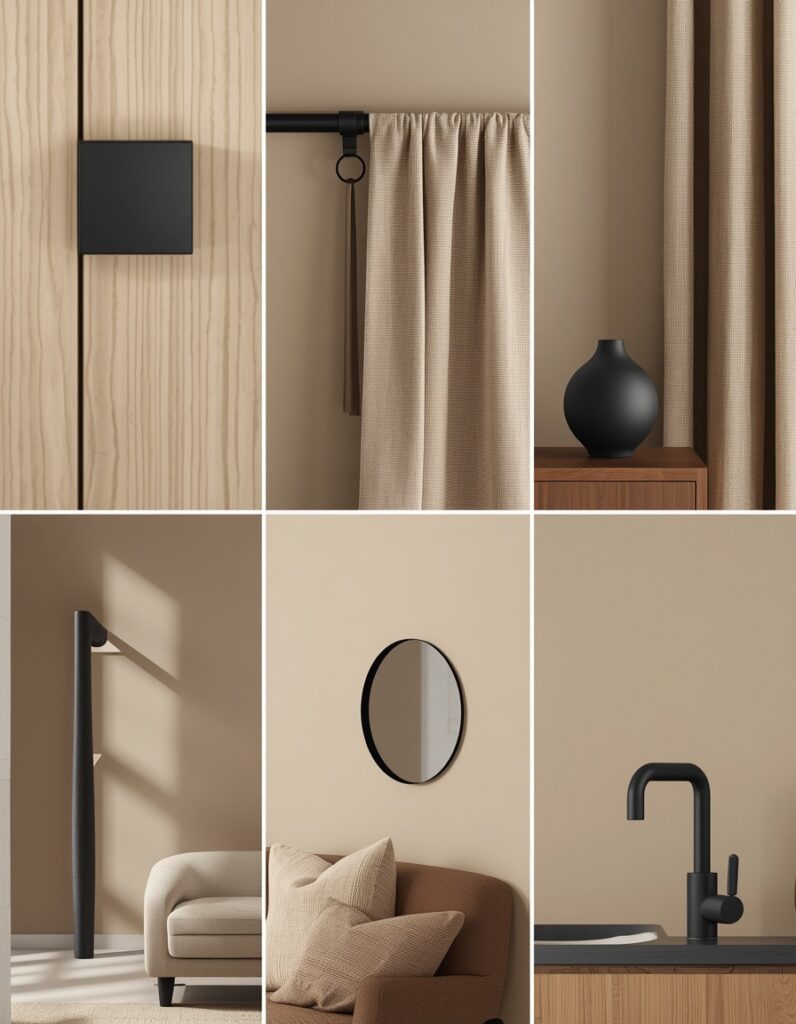
Black accents work differently in each room because the visual surface ratio changes with the room’s function and size. Here is the exact placement system by room.
Living room:
- One matte black arc floor lamp—the primary anchor, positioned behind and beside the sofa.
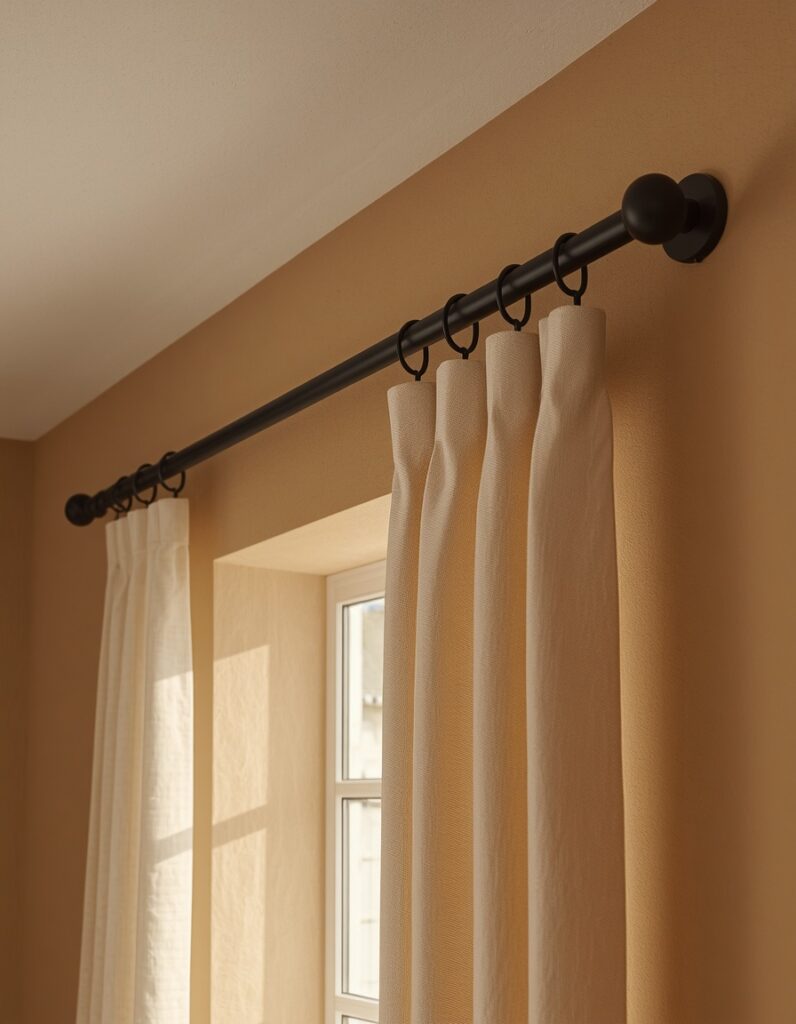
- Matte black curtain rod and rings at ceiling height—the horizontal anchor across the full window wall.
- Matte black lamp base on console if a table lamp is used.
- Nothing else—three black elements is the living room maximum.
Bedroom:
- Matte black bedside lamp bases on each nightstand—at shoulder height, 2700K bulb.
- Matte black curtain rod at ceiling height with sheer linen panels.
- Matte black picture frame if artwork is used—one piece only.
Kitchen:
- Matte black cabinet pulls on all doors and drawers—the single most impactful upgrade in any kitchen.
- Matte black faucet—replaces chrome immediately and permanently.
- Nothing else—the kitchen hardware is your entire black budget for that room.
Bathroom:
- Matte black faucet and shower fixtures.
- Matte black towel bar and toilet paper holder.
- Matte black mirror frame—one round or rectangular mirror with a slim matte black frame.
Home office:
- Matte black task lamp—the anchor over the desk surface.
- Matte black curtain rod if window is present.
- Matte black monitor arm if used—keeps cables managed and the desk surface clear.
Lighting: The Architectural Decision Most People Skip
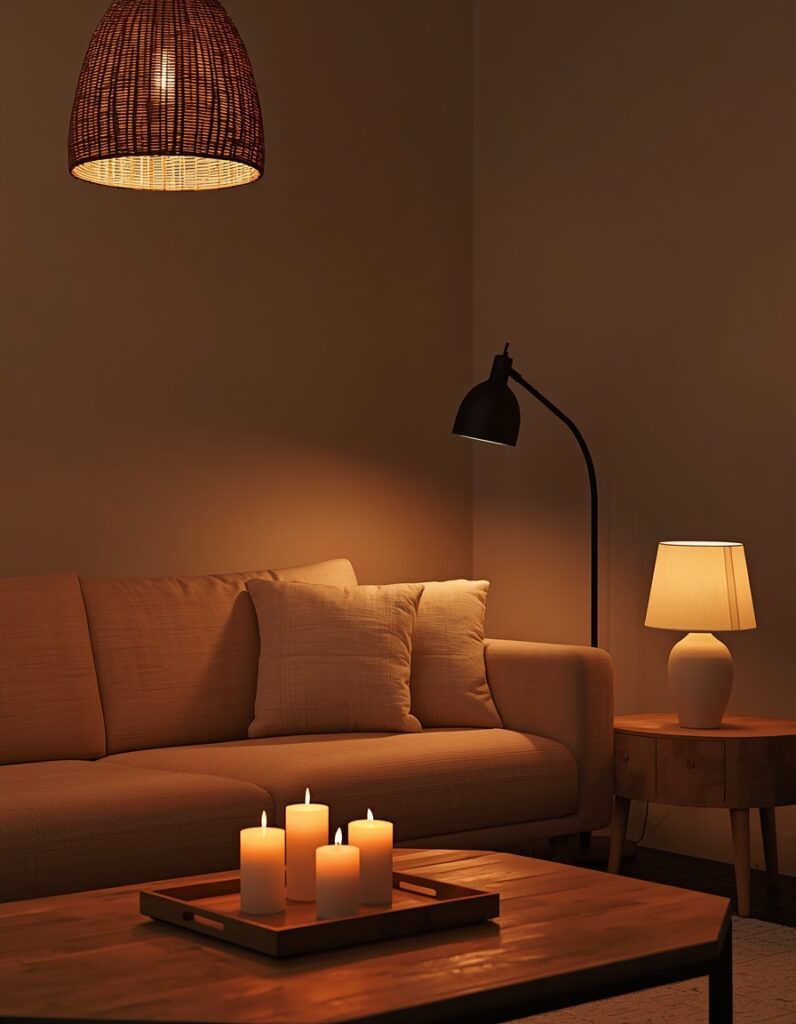
Warm minimalism cannot exist under the wrong light. This is not aesthetic preference—it is physics.
The Kelvin rule: Every bulb in a warm minimalist room operates between 2200K and 2700K. This temperature range mimics late-afternoon and candlelight—the natural cues that signal the approach of rest. Above 3000K the light reads as daylight and actively suppresses the calm that warm minimalism is engineered to produce.
The layering rule: Never a single overhead light source. Always at least four sources operating simultaneously at different heights. The overhead light in a warm minimalist room is on a dimmer and used only when getting dressed or cleaning. It is never the primary source for living, reading, or relaxing.
The four layers:
- Ambient: One pendant or chandelier in organic materials—rattan, paper, or natural wood. The bulb should be a warm globe at 2200–2700K.
- Task: One arc floor lamp positioned behind and beside the primary seating. Over-shoulder light for reading. The black arc lamp is simultaneously a functional light source and your primary black accent anchor in the room.
- Accent: Candles. Non-negotiable in warm minimalism. The specific flicker of candlelight at 1800K has a natural warmth that is impossible to replicate electrically. Three to five beeswax pillar candles on a wooden tray on the coffee table. Every evening.
- Decorative: One or two ceramic table lamps on consoles or side tables, below eye level from a seated position. Contributing warmth without competing with the other sources.
Textile Layering: Where Warmth Actually Lives
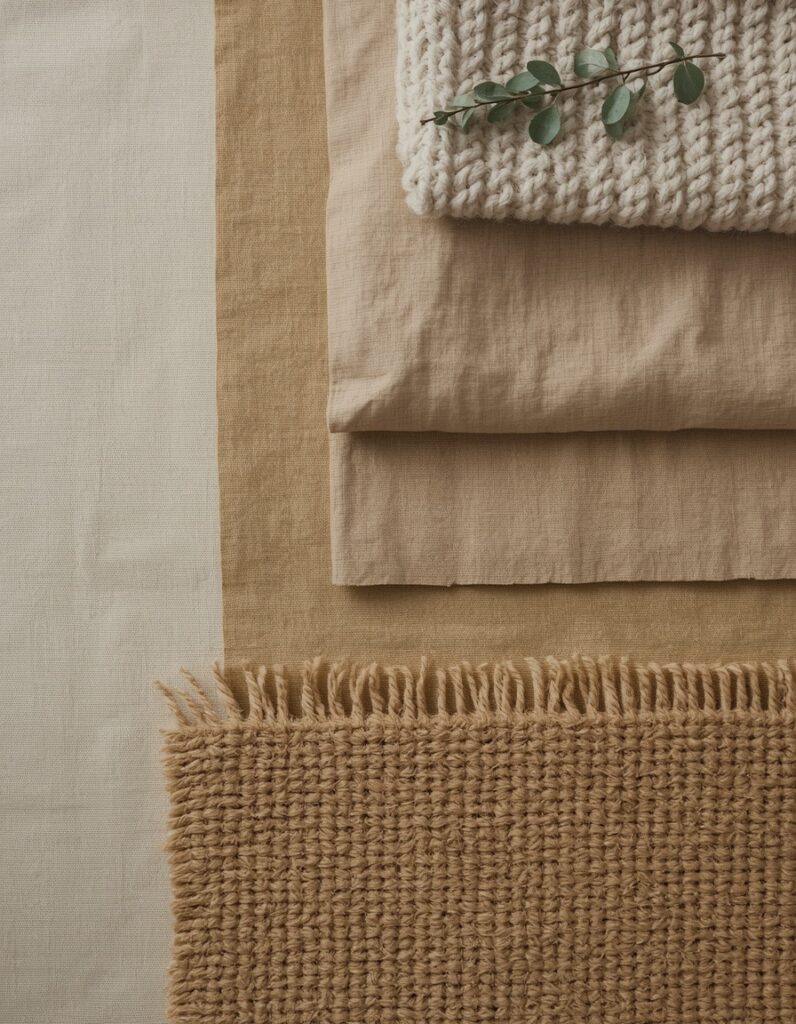
If the color system is the room’s skeleton and the black accents are its punctuation, the textiles are its comfort layer—the layer that determines whether a room feels warm from across the street or only warm in photographs.
The four textile layers in every warm minimalist room:
- Layer one — the rug. Natural fiber: wool, jute, or jute-wool blend. Always larger than seems necessary. Pattern if any should be a subtle diamond or herringbone in two tones that reads as texture from across the room.
- Layer two — the primary upholstery. Linen for aging beauty. Bouclé for maximum tactile warmth. Wool blend for families. Never synthetic fabric in any of these positions—synthetic materials under artificial light create a subtle visual harshness that undermines the entire palette.
- Layer three — the throw. One chunky merino wool throw per seating area. Draped naturally—never folded. The weight matters as much as the appearance. A throw that is too lightweight reads as a prop rather than an invitation.
- Layer four — the cushion edit. Three cushions on a sofa—never four. Two in the base neutral, one in your accent color. Arranged asymmetrically. The asymmetry is not carelessness—it is the wabi-sabi principle of deliberate imperfection that makes a room feel inhabited rather than staged.
The Five Mistakes That Break Warm Minimalism
- Mistake 1 — Gloss black instead of matte black. Gloss black reflects light and creates visual noise. It draws attention to itself rather than grounding the palette. Every black element in a warm minimalist room is matte. No exceptions.
- Mistake 2 — Cool-undertone neutrals. Blue-gray walls against warm wood tones create the most common warm minimalism failure—a room that looks warm on a mood board and cold in reality. Test every paint swatch against your largest wood surface before committing.
- Mistake 3 — Exceeding the 10% black rule. At 10%, black grounds the palette. At 20% it competes with it. The room starts to read as “dark” rather than “grounded.” Count your black elements and stay disciplined.
- Mistake 4 — Single overhead lighting. No warm palette can survive flat, single-source overhead lighting. It flattens every material, kills every texture, and removes every shadow that makes natural surfaces look three-dimensional. Layer your lighting every single time.
- Mistake 5 — Synthetic textiles. A synthetic rug, polyester cushions, or faux-linen curtains produce a visual harshness that warm minimalism’s entire material approach is designed to eliminate. The natural material requirement is not an aesthetic preference—it is the mechanism through which warm minimalism produces its effect.
Why Does a Minimalist Room Feel Cold?
A minimalist room feels cold for one reason above all others: cool undertones with nothing warm to counter them. Blue-gray walls, chrome hardware, stark white paint, and hard empty surfaces reflect the cool end of the spectrum, and with no warm wood, texture, or warm light to push back, the room reads as clinical rather than calm. The fix is not more stuff, it is warmth in the elements you already have: swap cool grays and stark whites for warm neutrals with a yellow, green, or soft pink undertone; add natural wood and woven texture; and switch to warm-white 2700K to 3000K bulbs. Warmth, not clutter, is what separates a minimalist room that feels serene from one that feels empty.
Takeaway: A minimalist room feels cold because of cool undertones, not because it is minimal. Warm the paint, add wood and texture, and use 2700K bulbs, and the same edited room reads calm instead of clinical.
Frequently Asked Questions
What is warm minimalism and how is it different from regular minimalism?
Warm minimalism retains the edited, intentional approach of traditional minimalism but replaces cool neutrals and synthetic materials with warm-undertone palettes, natural materials like linen, oak, and wool, and layered warm lighting. Regular minimalism often produces rooms that feel cold because it prioritizes visual reduction over tactile warmth. Warm minimalism prioritizes both—the editing discipline of minimalism and the material warmth of Japandi and wabi-sabi design.
How do you use black accents in a warm room without making it feel cold?
The answer is always matte finish and the 10% rule. Matte black absorbs light rather than reflecting it, which means it grounds the palette without creating visual noise. Limiting black to 10% of the room’s visual surface—hardware, one lamp base, curtain rods—means the warm materials remain dominant and the black serves only as punctuation. The moment black exceeds 10% it begins to compete with the warmth rather than defining it.
What paint colors work best for warm minimalism?
The three most effective warm minimalist paint colors in the US market are Sherwin-Williams Accessible Beige SW 7036 (the most versatile warm greige for living rooms), Benjamin Moore White Dove OC-17 (the gold standard warm white for any room), and Benjamin Moore Pale Oak OC-20 (the warmest greige option for bedrooms and color drenching). All three have warm yellow or green undertones that harmonize with natural wood tones—the defining technical requirement of the warm minimalist palette.
Why does my minimalist room feel cold?
Because its undertones run cool and nothing warm balances them. Cool-gray or blue-based walls, stark white paint, chrome hardware, and bare hard surfaces all reflect cool light, and without warm wood, texture, or warm bulbs the room reads clinical. The fix is warmth rather than more objects: choose warm neutrals with a yellow, green, or soft pink undertone, add natural wood and woven texture, keep one or two grounding matte-black details, and use warm-white 2700K to 3000K bulbs. The same minimal, edited room feels calm instead of cold once its undertones and light are warm rather than cool.
The Finished Room: Warm Before It Is Beautiful
The room that works is not the one with the most considered furniture selection or the most expensive linen. It is the one where the black anchor on the lamp base stops the eye at exactly the right moment, where the warm greige wall glows differently at 8am and 8pm, and where the matte surfaces absorb rather than perform.
That is warm minimalism doing what it is designed to do. Not impressing. Resting you.
Start with the hardware. Five minutes and a screwdriver and the kitchen has its black accents. Then the curtain rod. Then the lamp.
The palette follows the anchors. The warmth follows the palette. The rest follows everything.
Shop This Look
All products available on Amazon US with Prime shipping.
- Sofa — Article Sven Sofa in oatmeal bouclé. Deep-seated, solid wood legs, the warm minimalist sofa standard.
- Arc floor lamp — Brightech Sparq Arc Floor Lamp in Matte Black. Primary black anchor and primary reading light simultaneously.
- Jute rug — nuLOOM Rigo Hand Woven Jute Rug 8×10. Size up always.
- Cabinet pulls — Matte Black Cabinet Pulls 3-inch, 10-pack. Fastest single upgrade in any kitchen or bathroom.
- Kitchen faucet — Matte Black Kitchen Faucet Single Handle. Replaces chrome in one afternoon.
- Curtain rod — Matte Black Curtain Rod Ceiling Mount. Always ceiling-mount, always 8 inches beyond frame on each side.
- Curtain rings — Matte Black Curtain Rings with Clips.
- Pendant light — Stone & Beam Rattan Pendant Light. Organic form, warm diffused glow.
- Linen throw — Parachute Stonewashed Linen Throw.
- Merino throw — Chunky Merino Wool Throw Natural Oat. One per seating area, draped — never folded.
- Bouclé cushion — Oat Bouclé Cushion Cover. Two in oat, one in sage or terracotta.
- Beeswax candles — 100% Beeswax Pillar Candles Set of 3. On an olive wood tray. Every evening.
- LED accent lighting — Govee Smart LED Strip Lights Warm White 2700K. Under-console or under-shelf. Matched to room temperature.

