
This post contains affiliate links. If you buy through them, Homeoration earns a small commission at no extra cost to you.
Textured mineral wall finishes have become the defining interior look of the last few years, and the three names that come up are almost always the same: limewash, Venetian plaster, and microcement. Every guide you will find lines them up as three versions of the same idea at three price points, and tells you to choose by look and budget.
That framing is wrong, and it is why so many people end up with the expensive one in the wrong room. These three are not competing products. They answer genuinely different questions, and one of them is not really a decorative finish at all.
The short answer: Limewash is a breathable lime paint that soaks in, cheapest and DIY-friendly, for dry walls you rarely touch. Venetian plaster is troweled lime and marble dust burnished to stone-like depth, for feature walls. Microcement is a cement and resin coating, waterproof and rated for floors, for wet rooms and traffic.
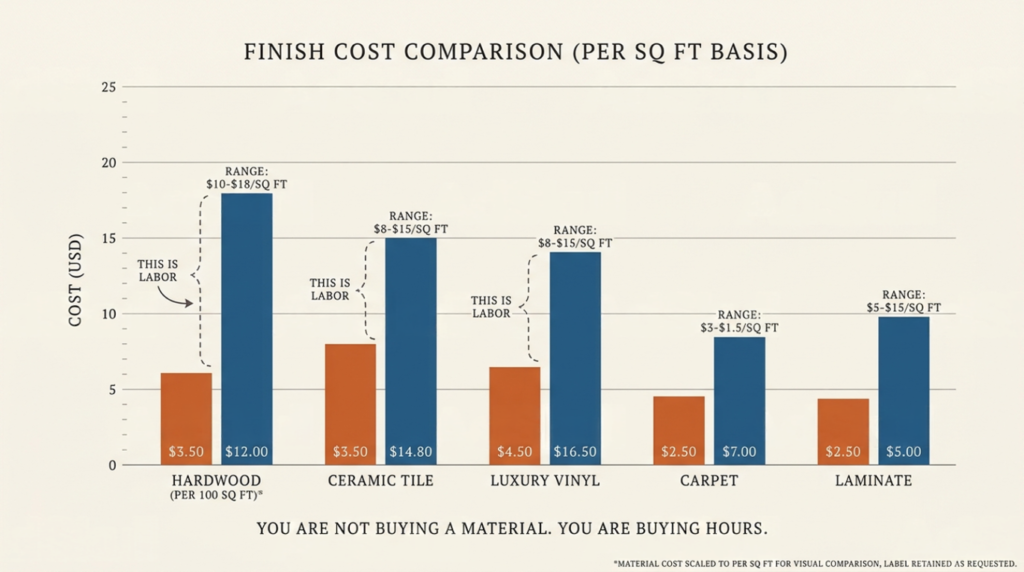
The number that proves it is the cost gap, because almost none of it is material. Limewash materials for a hundred square feet run somewhere around two hundred dollars. Venetian plaster materials for the same wall run around five hundred. But installed, Venetian plaster can cost three to four times what limewash does, which means the money is not going into the bucket. It is going into hours. You are not buying a material, you are buying a skill, and the finishes differ far more in what they demand and what they survive than in what they cost.
So this guide is organized around the questions nobody answers. Not just what each finish looks like and what it costs, but how long each lasts, where each can and cannot go, and, most usefully, how each one fails. Durability appears in every comparison. Failure mode almost never does, and failure mode is the part you actually live with.
Which finish fits your wall?
| If you want… | Choose… |
|---|---|
| The cheapest textured finish | Limewash |
| A DIY project you can finish in a weekend | Limewash |
| Depth and a polished stone look | Venetian plaster |
| A feature wall or fireplace surround | Venetian plaster |
| A bathroom, shower, or wet area | Microcement |
| A floor, or a surface you walk on | Microcement |
| To cover existing tile without demolition | Microcement |
| Maximum breathability on old masonry | Limewash |
| A finish for an exterior wall | Limewash or microcement |
Read that table as three different jobs rather than three price tiers. If your wall is dry and you want character, limewash. If you want depth and can pay for craft, Venetian plaster. If the surface has to survive water or feet, microcement is the only one of the three that qualifies.
What each one actually is
The compositions explain everything that follows.
Takeaway: Limewash is a breathable lime paint that soaks in. Venetian plaster is troweled lime and marble dust, burnished to stone. Microcement is a cement and resin coating, which is why it can do things the other two cannot.
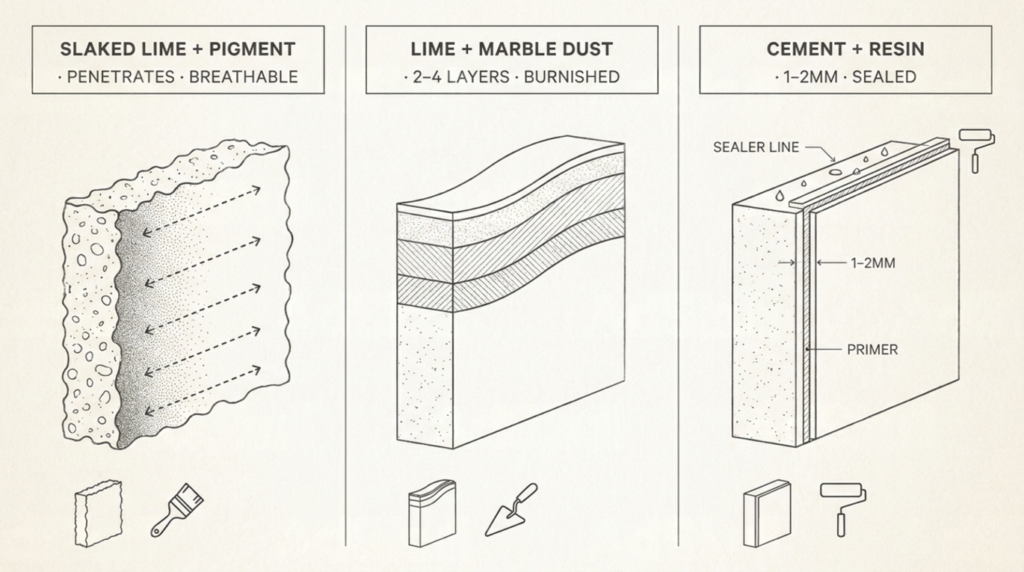
Limewash is slaked lime, water, and natural pigment. It is a paint rather than a plaster, thin enough to soak into a porous wall rather than sit on top of it, and it dries to a soft, chalky, mottled matte. Because it penetrates rather than coats, it is the most breathable of the three by a wide margin, which is why it is the traditional finish for old masonry that needs to move moisture rather than trap it.
Venetian plaster is slaked lime blended with fine marble dust, troweled on in several thin layers and burnished with a steel trowel to a dense, smooth, stone-like surface. It is a genuine plaster, built up in coats, and the polish is the point. Run your hand across it and it feels cool and solid, closer to marble than to a painted wall.
Microcement is the outlier. It is a cement-based coating with polymer resins and mineral additives, applied in layers of a millimeter or two, and it is an engineering material with a decorative finish rather than a decorative finish with useful properties. The resin content is what makes it flexible, hard-wearing, and capable of going where the two lime finishes cannot.
That last point is the one to hold onto. Limewash and Venetian plaster are both lime, both mineral, both breathable, both walls-only. Microcement is a different category of product that happens to look related.
Cost, and why the gap is labor
Takeaway: The cost gap between these finishes is labor, not material. Limewash is cheap because it is quick; Venetian plaster is expensive because burnishing is a timed skill. A cheap Venetian quote usually means fewer layers.
Published figures vary widely by region and by installer, so treat these as ranges rather than quotes, but the pattern across sources is consistent.
| Finish | Installed, per square foot | What drives the cost |
|---|---|---|
| Limewash | Roughly $4 to $10 | Materials and a single skilled day |
| Venetian plaster | Roughly $8 to $30 | Layers, burnishing, and craft time |
| Microcement | Roughly $14 to $25 | Multiple coats, primer, and sealer |
Now compare that to materials alone. Limewash materials for a hundred square feet come in near two hundred dollars, and a Venetian plaster material kit for the same wall near five hundred. A material gap of a bit over two to one produces an installed gap of three or four to one.
The difference is entirely time and skill. Limewash is cheap because a competent amateur can roll and brush a room in an afternoon. Venetian plaster is expensive because the burnish is a timing skill, it has to happen in a specific window as the plaster sets, and there is no way to shortcut it. Microcement sits high because it is a multi-stage system, primer, mesh where needed, two or more coats, then sealer, and every stage has to cure.
One practical consequence worth knowing: if a Venetian plaster quote comes in close to limewash prices, something is being left out, and it is almost always the number of layers. Fewer coats means less depth, and the depth is the entire reason to choose it.
Durability and lifespan
All three outlast conventional paint, but they age on very different schedules.
Takeaway: Limewash lasts decades on exterior masonry but wants refreshing indoors. Venetian plaster runs fifteen to twenty years and hardens as it ages. Microcement is the toughest and the only one rated for floors.
Limewash on exterior masonry can last decades, because the lime chemically bonds with a mineral substrate and effectively becomes part of the wall. Indoors on drywall it is a different story, and it typically wants refreshing on a cycle of years rather than decades, particularly in rooms that get touched.
Venetian plaster is generally cited at fifteen to twenty years or more, and it has an unusual property: it continues to harden over time as the lime cures, so it gets tougher rather than softer with age. It also self-heals very fine cracks for the same reason.
Microcement is the most durable of the three by a clear margin, which is what its cement base is for. It is rated for floors and heavy foot traffic, and its resin content makes it more flexible than Venetian plaster and therefore less prone to cracking when the substrate beneath it moves.
The honest long-run comparison is less lopsided than those numbers suggest. Limewash costs least up front and asks for repeat cycles. Venetian plaster costs more once and asks for very little. Over a couple of decades the totals converge, and the real difference is how often you want the disruption.
How each one fails, which nobody tells you
This is the section that decides most real projects, and it is missing from almost every comparison.
Takeaway: Limewash marks where it is touched and cannot be wiped clean. Venetian plaster cracks when the wall behind it moves. Microcement fails at its sealer, which is a maintenance schedule rather than a defect.
Limewash fails by contact, not by time. Because it soaks into the wall rather than forming a film on top, there is no surface layer to peel, but there is also no surface layer to protect it. It marks where hands, furniture, and shoulders touch it, and those marks do not wipe off the way they would from an eggshell paint. This is why a limewash hallway looks tired long before a limewash ceiling does. Put it where people do not brush past it.
Venetian plaster fails by cracking, and the crack usually comes from the wall rather than the plaster. It is a hard, dense surface bonded to a substrate that expands, contracts, and settles, and when the substrate moves enough, the plaster telegraphs it. Its self-healing handles hairlines; it does not handle a moving joint. The other failure is a scratch, which is visible on a burnished surface in a way it never is on a matte one.
Microcement fails at the sealer, not the cement. The cement layer is genuinely tough, but its water resistance depends on a topical sealer that wears in high-traffic areas and around water. When people report microcement staining or darkening, the cause is almost always a sealer that was due for renewal. It is a maintenance item with a schedule, not a permanent property of the material.
The useful way to read those three: limewash asks you to control what touches it, Venetian plaster asks you to have a stable wall, and microcement asks you to maintain a coating. Choose the demand you are willing to live with.
Water, floors, and where each can go
This is where the three separate completely, and it is not a matter of degree.
Takeaway: Microcement is the only one of the three rated for floors, showers, and exteriors, and it can go straight over existing tile. Limewash and Venetian plaster are wall finishes, and Venetian plaster is interior only.
Limewash and Venetian plaster are wall finishes. Neither is rated for floors, because neither has the compressive strength or abrasion resistance to take foot traffic. Venetian plaster is also not recommended for exterior use, while limewash is genuinely at home on exterior masonry and has been for centuries.
Microcement is rated for floors, walls, ceilings, stairs, and exteriors. On water, it is moisture-resistant on its own and becomes fully waterproof when installed over a waterproofing membrane with a sealer on top, which is what makes it viable inside a shower.
The renovation advantage is worth stating plainly, because it changes the cost calculation: microcement can be applied directly over existing tile. On a bathroom refit, that eliminates demolition, disposal, and substrate replacement, and it can make the seemingly expensive option the cheaper one overall.
So if the surface will get wet or walked on, the three-way comparison collapses into one answer. If it will not, microcement is usually more finish than the job requires.
Can you do it yourself?
The DIY answer varies more than any other factor here.
Takeaway: Limewash is a genuine weekend DIY project. Matte Venetian plaster is possible with practice; the polished version is not. Micro cement is a professional system, especially anywhere near water.
Limewash is the most approachable decorative finish available, and it is a reasonable first project for someone who has never worked with texture. It forgives unevenness because unevenness is the look, and the mottled cloudy effect builds through thin coats rather than requiring precision. The technique that produces the right movement is covered in our wabi-sabi home decor guide, which sets out the brush and the working pattern.
Venetian plaster is genuinely difficult, and the difficulty scales with the finish level. A matte marmorino-style plaster is achievable for a patient DIYer willing to practice on a board first. The high-polish version is a professional skill, and the burnish has to be timed to the set of the plaster, which is not something you can learn on the wall you care about.
Microcement is not a DIY material. It is a multi-layer system with primers, mesh reinforcement, curing windows, and a sealer, and the waterproofing details in a wet area are exactly where an amateur application fails. This is a hire-a-specialist finish.
Which finish for which room?
The room decides more than the budget does.
A living room or bedroom wall. Limewash, in most cases. It is the cheapest way to get real texture, the room is dry, and nobody is scrubbing the walls. If you want more depth and the wall is a genuine feature, Venetian plaster earns its cost here.
A feature wall, fireplace surround, or entryway. Venetian plaster. This is what it is for, and the polished depth reads best on a single surface rather than a whole house. Its role in a darker scheme is worked through in our dark Japandi living room guide.
A bathroom, shower, or wet room. Microcement, with a waterproofing membrane beneath and a sealer on top. Neither lime finish belongs in a shower.
A kitchen. Microcement behind the counter and around the sink, where splashes and cleaning are constant. Limewash on the walls away from the working zone if you want the softer look.
A floor, or a wall-to-floor continuous surface. Microcement, exclusively. It is the only one of the three rated to be walked on.
An older home with solid masonry walls. Limewash, comfortably. Its breathability is not a marketing claim here, it is the functional reason lime finishes exist on old buildings.
A hallway, stairwell, or high-contact wall. Not limewash, whatever the budget says. This is exactly where its contact marking shows fastest.
For a whole-room limewash project, ready-mixed limewash paint in warm neutral tones is widely available and is the only one of these three finishes you can reasonably buy and apply yourself. For a wall you want to sample first, a limewash sample kit is worth the small cost, because the mottled effect is genuinely hard to picture from a photograph.
Frequently asked questions
What is the difference between limewash and Venetian plaster?
Both are lime-based, but they are different products doing different jobs. Limewash is a thin lime paint that soaks into a porous wall and dries to a soft, chalky, mottled matte, and it is highly breathable because it becomes part of the wall rather than a layer on it. Venetian plaster is slaked lime blended with marble dust, troweled on in multiple thin layers and burnished with a steel trowel to a dense, polished, stone-like surface that feels cool and smooth to the touch. Limewash is cheap and DIY-friendly with a rustic character; Venetian plaster is expensive, skill-dependent, and refined. The look, the cost, and the skill required all differ substantially.
Is microcement better than Venetian plaster?
Neither is better in general, but microcement is clearly better for specific jobs. Microcement is a cement and resin coating rated for floors, showers, wet areas, and exteriors, and it can be applied directly over existing tile, which makes it the right answer for bathrooms, kitchens, and any surface you walk on. Venetian plaster is a lime and marble plaster with more visual depth and a polished, stone-like quality, but it is interior walls only and lacks the compressive strength for floors. If the surface has to survive water or foot traffic, microcement. If you want depth on a feature wall in a dry room, Venetian plaster.
How much does each finish cost per square foot?
Published figures vary considerably by region, installer, and wall condition, but the ranges cluster consistently. Installed, limewash tends to run roughly four to ten dollars per square foot, Venetian plaster roughly eight to thirty depending on the finish level and number of layers, and microcement roughly fourteen to twenty-five. What matters more than the numbers is that the gap is almost entirely labor rather than material, since limewash materials for a hundred square feet come in near two hundred dollars against roughly five hundred for Venetian plaster. Get quotes locally, and treat a suspiciously cheap Venetian plaster quote as a sign of fewer layers.
Can limewash be used in a bathroom?
Limewash can work on bathroom walls away from direct water, and its breathability is genuinely useful in a humid room, but it should not go inside a shower or anywhere it takes direct spray. It has no protective surface film, so it marks where it is touched and cannot be wiped clean the way a sealed finish can. For a powder room or a well-ventilated bathroom where the walls stay dry, it is a reasonable choice. For a shower enclosure, a wet room, or any surface that gets rinsed down, microcement over a waterproofing membrane is the appropriate material, since it is the only one of these three rated for direct water.
Which textured wall finish is easiest to DIY?
Limewash, by a wide margin, and it is a genuinely reasonable first project for someone who has never applied a texture finish. It forgives unevenness because the mottled, cloudy variation is the intended look rather than a flaw, and the effect builds gradually through thin coats. Matte Venetian plaster is achievable for a patient DIYer who practices on a board first, but the high-polish version depends on burnishing the plaster within a narrow window as it sets, which is a professional skill. Microcement is not a DIY material at all, since it is a multi-layer system with curing windows and waterproofing details where amateur applications fail.
The honest answer
The reason these three get compared is that they photograph similarly. The reason the comparison usually misleads is that they are not alternatives to each other.
If the wall is dry and you want texture cheaply, limewash, and accept that it will mark where people touch it. If you want real depth on one important surface and can pay for the hours, Venetian plaster, and make sure the wall behind it is stable. If the surface will meet water or feet, microcement is not the premium option, it is the only option.
Decide by the room and the failure you can tolerate, not by the price list. The cost differences are real, but they are buying skill and durability rather than a better version of the same thing.

