
This post contains a couple of affiliate links for paint samples. If you buy through them, Homeoration earns a small commission at no extra cost to you.
Most comparisons of these two styles end in the same place: Scandinavian is light and airy, Japandi is calm and earthy. That is true, and it is useless the moment you are standing in a paint aisle holding two chips that look identical. It tells you how the styles feel without telling you what to actually buy, and feeling is not a specification.
The Short Answer
Scandinavian design prioritizes light, warmth, and layered comfort, using pale wood, white walls, and raised furniture to make dim northern rooms feel bright. Japandi prioritizes negative space, natural materials, and grounded simplicity, using mixed wood tones, warm neutrals, and low furniture to make a room feel calm and composed.
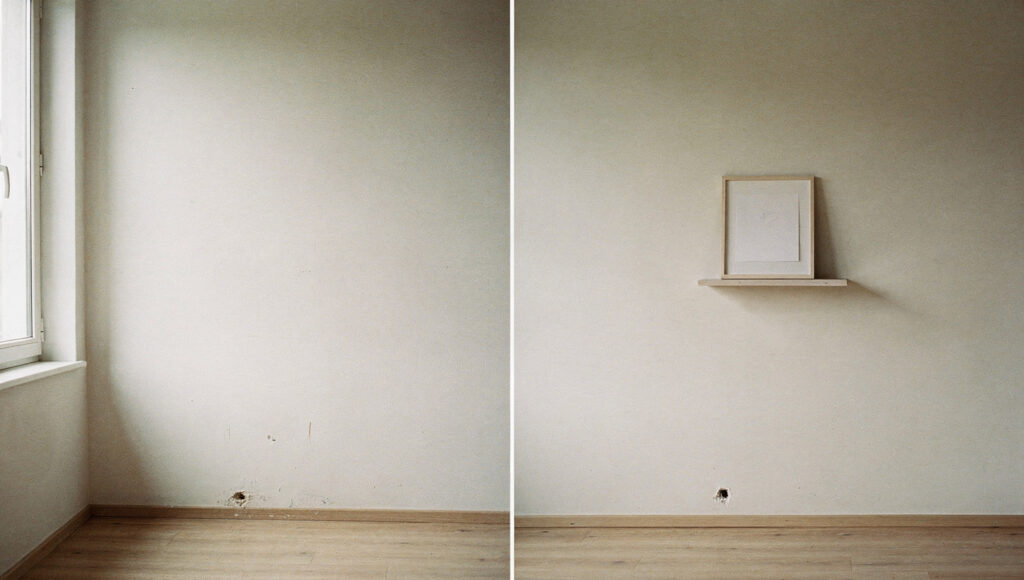
The real differences are concrete and checkable. They come down to five decisions: which wood you choose, how high your furniture sits, how much contrast you allow, which whites and neutrals go on the walls, and whether you organize the room around light or around emptiness. Get those five right and the style follows automatically, whatever the mood board said. Get one of them wrong, and the room reads as the other style wearing a costume.
Which One Fits You? Quick Answer
If you want to skip the explanation, here is the decision in one table.
| If you want… | Choose… |
|---|---|
| A brighter room | Scandinavian |
| A calmer room | Japandi |
| Dim or north-facing rooms to work | Scandinavian |
| Depth and drama in good light | Japandi |
| Pale wood: birch, ash, light oak | Scandinavian |
| Dark wood: walnut, black-stained oak | Japandi |
| Lots of family activity, kids, pets | Scandinavian |
| A strict minimal lifestyle | Japandi |
| Layered textiles and cosiness | Scandinavian |
| Bare surfaces and negative space | Japandi |
| A forgiving style on a budget | Scandinavian |
| Fewer, better pieces | Japandi |
This guide gives you each decision with specifics, verified paint codes, and a framework for choosing based on your actual room rather than an aspiration. The deeper palette mechanics behind both styles are worked out in the Japandi color palette guide.
Where Each Style Comes From, and Why It Matters
Takeaway: Scandinavian solves for light. Japandi solves for space. Every other difference follows from that one.

Scandinavian design emerged from the Nordic countries in the 1930s and flourished through the 1950s, and it was engineered around a single problem: long winters with very little daylight. Every signature of the style is a solution to that problem rather than a decorative preference. Pale wood, white walls, bare windows, mirrors, and light-reflecting surfaces exist because the room has to make the most of a few scarce hours of weak sun. In a Stockholm December you get roughly six hours of daylight, and it arrives thin and gray. A room finished in walnut and charcoal would swallow it. A room finished in birch and warm white gives it back.
Hygge, the cozy togetherness the style is famous for, is what gets added once the light problem is handled. That sequencing matters, because it explains why Scandinavian rooms layer textiles so heavily. Warmth is the second job, not the first, and it is solved with wool and sheepskin rather than with color or weight.
Japandi is a hybrid, and a much newer one. It marries Japanese design principles with Scandinavian ones, and the Japanese half brings two ideas Scandinavian simply does not have. The first is wabi-sabi, the acceptance of imperfection, age, and the marks of use, which is why Japandi favours oiled finishes that patinate over lacquers that stay pristine. The second is ma, the meaningful interval, the considered emptiness between objects. In Japanese design the gap is not the absence of content. It is content.
Those two imports are the source of every difference below. Japandi is not Scandinavian with darker wood, though that is how it is usually explained. It is Scandinavian reorganized around emptiness and imperfection rather than around light and comfort.
The practical consequence is a different question at the door. A Scandinavian room asks whether there is enough light. A Japandi room asks whether there is enough space around each thing. Two people can buy nearly identical furniture, ask those two different questions, and end up with rooms that do not resemble each other at all.
The Five Real Differences at a Glance
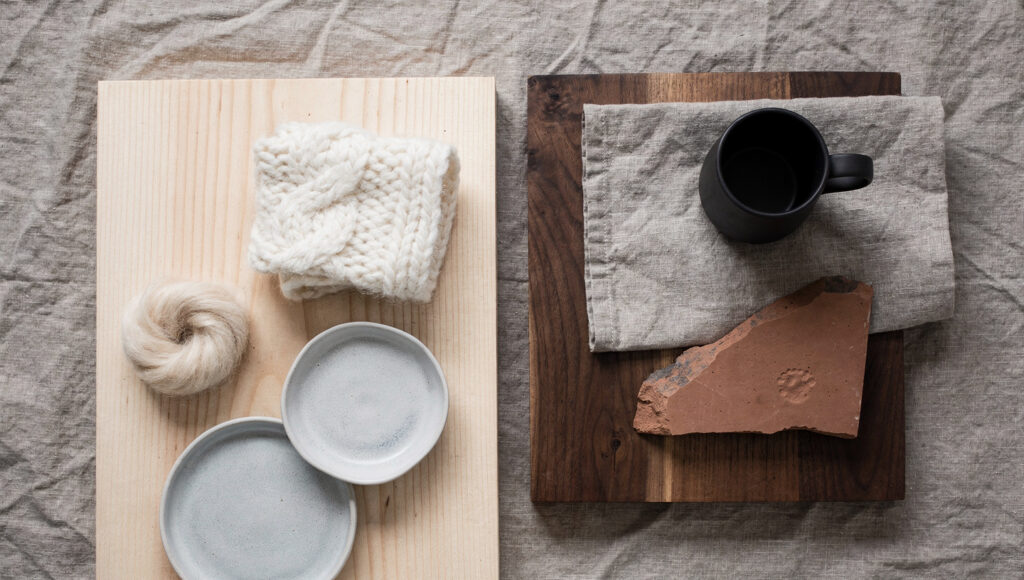
Before the detail, here is the whole comparison in one place. Read the right-hand column as a set of deliberate choices, not as a darker version of the left.
| Scandinavian | Japandi | |
|---|---|---|
| Wood | Pale and consistent: birch, ash, light oak | Mixed and contrasted: walnut, black-stained oak, white oak |
| Palette | Warm white, soft gray, muted pastel | Warm neutral, greige, earth tones, deep green |
| Contrast | Low and tonal | Deliberate: pale plaster against dark wood |
| Furniture | Slim legs, raised, rounded lines | Low, grounded, straight lines |
| Organizing idea | Light and openness | Negative space and imperfection |
| Textiles | Layered and abundant: wool, sheepskin, knits | Restrained: linen, one wool piece |
| Accents | Muted pastel, chalky blue, pale pink | Terracotta, sage, charcoal, black |
| Finish | Light lacquer, bright surfaces | Penetrating oil, matte surfaces |
| Reads as | Bright, cozy, welcoming | Calm, grounded, composed |
The one-line version: Scandinavian fills a room with light and softness. Japandi empties a room until what remains matters.
Difference 1: The Wood Decides Everything
Takeaway: Change one thing and change the wood. Pale and consistent reads Scandinavian. Mixed, with one genuinely dark oiled piece carrying weight, reads Japandi.
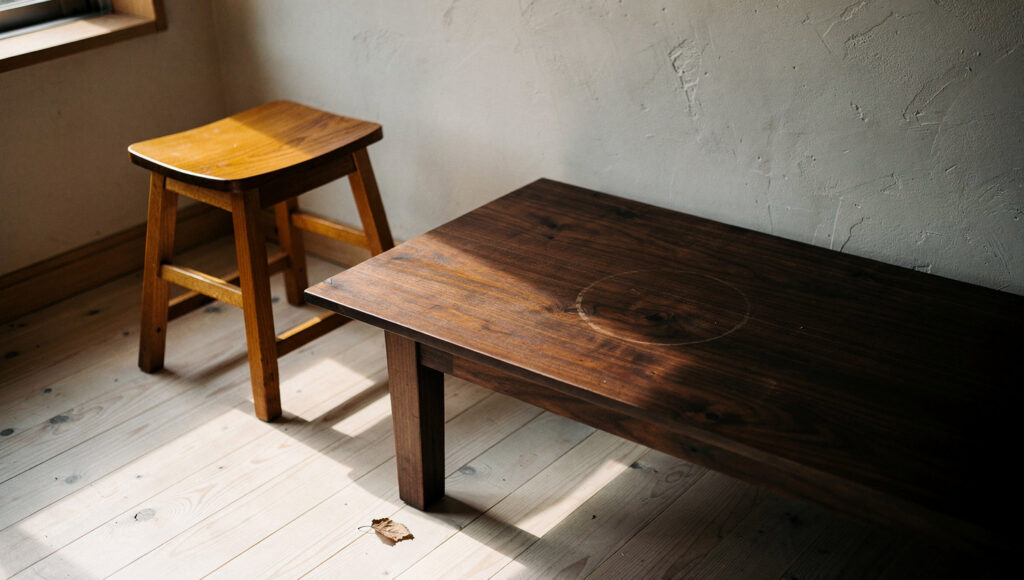
If you change only one thing, change the wood. It is the fastest way to move a room from one style to the other, and it is the difference most guides gesture at without ever specifying.
Scandinavian uses pale wood, consistently. Birch, ash, and light oak, usually a single species repeated throughout the room, finished light so the grain stays quiet and the surface returns light to the space. Consistency is the entire point. The wood is a bright, unifying backdrop, not a feature you are meant to notice. A Scandinavian room where the sideboard, chair legs, and floor are all in the same pale ash reads as calm precisely because nothing in the wood is competing for attention.
Japandi mixes wood tones deliberately, and this is where it separates. Walnut, black-stained oak, and white oak appear in the same room, and the darker species does real structural work as visual weight. A walnut low table against a pale plaster wall is a Japandi move that a Scandinavian room would never make, because that contrast is precisely what Scandinavian is trying to avoid. The dark wood anchors the room the way a heavy object anchors a composition.
The finish matters as much as the species, and it is the detail almost every guide skips. Scandinavian tends toward light lacquers and bright surfaces, which reflect and keep the room luminous. Japandi wants penetrating oil, which soaks into the timber rather than sitting on it, so the grain reads matte and tactile and the surface has no specular glare. Run your hand across an oiled walnut top and you feel the grain. That tactility is the wabi-sabi half of the style making itself physical. An oiled surface also ages, marks, and darkens with handling, which Japandi treats as improvement rather than damage.
There is a practical mixing rule worth knowing. Two wood tones in a room reads as intentional. Three starts to read as accidental unless one is clearly dominant and the others are deliberately subordinate. In a Japandi room, the standard division is a pale floor, one mid warm oak, and one genuinely dark piece carrying the weight. The undertone relationship matters too: a cool-gray-stained oak next to a warm honey oak will fight, while walnut and white oak sit together comfortably because both lean warm.
A buying warning worth more than a product link. Most furniture marketed as walnut at accessible prices is walnut veneer over MDF, or engineered wood with a walnut-look finish. That matters here more than in most styles, because a veneer cannot be oiled, cannot develop patina, and will chip at the edges rather than wear. If a listing does not say solid walnut and does not name a finish, assume veneer. For a piece that is meant to carry the weight of a whole room, this is the one place to buy solid or buy secondhand rather than buy cheap.
My honest read: this is where most Japandi rooms fail. People buy pale Scandinavian furniture, add a black vase and a paper lantern, and call it Japandi. Without at least one genuinely dark wood tone doing structural work, you have a Scandinavian room with an accessory on it.
Difference 2: Furniture Height and Line
Takeaway: Scandinavian seat heights sit around 17 to 19 inches on visible legs. Japandi drops to 14 to 16 inches on a plinth. The leg changes the style more than the wood does.
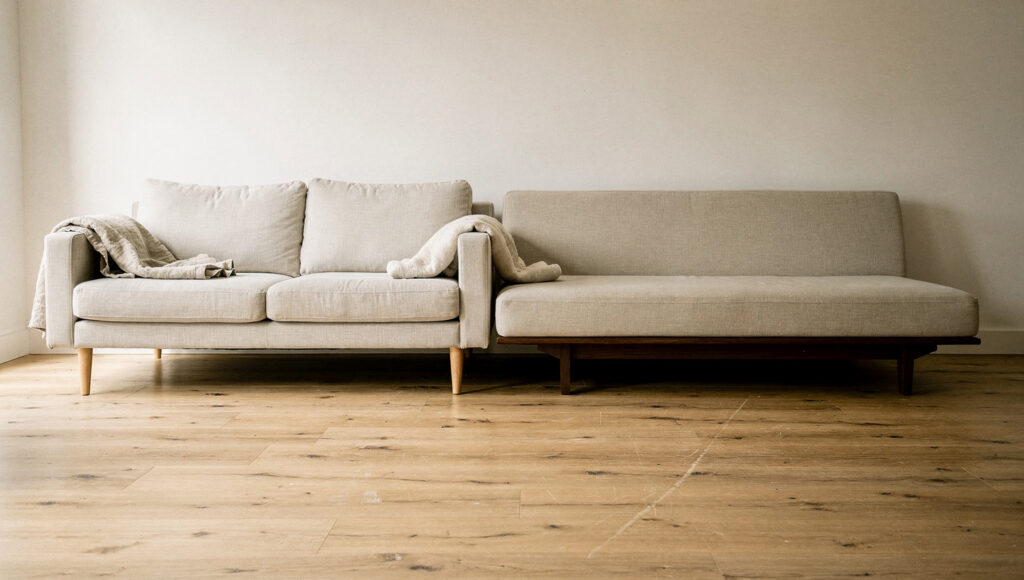
Stand in the doorway and look at where the furniture sits relative to the floor. It is the second-fastest tell, and it is more diagnostic than material.
Scandinavian furniture is raised and light on its feet. Slim tapered legs, visible floor beneath everything, rounded and friendly lines, a sofa you would describe as comfortable before you would describe it as composed. Seat heights sit in the conventional range, around 17 to 19 inches, and the leg is usually a visible design element in its own right, often in a contrasting pale timber. Lifting furniture off the ground keeps the room feeling airy and lets light travel underneath it, which serves the light-first logic the whole style is built on. You can see the floor continue under the sofa, and that continuity is what makes a small Nordic apartment feel bigger than it is.
Japandi furniture is low and grounded. Platform beds, low sofas with seat heights closer to 14 to 16 inches, tables that sit nearer the floor, straight lines, and restrained silhouettes with no visible leg articulation at all. Many Japandi pieces read as solid volumes resting on the ground rather than objects standing on legs.
The lowness is not a style tic borrowed for looks. It does two jobs. It creates the sense of enclosure and settledness that the Japanese half of the style is after, drawing on a tradition of floor-level living where the eye line sits lower and the room feels gathered around you. And it raises the visible wall area above the furniture, which is where the negative space actually lives. A low sofa against a tall wall leaves a large field of empty plaster above it. That field is doing the work.
Here is the test that proves height matters more than material. Take one walnut sofa. Put it on slim tapered legs and it reads mid-century Scandinavian. Put the identical walnut on a low plinth base and it reads Japandi. Same wood, same color, same room. The leg changed the style, because the leg changed how much wall you can see and how the room meets the floor.
If you are working with furniture you already own, this is the cheapest lever available to you. Swapping the legs on an existing sofa or sideboard moves it between styles for the price of the legs. Solid oak replacement furniture legs are widely sold in both tapered and plinth profiles, and changing them is a twenty-minute job with an Allen key. It is the single highest-leverage change in this entire guide, and it costs less than a cushion.
The practical consequence is that low furniture demands more from your walls. When the furniture drops, the wall above becomes the dominant surface in your sightline, which is why a Japandi room lives or dies on how the wall is handled. That is worked through in the Japandi living room wall decor guide.
Difference 3: Contrast and the Palette
Takeaway: Scandinavian tops out at a mid-tone. Japandi needs a dark note. That single row is the whole difference in paint terms.
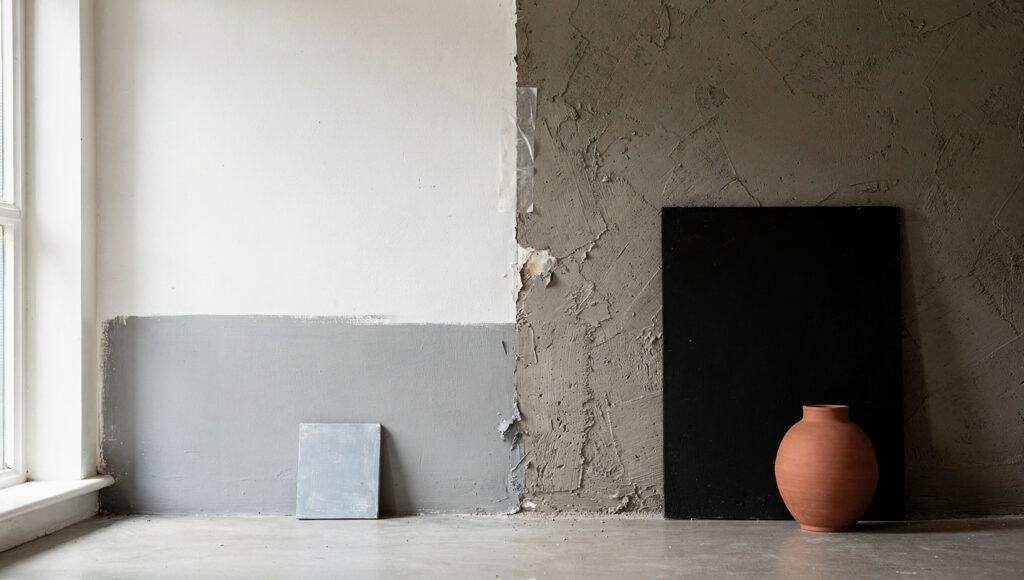
Both styles are neutral, so people assume the palettes are interchangeable. They are not, and the difference is not a matter of degree. It is structural.
Scandinavian runs low-contrast and tonal. Warm whites and soft grays with a lot of pale wood, and when color arrives it is a muted pastel: a chalky blue, a pale dusty pink, a soft washed sage. Everything sits close together in tone, within a narrow band of light reflectance, and that tightness is exactly what makes the room read as calm and bright rather than dramatic. Nothing in a Scandinavian palette is trying to create tension. The high average light reflectance is functional, not aesthetic. Pale surfaces multiply scarce daylight by bouncing it between walls.
Japandi runs deliberately contrasted. Warm neutrals and greige form the base, but the style actively wants a dark note to push against them: charcoal, black hardware, deep green, black-stained timber. That pale-against-dark tension is a Japandi signature, and the accents skew earthy rather than pastel, reaching for terracotta, clay, sage, and muted rust. The dark note is not decoration. It gives the eye somewhere to land in a room that has been emptied of everything else, and without it the emptiness reads as unfinished rather than intentional.
Here are verified codes for each style’s base and neutrals, all confirmed against the manufacturers before publishing. Light reflectance values are approximate and should be checked on the physical swatch.
| Role | Scandinavian | Japandi |
|---|---|---|
| Base white | Chantilly Lace BM OC-65, White Dove BM OC-17 | White Dove BM OC-17, Alabaster SW 7008 |
| Warm neutral | Muslin BM OC-12, Natural Cream BM OC-14 | Accessible Beige SW 7036, Pale Oak BM OC-20 |
| Deeper neutral | Agreeable gray SW 7029 | Revere Pewter BM HC-172, Natural Linen SW 9109 |
| Muted accent | Evergreen Fog SW 9130 | Saybrook Sage BM HC-114, Cavern Clay SW 7701 |
| Dark note | rarely used | Iron Ore SW 7069, Wrought Iron BM 2119-10 |
The pattern is visible in the table itself. The Scandinavian column tops out at a mid-tone and stops. The Japandi column has a dark row, and that row is the whole difference between the styles rendered as paint codes. If you want the deeper end of it, the dark Japandi living room guide covers the approach in full, and the specific codes and brand combinations live in the Japandi paint colors hub.
Whichever column you choose, test before you commit. Both palettes depend on undertone behavior that a paint chip will not show you, and the failure mode is identical in both directions: a warm white that goes yellow, or a greige that goes cold. Peel-and-stick paint samples let you move the real color around the room and look at it at the hours you actually use the space, which is the only test that predicts anything. For a full room repaint this step costs a few dollars and saves a few hundred.
One practical warning about the dark row. Iron Ore and Wrought Iron are near-black, and they behave very differently depending on your light. In a bright, south-facing room they read as sophisticated depth. In a dim north-facing room they close the walls in and the room loses whatever daylight it had. If your light is poor and you still want the Japandi contrast, put the dark note on a small object, a fixture, or hardware rather than on a wall.
Difference 4: Textiles and How Much Is Enough
Takeaway: Scandinavian answers a cold corner by adding a throw. Japandi answers it by removing one. Count your textiles: the answer is usually two fewer.
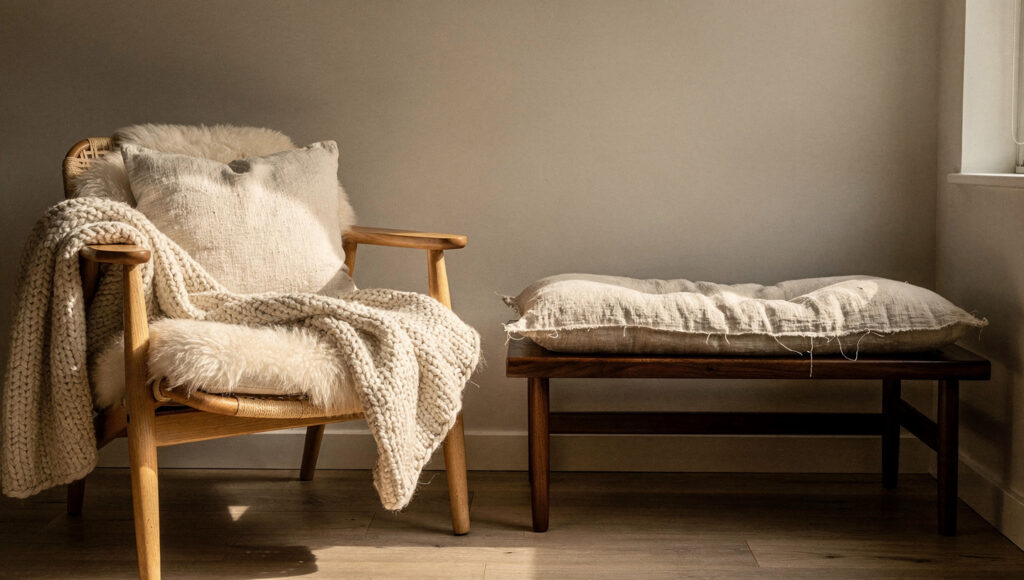
Scandinavian layers textiles generously, and the abundance is functional in origin rather than decorative. Sheepskins over chair arms, chunky knit throws, heavyweight wool blankets, cushions in multiples, and often a rug layered over floorboards or even over another rug. In a climate where central heating was historically minimal, layered textiles were how a room stayed survivable, and that necessity hardened into an aesthetic. Hygge is that history made visible. A Scandinavian room with bare surfaces has failed at its own brief, because the softness is the point rather than a garnish.
The layering follows a loose logic worth copying. Multiple textures, all held within a narrow tonal range, so the room builds warmth through accumulation without introducing visual complexity. Cream knit against oat wool against natural sheepskin: three textures, one color family. That is how a Scandinavian room gets to feel rich without getting busy.
Japandi restrains textiles hard, and this is the difference people feel but cannot name. Undyed linen, one wool piece, a single sheepskin at most, sometimes none. The material quality carries the warmth instead of the quantity. Where a Scandinavian room answers a cold corner by adding another throw, a Japandi room answers it by removing one and letting the linen and the wood do the work.
The Japandi preference is also for materials that show their age honestly. Washed linen creases and stays creased, and that is intended. Wool felts slightly with use. Undyed fiber shifts color over years of sun. All of that is wabi-sabi operating at the level of fabric, and it is why Japandi avoids performance textiles and crisp synthetics. A fabric that never changes cannot participate in a style built on the beauty of change.
If you are buying the one linen piece a Japandi room allows, the spec is narrow and worth getting right. You want 100 percent linen rather than a linen-cotton blend, stonewashed or pre-washed so it arrives soft and will not shrink, and undyed or natural rather than a dyed color. The Simple & Opulence 100% Linen Throw at 55 by 75 inches is a reliable natural-flax option. For a larger piece that reads as a bed layer, the MINUPWELL 100% French Flax Linen Blanket runs 79 by 57 inches. All three meet the test that matters: pure linen, washed, undyed. Check the listing says 100 percent linen, because linen-blend is the common substitution and it will not crease or age the way the style depends on.
Here is the failure mode to watch. A room can be perfect on wood tone, perfect on furniture height, and still drift Scandinavian purely because there are too many soft objects in it. Four cushions and two throws will pull a walnut-and-plaster room back toward Copenhagen no matter what the timber is doing. If your Japandi room feels almost right and you cannot identify why it is not landing, count the textiles. The answer is usually that there are two more than there should be.
Difference 5: Light Versus Emptiness
Takeaway: The Scandinavian test is whether the room feels bright on a gray February afternoon. The Japandi test is whether every remaining object feels necessary.
This is the deepest difference, and it quietly decides all four above it.
A Scandinavian room is organized around light. Windows stay as bare as privacy allows, with a sheer linen panel at most, because heavy drapery blocks a resource the room cannot spare. Mirrors are positioned to bounce daylight deeper into the space. Pale surfaces multiply what little light arrives. Furniture sits raised so light travels underneath it rather than being absorbed by a solid mass. Even the low contrast serves this, since a dark object in a dim room becomes a hole that light falls into. The success test is simple and honest: does the room feel bright on a gray afternoon in February?
A Japandi room is organized around emptiness. Ma, the considered interval, means the space around an object is what makes the object register at all. Walls stay largely bare on purpose. One branch in one vessel beats a shelf of ten objects, not because ten objects are ugly but because ten objects have no space between them and therefore cannot be seen individually. The success test is different: does every remaining thing feel necessary, and can you see meaningful stretches of wall and floor between them?
Light still matters in a Japandi room, but it is a tool rather than the governing principle. Japandi will happily trade some brightness for depth, which is why it tolerates walnut and charcoal that a Scandinavian room would reject on sight.
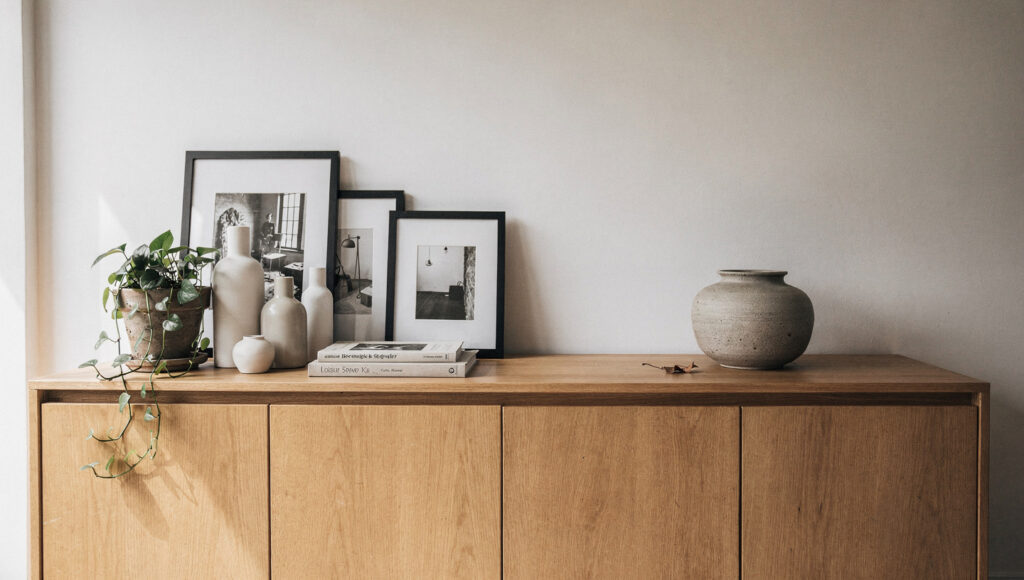
The clearest demonstration is a single piece of furniture. Take one oak sideboard against a plain wall. Crowd its top with pale ceramics, leaning framed photographs, a trailing plant, and a stack of books, under a bright bare window, and you have a Scandinavian room. Clear all of it, leave one unglazed stoneware vessel slightly off-center with wide clear space on either side, and you have a Japandi room. Same sideboard, same wall, same paint. The only thing that changed is how much emptiness you were willing to leave, and that single decision moved the room from one style to the other.
This is also why Japandi is harder to maintain than Scandinavian. Emptiness is not a purchase you make once. It is a standard you hold every day against the natural tendency of a home to accumulate.
Which Style Should You Choose? By Situation
The honest answer depends less on taste than on your room, your life, and how much you are willing to edit. Find yourself below.
If you rent. Scandinavian, in most cases, and for a practical reason: it is achievable without touching the architecture. Pale furniture, layered textiles, and bare windows deliver the style with nothing screwed to a wall. Japandi leans on wall treatments, plaster texture, and built-in emptiness that a rental often will not let you build. If you want Japandi in a rental, put the effort into furniture height and one dark piece rather than into the walls.
If you have a family, kids, or pets. Scandinavian, comfortably. Its layered textiles and low contrast hide a multitude of sins, and the style has always been rooted in practical family living rather than gallery discipline. Japandi’s bare surfaces and matte oiled finishes show everything, including fingerprints, and the negative space it depends on is the first casualty of a household with children in it.
If you have a small apartment. Scandinavian, usually. It was engineered to make small, dim rooms feel larger: pale surfaces bounce light, raised furniture keeps the floor visible and continuous, and low contrast avoids visual holes. Japandi’s low furniture genuinely does make ceilings feel higher, which is a real advantage, but it only pays off if you keep the space genuinely empty, and small spaces accumulate fast. Practical strategies for both sit in the small Japandi living room guide.
If you have a large home with good light. Japandi. This is where it belongs. Generous daylight means the darker woods and deeper accents cost you nothing, and a large room gives you the negative space the style needs to breathe. Scandinavian in a big, bright house can start to feel underweighted, because its low contrast has nothing to push against.
If your rooms are dark or north-facing. Scandinavian, and it is not close. The style exists to solve exactly this problem. A dim room done in dark Japandi is the single most common regret in this comparison. Go and look at the room at four in the afternoon in winter, not at noon in June, then decide.
If you are decorating for the first time. Scandinavian. It is more forgiving of mixed-quality pieces, cheaper to execute, more widely available at every price point, and it does not punish a mistake. Japandi puts every object on display, so every object has to earn it.
If you already own a lot and will not part with it. Scandinavian, honestly. Japandi is not a look you install. It is a standard you maintain, and it looks worse than Scandinavian when compromised.
My honest recommendation: if you are unsure, start Scandinavian and drift toward Japandi. The path is easy and cheap. Swap one pale piece for walnut, remove half the textiles, clear a wall, oil rather than lacquer the next thing you buy. Going the other direction, from a committed dark-and-empty Japandi room back toward light and layers, means replacing furniture rather than editing it. Start forgiving and tighten later.
Can You Mix Them?
Takeaway: Scandinavian light base plus Japandi editing works. Medium everything does not. Pick one column for the base and the other for the discipline.
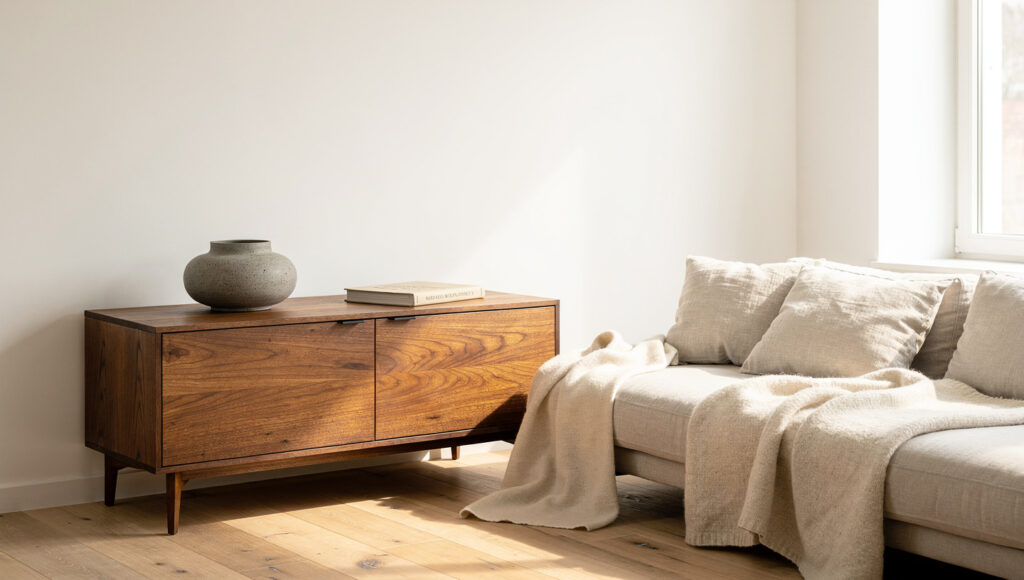
Yes, and it is more legitimate here than in most style comparisons, because Japandi already is the mix. It was built from Scandinavian foundations with Japanese principles applied on top, so the two share a structural language: natural materials, functional restraint, quality over quantity, and a refusal of ornament. You are not forcing two unrelated styles together. You are adjusting the ratio of a blend that already exists.
The way to combine them without producing mush is to choose your base and your discipline separately. Take the Scandinavian light base: pale walls, generous daylight, bare-ish windows, a warm white like White Dove, and a pale oak floor. Then apply Japandi’s editing on top of it. One dark wood piece carrying visual weight. Textiles cut back to undyed linen and a single wool throw. One wall left deliberately bare. Oiled finishes rather than lacquered ones on anything new.
What you get is a room brighter than strict Japandi and calmer than strict Scandinavian, and honestly it is where most well-executed real homes land. Very few people live in a photographic pure example of either style, and the hybrid is usually more liveable than either extreme, particularly outside Scandinavia where the light problem the original style solved does not exist in the same form.
What does not work is splitting the difference on every decision. Mid-tone wood everywhere, medium contrast, medium textile volume, medium emptiness. That reads as neither style. It reads as a beige room. The mix works when each individual decision is made decisively and the decisions come from different columns. It fails when each decision is made halfway.
The rule that keeps it coherent: pick one column for your base and the other for your discipline, then commit to both. Scandinavian light with Japandi editing works. Japandi wood with Scandinavian layering works too, and is a good option for a bright room where you want warmth. What fails is Scandinavian-ish light with Japandi-ish editing, because ish is not a design decision.
Frequently Asked Questions
Is Japandi just Scandinavian with darker wood?
No, though darker wood is the most visible difference and the one most guides stop at. The real difference is organizational. Scandinavian builds a room around light and layered comfort, because it was engineered for a climate with very little daylight. Japandi builds a room around negative space and imperfection, drawing on the Japanese ideas of ma, the meaningful interval, and wabi-sabi, the acceptance of age and wear. You can build a genuinely Japandi room in fairly pale wood if the emptiness, the low furniture, and the restraint are all there. And you can put walnut into a Scandinavian room and it stays resolutely Scandinavian if the furniture is raised, the textiles are layered, and the room is still organized around light.
Which style is better for a small apartment?
Scandinavian, in most cases. It was specifically engineered to make small, dim, northern rooms feel larger and brighter, and every tool it uses serves that: pale surfaces that bounce light, raised furniture that keeps the floor visible and continuous, bare windows, low contrast that avoids visual holes. Japandi can work beautifully in a small space, and low furniture genuinely does make ceilings feel higher, but it demands strict and permanent editing. Its bare surfaces and low pieces only read as calm when there is genuinely nothing extra in the room. In a small space, extra accumulates fast, so the honest question is not whether Japandi can work in your apartment but whether you will keep it empty enough for it to.
Which is cheaper to do well?
Scandinavian, generally, and for two reasons. Pale wood is more widely available at every price point, from flat-pack birch upward, and the layered textiles that define the style are inexpensive and forgiving. The layering also absorbs a mixed-quality room, because no single piece is under scrutiny. Japandi’s bare surfaces put every remaining object on display, so each piece has to hold up on its own, which pushes you toward fewer and better things. Fewer pieces can mean less total spend, but each one carries far more weight, and the solid oiled hardwood the style depends on is rarely cheap. Japandi punishes a cheap piece in a way Scandinavian does not.
Can I turn my Scandinavian room into a Japandi one without replacing everything?
Mostly yes, and in a specific order. Start by removing textiles, which costs nothing and does more than anything else. Then swap the legs on one large piece from tapered to a plinth or low profile, which drops the sightline and raises the visible wall. Then clear one wall completely and leave it clear. Then, when you next replace something, buy it in solid oiled walnut rather than pale lacquered wood. Those four moves take a Scandinavian room most of the way to Japandi without a single major purchase. The reverse journey is much harder, which is why starting Scandinavian is the safer bet if you are undecided.
The Honest Answer
These styles are cousins rather than rivals, and the choice is less about taste than about your room and your habits. Dim rooms, real family life, and a love of soft layers point to Scandinavian. Good light, a willingness to edit hard and keep editing, and a preference for composed over cozy point to Japandi.
Wood tone, furniture height, contrast, textile volume, and whether you organize around light or emptiness are the five levers, and you can move between the styles by adjusting them one at a time rather than starting over. That is the useful thing to take away: this is not a binary you commit to on day one. It is a dial.
If you are still torn, start with the light base and the pale wood, then subtract. Japandi is what is left when a Scandinavian room stops adding.

