
Paint is the most powerful and most misunderstood tool in interior design. It covers more surface area than any piece of furniture, costs less per square foot than any other finish, and has a greater impact on how a room feels than almost any other single decision. And yet most people choose paint last — after the sofa, after the rug, after the curtains — and then wonder why the room never quite comes together.
In a Japandi home, paint is not a background decision. It is the first decision. The warm undertone of your wall color determines whether your white oak furniture looks golden or jaundiced, whether your linen bedding looks warm or clinical, whether your ceramic accessories read as intentional or accidental. Get the paint right and every other element in the room begins to work. Get it wrong and no amount of careful furniture selection or textile layering will fix the feeling.
This guide covers the complete Japandi paint system for 2026 — the specific colors from Sherwin-Williams, Benjamin Moore, and Farrow & Ball that work, the undertone rules that determine why they work, and the room-by-room application that makes the difference between a paint choice that looks right in the store and one that looks right in your home.
- The one rule that determines everything: warm undertones only
- The Japandi paint palette — complete color system
- Room-by-room paint recommendations
- The Farrow & Ball question — is it worth the price?
- The five paint mistakes that break Japandi
- Frequently Asked Questions
- The Finished Palette: Start With the Wall
The one rule that determines everything: warm undertones only
Before any specific color recommendation, one principle governs the entire Japandi paint palette — every color must have a warm undertone.
Undertones are the secondary colors that live beneath the primary hue. A white paint can have a yellow undertone, a green undertone, a red undertone, or a blue undertone. From across the room the paint reads as white. But the undertone is doing critical work — it is either harmonizing with your wood tones and natural materials or fighting against them.
In a Japandi home, the wood — white oak, walnut, bamboo, ash — is always warm-toned. Yellow, honey, amber, brown. These warm wood tones need a paint color with a matching warm undertone. A yellow-toned oak desk against a blue-toned white wall creates a subtle but deeply unsettling dissonance — the wood starts to look orange, the wall starts to look gray, and the room feels vaguely wrong without anyone being able to name why.
The solution is always a warm undertone on the wall. Yellow, green, or red base — never blue, purple, or true cool gray.
How to test undertone before committing:
Buy the sample pot — always. Never make a final paint decision from a chip in the store. Paint a 12×12 inch swatch directly on your wall — not on white card — and observe it at three times of day: morning natural light, afternoon direct light, and evening artificial light. A warm-undertone paint glows at golden hour. A cool-undertone paint looks flat or slightly purple. The test takes three days and saves the cost of repainting an entire room.
The Japandi paint palette — complete color system
Category 1: Warm whites (the most versatile Japandi base)
Warm whites are the most commonly chosen Japandi wall color and the most commonly gotten wrong. The failure mode is always the same — choosing a white that is too cool, too bright, or too pure.
The correct Japandi white is not white. It is white with just enough yellow, green, or red warmth that it reads as almost-white in daylight and warm cream in evening light.
Benjamin Moore White Dove OC-17 The single most versatile warm white in the US market. White Dove has a very slight yellow-green undertone that reads as pure warm white in almost every light condition. It works with every wood tone from blonde bamboo to dark walnut, in every room from bright south-facing kitchens to dim north-facing bedrooms. If you are choosing one Japandi white and nothing else — this is it. Light Reflectance Value: 83.16.
Sherwin-Williams Alabaster SW 7008 Slightly warmer than White Dove — more cream, less white. Alabaster has a yellow undertone that becomes more pronounced in strong natural light, which is why it works particularly well in south and west-facing rooms. In rooms with less natural light it can read as slightly yellow — test carefully in dim conditions. LRV: 82.
Sherwin-Williams Shoji White SW 7042 The most Japanese of the warm whites — named appropriately. Shoji White has a subtle gray-green undertone that gives it a misty, restrained quality that reads differently from the more yellow-toned Alabaster and White Dove. It is the correct choice for rooms where you want warm white that feels more sophisticated and less obviously cream. LRV: 74.
Benjamin Moore Chantilly Lace OC-65 The cleanest of the warm whites — almost pure white with a very slight warm cast. For Japandi rooms that need maximum brightness without the clinical sharpness of pure titanium white. Works best in smaller rooms or rooms with limited natural light where a warmer white would make the space feel heavy.
Farrow & Ball Wimborne White No.239 The premium warm white option — a sophisticated off-white with a subtle yellow warmth that deepens beautifully at evening. More expensive than the US options but the depth and complexity of the color in changing light is genuinely superior. For rooms where budget allows, Wimborne White produces a wall surface that looks painted by hand rather than sprayed by a machine. LRV: approximately 80.
Category 2: Greige (the most characteristically Japandi color)
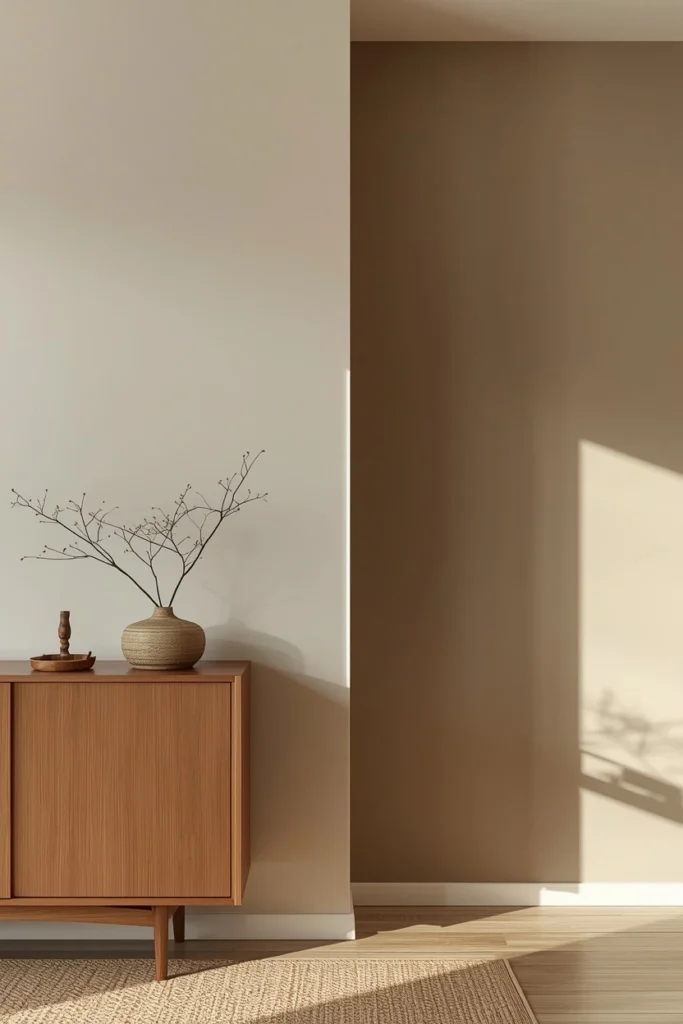
Greige — the spectrum between gray and beige — is the most quintessentially Japandi wall color. It sits at the intersection of the Japanese wabi-sabi earth tone tradition and the Scandinavian restrained neutral palette. It is warm enough to feel human, cool enough to feel considered.
The critical distinction within greige is the undertone direction — some greiges read predominantly gray, some read predominantly beige. For Japandi, you want the beige direction — warm, earthy, slightly sandy.
Sherwin-Williams Accessible Beige SW 7036 The most popular Japandi-adjacent neutral in the US market. Accessible Beige has a warm beige base with a slight green undertone that prevents it from reading as pink or orange. It is virtually foolproof in open-plan spaces with good natural light and works with every wood tone in the warm family. The single most frequently cited Japandi wall color in US interior design publications in 2026. LRV: 58.
Benjamin Moore Pale Oak OC-20 One step warmer than Accessible Beige — deeper, earthier, slightly more golden. Pale Oak works particularly well in bedrooms and dining rooms where more warmth is appropriate. In living rooms with strong natural light it reads as a sophisticated warm neutral. In rooms with limited light it can tip toward golden-brown — test carefully. LRV: 68.62.
Sherwin-Williams Agreeable gray SW 7029 The most popular paint color in the US by sales volume — for good reason. Agreeable gray sits perfectly between gray and beige, leaning warm in natural light and slightly cooler in artificial light. For Japandi rooms that need to feel calm and neutral without any obvious warmth — this is the choice. LRV: 60.
Benjamin Moore Revere Pewter HC-172 Deeper and greener than the other greiges — a warm gray-green that adds sophisticated depth in rooms that need more character. Works best in north-facing rooms where lighter greiges would look washed out, and in rooms where the furniture is lighter and needs a deeper wall to anchor it. One of the most used designer paint colors of the past decade for good reason. LRV: 55.27.
Farrow & Ball Elephant’s Breath No.229 The most recognized Farrow & Ball color in the interior design world. Elephant’s Breath is a warm gray with an unmistakable green undertone — it shifts between gray, green, and beige depending on the light and reads differently at every hour of the day. This behavioral quality — the way the color seems to breathe and change — is exactly what the Japandi philosophy of living finishes calls for. More expensive than US equivalents but delivers a complexity that is genuinely impossible to replicate at a lower price point. LRV: approximately 52.
Farrow & Ball Drop Cloth No.283 A deeper, earthier greige — warm straw and clay tones that reference natural textiles. Drop Cloth is the correct choice for rooms that need the warmth of Japandi without the restraint of Elephant’s Breath — slightly more expressive, particularly beautiful in dining rooms and studies with low natural light.
Category 3: Warm clay and terracotta-adjacent (for depth and drama)
For rooms that need more character than a greige can provide — dark Japandi bedrooms, moody dining rooms, accent walls — the warm clay and mushroom tones provide depth without abandoning the Japandi warmth principle.
Sherwin-Williams Accessible Beige SW 7036 (deeper application) Used for color drenching — walls, ceiling, and trim in the same color — Accessible Beige becomes significantly more dramatic and enveloping than it appears as a standard wall color. This technique, used in bedrooms particularly, creates the cocoon effect described in the color palette guide.
Benjamin Moore Hale Navy HC-154 For dark Japandi rooms — the navy that reads almost black in artificial light but reveals a complex blue-green depth in natural light. Used on a single accent wall or in color drenching for a bedroom or study. Not a primary Japandi choice but the correct choice when dark depth is the goal.
Sherwin-Williams Urbane Bronze SW 7048 Sherwin-Williams’ Color of the Year 2021 and still one of the most sophisticated dark neutrals available. A warm brown-gray that reads as charcoal in some lights and warm bronze in others. For the darkest Japandi interiors — moody, grounded, deeply calm.
Farrow & Ball Mole’s Breath No.276 A deep warm gray — heavier and more grounded than Elephant’s Breath, with less green and more brown. For rooms that need gravitas. Particularly beautiful in dining rooms with warm candlelight — the color deepens further in low light and creates a genuinely dramatic dinner atmosphere without abandoning warmth.
Benjamin Moore Muslin OC-12 The deepest of the warm whites — a rich cream that sits at the boundary between white and beige. For rooms that need more warmth than White Dove but more restraint than Pale Oak. Muslin with white oak furniture and oat linen bedding is one of the most considered Japandi bedroom combinations available.
Category 4: Muted accent wall colors
The Japandi accent wall philosophy follows the same rule as the accent color philosophy — one accent, used in one place, chosen for its relationship to the base neutral rather than for contrast.
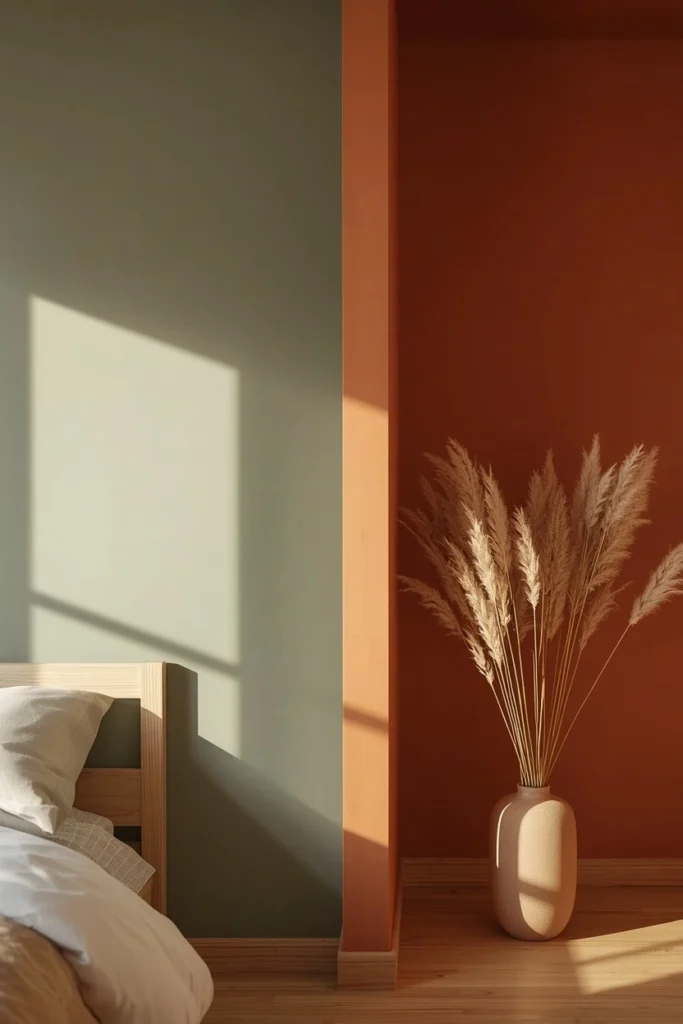
Benjamin Moore Saybrook Sage HC-114 The most used sage green in US interior design currently. A gray-green that is so desaturated it functions as a warm neutral rather than a color. On an accent wall behind a bed or sofa it adds depth without visual noise. Works with every warm white and greige on this list.
Sherwin-Williams Cavern Clay SW 7701 A warm terracotta-adjacent clay — the most Japanese-influenced of the accent wall options. References the earthy tones of raku pottery and natural stone. Particularly effective on the end wall of a hallway or as the wall behind a bed in a wabi-sabi bedroom.
Farrow & Ball Mizzle No.2766 A sophisticated misty green — more complex than Saybrook Sage, more alive. Changes significantly throughout the day — gray-green in morning light, deeper and more saturated in afternoon sun. For rooms with excellent natural light that can do justice to its tonal range.
Farrow & Ball Dead Salmon No.28 One of Farrow & Ball’s most beloved colors — a warm muted pink-clay that reads as neither pink nor salmon but something more complex. For rooms that need warmth without any green and without the earthiness of terracotta. Dining rooms and bedrooms particularly.
Room-by-room paint recommendations
Living room
The living room is where your Japandi paint choice has the greatest visual impact — the largest surface area and the most time spent in the space.
Primary recommendation: Sherwin-Williams Accessible Beige SW 7036 for open-plan living areas with good natural light. Paired with white oak or medium oak furniture and oat linen upholstery, this creates the definitive 2026 Japandi living room palette.
For smaller living rooms or rooms with north-facing windows: Benjamin Moore Revere Pewter HC-172 — the green-gray depth holds better in lower light than the more yellow-toned greiges.
Ceiling: always one shade lighter than the walls or the same color. In a living room with Accessible Beige walls — Sherwin-Williams Alabaster on the ceiling creates the correct tonal relationship without the stark contrast of pure white.
Bedroom
The bedroom rewards deeper, more enveloping versions of the palette.
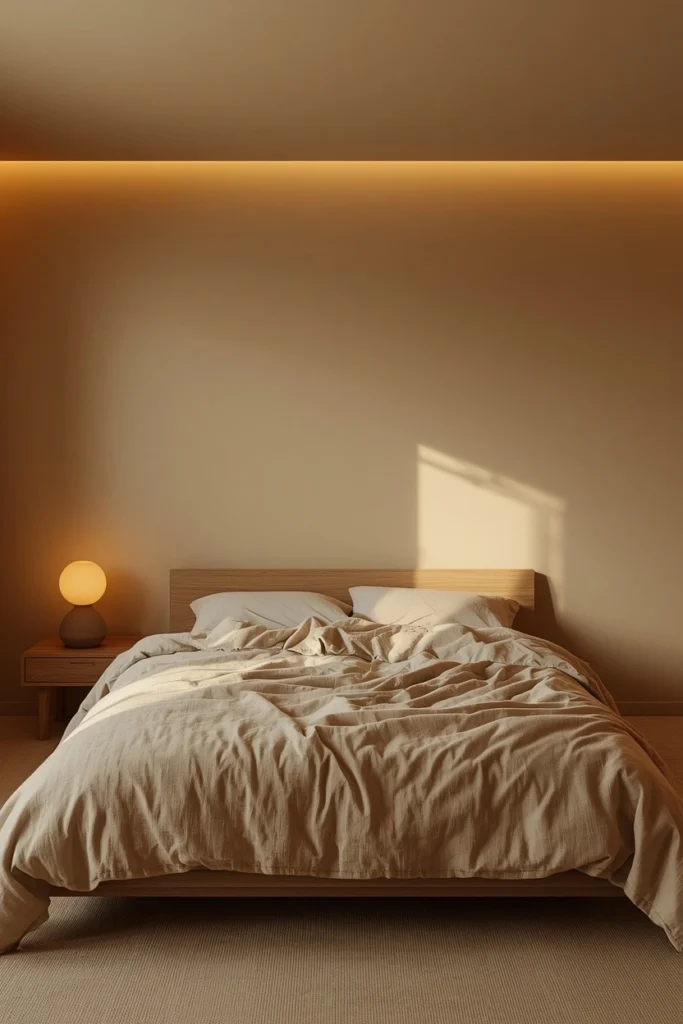
Primary recommendation: Benjamin Moore Pale Oak OC-20 for standard bedroom conditions. Warmer than the living room palette — more appropriate for a space designed for rest.
For color drenching (walls, trim, and ceiling in the same color): Sherwin-Williams Accessible Beige SW 7036 applied to all surfaces simultaneously. The color drenching technique in a bedroom with this color creates a room that feels like a warm, enclosed retreat — the most requested bedroom look in 2026.
For dark Japandi bedrooms: Sherwin-Williams Urbane Bronze SW 7048 on all four walls with warm white trim. Paired with undyed linen bedding and warm 2700K lighting, this creates a deeply moody yet warm bedroom that is genuinely difficult to leave in the morning.
Kitchen
Kitchens have more fixed surfaces than any other room — cabinetry, countertops, backsplash, hardware — which means the wall color must work with elements you may not be able to change.
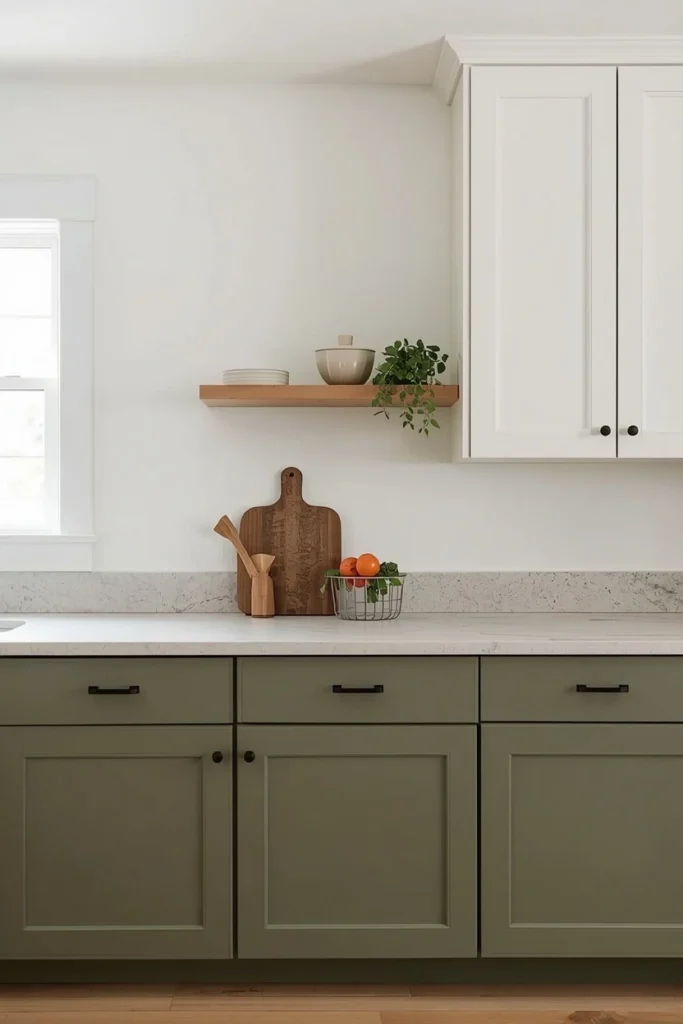
Upper cabinet recommendation: Benjamin Moore White Dove OC-17 — the cleanest warm white, maintains the sense of height and airiness above eye level.
Lower cabinet recommendation: Sherwin-Williams Accessible Beige SW 7036 or Benjamin Moore Saybrook Sage HC-114 — deeper than the upper cabinets, grounding the lower portion of the kitchen. The two-tone approach is the dominant Japandi kitchen trend in 2026.
Wall color (if visible between cabinets): match the upper cabinet color — White Dove or Alabaster — to maintain continuity.
Bathroom
Bathrooms benefit from the spa-adjacent qualities of the Japandi palette — warm stone tones that reference natural mineral surfaces.
Primary recommendation: Farrow & Ball Elephant’s Breath No.229 for bathrooms with good light. The green-gray complexity reads as stone and mineral in bathroom light — creating a spa quality that no US equivalent quite matches.
Accessible alternative: Benjamin Moore Pale Oak OC-20 — the warmest greige available at this price point, works with warm wood vanities and stone-look tile.
Home office
The home office benefits from the calming, focus-supporting qualities of the cooler end of the warm neutral spectrum.
Primary recommendation: Sherwin-Williams Shoji White SW 7042 — the gray-green undertone is more calming for sustained focus than the more yellow-toned warm whites. Pairs perfectly with the white oak desk and warm task lighting covered in the Japandi home office guide.
For darker, more focused home office environments: Benjamin Moore Revere Pewter HC-172 creates a grounded, serious atmosphere that supports deep work without the coldness of a true cool gray.
The Farrow & Ball question — is it worth the price?
Farrow & Ball paint costs approximately $115–125 per gallon compared to $65–75 for Benjamin Moore and Sherwin-Williams. The question every Japandi homeowner asks is whether the difference is worth it.
The honest answer is nuanced.
Farrow & Ball paints are made with higher concentrations of pigment and a chalky mineral base that gives their colors a depth and behavioral complexity that is genuinely difficult to replicate at a lower price point. Elephant’s Breath changes throughout the day in a way that Accessible Beige simply does not — it has more dimensions. In rooms where the wall color is a central part of the design — a beautifully lit living room, a carefully considered bedroom — the Farrow & Ball difference is visible.
In rooms where the wall color is a background for other elements — a home office, a utility bathroom, a hallway — the difference is less significant and the premium is harder to justify.
The practical recommendation: use Farrow & Ball for the one or two rooms in your home where the walls themselves are part of the design. Use Benjamin Moore or Sherwin-Williams everywhere else. This captures the Farrow & Ball quality where it matters most at a sustainable budget.
One important practical note: Farrow & Ball paint can be color-matched at Benjamin Moore stores using the Ben or Aura formula. The match is approximately 85–90% accurate — good enough for secondary rooms, not precise enough for primary rooms where the original is preferred.
The five paint mistakes that break Japandi
Using pure titanium white. Bright white — Sherwin-Williams High Reflective White, Benjamin Moore Super White — reads as clinical against warm wood tones. The wood looks yellow, the room looks like a hospital ward. Always choose an off-white with a warm undertone.
Going too dark too fast. A deep mushroom bedroom sounds beautiful in theory. Without adequate natural light or warm artificial lighting, deep warm neutrals can make small rooms feel oppressive. Always test a sample pot in the actual room for three days before committing.
Mixing undertone directions. Yellow-undertone walls with green-undertone wood, or red-undertone walls with yellow-undertone furniture. Each individual choice may be warm — but they are warm in different directions and fight each other. Pick one undertone direction per room and apply it consistently.
Ignoring the finish. The sheen level matters as much as the color. All Japandi interior walls should be matte or eggshell — never satin, never semi-gloss. Satin reflects light in ways that create visual noise and destroy the mineral, absorbed-light quality that makes Japandi walls feel calm. Save semi-gloss exclusively for trim.
Skipping the sample pot. The single most common and most expensive paint mistake. A color that looks perfect on a chip in the store looks completely different on your wall in your light. Always buy the sample. Always paint a 12×12 swatch on the actual wall. Always observe it for three days. The $5 sample pot saves $500 in repainting.
Frequently Asked Questions
What is the best paint color for a Japandi living room?
The most versatile Japandi living room paint in 2026 is Sherwin-Williams Accessible Beige SW 7036 — a warm greige that works with every wood tone and every natural textile in the Japandi palette. For rooms with excellent natural light, Farrow & Ball Elephant’s Breath No.229 delivers additional depth and tonal complexity. Both colors should be applied in a matte or eggshell finish.
Is Farrow & Ball worth the price for a Japandi home?
For the one or two rooms where the wall color is a central design element — the main living room, the primary bedroom — Farrow & Ball’s depth and behavioral complexity in changing light is worth the premium. For secondary rooms and utility spaces, a quality Benjamin Moore or Sherwin-Williams color in the same tonal family delivers excellent results at significantly lower cost.
What is the difference between Japandi white and regular white paint?
Japandi whites are warm-toned — they have a yellow, green, or red undertone that makes them read as warm cream in certain lights rather than pure white. Regular or bright whites (titanium whites) have a cool or neutral undertone that reads as clinical and fights against the warm wood tones central to Japandi design. The key brands for Japandi whites are Benjamin Moore White Dove (OC-17), Sherwin-Williams Alabaster (SW 7008), and Farrow & Ball Wimborne White (No.239).
The Finished Palette: Start With the Wall
Every great Japandi room begins the same way. Not with furniture selection. Not with a mood board. With a paint swatch held against a piece of wood in natural light.
If the swatch and the wood breathe together — same warmth, same direction, neither fighting the other — you have found your color. Everything else the room needs will fall into place around that relationship.
Start with the sample pot. Start with the wall. Let the room tell you what it needs next.

