
(Disclaimer: This post contains affiliate links. If you purchase through these links, Homeoration earns a small commission at no extra cost to you.)
The average American bedroom contains 300 objects. Most of them are not doing anything useful. They are not making the room more comfortable, more beautiful, or more restful. They are simply there—accumulated over years of convenience shopping, impulse purchases, and the low-level reluctance to make a decision about what stays and what goes.
The result is a bedroom that looks like a storage room with a bed in it. And a bedroom that looks like a storage room is not a room you can truly rest in—because your brain never fully switches off when it is surrounded by unresolved visual decisions.
Minimalist bedroom design solves this at the root. Not by making the room empty—emptiness is not the goal and never was—but by making every object in the room earn its place. What earns its place stays, and it stays with room to breathe around it. What does not earn its place leaves, and its absence is what creates the calm.
This guide covers the complete minimalist bedroom for 2026—the furniture, the storage system, the textile approach, the lighting, and the specific editing process that transforms a cluttered room into a genuine sanctuary.
- What Minimalist Bedroom Design Actually Means in 2026
- The Minimalist Bedroom Framework: 5 Foundational Decisions
- The Minimalist Bedroom Furniture Edit
- The Minimalist Textile System
- Minimalist Bedroom Storage: The "Edit First" Rule
- Minimalist Bedroom Color and Paint
- The Layered Lighting System
- Frequently Asked Questions
- The Finished Room: A Space That Actually Rests You
- Shop This Look
What Minimalist Bedroom Design Actually Means in 2026
Minimalism has an image problem. The word conjures white rooms with no personality, uncomfortable beds with no headboard, and the vague sense that the person who lives there has no possessions and possibly no emotions.
That is not minimalism. That is asceticism—a completely different thing.
Minimalism in 2026 is warm, personal, and deeply comfortable. It is defined not by what is absent but by the quality and intention behind what remains. A minimalist bedroom can have a beautiful headboard, a stack of books on the nightstand, a throw across the bed, and a plant in the corner. What it does not have is a pile of clothes on the chair, a dresser covered in products, a TV on the wall, and six cushions that serve no purpose.
The distinction is intention. Every object in a minimalist bedroom is there because it contributes to the room—to its beauty, its function, or its comfort. Nothing is there by default or inertia.
Today, the minimalist bedroom has also absorbed significant influence from Japandi and wabi-sabi—moving away from the cold, hard-edged minimalism of the 2010s toward something warmer, more tactile, and more human. Natural materials have replaced synthetic ones. Warm neutrals have replaced cool whites. The room feels edited rather than stripped.
The Minimalist Bedroom Framework: 5 Foundational Decisions
Before any furniture purchase or paint color choice, five foundational decisions determine the outcome of a minimalist bedroom. Get these right and every subsequent decision becomes easier.
Decision 1: The Bed is the Room
In a minimalist bedroom, the bed is not one piece of furniture among several—it is the room. Every other element exists in relationship to it. This means the bed must be chosen first, sized correctly, positioned perfectly, and dressed with enough quality that it can carry the visual weight of the entire space.
- Sizing: The bed should leave a minimum of 24 inches of clear floor on each side and 36 inches at the foot. A well-made queen bed in a room with proper clearances always looks more luxurious than a king bed crammed into a space that cannot hold it.
- Position: Always centered on the longest uninterrupted wall. Never in a corner. Never at an angle. The symmetry of a centered bed communicates visual stability and permanence.
Decision 2: One Storage System (Completely Committed To)
The most common minimalist bedroom failure is half-committed storage—a dresser that is always overflowing, a wardrobe that cannot close, and three extra items that live on the floor. A minimalist bedroom requires one storage system that is completely adequate for everything you own in the room. This usually means choosing between a floor-to-ceiling built-in wardrobe OR a combination of a slim dresser and under-bed storage. Two competing storage systems create visual noise.
Decision 3: Two Surfaces, Maximum
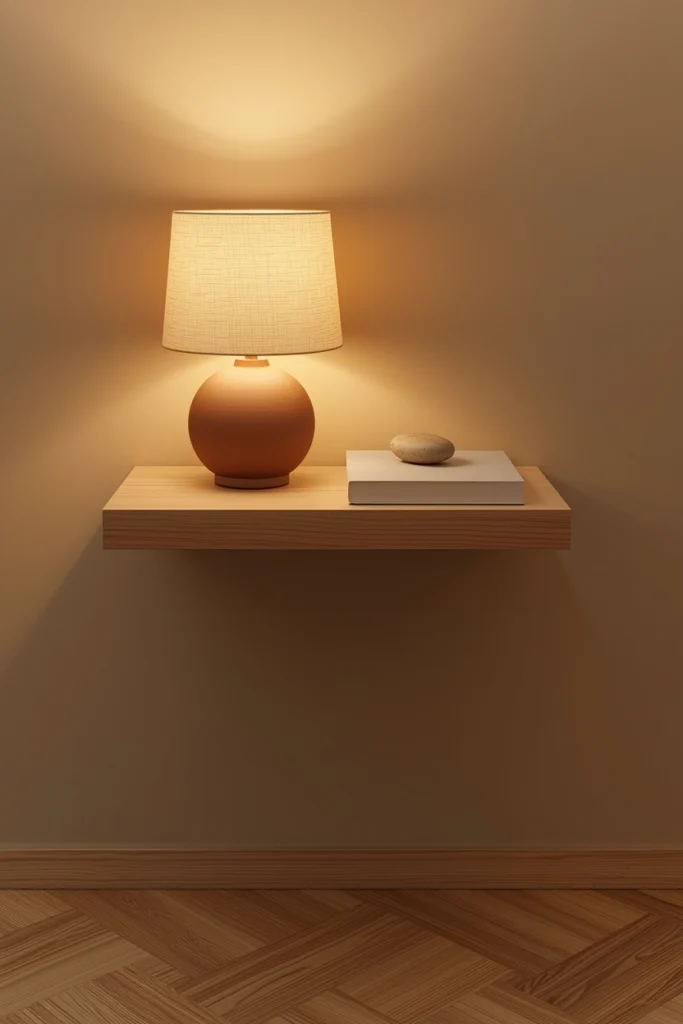
Only two surfaces are allowed in a minimalist bedroom: the nightstands, or one nightstand and one dresser top. Every other horizontal surface is either built-in storage or absent entirely.
- The Nightstand Rule: Three items maximum. A lamp. A book or glass of water. One small object of genuine meaning. The discipline of maintaining this limit every single day is the ongoing practice of minimalism.
Decision 4: The Color Commitment
A minimalist bedroom requires a complete color commitment—one tonal family carried through every surface and textile. The most successful minimalist bedroom palettes in 2026:
- Warm white walls + oat linen + natural oak + one sage green or terracotta accent
- Greige walls + warm charcoal bedding + walnut wood + no accent (the wood acts as the accent)
- Deep mushroom walls + undyed linen + white oak + dried botanical elements
Decision 5: Lighting as Architecture
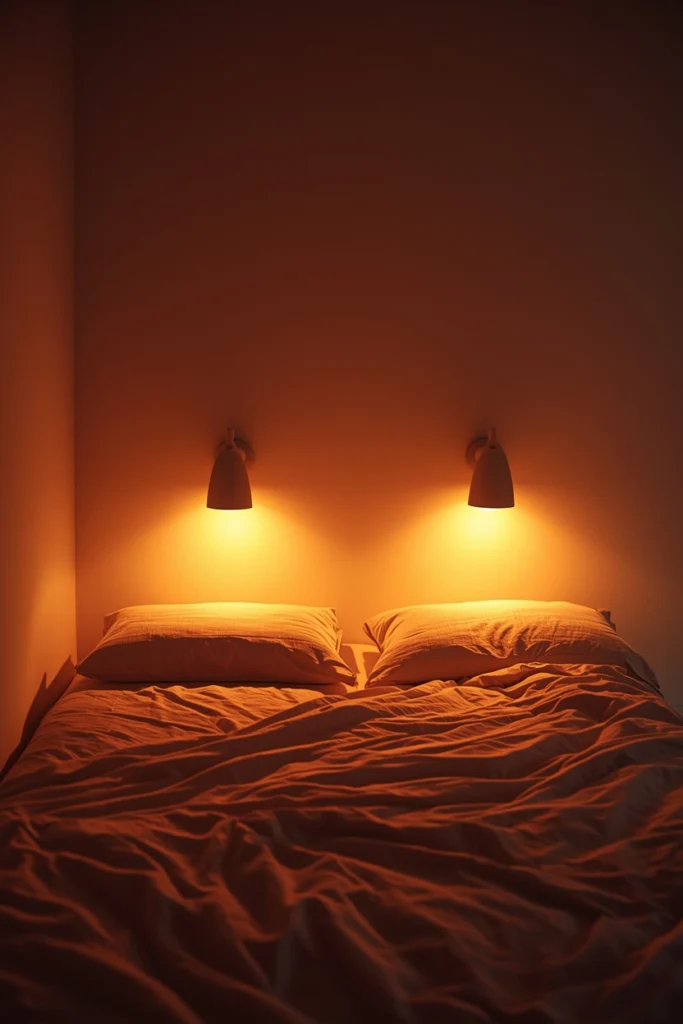
In a minimalist bedroom, lighting is structural, not decorative. Overhead lighting should be on a dimmer and used only when getting dressed or cleaning. The primary light sources are the bedside lamps, positioned so the center of the lampshade sits at shoulder height when you are seated in bed (approximately 24–28 inches from the mattress surface).
The Minimalist Bedroom Furniture Edit
The Bed Frame
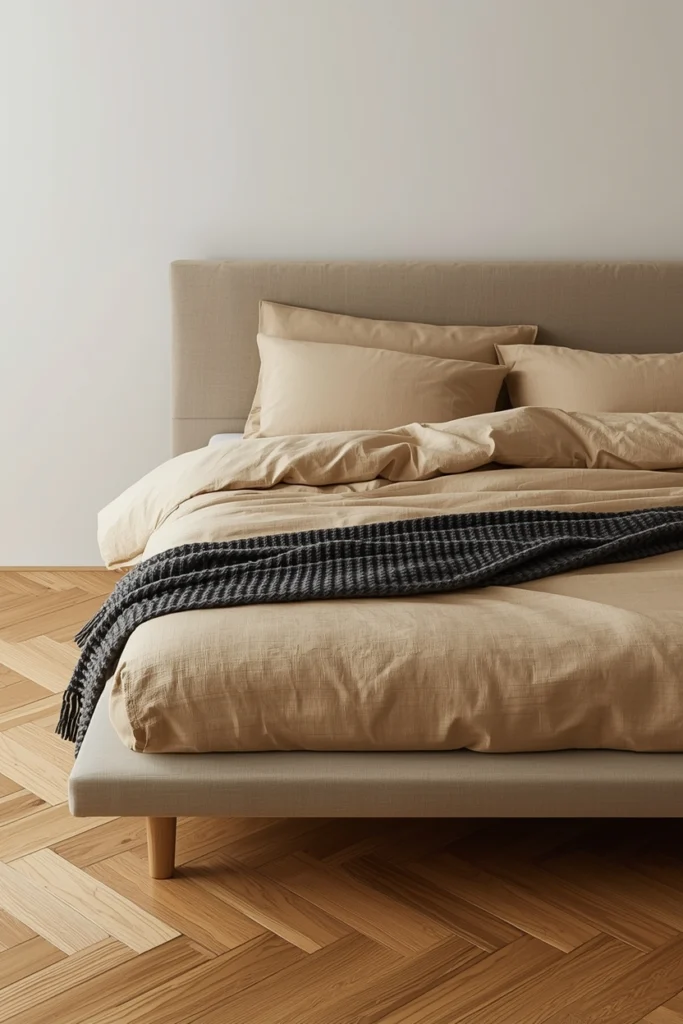
The minimalist bed frame in 2026 is low-profile, platform-style, and made from solid natural wood (white oak, walnut, or ash). The platform base eliminates the need for a box spring and keeps the visual weight of the bed grounded. Headboard Rule: You need one. Without it, the bed looks unanchored. Upholster it in linen or bouclé in the same tonal family as your bedding.
- Top Picks: West Elm Andes Bed (white oak), Article Tessu Bed (walnut), Pottery Barn Toulouse Bed (linen).
The Nightstand
The minimalist nightstand should be small (approximately 16×16 inches). Larger nightstands accumulate clutter by providing space for it. Wall-mounted nightstands are the most minimalist option because they keep the floor completely clear.
- Top Picks: CB2 Wrapped Nightstand (natural rattan), IKEA LACK Wall Shelf (painted in wall color), Article Arc Nightstand (white oak).
The Dresser Question
In a true minimalist bedroom, the dresser is optional. If a dresser is necessary, it should be:
- Low profile: No taller than 36 inches so it does not compete with the bed visually.
- Deep drawers: Six deep drawers hold more than eight shallow ones.
- Clear top: A maximum of three items allowed on the surface.
The Minimalist Textile System
Bedding is where minimalist bedrooms most commonly fail—either through under-investment (cheap synthetic fabrics) or over-complication (six cushions and two throws creating visual chaos).
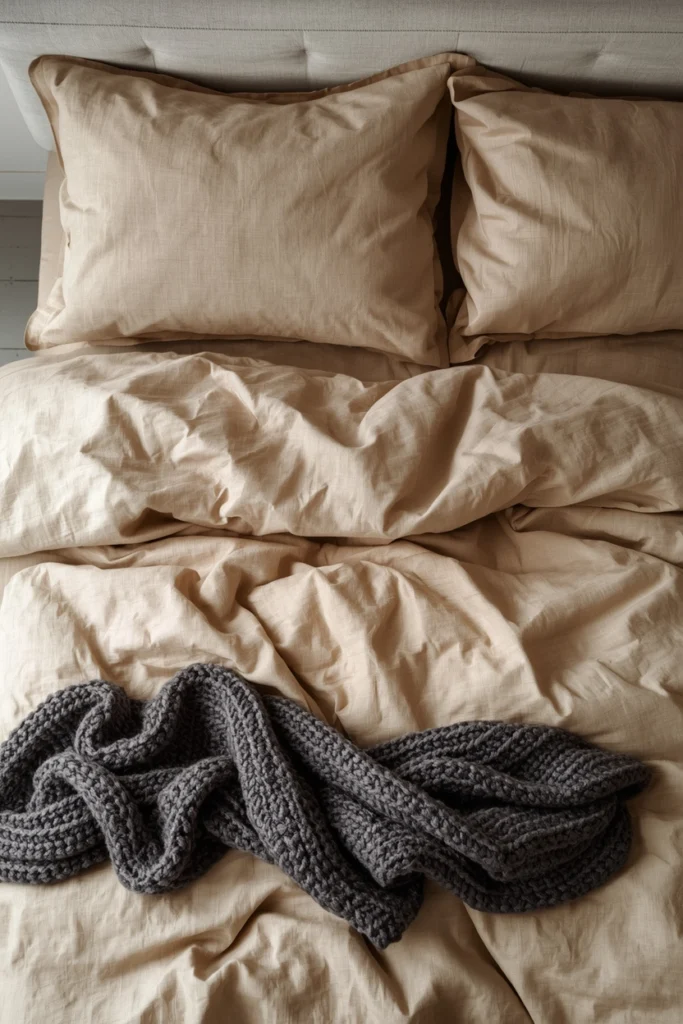
The correct minimalist bedding system has only four elements:
- The Fitted Sheet: 100% linen or Tencel in your base neutral. Never ironed.
- The Duvet: A premium down (or alternative) insert inside a linen/cotton cover. The duvet should be oversized for the bed to create a generous, enveloping quality.
- The Euro Shams: Two only, in the same fabric as the duvet cover, positioned flat against the headboard.
- The Throw: One chunky or highly textured throw draped across the lower third of the bed.
Minimalist Bedroom Storage: The “Edit First” Rule
The single most expensive mistake in minimalist bedroom design is buying storage solutions before editing what you own. Most people approach storage problems by buying more containers, resulting in a room with more storage that is still cluttered.
The Correct Sequence:
- Edit Ruthlessly: Remove everything not related to sleeping or getting dressed. Exercise equipment leaves. Unread books leave.
- Assess Volume: How much drawer and hanging space do you actually need for the remaining items?
- Buy Precisely: Purchase exactly the storage that matches the assessed volume.
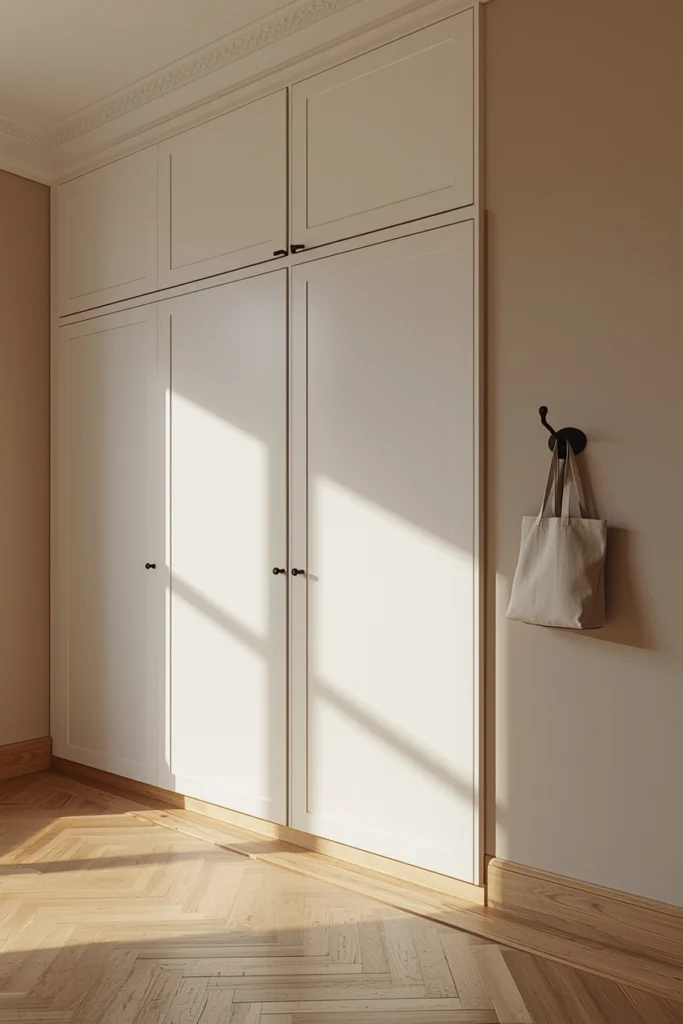
The Best Storage Hack: Install one single hook on the back of the bedroom door for the next day’s outfit. This is the minimalist solution to the “bedroom chair”—the universal surface where clothes accumulate.
Minimalist Bedroom Color and Paint
The minimalist bedroom palette follows the same warm-neutral principles as Japandi and Scandinavian design—because all three aesthetics converge in the bedroom more than in any other room.
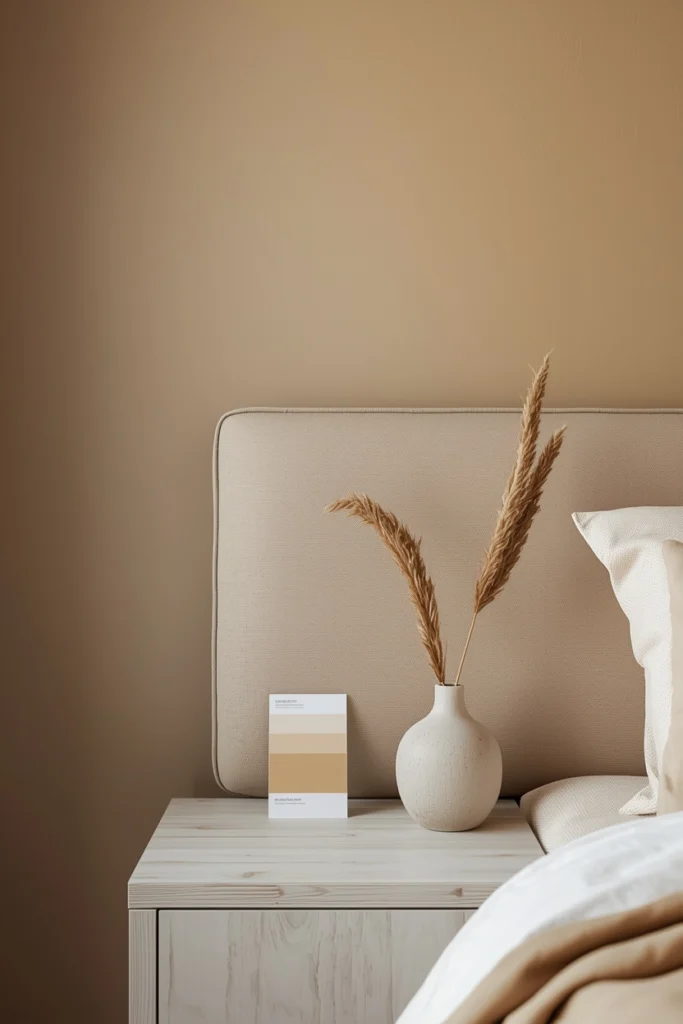
- Warm White: For rooms with excellent natural light, consider Benjamin Moore White Dove or Sherwin-Williams Alabaster. These walls read as almost-white in direct light and warm cream in evening light—the most versatile minimalist bedroom base available.
- Greige: For standard light conditions, Sherwin-Williams Accessible Beige or Benjamin Moore Pale Oak are the most forgiving minimalist colors in the US market. They work with every wood tone and every bedding color in the warm neutral family. For a deeper dive into how to perfectly balance these earthy tones, reference our complete Japandi Color Palette Guide.
- Color Drenching: For the most serene minimalist effect, painting the walls, ceiling, and trim in the exact same deep warm neutral creates a room that feels like a retreat rather than a box. Try Benjamin Moore Hale Navy or Sherwin-Williams Urbane Bronze for a dark minimalist room, or Revere Pewter for a lighter drenched effect.
The Accent Rule: One accent color, used in one place only—like the throw on the bed. A single point of terracotta, dusty sage, or warm charcoal is all the visual interest a minimalist bedroom needs.
The Layered Lighting System
In a minimalist bedroom, lighting is not just decorative—it is the architecture of your room’s mood. Relying on a single bright ceiling fixture instantly ruins the calm atmosphere. You need a strict, layered approach to create true visual silence.
- The Primary Source (Bedside Lamps): Your nightstand lamps are the main light source for the room. For optimal reading comfort and aesthetic balance, the center of the lampshade should sit exactly at shoulder height when you are seated in bed (approximately 24 to 28 inches from the mattress surface).
- The Overhead Dimmer: Overhead lighting is strictly functional. It must be installed on a high-quality dimmer switch and used only when getting dressed, cleaning, or organizing the wardrobe. It should never be your primary light source for evening relaxation.
- The 2700K Rule: The temperature of your bulbs dictates the warmth of the room. Always use 2700K LED bulbs in a minimalist bedroom. This temperature mimics the soft, amber glow of late afternoon sun, which signals to your nervous system that it is time to wind down. Anything higher (like 3000K or 4000K) reads as sterile daylight, completely counteracting your relaxing neutral paint colors.
Frequently Asked Questions
How do I start making my bedroom more minimalist? Start with the surfaces rather than the wardrobe. Clear your nightstand completely. Add back only three items: your lamp, your current book, and one meaningful object. Live with those clear surfaces for two weeks. The visual clarity this creates is highly motivating and costs nothing.
What bedding is best for a minimalist bedroom? The best minimalist bedding is 100% linen or Tencel in a warm neutral (oat, warm white, or greige). Parachute Home and Brooklinen are the two most reliable US brands for this quality at accessible price points.
Can a minimalist bedroom still feel warm and cozy? Yes. Warmth comes from material quality and texture, not from the quantity of objects. A bedroom with one chunky merino throw, linen bedding, a solid oak bed frame, and warm 2700K lighting feels warmer and more inviting than a maximalist bedroom filled with synthetic materials.
The Finished Room: A Space That Actually Rests You
The test of a minimalist bedroom is not how it looks in a photograph. It is how you feel when you walk into it at the end of the day.
A room with 300 objects asks something of you the moment you enter—your brain registers each one as an unresolved visual task. A room with thirty considered objects, each earning its place, asks nothing. It simply receives you.
Start tonight. Clear one surface. Just one. Let that be enough.
Shop This Look
- The Bed Frame: Farmhouse King Bed with Headboard Platform base, solid wood, clean profile.
- The Linen Duvet Cover: BESTOUCH Home Linen Duvet in Flax The US benchmark for minimalist bedding.
- The Linen Sheet Set: LBRO2M Linen Core Sheet Set in Sand Mid-range price point, excellent quality.
- The Merino Throw: Chunky Merino Wool Throw Draped across the lower third of the bed.
- The Nightstand Lamp: Handmade Stoneware Lamp Warm linen shade, 2700K bulb.
- The Wall-Mounted Nightstand: LEYAOYAO Rattan Nightstand Set of 2 Keeps the floor completely clear.
- The Storage Solution: Closet System with 6 Drawers Floor to ceiling, completely conceals everything inside.
- The Catchall Tray: Olive Wood Tray For the dresser top. Contains what the surface accumulates.

