
This post contains affiliate links. If you buy through them, Homeoration earns a small commission at no extra cost to you.
Most bedrooms are lit exactly like offices. One fixture, dead center in the ceiling, throwing flat light down onto everything from above. It is the cheapest way to wire a room and the worst way to light the one room you are supposed to wind down in.
You notice the result without identifying the cause. The room looks correct in daylight and feels faintly institutional at eleven at night. Overhead light casts hard shadows downward across a face, flattens every texture in the room, and leaves the whole space evenly and uninterestingly bright.
Japandi bedrooms solve this with a single organizing idea, and it is not a fixture you buy. Almost every light source drops below eye level. Everything else in this guide follows from that one decision.
The Short Answer
A Japandi bedroom is lit from below eye level, not from the ceiling. Use two to three sources at low and mid heights, keep every bulb at 2700K, and skip the central ceiling fixture entirely or leave it switched off. Where a ceiling fixture is unavoidable, diffuse it heavily with a washi paper pendant hung low and off-center. Add wall sconces beside the bed for reading, put everything on a dimmer, and layer a blackout curtain with a sheer inner panel to control the morning.
Nothing in this room is lit from the ceiling. The pools of light sit low, and the upper half of the room is allowed to stay dark.
The Bedroom Lighting Plan, In One Table
| Layer | Height | What it is | Doing what |
|---|---|---|---|
| Low | Under 24 in | Floor lantern, low table lamp, candle | Most of the atmosphere |
| Bedside | 40 to 48 in from floor | Wall sconce or nightstand lamp | Reading, without lighting the room |
| Hidden | Floor level | LED strip under a floating frame | Night navigation, no glare |
| Ceiling | Overhead | Diffused pendant, hung low and off-center | Only if the room needs it |
| Daylight | Window | Blackout layer plus sheer inner panel | Darkness at night, softness in the morning |
Two to three of these is enough. A bedroom needs less light than any other room in the house, roughly 10 to 15 lumens per square foot against the 20 a living room wants, and the warm minimalist lighting guide sets out how to calculate and split that figure.
The “Low-Horizon” Rule
Stand in the doorway and find the highest lit thing in the room. If it is the ceiling, that is the problem.
Takeaway: Put every light source below eye level. This is the single decision that separates a Japandi bedroom from a normally lit one, and it costs nothing to test.
By placing all artificial light sources below eye level—such as a floor-standing paper lantern or low-mounted wall sconces—we subconsciously signal to the brain that the day is over. This low-slung illumination pairs perfectly with the low-profile architecture of your Japandi bed frame and minimalist nightstands, creating a cohesive visual plane that is inherently restful.
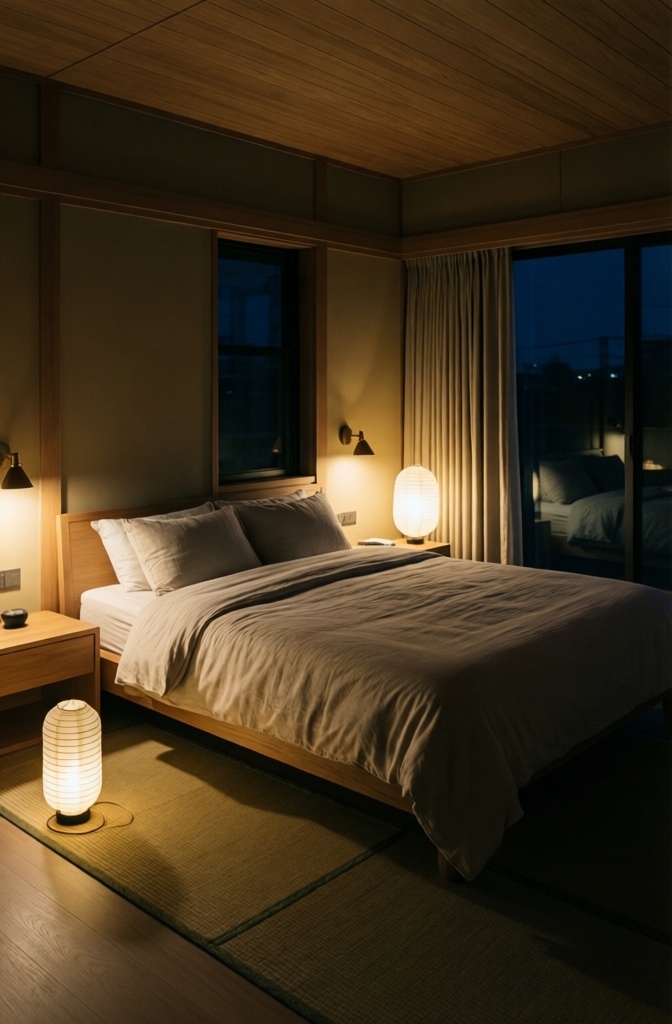
Overhead light is the default because it is the cheapest thing to wire, not because it suits the room. A single central fixture produces flat, shadowless illumination from directly above, which is how classrooms, offices, and waiting rooms are lit. Your eye recognizes that pattern before you consciously think about it.
Light arriving from below eye level does the opposite. It is what firelight, candles, and lamplight have always been, and a room lit that way reads as evening regardless of what time it actually is.
In practice that means a floor-standing paper lantern, a low table lamp on a nightstand, or a wall sconce mounted at seated height. It also means that the light pools rather than floods, leaving the upper half of the room in shadow, which is where the sense of enclosure comes from. The same restraint that governs a zen bedroom applies to light as much as to objects.
This pairs structurally with the rest of a Japandi bedroom. The low bed frame, the layered bedding, and the low nightstands already establish a horizontal plane well below standing eye level. Lighting the room from that same plane makes the whole scheme coherent instead of a low room with a high light in it.
The test takes ten seconds. Stand in the doorway at night with everything switched on and find the highest lit object in the room. If it is the ceiling, that is your answer.
The Diffused Pendant, If You Need One
A washi pendant hung low in a corner reads as a captive moon rather than as a ceiling light.
Takeaway: If a ceiling fixture is unavoidable, hang it low, place it off-center, and diffuse it so heavily that the bulb is never visible.
Some bedrooms have one ceiling point and no realistic way to add wiring. That is a common constraint and it is workable.
The Japandi answer is the oversized washi paper pendant, a form drawn from the Akari light sculptures Isamu Noguchi began designing in 1951, which paired traditional Japanese paper lantern craft with modern sculptural form. The paper does the essential work: it absorbs the hardness of the bulb and emits soft light in every direction, casting no hard shadow anywhere in the room.
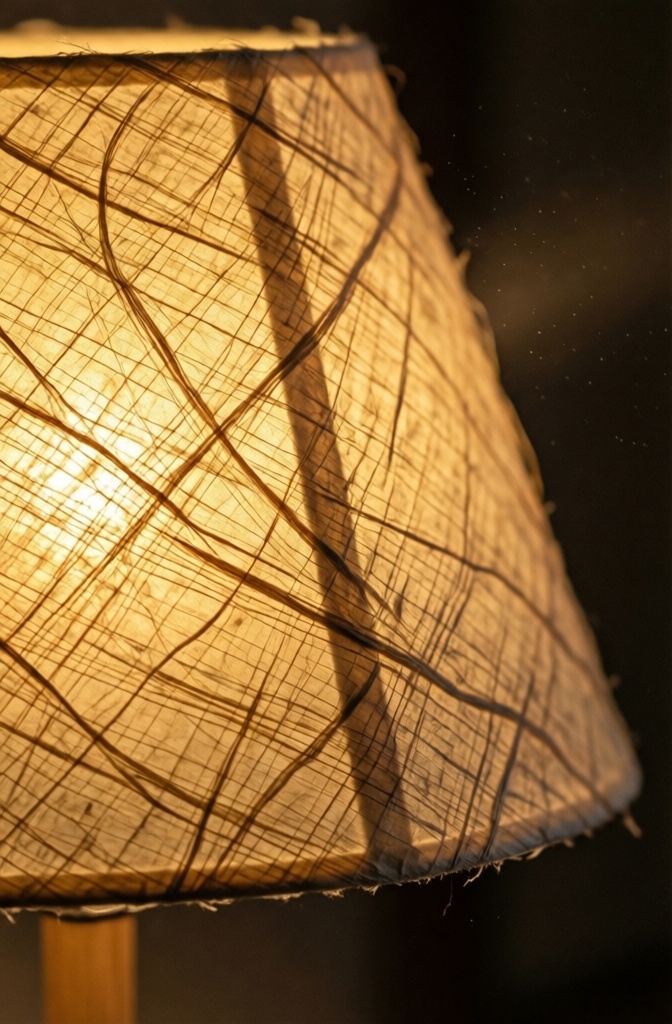
Three things make it work rather than just look right.
Hang it low. A pendant at standard ceiling height is still an overhead light. Dropped so the bottom of the shade sits closer to shoulder height, it stops reading as a ceiling fixture and starts reading as an object in the room.
Move it off-center. A pendant in a corner or over a chair reads as a lantern. A pendant dead center over the bed reads as a light fitting, and it also sits directly in your field of view when you lie down.
Diffuse it completely. The bulb should never be visible from any position in the room, including lying in bed. This is the principle Japanese aesthetics calls in’ei raisan, praise of shadows, where the interest in a room sits in its dim gradients rather than in bright even illumination.
Washi, linen, opal glass, and pleated fabric all diffuse well. A bare filament in a minimalist metal fitting looks excellent switched off and produces glare from the bed.
Sconces Beside the Bed
Directional sconces let one person read while the room stays dark. That is the whole argument for them.
Takeaway: Mount the bottom of the shade at seated eye level, roughly 40 to 48 inches from the floor. Sit in bed and mark the wall before you drill.
This is where the Scandinavian half of Japandi earns its place. Slim architectural wall sconces in matte black or blackened brass provide the sharp, deliberate contrast that keeps a soft room from going shapeless, and they solve a practical problem nothing else solves.
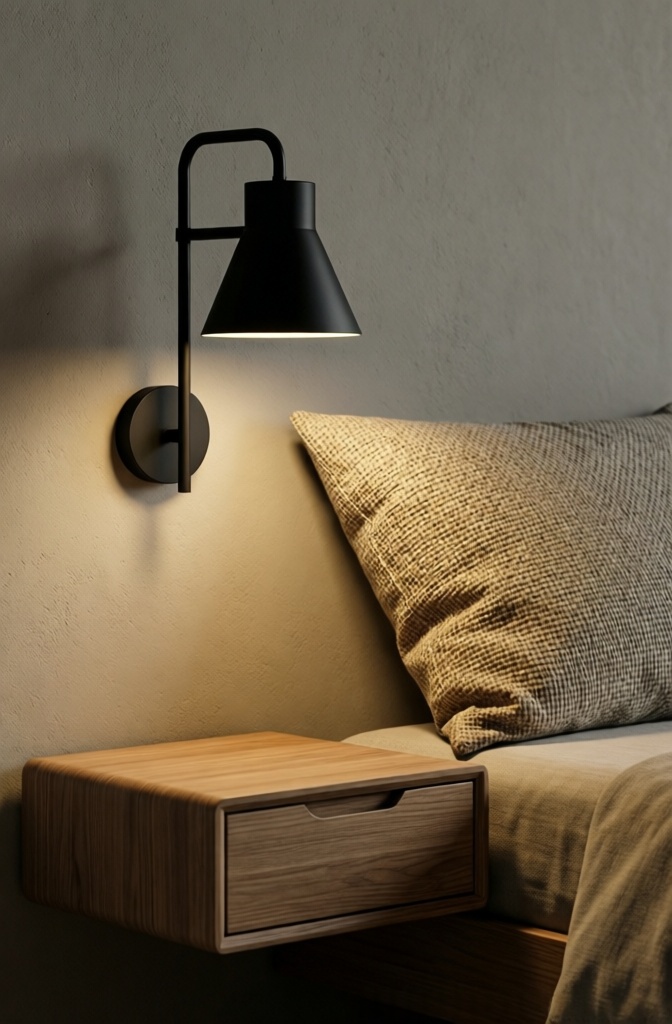
A directional sconce lets one person read without lighting the room. A nightstand lamp lights the whole nightstand and a good part of the room with it. If two people share a bed and one of them sleeps earlier, this difference matters more than anything else on this page.
Mounting height. The bottom of the shade wants to sit at roughly eye level when you are sitting up against the headboard, which typically lands between 40 and 48 inches from the floor depending on your mattress height and bed frame. Do not use a rule of thumb. Sit in the bed, hold a pencil at your eye height, and mark the wall.
Placement. Far enough out from the bed that the light falls onto a book rather than onto the headboard, usually 8 to 12 inches beyond the edge of the mattress.
Material. Matte black, blackened brass, or unlacquered brass. Polished chrome is the same disqualifier here that it is on Japandi seating, and a chrome sconce is more visible than a chrome chair leg because it sits at eye level.
If the wall cannot be wired, plug-in sconces with a cord routed down behind the nightstand work, and so does a small nightstand lamp with a shade that directs light downward rather than outward.
Hidden Light at Floor Level
A recessed strip under a floating frame gives you enough light to cross the room without waking anyone.
Takeaway: A dimmable warm LED strip under the bed frame solves night navigation without a single visible fixture.
Install a dimmable LED strip at 2700K, recessed entirely out of sight under the lip of a floating bed frame or behind the headboard. Two things happen.
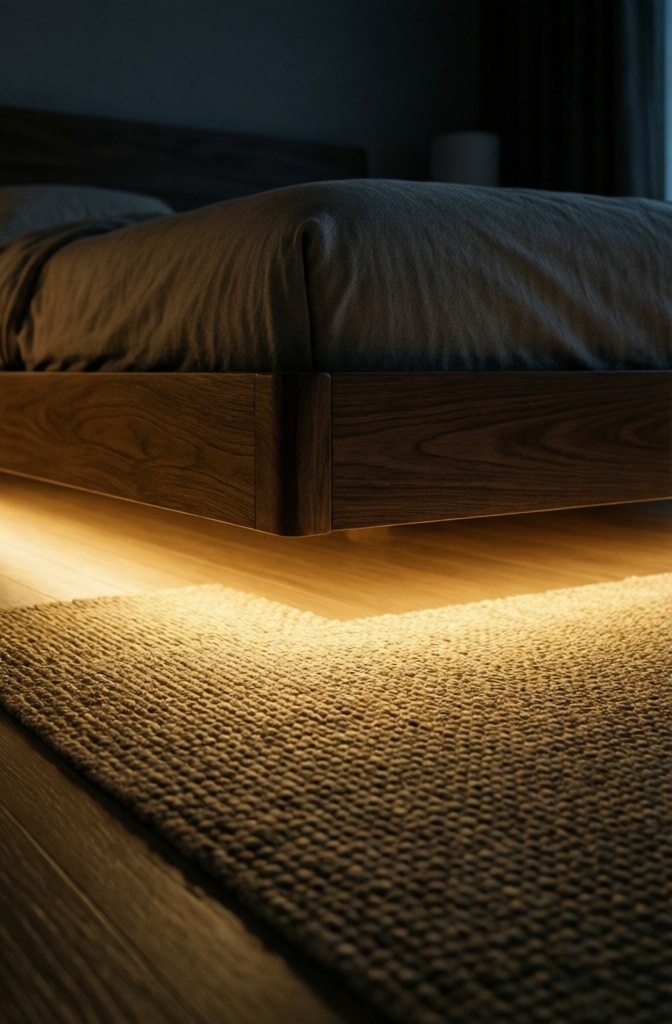
It becomes a night light with no glare and no visible source, which is the version of a night light that does not wake you properly on the way to the bathroom. And it washes soft light across the floor, which makes a heavy solid timber frame appear to lift off the rug.
Two specifics that decide whether this looks intentional or looks like a car modification. The strip must be genuinely invisible from every standing and seated position in the room, which usually means recessing it behind a lip rather than sticking it to the underside of a rail. And it must be warm and dimmable, at 2700K, matching everything else in the room. A cool white strip under a bed is the single fastest way to make a calm bedroom look like a hotel corridor.
Bulbs: One Number, Everywhere
Every bulb in the room at the same figure. Mixed color temperatures are the most common invisible problem in a bedroom.
Takeaway: 2700K across every source, ideally dim-to-warm so it drops toward 2200K as you turn it down. Replace them all at once, from one pack.
The full specification, including what color rendering does to timber and linen and how to calculate the lumens a room needs, sits in the warm minimalist lighting guide. Three points matter specifically for a bedroom.
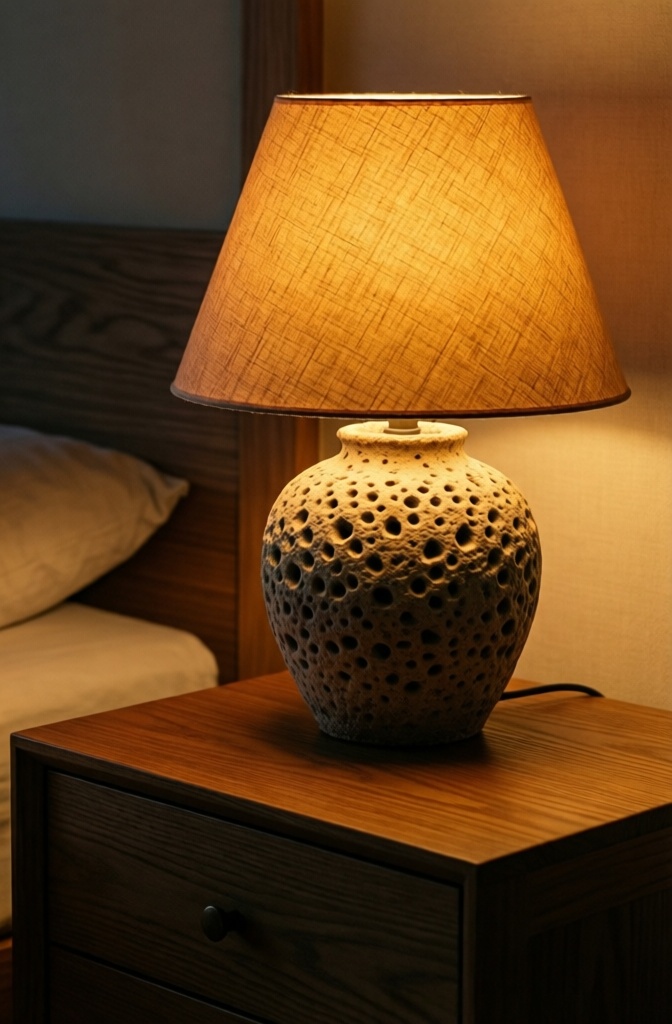
2700K is the ceiling, not the target to approach from above. Anything at 3000K and higher reads as daytime light in a room you use at night. In a bedroom it is worth going warmer still in the evening, toward 2200K.
Dim-to-warm is worth the small premium here more than anywhere else. Traditional bulbs got warmer and more amber as you turned them down. Most LEDs hold the same color all the way to the bottom, which is why a dimmed LED bedroom can still feel oddly flat. Philips Warm Glow bulbs shift from 2700K down to 2200K as they dim, at CRI 90, on a standard E26 base. Buy the multipack rather than singles, because a bedroom with two lamps and a pendant needs three or four and buying them separately over time is how rooms end up with mixed color temperatures.
Consistency beats quality. Three good bulbs at three different Kelvin values will look worse than three ordinary bulbs that match. If you do nothing else, replace every bulb in the room at once from a single pack.
Controlling the Morning
Two layers at the window. The blackout does the night, the sheer does the morning.
Takeaway: Layer a blackout curtain with a sheer inner panel. One controls darkness, the other controls how the sunrise arrives.
Lighting design does not stop at the bulbs, and in a bedroom the window is doing more work than any fixture.
The arrangement that works is two layers. A heavy natural linen or cotton blackout curtain closest to the window for genuine darkness. Then a sheer, unbleached linen panel on the inside.
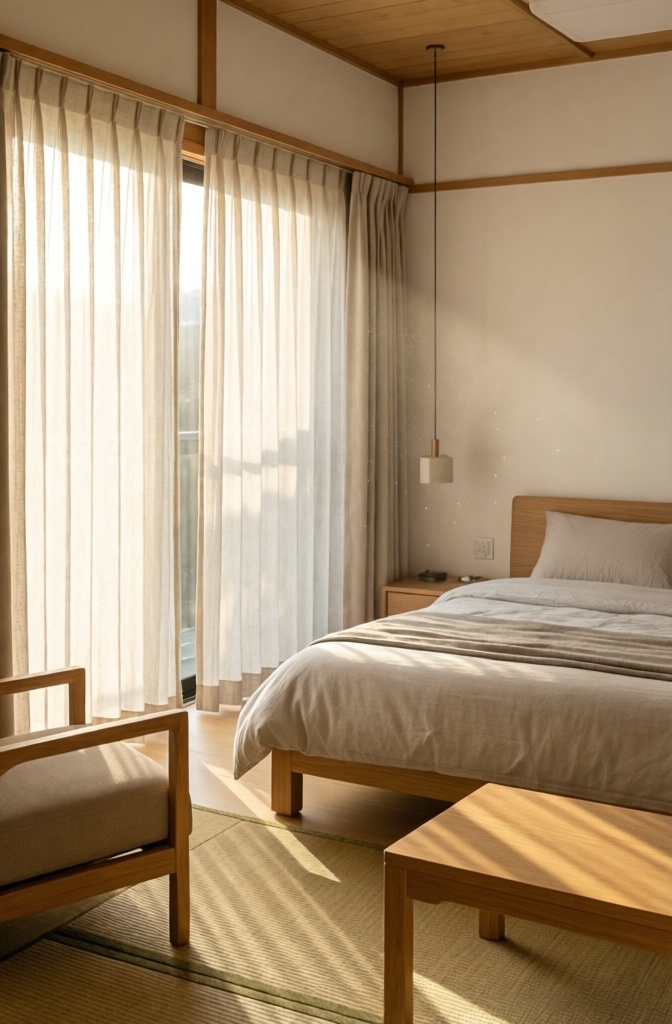
When the blackout layer is drawn back in the morning, the sheer panel diffuses direct sunrise into a soft even wash across the room. You get darkness when you want it and a gentle transition when you do not, without either layer compromising the other.
Two details make it read as considered. Hang both layers high and wide, with the rod well above the window frame and extending past it on both sides, which makes the window look larger and lets the curtains stack clear of the glass. And choose fabrics with real weight. Linen with body hangs in a way that thin polyester never does, and the same soft mass also quiets the room acoustically, which matters more in a sparse bedroom than most people expect. Undyed and unbleached shades sit naturally within the Japandi color palette.
The Dimmer
A physical dial you turn down before bed. The action is the point.
Takeaway: Dimmers cost less than almost any fixture and change the room more. If you install one thing from this guide, install these.
Every source in the room should be dimmable. This is the cheapest component in the entire plan and the one that changes the room most, because a bedroom does not need one brightness, it needs a range.
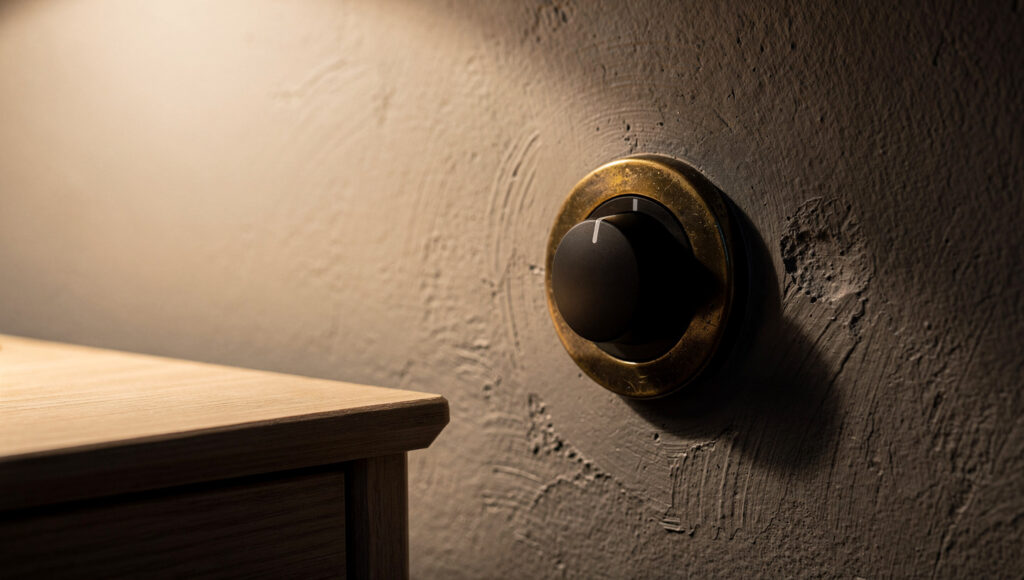
There is an argument for the analog switch over the app. A physical brass or matte black dial that you turn down as you get ready for bed becomes a small deliberate action, and the act of turning it marks the shift from the active part of the evening to the quiet part. An app does the same job and asks nothing of you, which is efficient and forgettable.
That is a preference rather than a rule, and it is worth naming because it is the kind of small ritual a wabi-sabi sensibility values: the object that requires a hand, wears with use, and marks time.
Putting It Together, By Room Type
Small bedroom, one ceiling point, renting. Two table lamps at nightstand height with 2700K dim-to-warm bulbs, and the ceiling fixture left off. Add a plug-in floor lantern in a corner if there is room. No wiring, no drilling, and it covers most of the available improvement.
Owned, able to wire. Two wall sconces flanking the bed at seated eye level, one low floor lantern, an LED strip under the frame, and either no ceiling fixture or a low-hung diffused pendant off-center. Everything on dimmers.
Two people, different bedtimes. Directional sconces are the answer and nothing else comes close. Individually switched, aimed at the book rather than the room.
Bedroom that doubles as a workspace. Keep the room at 2700K and add one slightly cooler task light over the work surface only, which is the same tension worked through in the Japandi desk guide.
Very dark room with little daylight. Skip the blackout layer entirely and run sheer linen alone, then add a third low source. A dark room does not need help being dark.
Frequently Asked Questions
What color temperature should bedroom lighting be?
Use 2700K as the maximum for every source in a bedroom, and treat it as a ceiling rather than a target to approach from above. That figure sits close to traditional incandescent light and reads as evening rather than as daytime. Anything at 3000K or higher will make the room feel like a workspace at night no matter how well it is decorated. The better option is a dim-to-warm bulb that shifts from 2700K down to around 2200K as you dim it, which restores the behavior incandescent bulbs had. Whatever you choose, keep every bulb in the room at the same figure, since mixed color temperatures are a common and hard-to-diagnose problem.
Should a bedroom have a ceiling light?
Preferably not, or at least not one you rely on. A single central ceiling fixture produces flat overhead illumination that casts hard downward shadows and flattens every texture in the room, which is the lighting pattern used in offices and classrooms. A Japandi bedroom instead places two to three sources below eye level, which is where lamplight and firelight have always come from. If your room has only one ceiling point and adding wiring is not an option, leave it switched off and use table lamps, or replace the fixture with a heavily diffused washi paper pendant hung low and positioned off-center rather than over the bed.
How high should bedside wall sconces be mounted?
Aim for the bottom of the shade to sit at roughly eye level when you are sitting up against the headboard, which usually lands between 40 and 48 inches from the floor. That range varies with your mattress thickness and bed frame height, so measure rather than guessing: sit in the bed, hold a pencil at your eye height, and mark the wall at that point. Position each sconce 8 to 12 inches beyond the edge of the mattress so the light falls onto a book rather than onto the headboard. Directional sconces let one person read while the rest of the room stays dark.
What is a washi paper pendant and why use one?
Washi is traditional Japanese paper, and a washi pendant is a lantern-style shade made from it, a form popularized by the Akari light sculptures Isamu Noguchi began designing in 1951. The paper diffuses the bulb completely, emitting soft light in every direction and casting no hard shadows anywhere in the room. In a Japandi bedroom it is the one acceptable way to use a ceiling fixture, provided you hang it low enough that it reads as an object rather than as a light fitting, and place it off-center rather than over the bed where it sits in your field of view.
How do I light a rented bedroom without wiring anything?
Two table lamps at nightstand height, 2700K dim-to-warm bulbs in both, and the existing ceiling fixture left switched off. That alone covers most of the available improvement and requires no tools. If there is floor space, add a low paper floor lantern in a corner for a third source at a different height. Plug-in wall sconces with the cord routed down behind a nightstand are an option where you want directional reading light without drilling, and a plug-in dimmer between the lamp and the socket gives you range without touching the wall switch. Keep all three bulbs at the same color temperature.
The Honest Answer
The fixture you buy matters far less than where you put it. A beautiful paper lantern installed dead center in the ceiling still produces an overhead-lit room, and two ordinary table lamps at nightstand height produce a room that feels genuinely different at night.
Get the sources below eye level, keep every bulb at 2700K, and put it all on a dimmer. That is the whole plan, and none of it requires an expensive fixture to work.
Want the scheme worked out for your specific room? Our warm-minimalist quiz uses your light direction and finishes to build a verified palette and lighting plan.

