(This post contains affiliate links. If you purchase through these links, Homeoration earns a small commission at no extra cost to you.—it helps keep this content free.)
Minimal interiors are almost universally associated with flooded daylight, pale woods, and walls the color of fresh snow. That approach produces rooms of considerable beauty. It also produces rooms that, for certain temperaments and certain spaces, feel exposed — too bright, too open, too unwilling to provide shelter.
Dark Japandi is the correction.

Subscribe to Homeoration!
Get decor ideas, room inspirations & seasonal styling tips.
By subscribing you agree to receive emails & accept our Privacy Policy.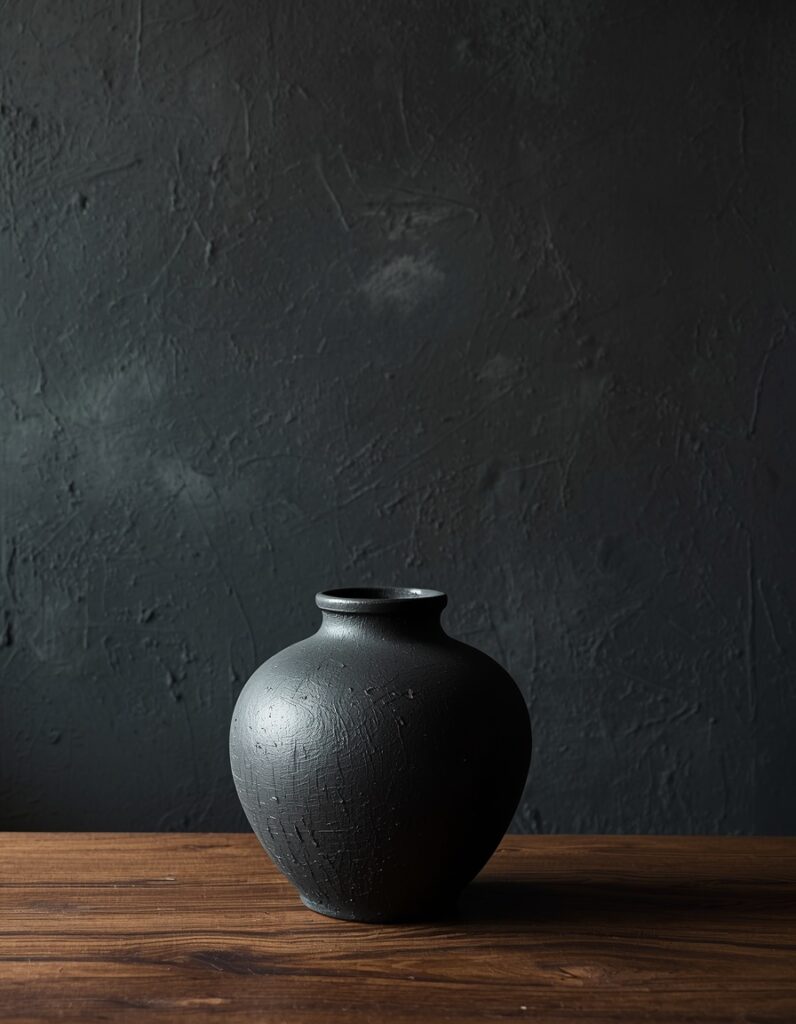
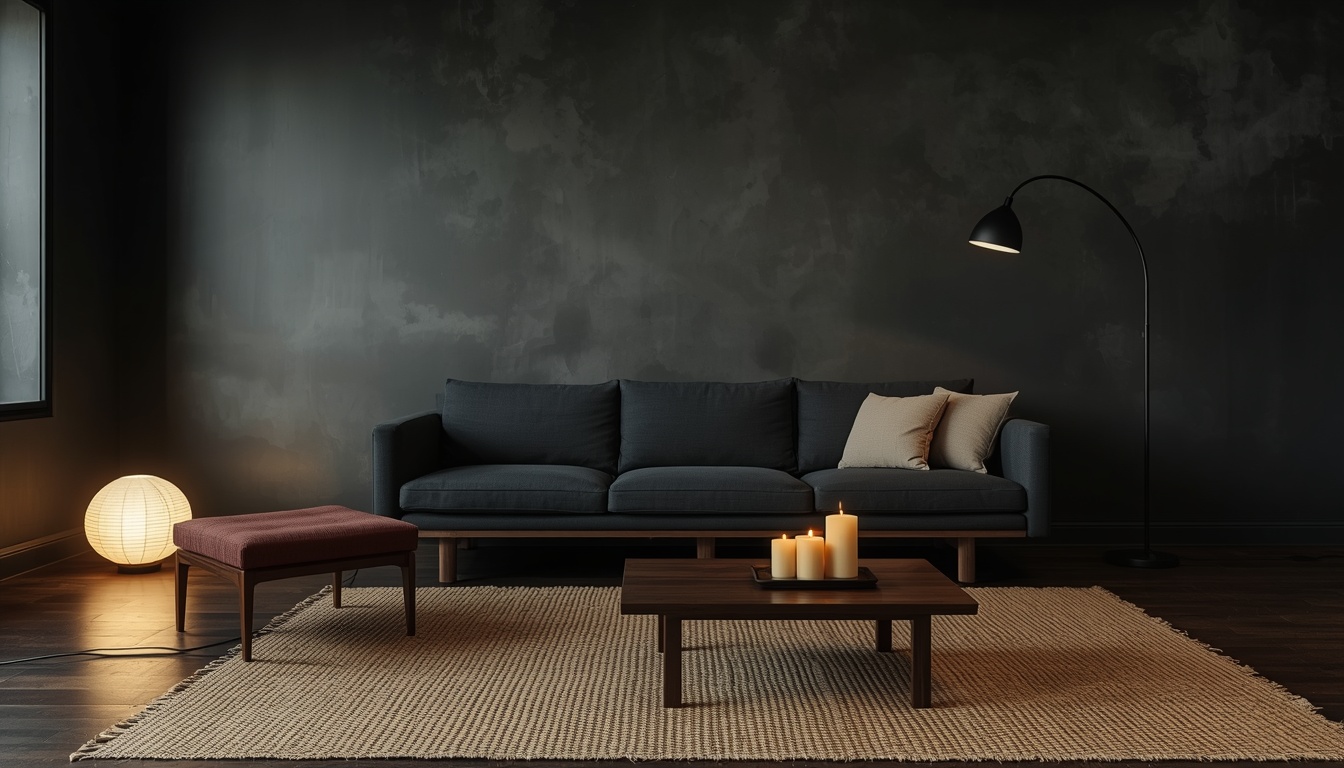
By anchoring the structural restraint of Japanese design in a deep, enveloping palette — charcoals, smoked timbers, warm near-blacks — Dark Japandi creates a living room that does not ask to be admired. It asks to be inhabited. The walls recede. The furniture settles. The room becomes, in the most precise sense of the word, a sanctuary.
Table of Contents
The Principle That Dark Rooms Always Get Wrong
The failure mode of most dark living rooms is not the darkness. It is what people put inside it.
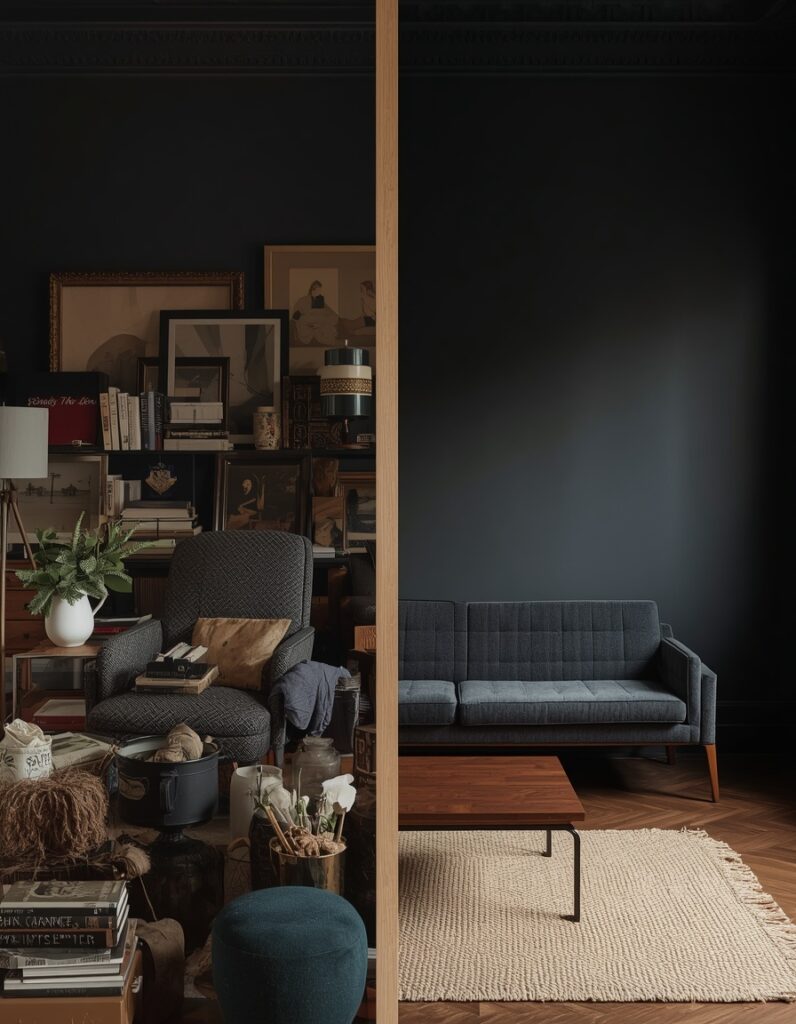
A dark room furnished with heavy, visually complicated pieces — ornate legs, patterned upholstery, multiple competing textures — becomes suffocating. The eye has nowhere to rest. Every surface competes for attention within the same shadowed envelope and the room reads as oppressive rather than intimate.
Dark Japandi succeeds because it applies the Japanese concept of ma — intentional negative space — with even greater discipline than its lighter counterpart. When walls recede into deep shadow, the objects placed against them must be edited ruthlessly. The darkness is not a backdrop. It is a material. It requires the same respect and restraint as any architectural surface.
The three principles that govern every Dark Japandi decision:
- Enveloping color over high contrast — dark walls paired with dark furniture, not bright accents fighting for attention
- Textural dominance over decorative complexity — visual interest generated through material depth rather than pattern or object accumulation
- Low-slung proportion over height — furniture kept close to the ground, maximizing the empty air above it, preventing the dark ceiling from pressing downward
When these three principles are applied simultaneously, a dark room does not feel smaller. It feels endless — the edges dissolving into shadow, the boundary between wall and air becoming deliberately ambiguous.
The Palette: Muddy Darks and Warm Near-Blacks
The single most critical palette decision in a Dark Japandi room is the undertone direction of the dark color. Pure black is never the answer. Pure black absorbs light uniformly — it flattens the room, eliminates material depth, and produces a visual void rather than a sanctuary.
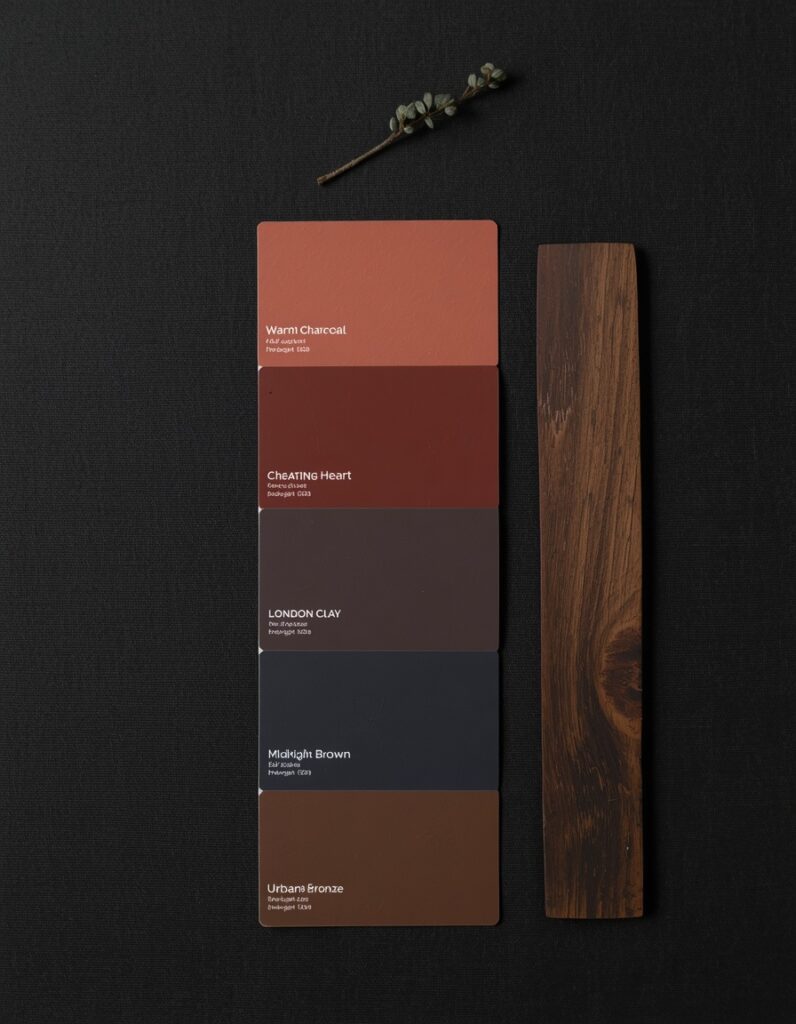
The correct dark colors for a Japandi interior are what designers call “muddy darks” — colors with warm undertones of brown, green, or taupe that make them behave differently as the light changes throughout the day. A warm charcoal at 9am reads as deep gray. At 4pm in amber light it reads almost brown. At evening in candlelight it reads as the color of old timber. This behavioral quality — this refusal to be a single fixed color — is precisely what wabi-sabi values in a surface.
The definitive 2026 Dark Japandi palette:
- Sherwin-Williams Iron Ore SW 7069 — a warm charcoal with a subtle green undertone that shifts from graphite in morning light to deep forest shadow at dusk. The most versatile Dark Japandi wall color in the US market
- Benjamin Moore Cheating Heart 1617 — slightly softer and more brown-toned than Iron Ore. Works particularly well in living rooms with limited natural light where a warmer dark prevents the space from reading as cold
- Farrow & Ball London Clay No.244 — a deeply grounding rich brown that sits at the boundary between dark neutral and warm earth tone. The most wabi-sabi of the dark palette options
- Benjamin Moore Midnight Oil 1631 — a near-black with a subtle earthy olive-green undertone. For rooms where maximum depth is the goal without committing to pure black
- Sherwin-Williams Urbane Bronze SW 7048 — a warm brown-gray that reads as charcoal in low light and deep bronze in direct afternoon sun. The most dynamic Dark Japandi color available
The color drenching imperative:
A Dark Japandi room is color-drenched without exception. Walls, trim, baseboards, doors, and ceiling in the exact same matte dark shade. The white lines of contrasting trim trap the eye — they create a cage of light within the dark envelope that destroys the spatial ambiguity the palette is designed to produce. Color drenching eliminates those lines. The room becomes a continuous dark field in which the furniture, the lighting, and the textiles are the only things the eye encounters.
The Materiality of Walnut, Smoked Oak, and Shou Sugi Ban
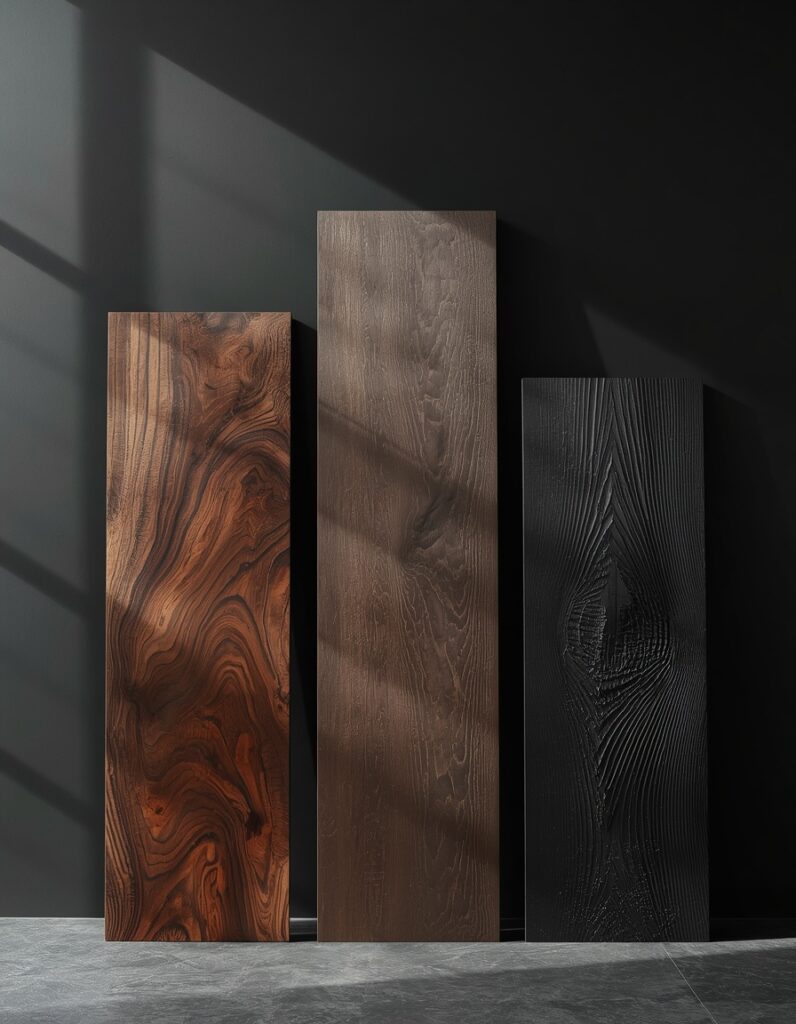
Standard Japandi design relies on light white oak and pale ash — woods chosen for their warmth against neutral walls. Dark Japandi demands a complete recalibration of the timber palette. The woods must carry their own visual weight. Against deep charcoal walls, light oak reads as too bright — it becomes the only point of contrast in the room and draws attention away from the material depth that the darkness is meant to create.
Dark walnut is the cornerstone timber of Dark Japandi. Its rich brown-chocolate tones sit warmly against charcoal walls without creating harsh contrast. The sweeping grain of good walnut — the way the figure shifts from straight to cathedral depending on the cut — provides all the visual complexity a dark room needs without introducing any additional objects or decoration. A single walnut coffee table in a color-drenched dark room is enough.
Smoked oak offers a cooler, more desaturated alternative. The smoking process drives the tannins to the wood’s surface, producing a gray-brown tone that sits at the intersection of timber and stone. It pairs with the cooler end of the Dark Japandi palette — Iron Ore and Midnight Oil — more naturally than walnut, which can pull warm against very green-toned darks.
Shou Sugi Ban (yakisugi) — the traditional Japanese practice of preserving timber by controlled charring — is the most authentic dark timber choice available. The charred surface produces a deeply textured matte black wood that catches ambient light in razor-thin lines along the grain ridges. A single Shou Sugi Ban element — a console, a side table, a single wall panel — is the mark of genuine architectural engagement with the Dark Japandi aesthetic. It does not imitate darkness. It is darkness, materially expressed.
The timber discipline: never exceed two wood species in a Dark Japandi room. Beyond two, the eye begins to catalog the variations rather than settling into the overall material field. And categorically avoid any timber with red or orange undertones — cherry, mahogany, or red oak — which will fight every warm-dark paint color on this list.
Affiliate picks — dark timber furniture:
- Oval Coffee Table with Storage ~$299 — solid walnut, organic form, the sweeping grain provides all the visual complexity a Dark Japandi living room requires
- FATORRI Console Table ~$140–180 — for introducing the Shou Sugi Ban aesthetic without full renovation scope
Furniture and Spatial Planning: Grounding the Shadow
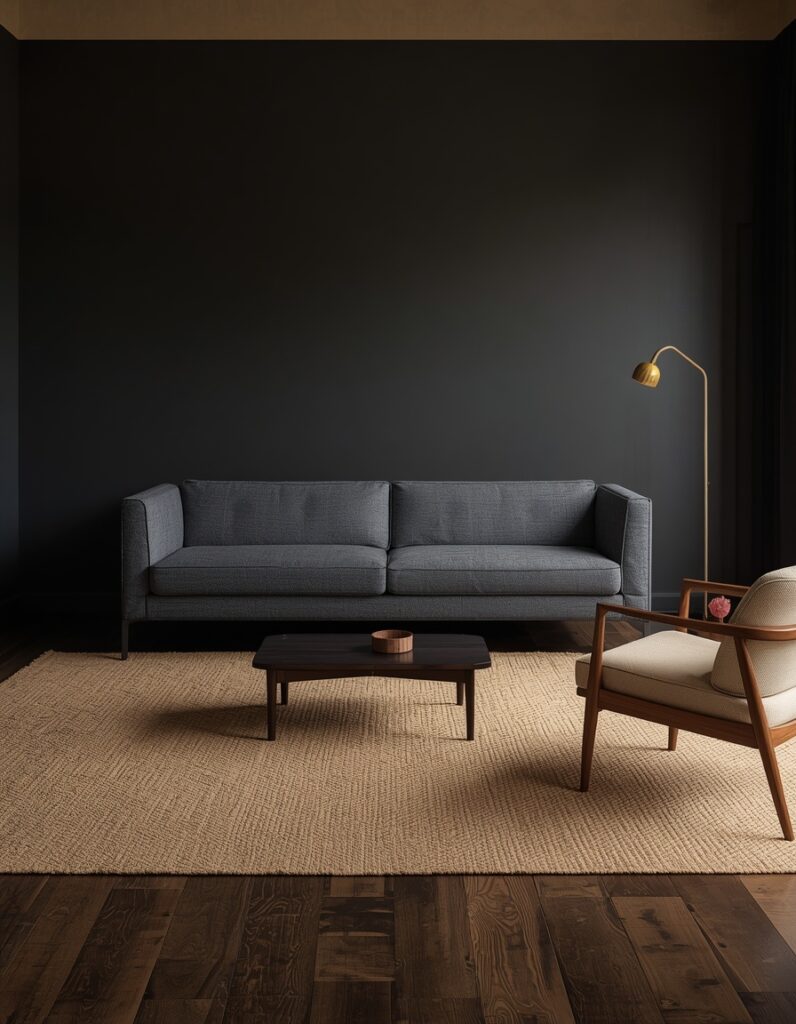
In a dark room, every piece of furniture must appear intentional. Anything that looks provisional — light metal legs disappearing into the shadows, a side table that might have arrived yesterday — breaks the sense of permanence that Dark Japandi depends on.
The sofa as architectural volume:
The sofa in a Dark Japandi living room is a low, solid volume — not a collection of cushions perched on visible legs. Look for modular designs that sit close to the floor, or sofas with solid wood plinth bases that read as part of the floor plane rather than hovering above it.
The single most important furniture decision is the contrast strategy. Two approaches work:
- Disappearance — a charcoal or deep taupe bouclé sofa that merges with the dark walls, making the sofa read as part of the architectural envelope rather than a separate object
- Singular contrast — a warm oat or natural linen sofa that glows against the dark backdrop, becoming the room’s single intentional point of light
Both approaches are correct. The wrong approach is anything in between — a medium gray, a dull off-white, a muted blue. These half-measures fight the dark palette without providing genuine contrast.
The spatial planning imperative:
Float every piece of furniture away from the walls. In a dark room, furniture pushed against the perimeter makes the space read as a waiting area. The dark walls become visible on all sides of the furniture rather than behind it, and the room loses its sense of shelter.
Pull the sofa inward. Leave a minimum of 24–36 inches of dark floor visible between the sofa back and the wall behind it. That dark floor gap creates depth — the eye reads the room as larger than it is because the floor plane extends visibly beyond the furniture.
The rug as anchor:
A large hand-knotted wool rug in charcoal, deep taupe, or natural undyed fiber anchors the floating furniture arrangement and creates the room’s intimate interior island. The rug should be substantial — an 8×10 minimum, ideally 9×12 — and in a material with enough texture that it reads as warm rather than flat against the dark floor.
Affiliate picks — Dark Japandi furniture:
- WJShome Cloud Modular Sectional Sofa ~$1,399 — sits close to the ground, solid wood plinth base, charcoal wool upholstery that reads as architectural volume rather than decorative seating
- nuLOOM 9×12 Elfriede Jute & Cotton Hand Woven Area Rug ~$220–320 — the textural contrast of natural undyed jute against dark floors and dark walls is one of the most resolved material combinations in Dark Japandi design
Curating Shadow and Ambient Glow
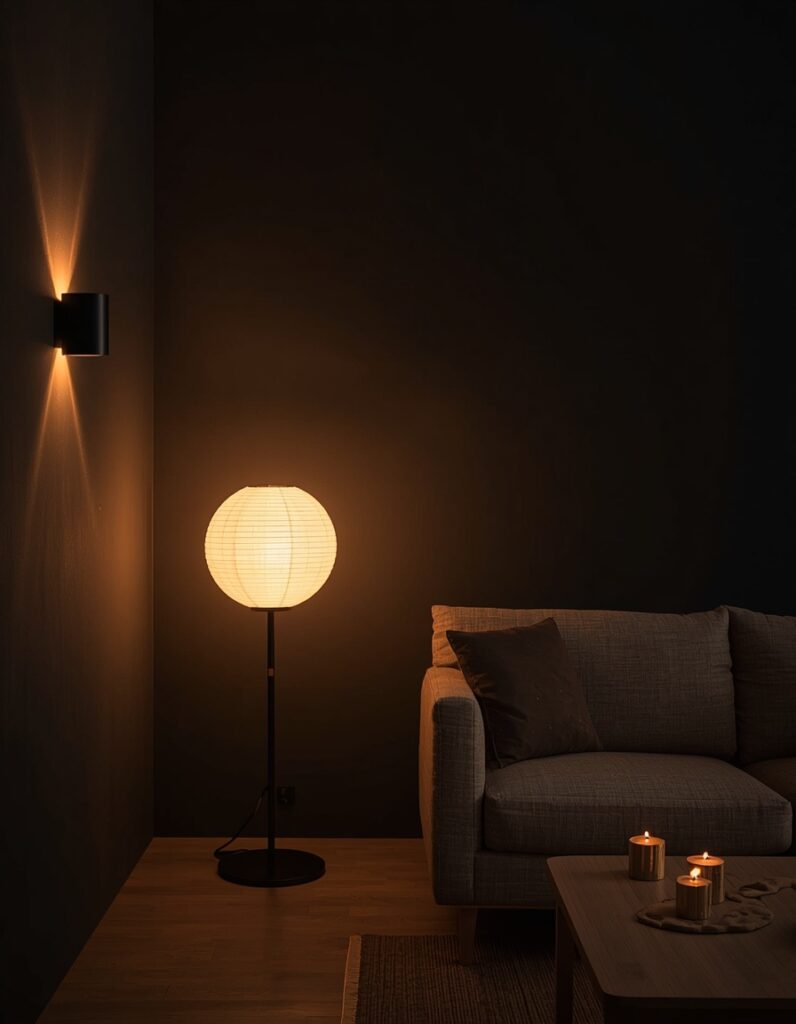
The fundamental misunderstanding of dark room lighting is the impulse to flood the darkness with light. Bright overhead illumination in a dark room does not make it feel lighter — it makes it feel like a dark room with a bright ceiling. The eye registers the harsh contrast between the illuminated ceiling and the shadowed walls and reads the whole space as inconsistent.
Dark Japandi lighting operates on a different principle entirely. The goal is not to illuminate the room. It is to place light with the same deliberation that furniture is placed — in specific locations, at specific intensities, for specific purposes.
The four light sources of a Dark Japandi living room:
The rice paper lantern: the Noguchi-style washi paper floor lamp is the essential Dark Japandi light source. During daylight hours it functions as a sculptural object — the white paper reading as a glowing counterpoint to the dark walls. At night it diffuses its bulb into a soft, omnidirectional amber glow that warms the surrounding dark surfaces without creating any harsh directional shadow.
The arc floor lamp: positioned behind and beside the primary seating, the matte black arc lamp directs warm light over the shoulder — the reading position, the conversation position, the resting position. The matte black of the lamp disappears into the dark room during the day. At night only the warm circle of light it produces is visible.
Candlelight: three to five beeswax pillar candles on an olive wood or dark walnut tray on the coffee table. The specific quality of candlelight at 1800K — its flicker, its warmth, its movement — is unreplicable by any electric source. In a dark room it is not supplementary. It is structural.
The directional accent: a single matte black wall sconce or adjustable picture light directed at one specific surface — the grain of the walnut coffee table, the mineral texture of the limewash wall, the form of a large ceramic vessel. This singular highlighted moment creates depth within the darkness — it tells the eye where to travel.
The overhead light rule: the overhead light in a Dark Japandi living room is on a dimmer and used exclusively when cleaning or rearranging. It is never the primary source for any occupied moment in the room.
Every bulb at 2700K or below. Above this temperature the warm dark walls begin to read as cold. The entire material palette shifts — walnut looks less rich, limewash looks less alive, the room loses its enveloping quality. 2700K is the threshold below which warmth is preserved. Above it, the investment in dark materiality is partially wasted.
Affiliate picks — Dark Japandi lighting:
- Noguchi-Style Rice Paper Floor Lamp ~$65–110 — the essential Dark Japandi sculptural light source. Warm linen paper shade, warm 2700K bulb
- Brightech Sparq Arc Floor Lamp in Matte Black ~$85–120 — disappears into the dark room during the day, provides over-shoulder reading light at night
- 100% Beeswax Pillar Candles Set of 3 ~$28–40 — burns cleaner and warmer than paraffin. On a dark walnut tray on the coffee table. Every evening
The Materiality of Walls: Beyond Flat Paint
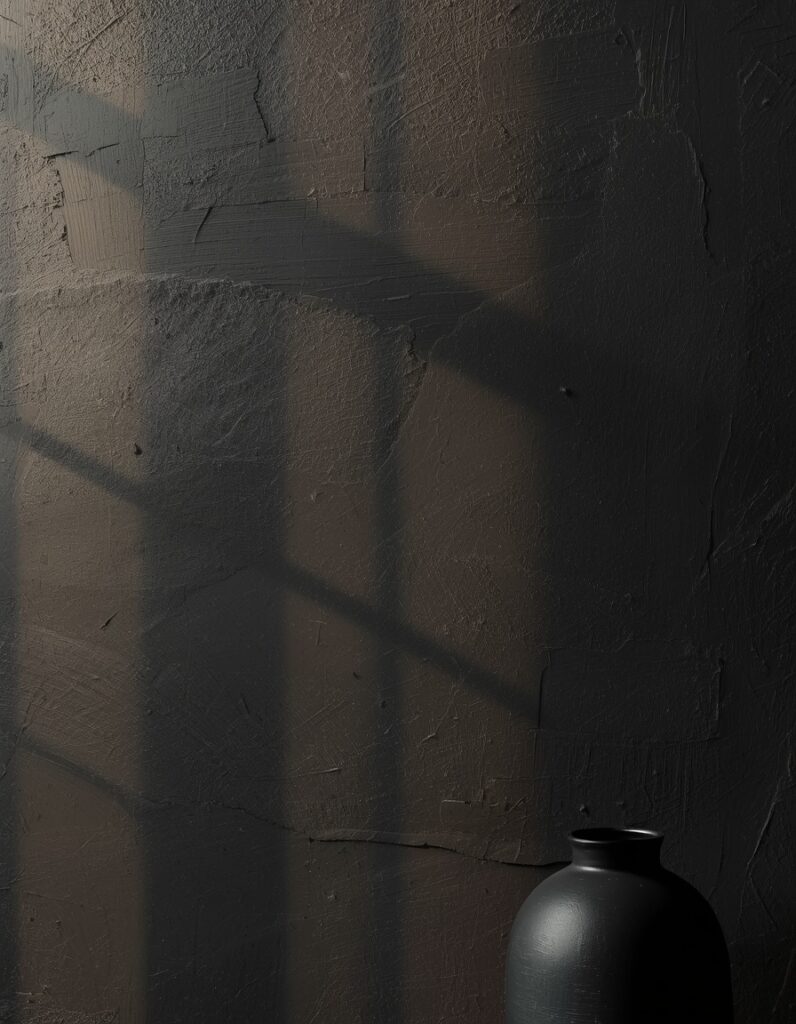
Flat emulsion paint on a dark wall is a design failure dressed as a design choice. Standard paint creates a uniform, opaque surface that reads as heavy and lifeless — the darkness it produces is the darkness of a painted surface, not the darkness of depth.
In Dark Japandi design, wall texture is not a decorative layer applied over a decision already made. It is half the decision. The material applied to the wall determines whether darkness reads as oppressive or enveloping — whether the room feels like a box painted dark or a space carved from something ancient and deliberate.
Roman clay and Venetian plaster:
Roman clay — a water-based, clay-pigmented plaster applied in thin layers — produces a surface of extraordinary depth. Each application layer leaves slightly different tool marks, meaning the final surface has genuine three-dimensionality that catches raking light and creates shifting tonal variation throughout the day. In a deep charcoal shade, Roman clay does not look like a painted wall. It looks like the wall has always been this color — as if the darkness is inherent to the material rather than applied to it.
Limewash:
Limewash is a mineral-based, breathable finish made from crushed limestone pigmented with natural earths. Its key quality is translucency — each coat is partially transparent, allowing previous layers to show through. The result is a surface that appears to glow from within rather than simply reflecting light from its surface. In dark tones, limewash produces a quality of darkness that no other finish replicates — deep, alive, and subtly luminous even in shadow.
Micro-cement:
For living rooms with a stronger architectural character — exposed concrete floors, industrial steel windows — micro-cement creates a seamless, monolithic dark surface that runs continuously from wall to floor with no transition line. The spatial effect is radical. The room becomes a single continuous dark volume rather than a box with walls and a floor.
The material specification: whichever finish is chosen, the application must be matte. Any sheen in a dark room reflects overhead light as a visible highlight that destroys the depth the color is creating. Specify dead-matte for every dark surface.
Textural Layering: The Prevention of Flatness
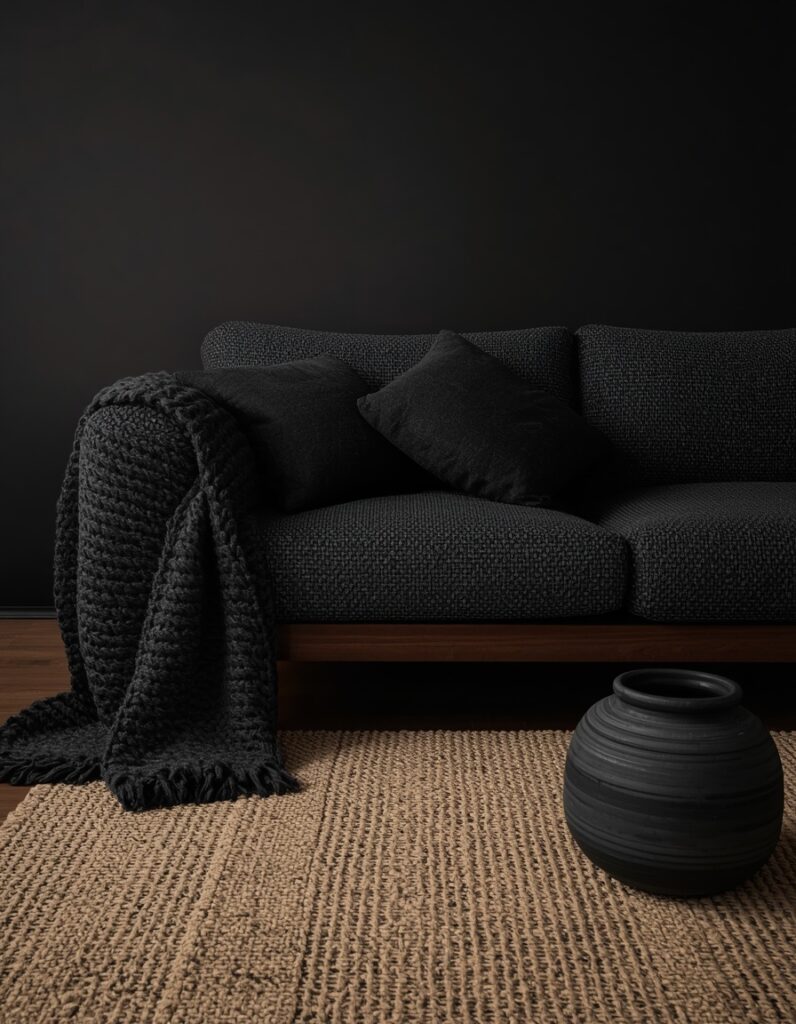

When color contrast is removed from a room — when the walls, the trim, and much of the furniture occupy the same deep tonal register — visual interest must be generated entirely through tactile variation. This is the material intelligence of Dark Japandi. The room is not visually quiet because it is empty. It is visually quiet because every surface earns its complexity through texture rather than through color.
The textile hierarchy:
The rug is the foundation — a hand-knotted or hand-woven wool or jute piece with enough surface irregularity that it reads as warm rather than flat. A machine-made rug in a dark room looks cheap regardless of the color. The hand-knotted quality — the slight variation in pile height, the visible knot structure at the back, the irregular selvedge edge — is visible and it communicates quality.
The sofa upholstery is the primary vertical texture. Bouclé — with its looped surface that catches light in thousands of small individual points — is the most effective upholstery material in a dark room because it generates visual warmth without introducing any color. A charcoal bouclé sofa against charcoal limewash walls reads as layered and dimensional. A flat charcoal fabric sofa against the same wall disappears completely.
The throw is the accessible layer — a chunky merino wool or heavyweight cotton knit draped naturally, not folded. The weight and the drape of the throw communicate comfort in a way that nothing styled ever achieves.
The decor discipline:
A Dark Japandi living room tolerates precisely two or three decorative objects. Every additional object fragments the visual silence. The objects that remain must justify their presence through material quality alone — an oversized unglazed clay vessel, a single dried architectural stem, a smooth river stone. Nothing that reads as decorative in the conventional sense. Everything that reads as found, honest, and inevitable in its placement.
Affiliate picks — Dark Japandi textiles and decor:
- YnM Chunky Throw Blanket ~$85–120 — the weight distinguishes it from decorative throws. Draped, never folded
- Large Blak Ceramic Vase – 9.8 Inch Rustic— ~$30–60 — the single decorative object a Dark Japandi living room requires. One vase, one dried stem, nothing else on the console
Frequently Asked Questions
Will a Dark Japandi living room feel too small?
Executed correctly, it will not. Dark colors dissolve the perceived edges of a room — the walls recede into shadow rather than advancing toward the center. By keeping furniture low-profile, floating it away from the walls, and maintaining strict editorial discipline about object count, the negative space above the furniture reads as expansive. The room feels intimate and enveloping rather than constrained.
Can Dark Japandi work in a living room with limited natural light?
It is often the correct choice for exactly these rooms. Attempting to compensate for limited natural light with bright white walls produces a flat, dingy result — a room that is clearly trying to be something it cannot be. Embracing the room’s natural character by going dark produces an intentional, atmospheric space that reads as designed rather than compromised. Layer warm artificial light sources at multiple heights and the room becomes genuinely beautiful after dark.
How do I introduce warmth into a dark minimalist living room?
Warmth in a Dark Japandi room is entirely a function of material and light — never of color. Dark walnut with its rich brown grain introduces warmth. Limewash walls with their mineral depth introduce warmth. Bouclé upholstery, chunky wool throws, and hand-knotted jute rugs introduce warmth. And every bulb operating at 2700K or below introduces warmth. None of these decisions require moving away from the dark palette.
The Finished Space: Darkness as Architecture
A room does not need light to feel alive. It needs intention.
The Dark Japandi living room — color-drenched in warm charcoal, furnished with the grain of dark walnut and the texture of hand-knotted wool, lit by the amber glow of rice paper and candlelight — does not borrow its atmosphere from the daylight outside. It generates its own.
The walls recede. The furniture settles. The room becomes the thing a living room is rarely allowed to be — genuinely sheltering. Not a display space. Not a social performance. A room that holds its occupants rather than presenting them.
That is the specific promise of Dark Japandi. And it begins, as all architectural decisions do, with the wall.
Subscribe to Homeoration!
Get decor ideas, room inspirations & seasonal styling tips.
By subscribing you agree to receive emails & accept our Privacy Policy.
[…] those who prefer deeper tones, these principles are explored further in dark Japandi living room ideas that focus on warmth rather than […]
[…] For those following the moodier path of the aesthetic, traditional white paper can sometimes feel too high-contrast. Instead, look for smoked glass pendants or bronze-tinted fixtures. They maintain the minimalism but add a layer of sophisticated depth that pairs perfectly with the walnut and charcoal accents we detailed in our exploration of Dark Japandi Living Room Ideas. […]
[…] thick impasto strokes in “sand” or “charcoal” tones. This adheres to the Dark Japandi Living Room Ideas aesthetic by providing a heavy, grounding focal point without distracting from the room’s […]