
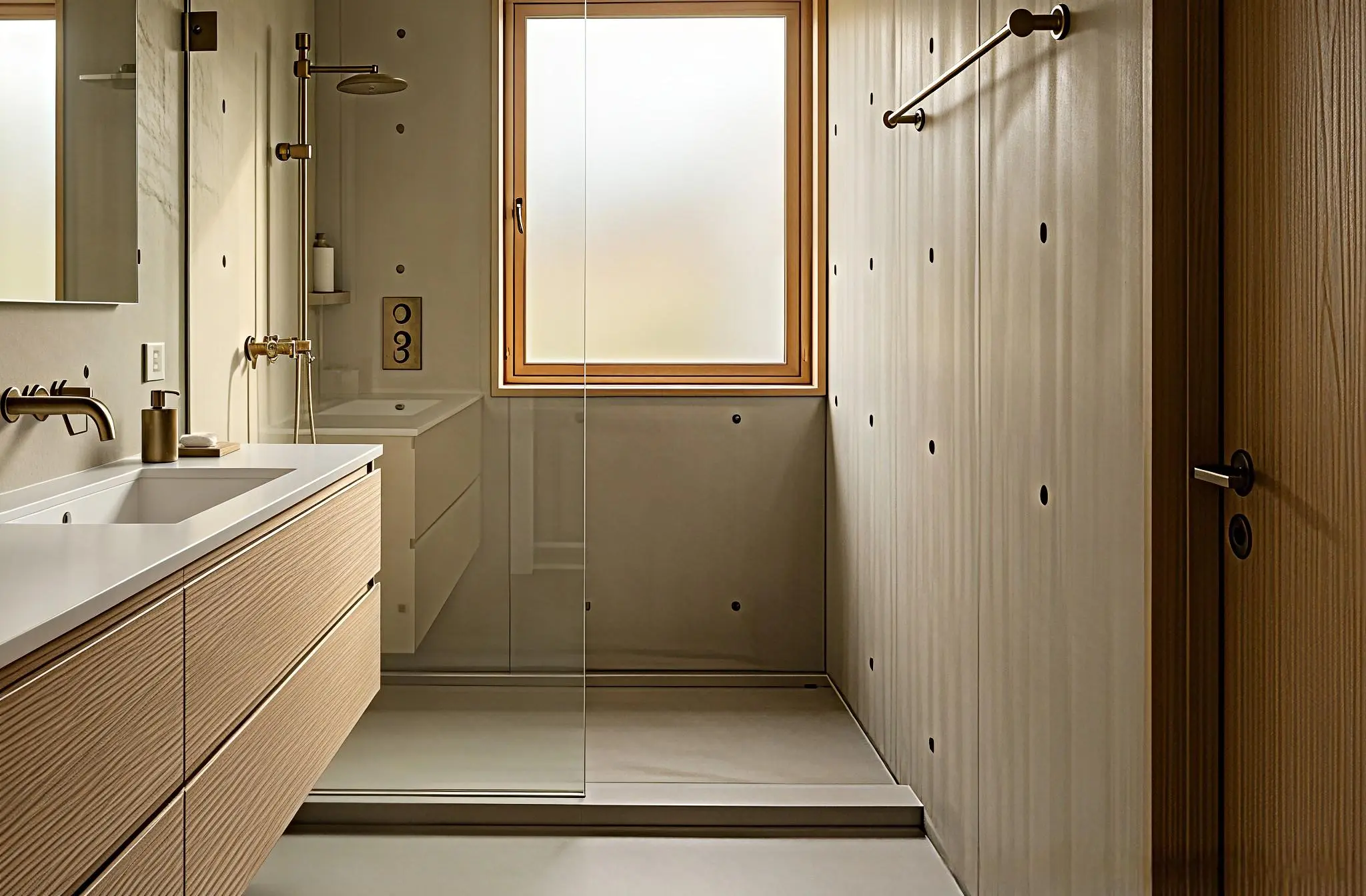
The bathroom is arguably the most functional room in a home, yet it is often the most visually chaotic. Between fragmented tile layouts, harsh overhead lighting, and cluttered countertops, the space is frequently reduced to pure utility rather than restoration. A bathroom should not merely be a place to wash; it must function as a sanctuary of visual silence.
To achieve this level of calm, the architecture must be intentional. The Japandi design philosophy—a rigorous blend of Japanese wabi-sabi minimalism and Scandinavian practicality—provides the ultimate framework for this transition. By prioritizing raw textures, seamless planes, and absolute spatial discipline, the Japandi bathroom restructure transforms a chaotic utility room into a grounded, restorative environment.
The Philosophy of the Minimalist Wet Room
The traditional Western bathroom layout relies heavily on physical barriers: glass shower boxes, heavy curbs, and segmented zones that aggressively chop up the visual footprint of the room. This approach makes spaces feel confined and visually loud.
The Japandi restructure advocates for the open-flow, curbless wet room. By eliminating the shower curb and removing heavy glass partitions, the architecture allows the eye to travel across the space uninterrupted. The focus shifts to continuous floor lines, where the same large-format stone or sealed concrete flows seamlessly from the doorway straight into the shower drain. This unbroken horizontal plane is the foundation of spatial calm, creating an environment that feels infinite, fluid, and inherently restful.
Micro-Cement: The Tactile Wall Treatment
If the goal is visual silence, traditional tile is often the first element that must be removed. The repetitive grid of subway tile and the sharp, contrasting grout lines create an inescapable geometric noise. In a space designed for decompression, grout lines are a distraction.
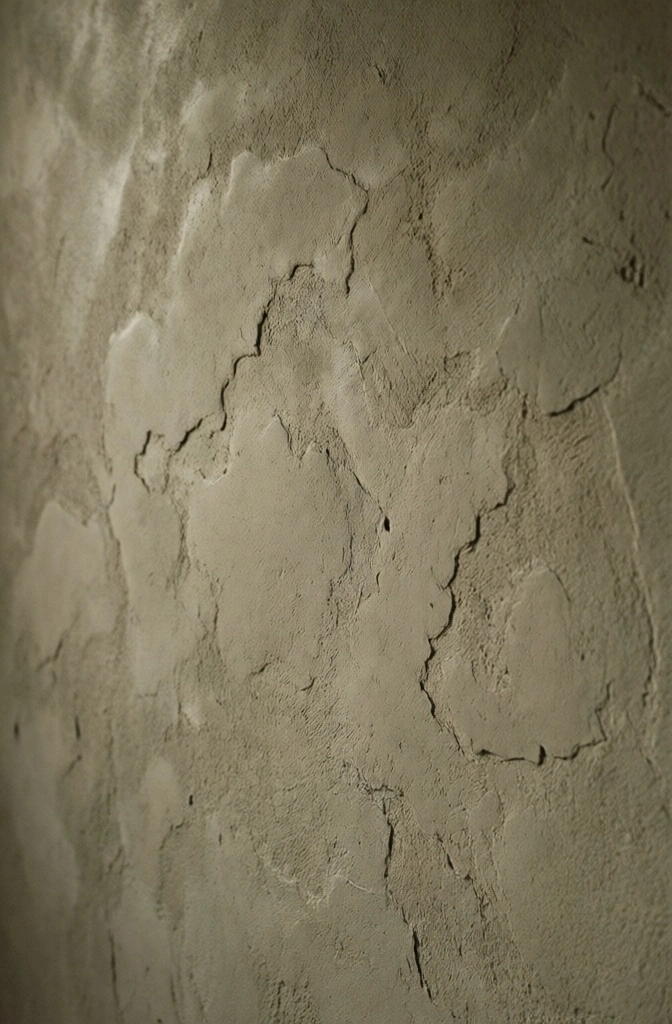
The high-end alternative is seamless micro-cement. Treatments like Moroccan Tadelakt or Roman clay offer a continuous, waterproof finish that wraps the walls in soft, monolithic warmth. Unlike glossy ceramic tiles that bounce harsh light around the room, micro-cement absorbs light gently, creating a subtle, suede-like texture that feels organic to the touch.
This seamless application completely redefines the boundaries of the room. Without the rigid grid of tilework, the walls no longer feel like constructed barriers; instead, they feel like natural, carved stone, turning the daily ritual of bathing into a deeply grounded, tactile experience.
The Material Science: Selecting the Right Seamless Finish
To achieve the monolithic, unbroken visual plane essential to Japandi architecture, we must eliminate traditional tile and grout. However, not all seamless wall treatments are engineered for the high-humidity, direct-water environment of a curbless wet room. Specifying the correct plaster or cementitious coating is the difference between a lifetime waterproof seal and an expensive structural failure.
Here is the technical breakdown of the three primary seamless finishes used in high-end Japandi bathroom design.
Moroccan Tadelakt
Tadelakt is the pinnacle of organic, wabi-sabi luxury. Originating in Marrakesh, it is a traditional lime plaster that is meticulously burnished with a smooth river stone and treated with a natural soap to create a hydrophobic (water-repellent) surface.
- The Texture: It offers an incredibly tactile, suede-like finish with a subtle, cloudy sheen. It feels soft and warm to the touch, lacking the cold rigidity of traditional concrete.
- Water Resistance: When properly applied, Tadelakt is inherently waterproof, making it highly suitable for shower enclosures and custom-built soaking tubs.
- Installation & Maintenance Logistics: Tadelakt is highly labor-intensive and requires a master artisan to install. Furthermore, it demands specific chemical maintenance. To sustain its waterproof barrier, it must be cleaned exclusively with a natural olive-oil-based black soap. The fatty acids in the soap react continuously with the lime in the plaster, regenerating the water-resistant seal over time. Harsh chemical bathroom cleaners will strip the finish and destroy the wall.
Roman Clay
Roman Clay is a synthetic, eco-friendly plaster typically made from gypsum, cement, and fine marble dust. It is heavily favored in Japandi interiors for its ability to soften a room and catch natural light beautifully.
- The Texture: It provides a highly mottled, cloud-like aesthetic with a completely flat, matte finish. It perfectly mimics the look of aged, historic plaster walls.
- Water Resistance: Unlike Tadelakt, Roman Clay is not inherently waterproof. Even when sealed, it is highly susceptible to water spotting and degradation from continuous moisture.
- Installation & Maintenance Logistics: Roman Clay is applied with a putty knife or trowel in thin, overlapping layers. While it is excellent for the “dry zones” of your bathroom—such as behind the vanity or around the toilet—it should strictly be kept out of the wet room shower enclosure.
Micro-Cement
Micro-cement is an engineered, high-performance coating blending cement, water-based resins, additives, and mineral pigments. It is the workhorse of modern minimalist architecture.
- The Texture: It offers a more uniform, contemporary look than Tadelakt or Roman Clay. While it can be troweled to show slight movement and organic texture, its final appearance is cleaner, more durable, and slightly more industrial.
- Water Resistance: Micro-cement is highly water-resistant natively and becomes 100% waterproof when finished with a specialized polyurethane topcoat. It will not absorb water, making it the safest, most reliable choice for floors, walls, and ceilings inside a heavy-use wet room.
- Installation & Maintenance Logistics: This is the most logistically favorable material for a bathroom renovation. Because it is applied at a thickness of just 2 to 3 millimeters, micro-cement can be troweled directly over existing structural substrates—and even directly over old bathroom tiles—saving immense demolition costs. It requires zero specialized maintenance and can be cleaned with standard mild detergents.
The Lighting Blueprint: Engineering Visual Calm
In Japandi architecture, light is treated as a structural material, not just an afterthought. Harsh, direct overhead lighting—like standard builder-grade recessed spotlights—instantly destroys the restorative, wabi-sabi atmosphere of a wet room. To engineer true visual calm, we must abandon standard grid lighting and implement a highly technical, layered illumination strategy.
- Perimeter Washing & Ambient Glow: Eliminate reliance on direct downlights. Instead, utilize indirect perimeter washing. By integrating IP65-rated LED strip lighting behind floating mirrors or inside built-in architectural wall niches, you create a soft, diffused halo effect. This washes the textured micro-cement walls in light, highlighting the organic movement of the plaster without blinding the user.
- Dedicated Task Lighting: For vanity illumination, replace harsh directional bars with asymmetrical task lighting. Suspend low-voltage pendant lights featuring natural, light-diffusing shades—such as raw ceramic, frosted glass, or treated washi paper. This focuses soft, functional light precisely where needed without polluting the ambient shadow play of the room.
- Strict Color Temperature Mandate (2700K – 3000K): The biological impact of a Japandi bathroom relies entirely on the Kelvin scale. You must strictly mandate the use of 2700K to 3000K bulbs across all fixtures in the room. This specific temperature range mimics the circadian-friendly glow of late afternoon sunlight or candlelight. It brings out the rich, warm undertones of the solid oak vanity and natural stone, preventing the minimalist space from feeling like a sterile clinical environment.
The Vanity: Slatted Wood and Concealed Storage
In a Japandi bathroom, the vanity must serve a dual purpose: it acts as a visual anchor of natural warmth, and it serves as the ultimate storage vault.
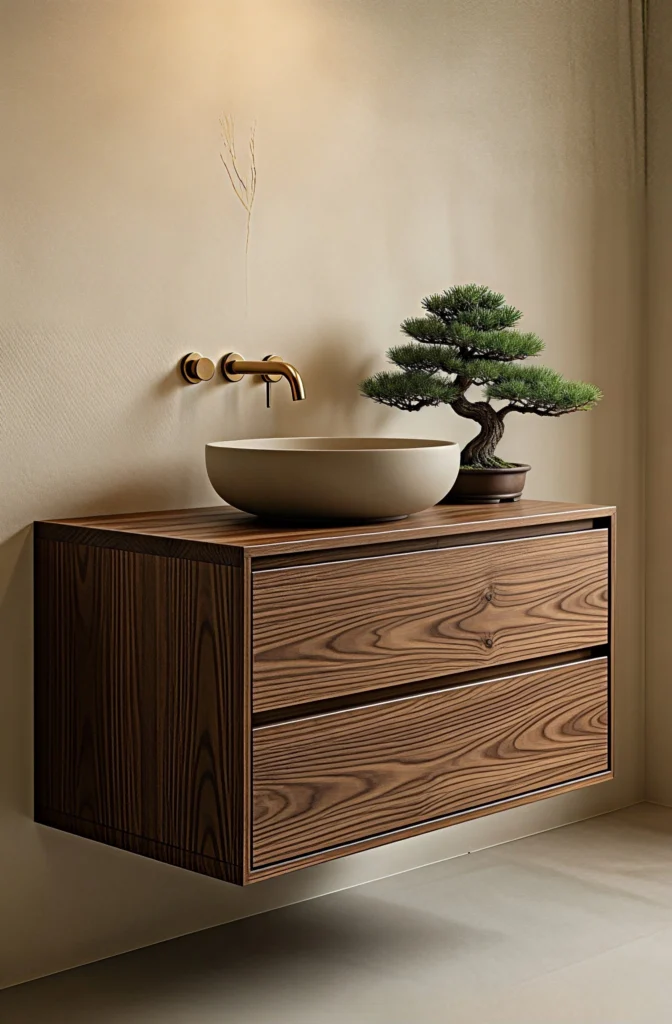
A floating, solid white oak vanity is the gold standard here. Elevating the cabinetry off the floor maintains the continuous visual line of the wet room, making the space feel larger and less restricted. Opting for slatted timber fronts—such as sliding tambour doors—adds vertical rhythm and architectural texture that pairs perfectly with the smooth, monolithic micro-cement walls.
However, the true success of a Japandi vanity lies in its internal organization.
The cardinal rule of this aesthetic is that countertops must remain 100% empty. Leaving bottles, toothbrushes, and skincare products on display immediately shatters the visual silence. To achieve a perfectly clear surface, you must engineer the inside of your vanity.
- Invest in modular bamboo or clear acrylic drawer dividers.
- Assign a strict, dedicated zone for every daily essential.
- If it does not fit neatly inside the drawer, it does not belong in the bathroom.
Hardware as High-Contrast Architecture
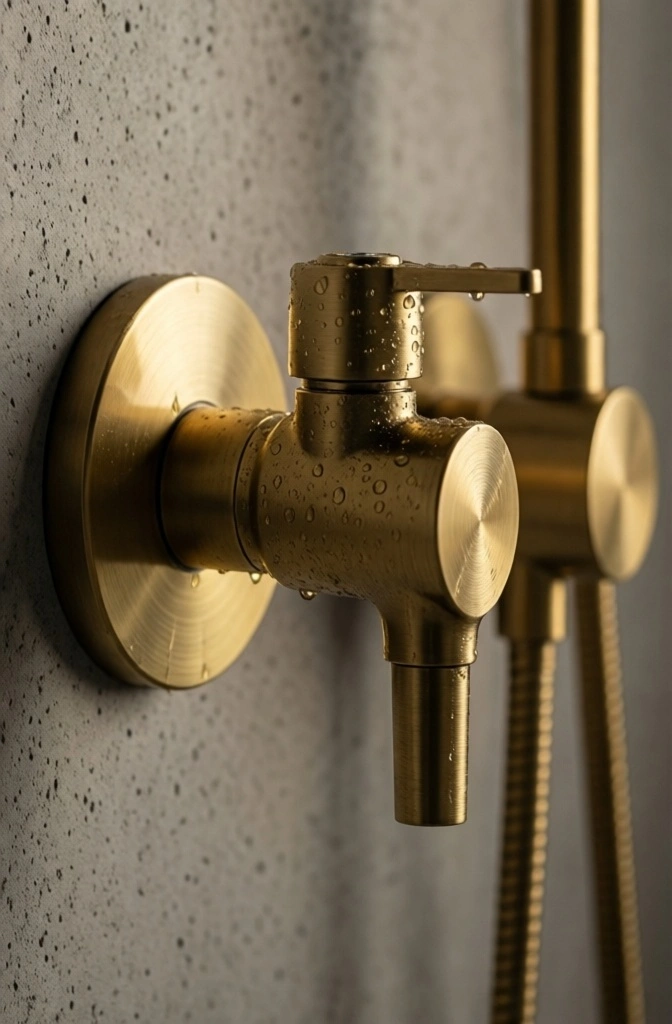
With a foundation of soft micro-cement and warm oak, the room requires a moment of sharp, defining contrast. If the walls are the canvas, the plumbing fixtures are the ink.
Standard chrome fixtures tend to look sterile and out of place in a wabi-sabi environment. Instead, treat your hardware as structural jewelry.
- Matte Black: Offers a crisp, graphic silhouette that grounds the room and provides a distinctly modern edge.
- Unlacquered Brass: Provides a living finish that will naturally patina and darken over time, perfectly capturing the wabi-sabi appreciation for aging materials.
Wall-mounted basin faucets are highly recommended over deck-mounted options. Moving the hardware to the wall keeps the vanity counter completely clear, prevents hard water buildup around the base of the tap, and reinforces the minimalist aesthetic.
The Organic Layer
A bathroom built purely from stone, metal, and wood can easily veer into feeling austere or cold. The final step in the restructure is introducing the organic layer—the soft textiles and natural elements that breathe life into the architecture.
Keep this layer highly intentional and deeply tactile:
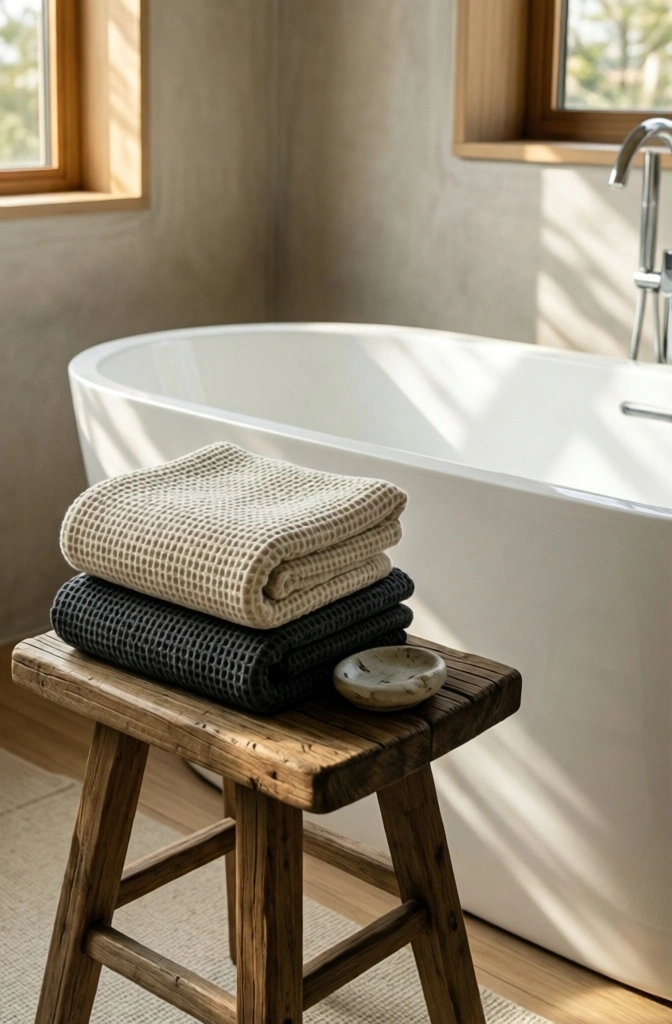
- Waffle-Knit Linens: Replace thick, generic terrycloth with organic cotton waffle-knit towels. They are lightweight, dry quickly, and drape beautifully without looking bulky.
- Slatted Teak: Introduce a slatted teak wood bath mat outside the shower zone. It adds a secondary layer of rich wood tone and feels phenomenal underfoot.
- Architectural Greenery: Bring in a single, humidity-tolerant statement plant, such as a Ficus Audrey or a minimalist bonsai.
These organic elements soften the hard architectural lines, ensuring the room feels like a restorative sanctuary rather than a sterile utility closet.

Frequently Asked Questions
Is a Japandi bathroom hard to keep clean? No, it is actually much easier to maintain than a traditional bathroom. By replacing standard tile with seamless micro-cement, you eliminate grout lines, which are notorious for trapping dirt and mold. Furthermore, the strict rule of keeping countertops 100% empty means wiping down surfaces takes seconds, not minutes.
Can I do a Japandi style in a small bathroom? Absolutely. The Japandi philosophy is highly effective in small spaces because it relies on visual restraint. Features like a floating vanity and a curbless wet room eliminate heavy physical barriers, allowing the eye to see more continuous floor space, which creates a powerful illusion of a much larger room.
Final Thought
A successful Japandi bathroom restructure is not simply about replicating a trendy aesthetic; it is about fundamentally changing how the room operates. By investing in tactile materials, seamless architecture, and rigorous spatial organization, you are building an environment designed for daily restoration. It shifts the bathroom from a place of chaotic utility into a grounded, peaceful sanctuary where you can truly decompress.
If you are ready to bring more intentional design and visual silence into your home, subscribe to the Homeoration newsletter. You will receive practical room guides, curated sourcing lists, and seasonal aesthetic inspiration delivered straight to your inbox.