
Biophilic design is the most overused and least precisely defined term in 2026 interior design coverage. Most articles describe it the same way: add plants, use natural materials, let in more light, feel calmer. None of them explain what separates a genuinely biophilic room from a room that simply contains a few plants — and most of them lean on wellness statistics that do not survive scrutiny.
That distinction is the entire subject of this guide, and every room-specific guide that follows it on this site.
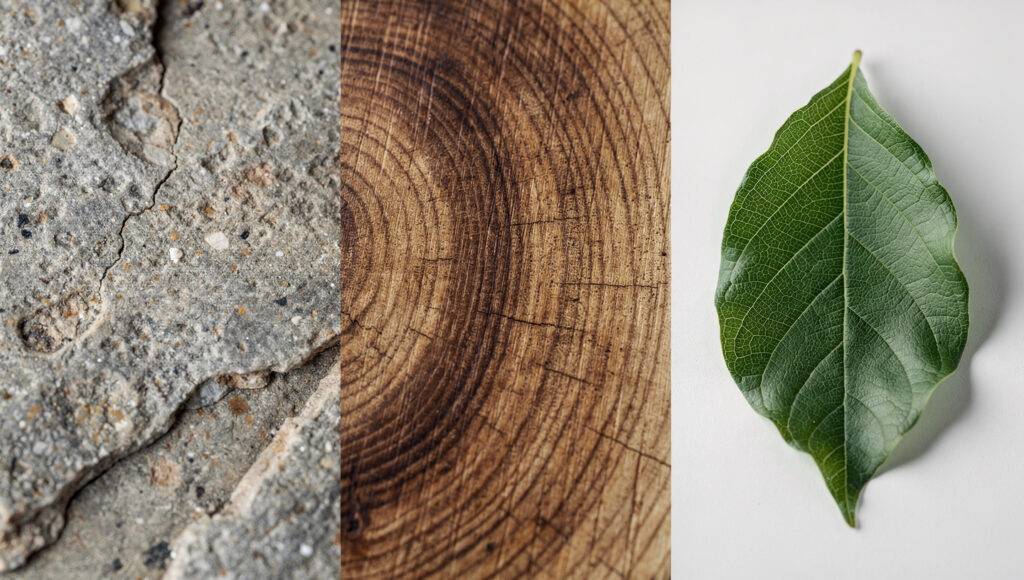
- What Biophilic Design Actually Is
- The Term's Real Origin — and Why That Matters Here
- The Tension Every Guide Ignores
- Materials: Where Most of the Work Happens
- Light and Water: The Two Layer-Three Elements Worth the Effort
- Common Mistakes That Undermine the Effect
- How This Applies Room by Room
- Frequently Asked Questions
What Biophilic Design Actually Is
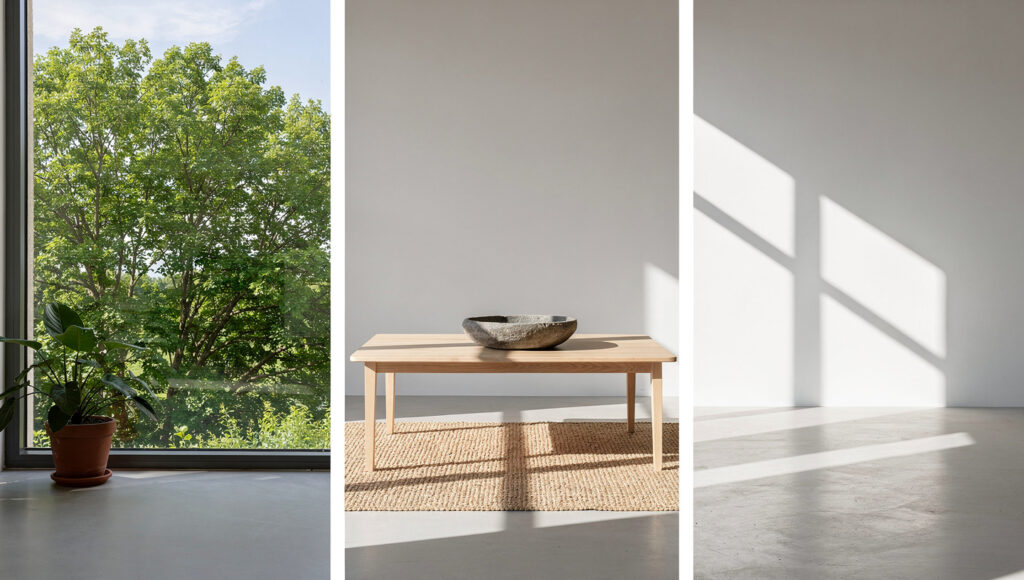
Biophilic design is the practice of structuring a built space around three categories of natural connection rather than one. Most popular coverage collapses all three into “add plants,” which is why so many rooms attempting this aesthetic end up cluttered rather than calm.
Layer one: direct nature. Living plants, natural light, moving water, fresh air. This is the layer people default to first and the only layer most rooms ever address.
Layer two: natural materials. Wood that shows its grain, stone that shows its mineral variation, clay, natural fiber textiles. This layer carries more of the actual sensory and visual weight of a biophilic space than plants do, and it is the layer most guides skip almost entirely.
Layer three: natural pattern. The way light shifts through a day, the way air moves, the kind of view available from inside a room. This is the hardest layer to retrofit into an existing space and the one most responsible for whether a room feels genuinely alive or simply decorated to look that way.
A room that addresses only layer one — plants on every surface, painted walls, synthetic textiles, blocked-out windows — is not biophilic. It is decorated. A room that addresses all three layers, even modestly, reads as genuinely connected to the outdoors with significantly less visual effort and far fewer individual objects.
We have applied this three-layer test to rooms submitted by readers for feedback, and the pattern is consistent: rooms that score high on layer one alone and low on layers two and three are almost always described by their owners as “still not quite right” despite a genuine plant investment. The missing layers are usually the reason.
The Term’s Real Origin — and Why That Matters Here

The word “biophilia” was popularized by biologist Edward O. Wilson in the 1980s to describe an innate human affinity for other living systems — a concept rooted in evolutionary biology, not interior decorating. Architects and designers adapted it decades later into a built-environment framework.
This history matters for one practical reason: it explains why so much current coverage over-claims. A concept that began as a biological hypothesis has been repeatedly translated into specific percentage claims about stress reduction and cognitive performance that the original research never quite supports at that level of precision. Our position on this is direct: we do not repeat those numbers, because we cannot verify them, and a design philosophy this genuinely useful does not need invented statistics to justify itself. The case for biophilic design is observable in the room itself — in how a space with honest materials and real light behaves differently from one without them.
The Tension Every Guide Ignores
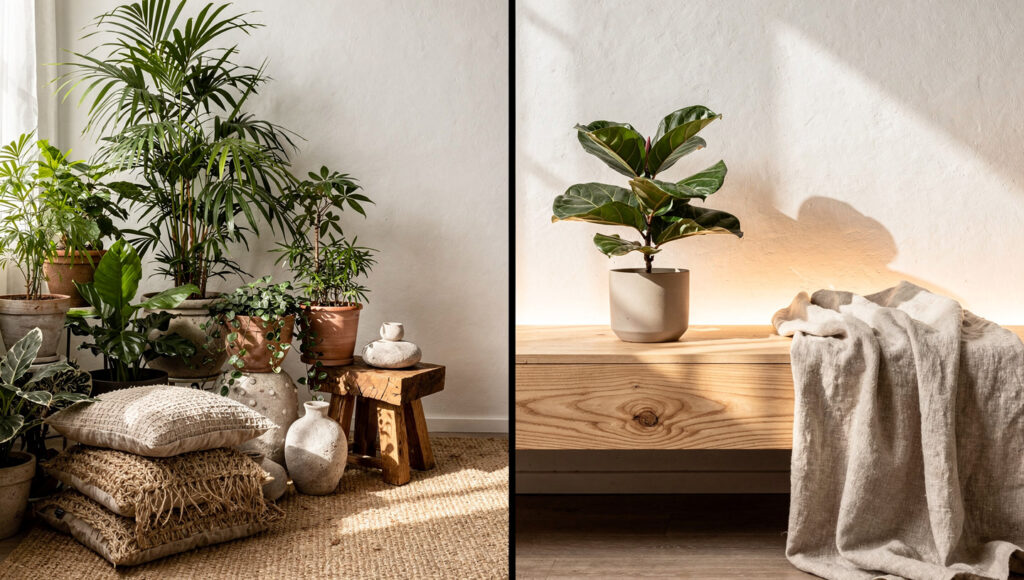
The genuine difficulty in applying biophilic design to a minimalist or Japandi home is not finding natural materials. It is reconciling the apparent abundance of nature with the editing discipline that a calm, minimal room requires.
These two values are not actually in conflict, but most coverage treats biophilic design as inherently maximalist — more plants, more texture, more pattern, more visual stimulation. This is one valid expression of the philosophy. It is not the only one, and it is not the version that works for an audience that has already chosen restraint as a core value.
The restrained version of biophilic design applies the same three-layer framework with significantly fewer objects and significantly more attention to material quality. One large, well-placed plant rather than twelve small ones. One piece of furniture with visible, honest wood grain rather than a room full of mixed natural-adjacent materials. One water feature, sized correctly, rather than a wall of moving water. The three layers are still fully present. The execution is edited.
The opinion we will state plainly: the maximalist living-wall version of biophilic design photographs beautifully and lives poorly. A wall of plants requires maintenance most households underestimate by a wide margin, and the visual density it creates works directly against the calm that drew a minimalist or Japandi audience to this site in the first place. We recommend the restrained version for nearly every reader of this guide, with the maximalist version reserved for households that have already proven, through smaller plant commitments, that they will keep up with the care a living wall demands.
Materials: Where Most of the Work Happens
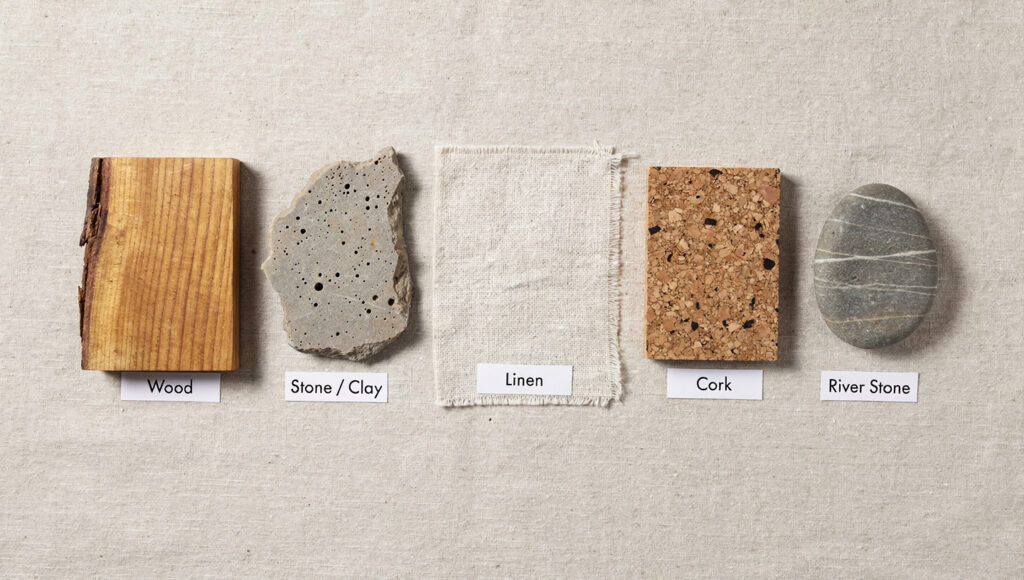
Across every room-specific application of biophilic design, the material layer does more visual and sensory work than the plant layer, and it is also the layer with the most room for a genuine quality gap between a real specification and a marketing claim.
Wood with visible character — live-edge cuts, exposed grain, minimal or no stain — is the most foundational material decision. A laminate or painted wood-effect surface does not qualify regardless of how the product is marketed.
Stone, clay, and unglazed ceramic introduce the mineral world and the specific honesty of irregular, handmade surfaces. These materials are durable design decisions precisely because their irregularity is structural rather than stylistic.
Natural fiber textiles — linen, wool, jute, cotton, undyed where possible — carry texture that synthetic fiber cannot replicate, and they age in a way that mirrors how natural materials age outdoors: softening, creasing, developing character rather than degrading.
Cork, harvested without felling the source tree, is the most underused biophilic material in US residential interiors — genuinely sustainable, naturally sound-absorbing, and visually distinct from every other natural material on this list.
The real-world exception worth naming: reclaimed wood, while genuinely biophilic in material terms, frequently arrives from suppliers with inconsistent moisture content, which can cause warping or cracking in dry-climate homes within the first year. When we have sourced reclaimed wood for material mockups, the pieces that performed best came from suppliers who kiln-dry after reclamation rather than selling material straight from deconstruction. This is a question worth asking any reclaimed wood supplier directly before purchase — it is rarely volunteered.
| Material Layer | Best Application | What to Avoid | Genuine Limitation |
|---|---|---|---|
| Wood | Live-edge furniture, exposed grain surfaces | Laminate, wood-print vinyl, heavy stain that hides grain | Reclaimed sources may warp without proper kiln-drying |
| Stone/clay | Unglazed ceramic vessels, raw stone accents | Polished, glossy, factory-uniform finishes | Heavier than equivalent synthetic — confirm floor load for large pieces |
| Textile | Undyed linen, wool, jute | Synthetic blends, high-sheen fabric | Requires more frequent cleaning than stain-resistant synthetics |
| Cork | Wall panels, nightstand tops | N/A — genuinely underused, no caution needed | Limited US retail availability — sourcing takes more effort |
Light and Water: The Two Layer-Three Elements Worth the Effort
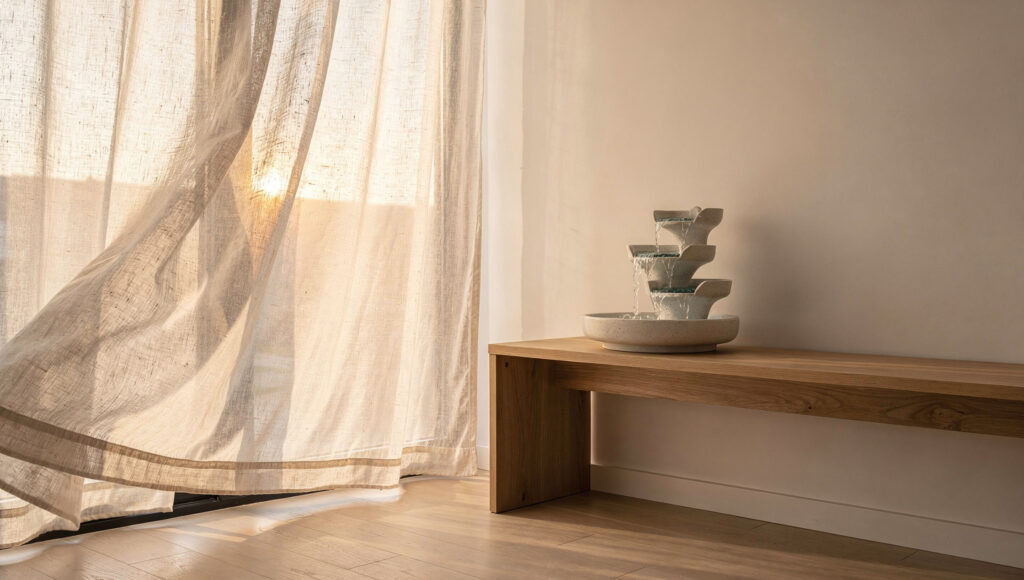
Light and water sit at the intersection of layer one and layer three — they are direct natural elements, but their effect depends entirely on how they move and change, which is the sensory-pattern dimension most guides skip discussing in specific terms.
Light should be allowed to shift across a day rather than maintained at a constant artificial level. Sheer, undyed natural fiber window treatments that transmit 40–60% of available daylight achieve this without sacrificing privacy or the ability to fully darken a room at night.
Water, at residential scale, does not require a feature large enough to be heard from across the room. A small tabletop or wall-mounted recirculating feature, correctly sized to the room, provides the visual and acoustic benefit without overwhelming a space designed for calm rather than spectacle.
The detail most guides skip entirely: maintenance. A tabletop water feature requires the reservoir to be refilled roughly every one to two weeks depending on humidity, and the pump should be cleaned of mineral buildup every one to two months in homes with hard water. We mention this not to discourage the choice but because a water feature abandoned after the novelty fades — sitting dry and unused on a shelf — undermines the entire design more visibly than never having added one at all.
Common Mistakes That Undermine the Effect
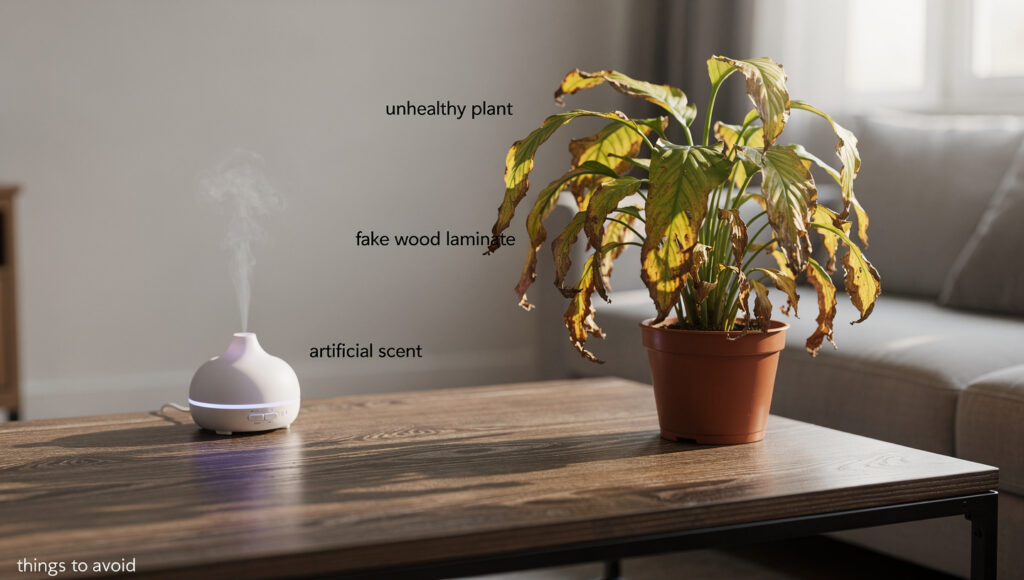
Three mistakes appear repeatedly in rooms attempting this aesthetic, and each one undermines the framework more than the absence of any single element would.
A struggling or dying plant does more visual and psychological damage than no plant at all. A biophilic room with one visibly unhealthy plant reads as neglected rather than connected to nature. If a species is consistently struggling in a given light condition, replace it with a more tolerant species rather than persisting — a healthy snake plant or pothos in lower light outperforms a stressed fiddle leaf fig every time.
Synthetic materials marketed as natural-adjacent — wood-print laminate, faux stone panels, artificial moss — fail the moment they are touched. Visual photography can disguise this; daily use cannot. We have walked through showrooms specifically to test this distinction by hand, and the difference between genuine and synthetic surfaces is immediately obvious at close range even when the photograph from across the room looks identical.
Artificial scent as a substitute for genuine sensory layering — plug-in diffusers marketed with forest or rain scent names — is the opposite of the biophilic principle rather than an expression of it. The sensory layer this framework calls for comes from real material behavior: the scent of unfinished wood, the sound of actual moving water, the changing quality of real daylight. A synthetic substitute for any of these is decoration wearing the language of biophilic design without its substance.
How This Applies Room by Room
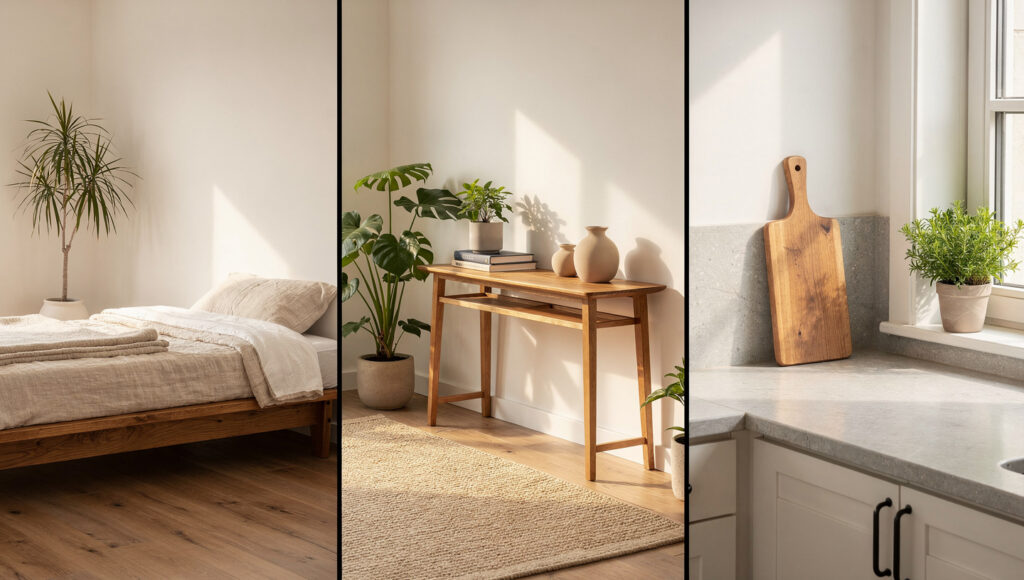
The three-layer framework does not change between rooms. Its application does, because each room has a different function and a different relationship to rest, activity, and sensory input.
Bedroom — the most restrained application, since the room’s primary function is rest. One architectural plant, visible wood grain in the bed frame, natural fiber bedding, light that can be fully shut out at night despite being abundant during the day.
Living room — the most socially visible application, where slightly more material and plant presence is appropriate because the room hosts more activity and more people, and where seating material and traffic flow introduce constraints a bedroom does not have.
Kitchen — increasingly recognized as one of the most significant spaces for biophilic application, where natural materials at the counter and cabinet level combine with herb plants that serve a genuine function rather than a purely decorative one.
Each room-specific guide on this site applies the same framework with the same discipline: fewer, more honest elements rather than more of everything simultaneously.
Frequently Asked Questions
What is the difference between biophilic design and just having houseplants?
Houseplants address only one of the three layers biophilic design requires — direct nature. A genuinely biophilic room also addresses natural materials (wood with visible grain, stone, natural fiber textiles) and natural sensory pattern (shifting light, water, airflow). A room with many plants but synthetic materials and constant artificial lighting is decorated with greenery, not biophilic in the complete sense.
Is biophilic design compatible with minimalist or Japandi style?
Yes, and the combination is one of the more resolved expressions of the philosophy. The tension between biophilic abundance and minimalist restraint is resolved by editing object count while maintaining material quality — one well-chosen plant and one piece of visibly grained wood furniture address the same design layers as a room full of mixed greenery, with significantly more visual calm.
What is the easiest first step toward a biophilic home?
Address the material layer before the plant layer. Replacing one painted or laminate surface with something showing genuine wood grain, stone texture, or natural fiber does more biophilic work than adding several plants to an otherwise synthetic room. Once the material foundation is honest, one well-placed architectural plant completes the layer most people start with by default.
The Finished Framework
Three layers. Direct nature, honest materials, natural sensory pattern. Every room-specific guide that follows from this post applies the same framework to a different space, with the editing discipline that distinguishes a composed biophilic room from a cluttered one.
The mistakes that undermine this aesthetic are rarely about choosing the wrong plant or the wrong stone. They are about substituting the appearance of a natural material for the real behavior of one — and a room, lived in daily, always finds the difference eventually.

