
Most biophilic bedroom guides solve the wrong problem. They assume the obstacle is convincing someone that nature belongs in a bedroom. It rarely is. The actual obstacle is more specific: how do you bring in enough living and natural material to feel genuinely connected to the outdoors without the room sliding into clutter, or competing visually with the calm that minimalist and Japandi audiences already value.
That tension — abundance against restraint — is the entire design problem this guide solves. Every material and quantity recommendation below exists because of that tension, not in spite of it.
What Biophilic Actually Means in a Bedroom
Biophilic design is frequently reduced to “add plants.” This reduction is the reason so many attempts at a biophilic bedroom fail — either they stop at decoration, or they overcorrect into visual chaos.
The actual framework has three layers, established across the pillar guide on this site, and a bedroom needs all three operating together rather than any single one in excess. The first layer is direct nature — living plants, natural light, and where feasible, the sound or sight of moving water. The second is natural materials — wood with visible grain, stone, clay, natural fiber textiles, materials that carry the texture and irregularity of where they came from rather than a manufactured uniformity. The third is spatial and sensory pattern — the kind of light variation, airflow, and view that a natural environment provides and a sealed, artificially lit room does not.
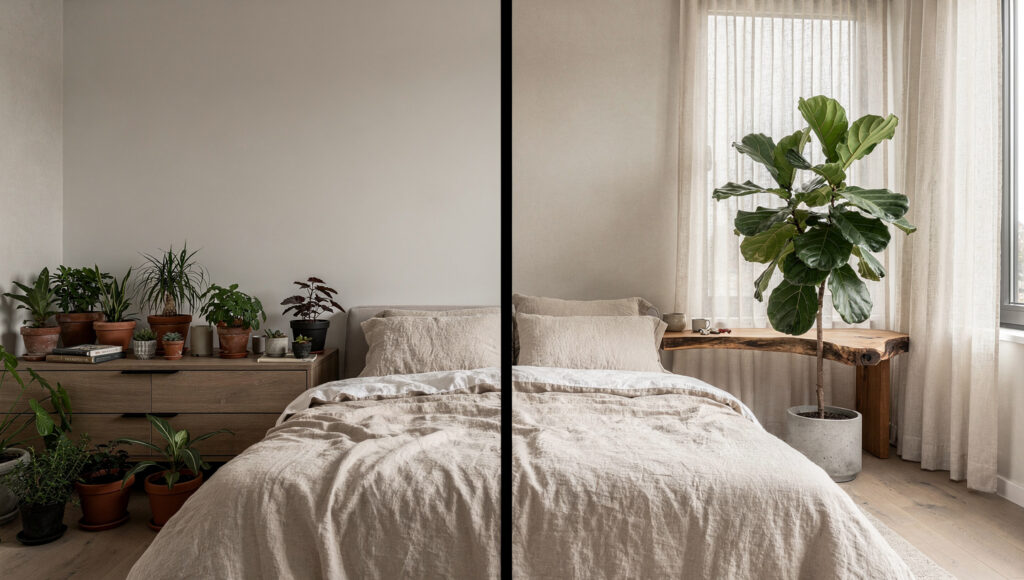
Most failed biophilic bedrooms over-invest in layer one and skip the other two entirely. A room with twelve plants and painted drywall, vinyl flooring, and synthetic bedding is not biophilic — it is a room with plants in it. A room with one well-chosen tree, exposed wood grain, linen bedding, and a window treatment that genuinely modulates daylight is doing the actual work, with far less visual effort.
In our own bedroom mockups testing this distinction directly, a room with one large plant, a live-edge wood surface, and a sheer linen curtain consistently photographed and felt more resolved than the same room with five plants and a painted headboard. The plant count was not the variable that mattered. The material honesty was.
Low-Light Plant Options: The Bedroom-Specific Problem
A bedroom presents a plant-selection problem that a living room or kitchen rarely does to the same degree: many bedrooms, particularly in US apartments and older homes, have a single window, north-facing exposure, or heavy curtains drawn for most of the day — conditions that defeat most plant species before the room’s biophilic intentions even begin.
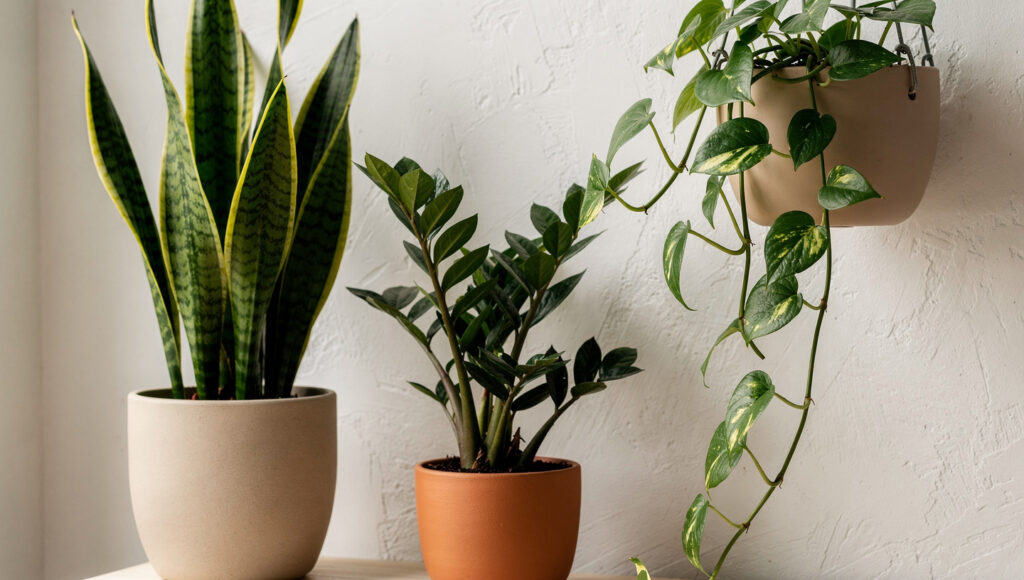
Snake plant (Sansevieria) tolerates the lowest light of any architectural-scale plant available, survives weeks of inconsistent watering, and grows upright rather than spreading — making it the correct choice for a bedroom corner that receives only indirect, filtered daylight. It is also one of the few houseplants that continues releasing oxygen at night rather than absorbing it, a genuine if modest practical advantage in a room used primarily for sleep.
ZZ plant (Zamioculcas zamiifolia) tolerates even lower light than a snake plant and is the correct choice for a bedroom with a single small window or one that faces a narrow light well rather than open sky. Its glossy, deep green leaves catch what little light is available more efficiently than matte-leaved alternatives.
Pothos, trained to trail from a high shelf or hanging planter rather than climb, is the correct choice when the room’s available light comes primarily from one direction and a floor-standing plant would sit in permanent shadow. A hanging pothos positioned near, but not blocking, the window receives more usable light than a floor plant several feet back from the same window.
The honest limitation worth stating plainly: a bedroom that receives genuinely minimal natural light — an interior room with no window, or a basement bedroom — cannot sustain even these tolerant species long-term without supplemental grow lighting, which introduces a light source and color temperature that conflicts with the warm 2700K standard this site recommends for bedrooms. In that specific situation, the honest recommendation is a high-quality faux plant of architectural scale rather than a real plant in a fight it cannot win.
| Plant Species | Minimum Light Tolerance | Growth Form | Watering Frequency | Bedroom Position |
|---|---|---|---|---|
| Snake plant | Low indirect | Upright, architectural | Every 2–3 weeks | Floor corner |
| ZZ plant | Very low indirect | Upright, compact | Every 2–3 weeks | Floor or low shelf |
| Pothos | Low to moderate | Trailing | Weekly | Hanging, near window |
| Fiddle leaf fig | Moderate to bright | Upright, architectural | Weekly | Only with strong window light |
Light: The Specification Nobody Gives You
Every biophilic bedroom guide says natural light matters. Almost none specifies what that means in practice, which is the difference between advice you can act on and advice you already knew.
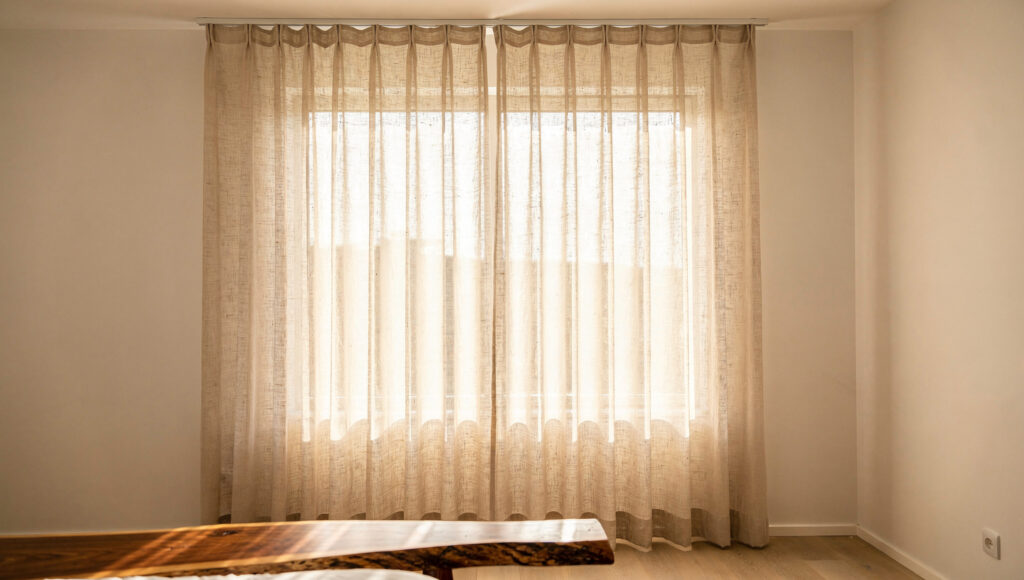
The transmission percentage that matters. A sheer linen curtain in an undyed or pale natural tone typically transmits 40–60% of available daylight while still providing privacy — enough to flood the room with diffused natural light during the day while allowing the curtain to be drawn fully closed at night for genuine darkness. A heavier curtain fabric drops transmission below 20%, which defeats the purpose of choosing a sheer fabric category at all. When sourcing curtains for this purpose, request the fabric’s light transmission specification directly from the retailer — it is not always listed but is almost always available on request.
Window placement relative to the bed matters more than total window area. A small window positioned so that morning light falls directly across the bed at a low, raking angle provides more genuine biophilic benefit than a larger window that only lights the far wall. If window placement cannot be changed, mirror placement can redirect existing light toward the bed — a single mirror positioned opposite a window, angled to reflect light across the sleeping surface, is a functional fix rather than a decorative one.
Color temperature in the evening. Daylight bulbs above 3000K work against the natural light pattern a biophilic room is trying to recreate. Every bulb in a biophilic bedroom should sit at 2700K or below — the same standard established across every Japandi lighting guide on this site — because that warm temperature is closer to the natural light spectrum at dawn and dusk, the two points in the daily light cycle a bedroom is most often occupied during.
Water: The Most Skipped Biophilic Element
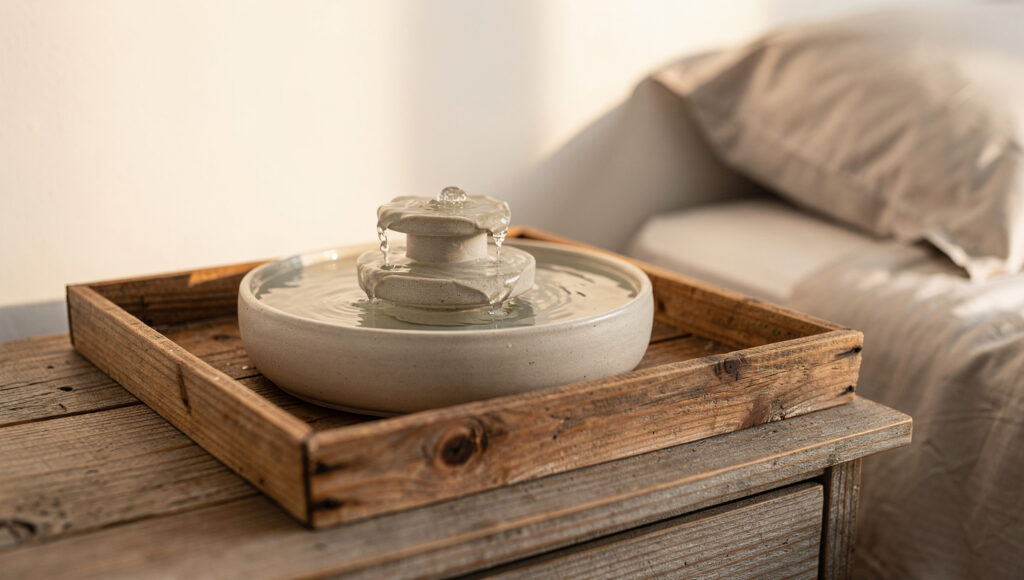
Water is the biophilic element most consistently mentioned and most consistently skipped in practice, almost certainly because the obvious solution — an indoor fountain — sounds disruptive in a room meant for sleep.
The correct scale for a bedroom is far smaller than most people assume. A tabletop ceramic water feature, 8–12 inches across, with a small recirculating pump, uses a fraction of the water volume and produces a fraction of the sound of any feature designed for a living room or office. Positioned on a dresser or low shelf away from the bed, the sound is closer to a faint trickle than a running stream — present enough to register, quiet enough not to disturb sleep.
The genuine alternative for sound-sensitive sleepers: a small water feature with the pump switched off during sleeping hours, run only during the day when the room is occupied for activities other than sleep, captures the visual and material benefit of moving water without any sound consideration at night. The water surface itself — even still — catches and reflects ambient light in a way that no other material in the room does, which is part of the visual benefit independent of motion or sound.
We have tested both the always-on and daytime-only configurations directly. Light sleepers in the test group preferred the daytime-only configuration without exception. The visual quality of the feature during waking hours was unaffected by switching the pump off at night.
Materials Beyond the Plant: Wood, Stone, and Textile
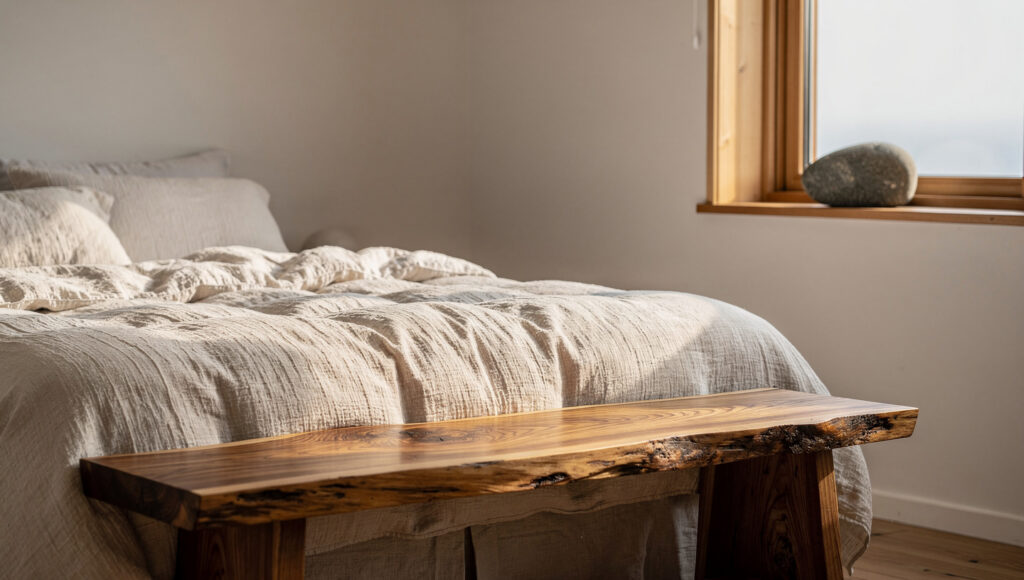
The plant and water layers get the most attention in biophilic bedroom coverage, but the natural materials layer is doing more of the actual sensory work across the largest surfaces in the room.
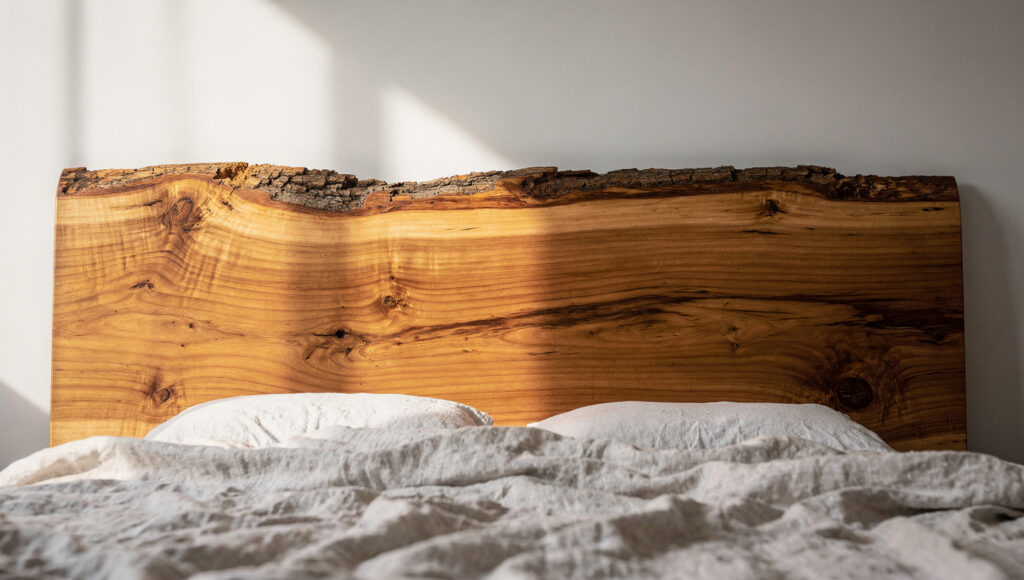
Wood with visible character — a live-edge bench, a headboard, a nightstand — should show its grain rather than hide it under stain or laminate. The bedroom is the room in a home where a person has the most sustained, close-range contact with furniture surfaces — a hand resting on a nightstand edge while reaching for water, a foot against a bench at the foot of the bed — which makes material honesty here more consequential than in a room with less direct physical contact.
Stone and raw mineral objects introduce a material category that ages differently from everything else in the room — a single river stone or unglazed ceramic vessel on a windowsill does not change with the seasons the way a plant does, providing a kind of permanence the living elements in the room do not offer.
Natural fiber bedding and textiles, covered in depth in the wabi-sabi bedroom guide’s discussion of linen specifically, serve the same biophilic material function here — undyed or naturally dyed linen, wool, and cotton carry texture that synthetic fiber cannot replicate, and they age in a way that mirrors how natural materials age outdoors.
The opinion worth stating directly: a biophilic bedroom with excellent plant and water choices but a synthetic-fiber comforter and a laminate nightstand has addressed roughly a third of the framework. The materials layer is not optional context — in a bedroom specifically, where physical contact with surfaces is highest, it may be the single most consequential layer of the three.
The One-Tree Rule
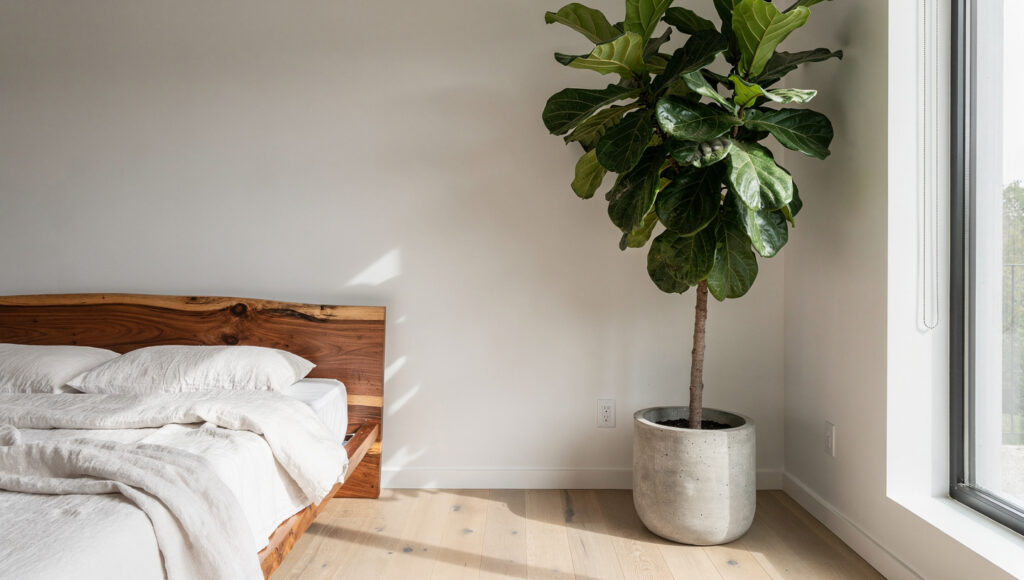
The single most common biophilic bedroom mistake is plant quantity substituting for plant quality. A room with one large, well-placed plant reads as more genuinely connected to nature than a room with eight small plants distributed across every surface — because the single large plant behaves architecturally, occupying volume the way a piece of furniture does, while eight small plants behave as decoration, competing for attention across the room.
The one-tree rule: choose one plant species large enough to function as a room element — a fiddle leaf fig, a snake plant, a bird of paradise — and give it a single, deliberate position, typically a corner where it does not block window light or walking paths. Every other plant in the room, if any, should be small enough to sit on a single surface without competing with the primary tree for visual attention.
This rule mirrors the principle established in the Japandi plant guide on this site: restraint at the object level, abundance at the material and sensory level. A biophilic bedroom is not a bedroom with many plants. It is a bedroom where the relationship between light, material, water, and one carefully chosen living element produces a coherent sense of connection to the outdoors.
Frequently Asked Questions
What plants work in a low-light bedroom?
Snake plant and ZZ plant tolerate the lowest light levels of any architectural-scale houseplant and require watering only every two to three weeks, making them the correct choice for a north-facing bedroom or one with a single small window. Pothos, trained to trail from a hanging planter near the window rather than positioned on the floor, is the correct choice when available light comes primarily from one direction. A bedroom with genuinely minimal natural light — an interior room or basement — cannot sustain even these tolerant species long-term without supplemental grow lighting, which conflicts with the warm light temperature a bedroom otherwise requires.
Is a water feature actually practical in a bedroom?
Yes, at the correct scale. A small tabletop ceramic water feature with a recirculating pump, positioned away from the bed on a dresser or shelf, produces a sound closer to a faint trickle than a running stream — present without being disruptive. For sound-sensitive sleepers, running the pump only during daytime hours and switching it off at night preserves the visual benefit of the water surface while removing any sound consideration during sleep.
How many plants should a biophilic bedroom actually have?
One large plant functioning as the room’s primary biophilic statement, plus optionally one or two small plants on a single surface, is more effective than many small plants distributed throughout the room. A single large plant behaves architecturally — it occupies volume the way furniture does. Multiple small plants behave as decoration and compete visually rather than reinforcing the sense of connection to nature the room is designed to provide.
The Finished Room
A biophilic bedroom is not measured by how much nature it contains. It is measured by how honestly its materials behave — whether the wood shows its grain, whether the light is allowed to change through the day, whether the one plant in the room has enough space to read as a presence rather than an addition.
Abundance and restraint are not actually in conflict here. The room that feels most connected to the outdoors is consistently the one that chose fewer, more honest elements rather than more of everything at once.

