
A wabi-sabi kitchen doesn’t look like a sterile showroom. It looks like a place where food is actually celebrated — and the distinction between those two descriptions carries more practical design weight than most kitchen guides acknowledge.
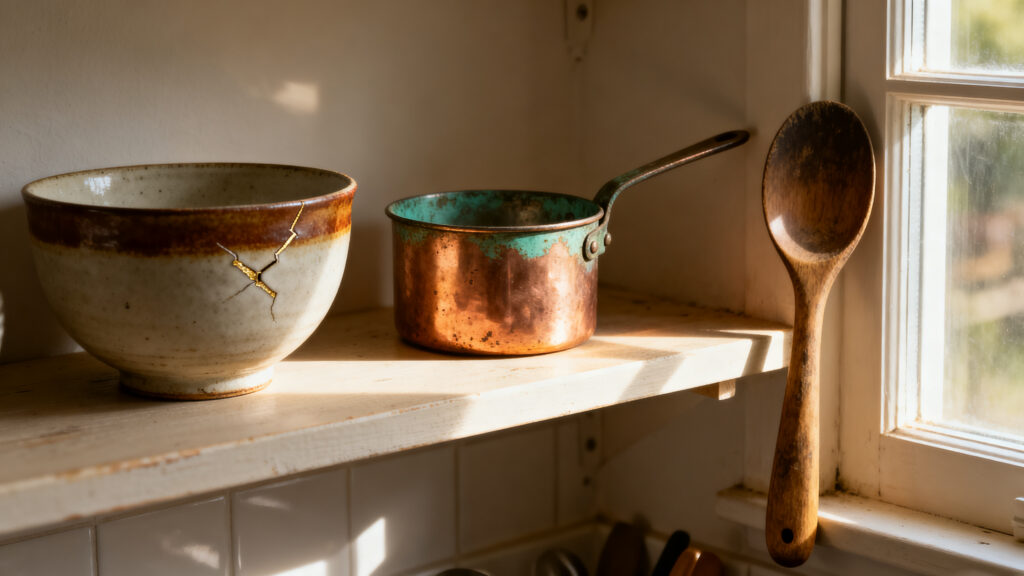
Every other room covered in this site’s wabi-sabi series has asked the same fundamental question: how do you make imperfection read as deliberate rather than neglected? The kitchen asks a different question entirely. Here, the imperfection doesn’t need to be managed or carefully curated to look intentional. It gets created automatically, every time you cook — the cutting board darkens from oil and use, the ceramic bowl develops a hairline from thermal shock, the copper vessel turns green at the rim, the wooden shelf absorbs the steam of a hundred Sunday soups. The kitchen is the one room in the home where the wabi-sabi philosophy gets proven by daily life rather than designed in by deliberate choice.
That distinction is this guide’s entire organizing principle.
- The Kitchen Is Where Wabi-Sabi Gets Proven, Not Designed In
- Open Shelving: The Discipline That Separates Display From Clutter
- Handmade Ceramics: Choosing Objects That Earn Their Place
- Cabinet and Counter Decisions: What Ages Correctly in a Kitchen
- The Appliance Problem
- What Undermines a Wabi-Sabi Kitchen
- Frequently Asked Questions
- The Finished Kitchen
The Kitchen Is Where Wabi-Sabi Gets Proven, Not Designed In
In a living room or bedroom, wabi-sabi requires deliberate restraint — the conscious decision to leave a surface clear, to choose an imperfect ceramic over a uniform one, to resist ironing the linen. Without those active choices, the philosophy doesn’t arrive on its own.
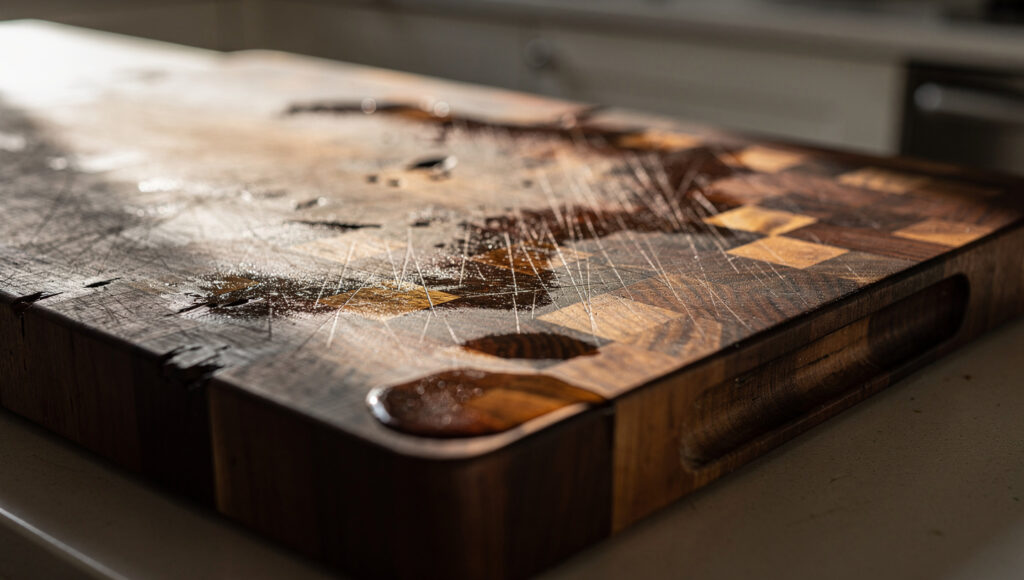
In a kitchen, it does. Cooking is inherently an aging process applied to the objects it touches. A cutting board used daily for three years carries the record of three years of meals in its surface — the darkening from oil, the shallow grooves from a decade of knife strokes, the specific worn area where one person’s hand always rests. No styling decision produces this. Only time and genuine use do.
This is the quality that makes the kitchen the most authentically wabi-sabi room in any home, and also the room where the philosophy is most frequently betrayed. A kitchen where the handmade ceramics are on the open shelf but never taken down for actual eating, where the cutting board is beautiful but clearly unused, where the copper pot hangs on a rail but the actual cooking happens in a non-stick pan stored in a cabinet — this is the kitchen that has the aesthetic without the substance. The objects are not aging honestly. They are aging decoratively, which is a different thing entirely and the specific failure mode this guide addresses.
We have observed this directly in kitchens submitted for feedback where the owner described their aesthetic as wabi-sabi but the photographed objects showed no evidence of actual use — ceramics without staining, cutting boards without knife marks, linen towels without a single crease from drying hands. The photographs were beautiful. The kitchens were not wabi-sabi. They were staged to look like wabi-sabi while being used like a showroom, and the tension between those two states was immediately readable.
Open Shelving: The Discipline That Separates Display From Clutter
Open shelving is the most written-about element of a wabi-sabi kitchen and the most frequently misexecuted. Every guide says “display handmade ceramics on open shelves.” Almost none specifies which objects should not be there, which is the more important instruction.
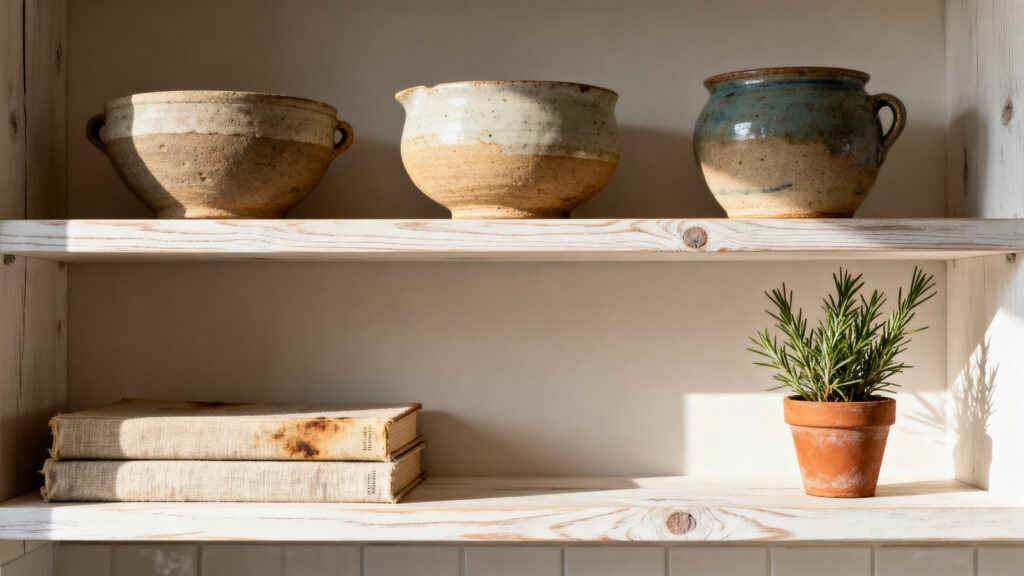
The open shelf edit in a wabi-sabi kitchen is as strict as the nightstand edit in the wabi-sabi bedroom. The shelf should display objects that have been actively chosen for their material quality or personal meaning, and nothing else. The test for whether an object earns a shelf position: is it genuinely handmade or aged, and is it in active enough use that removing it from the shelf to use it and returning it creates a natural ongoing relationship between the shelf and the kitchen’s daily life? Objects that pass this test belong. Objects that simply fill visual space do not.
The specific objects that earn open shelf position in a wabi-sabi kitchen:
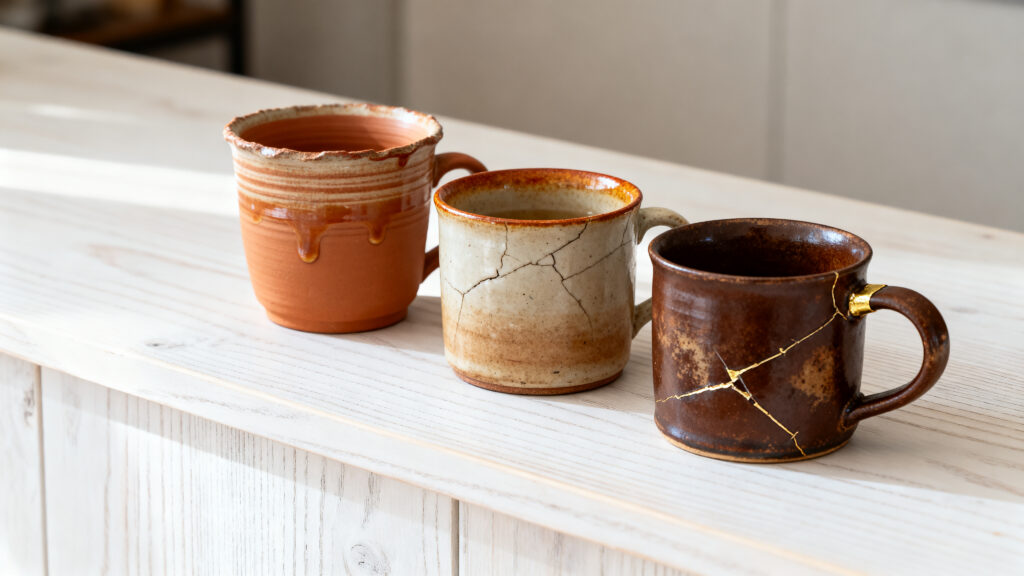
A small collection of mismatched handmade ceramic mugs — not a set, because a set is a retail decision rather than an accumulated one. The mismatch between pieces from different makers, in slightly different clay tones and glaze approaches, is the visual record of finding them separately rather than buying them together.
Two or three ceramic serving bowls used frequently enough to show their actual use — the slight staining at the rim from food acids, the small chip that happened during a family dinner. These are not damage. They are the bowl’s history.
A small number of linen-bound or simply covered cookbooks — actually read and stained, not bought for their spines.
What does not belong on a wabi-sabi kitchen open shelf: matching retail ceramic sets purchased specifically for display, decorative objects that have no kitchen function, anything purchased from the same collection at the same time to create visual coordination.
| Object Category | Open Shelf — Correct | Open Shelf — Incorrect |
|---|---|---|
| Ceramics | Mismatched handmade pieces from different makers, showing genuine use | A matched set purchased together for visual consistency |
| Cookware | One or two pieces in active daily use, aging naturally | Copper pots hung decoratively but never cooked in |
| Books | Well-read cookbooks with stained pages and cracked spines | Pristine cookbooks purchased for cover aesthetics |
| Plants | One small herb in a terracotta pot, actively used in cooking | A decorative plant chosen purely for appearance |
| Textiles | Linen towels that show daily use — crease, softening | A pressed linen towel folded decoratively and never used |
Handmade Ceramics: Choosing Objects That Earn Their Place
The handmade ceramic instruction appears in every wabi-sabi kitchen guide, including this one, and it deserves a more specific treatment than most guides provide, because “handmade ceramics” in the US market describes everything from a genuinely hand-thrown stoneware piece to a factory-produced item with deliberate irregularity pressed into its surface to signal handcraft.
The distinguishing physical qualities of a genuinely handmade ceramic piece:
The throwing lines — the faint horizontal ridges left by the maker’s fingers during wheel throwing — should be visible on the interior surface of any wheel-thrown piece. A ceramic with a perfectly smooth interior was cast in a mold rather than thrown on a wheel, regardless of what the product description says.
The weight distribution should be slightly irregular. A wheel-thrown piece held in the hand will feel subtly different on one side than the other — the wall thickness varies slightly as the maker centers and shapes the clay. A cast piece has perfectly uniform wall thickness throughout.
The glaze should show variation — pooling slightly thicker at the base, thinner at the rim, different in its surface quality across the piece rather than a uniform, factory-consistent finish.
The aging trajectory that no buying guide mentions: a genuinely handmade ceramic piece changes in use. The stoneware develops a slight darkening at the rim from repeated contact with liquid. A small chip, if it happens, can be repaired with the kintsugi technique covered in the Wabi – Sabi guide — gold-lacquer repair that makes the damage the object’s most interesting feature. Over five years of daily use, a genuine handmade mug develops a character that a new one cannot replicate, which is the entire wabi-sabi argument for ceramic investment: the piece gets more beautiful with time, not less.
The opinion stated directly: buying a handmade ceramic piece at $25 to $60 from a local ceramicist or a craft fair is a better investment in the long term than buying a “handmade-look” ceramic from a mass-market retailer at the same price, because the genuine piece ages into greater character while the manufactured version ages into greater shabbiness. The patina of honest use works differently on genuine clay than on industrially pressed stoneware, and the difference becomes obvious within two to three years of daily use.
Cabinet and Counter Decisions: What Ages Correctly in a Kitchen
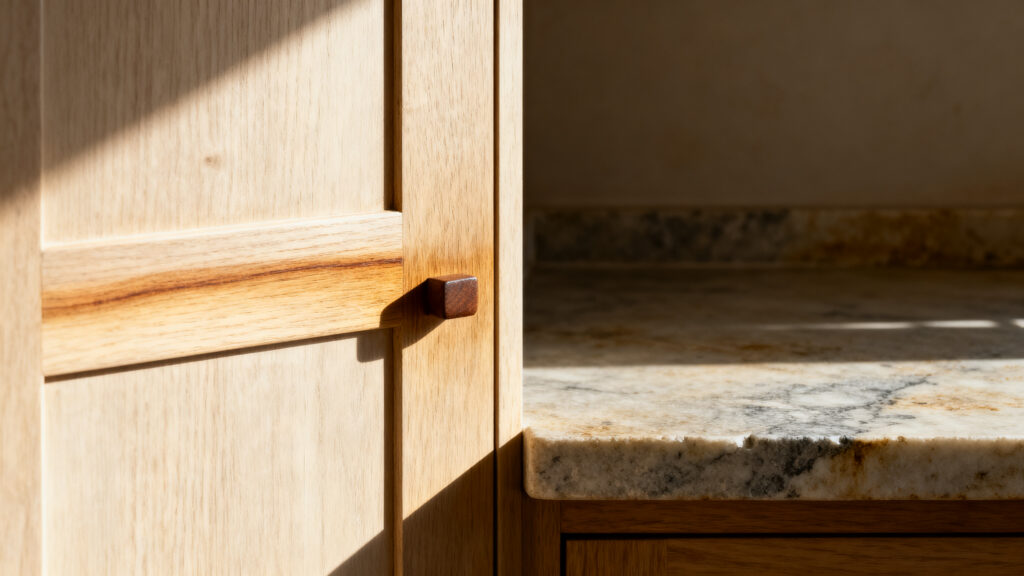
The cabinet and counter decisions in a wabi-sabi kitchen are made with a different primary question than most kitchen renovation decisions. Rather than “how will this look when new,” the correct question is “how will this look in five years of daily cooking use.”
Cabinet doors: flat-panel solid wood doors in white oak or walnut, with a penetrating oil finish rather than a surface lacquer, age correctly in a wabi-sabi kitchen. The oil finish allows the door to develop a gentle darkening and grain emphasis over years of hand contact at the door edges — the specific area where the finish is touched most frequently showing slightly more depth than the center panel, a natural gradation that a lacquer-coated surface never produces because the lacquer sits between the hand and the wood.
A painted cabinet door does not age correctly in this framework. Paint chips, scratches, and scuffs in ways that read as damage rather than character, because paint was never intended to develop patina through use — it was intended to provide a uniform, protective surface. When that surface fails, it looks like failure rather than beauty.
Counter surfaces: soapstone and honed limestone are the correct wabi-sabi counter materials because both develop character through use rather than showing it as damage. Soapstone darkens and acquires gray markings from acidic foods that blend into its natural surface over time — most owners oil their soapstone annually to even out these marks, but the marks between oilings are not a problem the stone is asking to be rescued from. Honed limestone develops a slight patina at the edges and around the sink from water contact.
The counter that does not belong in this framework: high-gloss quartz. It is engineered to resist all change indefinitely — scratch-resistant, stain-resistant, UV-resistant — which means it will look exactly the same in ten years as it does on installation day. For a kitchen built around the philosophy that beauty accumulates through time and use, a surface specifically engineered to prevent accumulation is a direct material contradiction.
The Appliance Problem
Modern kitchen appliances — refrigerators, dishwashers, ovens — present a specific challenge in a wabi-sabi kitchen that most wabi-sabi kitchen guides avoid addressing: they are synthetic, manufactured, and explicitly engineered to look the same in ten years as they do today. They are the material opposite of every principle covered in this guide.
The resolution is not to remove appliances or pretend they don’t exist. A wabi-sabi kitchen is still a functioning kitchen. The resolution is to make appliances as architecturally invisible as possible, so the material surfaces that do age honestly — the wood, the stone, the ceramics — carry the room’s visual character without competition from objects designed to read as synthetic permanence.
Panel-fronted refrigerators and dishwashers, fitted with doors that match the cabinet material and finish, reduce the appliance’s visual signature to approximately zero. The refrigerator disappears into the cabinetry run. The dishwasher reads as another cabinet door. What remains visible — the oven, the range, the kettle — is reduced to the minimum functional set.
The counter appliance rule in a wabi-sabi kitchen: one appliance on the counter at a time. The kettle, because it is used multiple times daily. Nothing else. A toaster, a coffee machine, a stand mixer, a bread maker — each of these in a wabi-sabi kitchen has a home inside a cabinet, not on the counter surface. The counter is for food preparation, the cutting board, and the one or two ceramic objects whose use justifies their permanent counter position.
What Undermines a Wabi-Sabi Kitchen
Beyond the specific decisions covered above, three broader patterns consistently undermine a kitchen attempting this aesthetic.
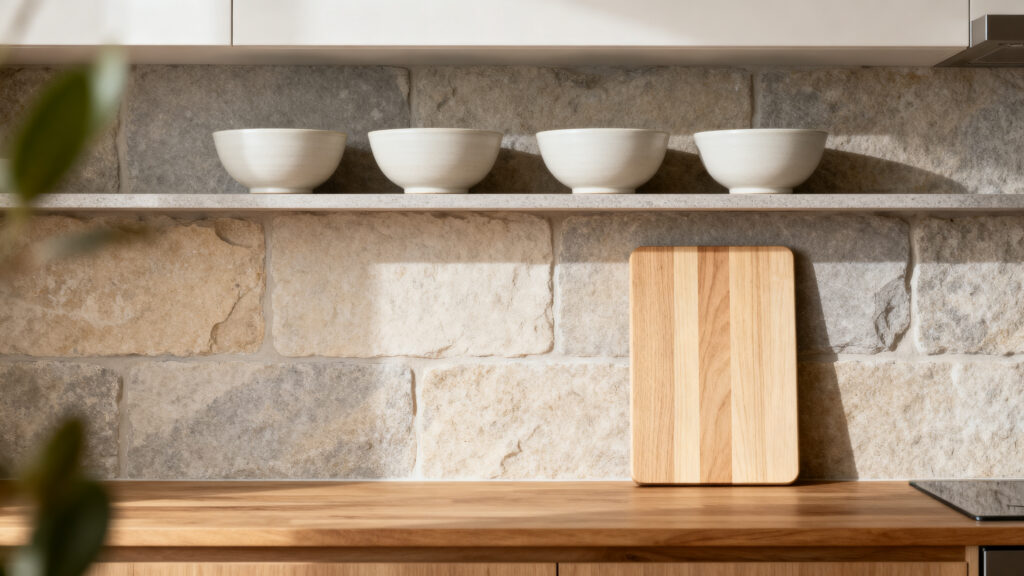
Decorative use of functional objects. A copper pot hung on a rail that is never actually cooked in. A cutting board displayed against the backsplash that is never used on the counter. A linen towel folded to a precise rectangle that is never used to dry hands. These objects are performing wabi-sabi rather than embodying it, and the performance is readable — the pristine condition of objects that should show use is its own kind of clutter, a visual noise that says “this kitchen was styled for a photograph rather than lived in.”
Matching retail sets on open shelves. A set of four matching ceramic bowls from the same manufacturer, purchased together, displayed together, is the opposite of the accumulated, individually found collection that makes an open shelf genuinely wabi-sabi. The set announces that it was bought, not gathered. It reads as a retail decision wearing the language of considered curation — and the honest answer is that matching sets belong in the cabinet, where they function well as serving ware, while the open shelf is reserved for the genuine mismatch of pieces found separately over time.
Over-cleaning natural surfaces. A soapstone counter vigorously cleaned with abrasive products to remove every trace of use is a counter being worked against its own material nature. A wooden cutting board bleached regularly to keep it from darkening is a board being prevented from becoming what daily use would naturally make it. The maintenance standard in a wabi-sabi kitchen is cleanliness — food-safe, hygienic, genuinely clean — but not the elimination of every surface marking that accumulates through honest use. These two things are not the same, and conflating them is the single most common error in a kitchen that otherwise has the right materials in the right places.
Frequently Asked Questions
What is a wabi-sabi kitchen and how is it different from a minimalist one?
A wabi-sabi kitchen shares minimalism’s edited object count but differs fundamentally in its relationship to time. A minimalist kitchen values uniformity and resists visual change. A wabi-sabi kitchen is specifically built around materials that develop character through daily use — soapstone that darkens, wooden shelves that deepen, handmade ceramics that accumulate the marks of meals. It is the one room in the home where the philosophy gets proven by cooking rather than designed in by styling decisions.
What should go on open shelves in a wabi-sabi kitchen?
Mismatched handmade ceramics in active daily use, well-read cookbooks with stained pages, one small herb in a terracotta pot used in cooking, and linen towels that show genuine use. Matching retail ceramic sets, decorative objects without kitchen function, and pristine items purchased specifically for display do not belong on a wabi-sabi kitchen open shelf. The test for every object: is it genuinely aged or handmade, and does it move between the shelf and daily use in a way that creates an honest ongoing relationship between the object and the kitchen’s life?
How do you choose handmade ceramics for a wabi-sabi kitchen?
Look for three physical tells of genuine handmade work: visible throwing lines on the interior surface of wheel-thrown pieces, slightly irregular wall thickness that can be felt when holding the piece, and glaze that pools and varies across the surface rather than applying with factory uniformity. A genuinely handmade ceramic ages into greater character through daily use — the stoneware deepens, small chips can be kintsugi-repaired — while a manufactured piece marketed as “handmade-look” ages into shabbiness, and the difference between the two becomes unmistakable within two to three years of daily kitchen use.
The Finished Kitchen
A wabi-sabi kitchen does not require new objects or a renovation. It requires using what is already there with enough honest daily engagement that the materials record that use rather than resist it. The cutting board that shows five years of meals. The ceramic that has been repaired rather than replaced. The shelf that holds objects that have been touched, used, and returned rather than placed and preserved.
The kitchen is the one room in the home that will do most of this work without being asked.

