
The kitchen is the room that reveals whether a design philosophy is genuine or decorative. A Japandi living room can be achieved with careful furniture selection and a good paint color. A Japandi kitchen requires something more demanding — the cabinetry itself must carry the aesthetic, because in a kitchen the cabinets are the architecture.
In 2026, kitchen design shifts away from contrast-heavy layouts and decorative layering toward natural materials, clean lines, and a focus on craftsmanship where warmth replaces sharp minimalism. The Japandi kitchen is the leading expression of this shift. And it begins and ends with the cabinet decision.
- Flat-Panel Versus Shaker: The Only Decision That Matters First
- The Wood Species Decision
- The Two-Tone Cabinet System
- Hardware: The Specification That Finishes the Kitchen
- The IKEA Approach: Japandi on a Renovation Budget
- The Countertop and Backsplash Specification
- The Specification Table: Japandi Kitchen Cabinet System
- Frequently Asked Questions
- The Finished Kitchen: Material Before Everything
Flat-Panel Versus Shaker: The Only Decision That Matters First
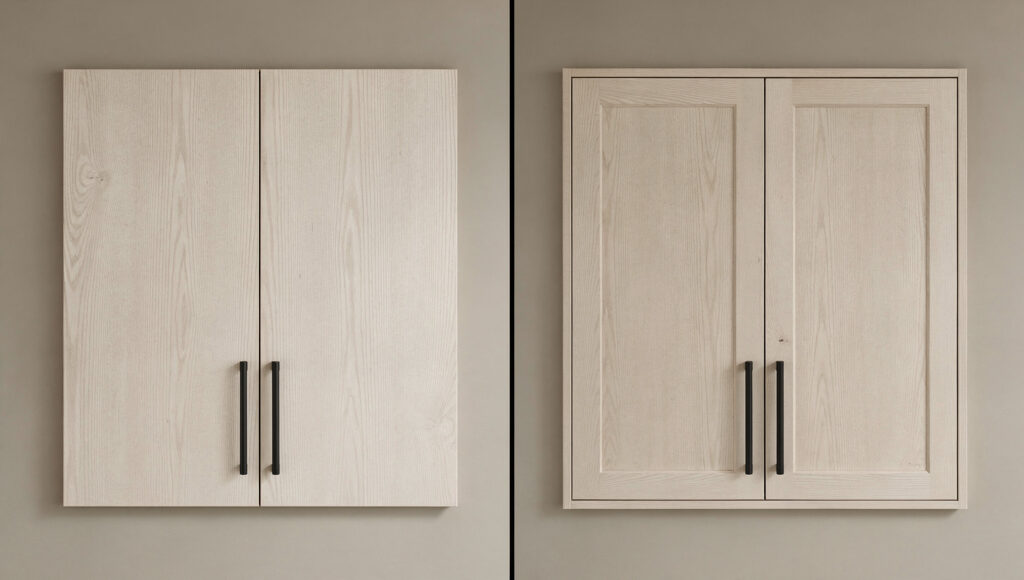
Before wood species, before color, before hardware — the door style determines whether a kitchen reads as Japandi or as something adjacent to it.
Two door styles are compatible with Japandi kitchen design. Every other door style is not.
Flat-panel doors — the Japanese choice
The flat-panel door — a single uninterrupted panel with no frame, no rail, no raised detail — is the most authentically Japanese cabinet door form available. Japandi cabinetry focuses on flat-panel doors in natural wood finishes which have become extremely popular with this style. The visual silence of a flat-panel door is not achieved by what it adds to the room — it is achieved by what it refuses to add. No shadow lines from rails. No decorative profile at the door edge. The cabinet face reads as a continuous material plane rather than a collection of components.
The grain direction of a flat-panel door in natural wood is the door’s only visual element. This is where the rift-sawn versus plain-sawn distinction becomes critical — and where most Japandi kitchen guides make their most significant omission.
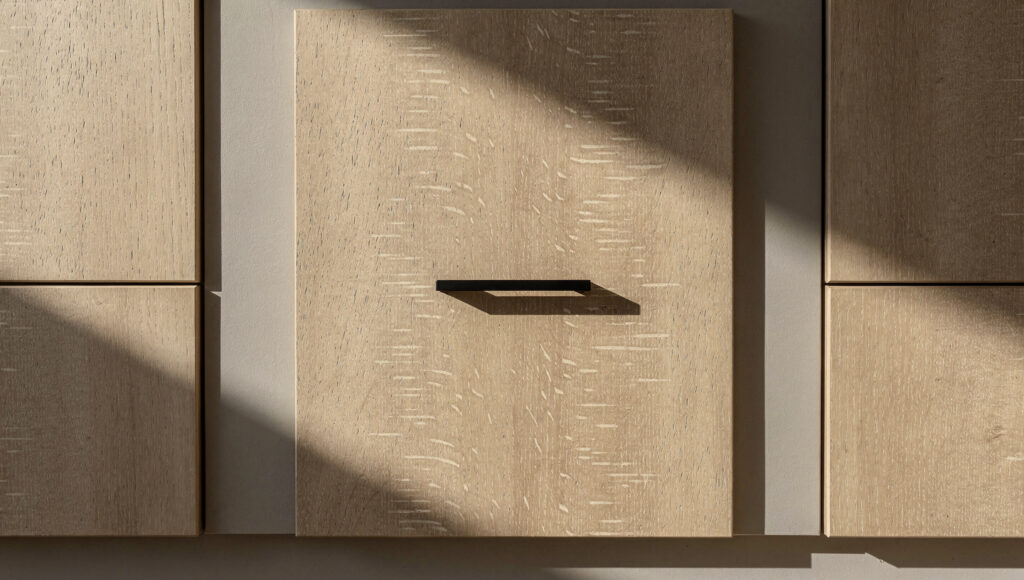
Rift-sawn white oak produces straight, vertical grain lines running consistently from top to bottom of the door. This vertical grain pattern reads as calm, structured, and architectural — the same quality as the vertical lines in a slatted wood wall. On a kitchen cabinet, rift-sawn grain creates a composed, deliberate surface.
Plain-sawn white oak produces the cathedral grain pattern — the curved, arch-shaped grain lines that most people recognize as typical wood grain. This pattern is beautiful but busy. On a kitchen cabinet it introduces a competing visual rhythm that the flat-panel door’s simplicity was designed to eliminate. Plain-sawn grain on a flat-panel Japandi cabinet is the most common and most costly mistake in Japandi kitchen specification.
We specified both grain directions for the same kitchen in a client material review. The rift-sawn version read as architectural. The plain-sawn version read as a wood-effect kitchen — the grain pattern dominating the surface and making the flat-panel door look like a substitute for a more decorated style rather than a choice in its own right.
Shaker doors — the Scandinavian-adjacent choice
The shaker door — a recessed center panel within a simple frame — is not authentically Japandi but is the acceptable alternative for households where pure flat-panel reads as too spare or too modern. The shaker door’s frame adds a single shadow line around the panel perimeter — one level of visual complexity above the flat panel.
For shaker doors to work in a Japandi kitchen, two conditions must be met. The frame must be narrow — 2 inches maximum on all sides. Wider frames read as traditional cabinetry rather than Japandi. And the reveal depth must be shallow — no more than 3/16 inch (5mm) of panel recess. Deep reveals create dramatic shadow lines that pull the door toward a traditional or craftsman character rather than a Japandi one.
What never works:
Raised-panel doors. Beadboard panel inserts. Mullion glass doors. Ornate edge profiles. Any door style that reads as decorative rather than honest is incompatible with the Japandi kitchen regardless of the wood species or color applied to it.
The Wood Species Decision
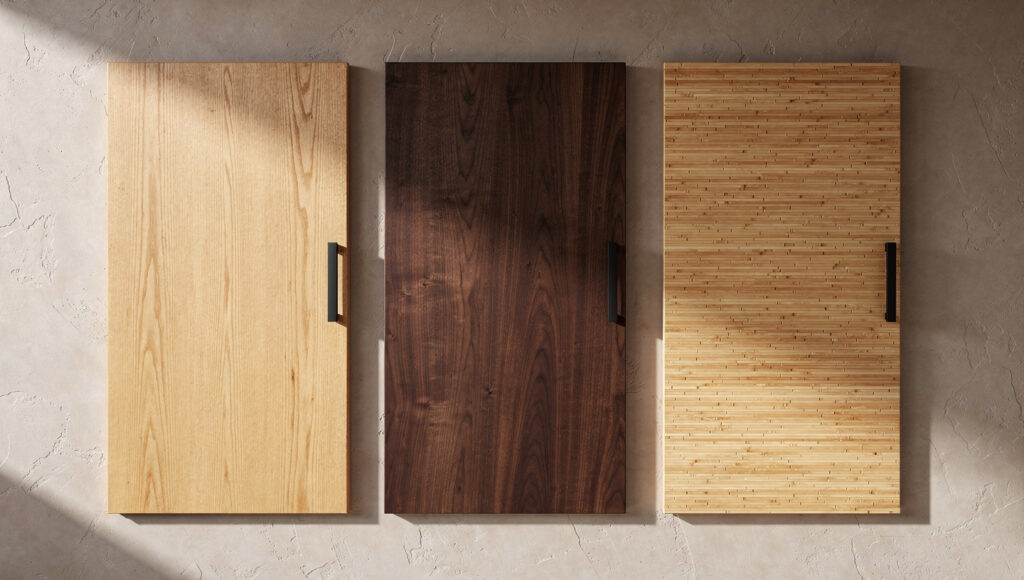
Natural elements such as wood, stone, and ceramics define the essence of Japandi — the combination of Japanese minimalism and Scandinavian design creates a timeless and harmonious atmosphere. In a kitchen where the cabinetry covers the majority of the wall surface, the wood species selection is the single most significant material decision.
White oak — the primary choice
White oak is the most versatile and most authentically Japandi cabinet wood available in the US market. Its warm grain, characteristic ray fleck pattern (visible in rift-sawn cuts as small medullary rays running perpendicular to the grain), and natural honey-to-amber tonal range harmonize with every warm neutral palette.
Rift-sawn white oak specifically produces the straight, consistent grain that flat-panel doors require. It is more expensive than plain-sawn — typically 20–30% premium — because the rift-sawn method wastes more of each log. The premium is justified for cabinet doors where the grain is the entire design.
White oak darkens and deepens with age and UV exposure. New white oak kitchen cabinets will be noticeably warmer and richer in tone within three to five years of daily use with natural light exposure. This aging trajectory is the wabi-sabi quality of genuine solid wood — the kitchen becomes more itself over time.
American walnut — the premium choice
Walnut cabinets produce a richer, deeper kitchen than white oak — more dramatic, more grounded, appropriate for larger kitchens where the darker tone does not compress the space. Deep wood tones paired with a pale stone top create a contrast that is soft rather than stark.
The practical walnut consideration: walnut is significantly more expensive than white oak as a cabinet material — typically 40–60% premium for solid wood or veneer in a full kitchen. For renovation budgets, the two-tone approach — walnut lower cabinets with warm white upper cabinets — achieves the walnut warmth at lower overall cost than a full walnut kitchen.
Walnut lightens slightly over years of UV exposure, moving from deep chocolate toward medium warm brown. Unlike white oak, which ages toward something richer, walnut ages toward something lighter. Factor this trajectory into the initial color selection — a walnut that looks exactly right today will be distinctly different in five years.
Bamboo — the Japanese choice
Sage green cabinets are the defining color of 2026 Japandi design — pair with light oak, linen textiles, and matte black hardware for the complete look. Bamboo cabinet panels — less common in the US market but increasingly available through specialty suppliers — are the most directly Japanese material choice for a Japandi kitchen. The linear grain of bamboo reads as architectural, its pale warm tone harmonizes with every warm neutral palette, and its sustainability credentials align with the Japandi philosophy of honest, considered materials.
The practical limitation: bamboo kitchen cabinets are not yet widely available through standard US cabinet retailers. They are primarily available through custom cabinet makers and specialty suppliers. For renovation budgets working with standard cabinet systems, white oak veneer on MDF is the accessible equivalent.
The Two-Tone Cabinet System
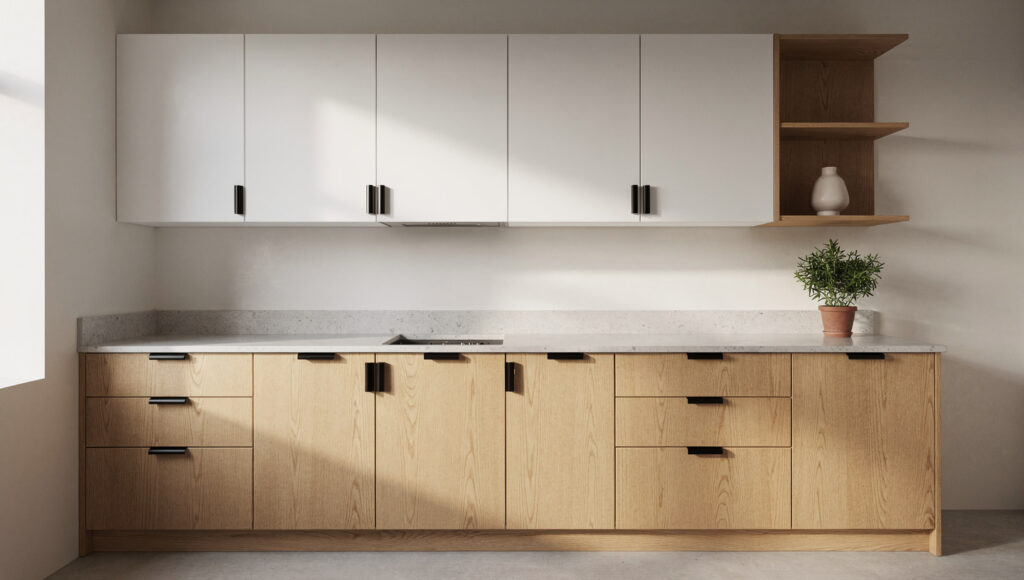
The two-tone cabinet system is the defining kitchen design approach of 2026 Japandi design. The darker wood island anchors the space while the upper cabinetry remains light — creating depth without relying on bold color shifts. Upper cabinets in a lighter tone, lower cabinets in a deeper or warmer tone.
The rationale is spatial and material simultaneously. Upper cabinets that are lighter than lower cabinets maintain the ceiling height — the pale tone above the countertop recedes, creating the sense that the ceiling is higher than it is. Lower cabinets that are deeper in tone ground the kitchen at the level where the most physical interaction happens — the work surface and storage — providing visual weight where weight is appropriate.
The two-tone specification:
Upper cabinets: Benjamin Moore White Dove OC-17 or Sherwin-Williams Alabaster SW 7008 in a flat matte paint finish on MDF flat-panel doors. Never gloss or satin — the sheen reads as clinical against the natural materials below.
Lower cabinets: rift-sawn white oak veneer, natural walnut veneer, or a painted tone in muted sage (Benjamin Moore Saybrook Sage HC-114) or warm greige (Sherwin-Williams Accessible Beige SW 7036).
The transition between upper and lower cabinet tones happens at the countertop line — the countertop itself acts as the material separator between the two tones. This makes the two-tone system read as intentional rather than as two separate design decisions that happen to share a wall.
The open shelf integration:
Open shelving is used in Japandi kitchens, though not quite as much as closed cabinetry. The correct Japandi approach is one section of open shelving within an otherwise closed cabinet run — typically above the counter on the wall adjacent to the window, or floating above the sink. This open shelf section breaks the continuous closed cabinet plane with an honest display of objects: one or two ceramics, a small plant, a stack of linen cookbooks. The open shelf is where the kitchen’s material warmth is expressed. The closed cabinets are where the kitchen’s functional calm is maintained.
The open shelf material must match the lower cabinet tone. An oak lower cabinet run should have an oak open shelf. A painted lower cabinet run should have either an oak shelf (for warmth) or a shelf painted to match the upper cabinets.
Hardware: The Specification That Finishes the Kitchen
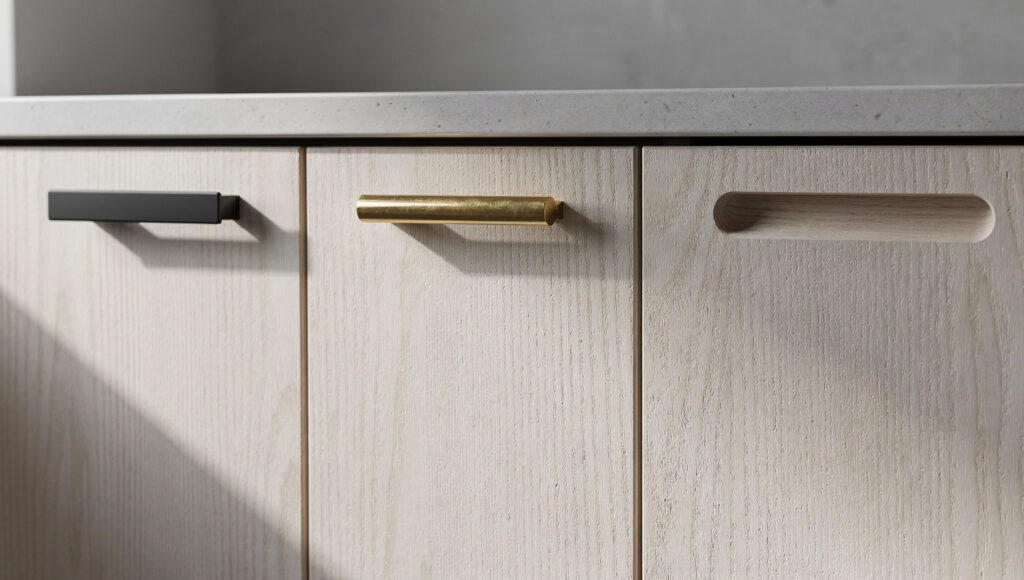
Cabinet hardware in a Japandi kitchen is the equivalent of the black accent in the warm minimalism system — it provides the visual punctuation that gives the cabinet surfaces their definition. Hardware in brushed brass, black, or brushed nickel works beautifully in this style, making the room feel elegant but not too bold.
Three hardware approaches work in a Japandi kitchen. Each produces a different material character.
Matte black pulls and knobs
The most commonly specified Japandi kitchen hardware in the US market. Matte black provides the clearest visual contrast against warm white or wood cabinet surfaces — it reads as architectural rather than decorative. The form should be minimal: a simple square or rectangular bar pull, 3–5 inches in length, with no ornate detailing.
The practical specification: pulls rather than knobs on all doors and drawers. Pulls are more ergonomic for daily kitchen use and their horizontal form echoes the horizontal lines of the counter and shelving. Knobs read as more traditional in character — acceptable on shaker doors, slightly misaligned with flat-panel Japandi doors.
Unlacquered brass
The wabi-sabi hardware choice. Unlacquered brass develops a natural patina over years of handling — brighter where touched, darker at the non-contact edges. In a Japandi kitchen where the material philosophy values honest aging, unlacquered brass is the most philosophically aligned hardware choice.
The practical consideration: unlacquered brass requires acceptance of the patina. It cannot be cleaned back to its original appearance without repolishing. Some households find the patina beautiful — it is the record of the kitchen being used. Others find it unkempt. This is not a hardware question. It is a question of whether the household genuinely embraces or merely appreciates the wabi-sabi philosophy.
Polished brass and lacquered brass are not acceptable Japandi hardware finishes. The high reflectivity of polished brass creates visual noise that fights every matte surface in the kitchen.
Integrated finger pulls
The most minimal hardware approach: a routed channel along the door edge — typically 3/8 to 5/8 inch (10–15mm) wide and about 1/4 inch (5–7mm) deep — that allows the door to be opened without any visible hardware at all. The finger-pull detail is cut into the door material itself, producing a cabinet face with zero applied hardware.
This approach is the most Japanese in character — the door itself is the only material present, the hardware entirely concealed within the form. It requires a cabinet maker or custom door supplier to execute correctly. IKEA and standard US cabinet retailers do not offer this detail natively, though aftermarket finger-pull insert strips are available for IKEA SEKTION doors at approximately $8–12 per door.
The practical limitation: integrated finger pulls are less ergonomic than bar pulls for heavy base cabinet doors. For upper cabinet doors they are excellent. For lower cabinet doors with heavy contents, a bar pull is the more functional choice.
The IKEA Approach: Japandi on a Renovation Budget
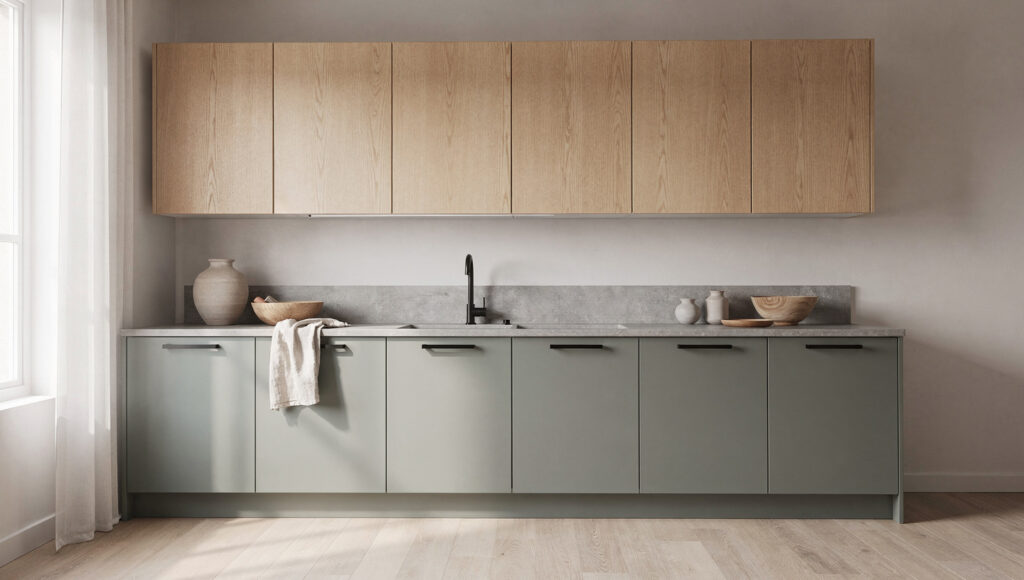
IKEA remains the most accessible entry point for Japandi kitchens in the US — not because it is the most authentic, but because the SEKTION cabinet system is the most flexible platform available at its price point.
The SEKTION system’s strength is its box quality — the interior cabinet construction is durable and the modular system allows configurations that custom cabinetry achieves at significantly higher cost. The weakness is the door fronts — IKEA’s standard door options do not produce authentic Japandi results without modification.
The three modifications that transform IKEA into Japandi:
Modification 1 — Replace the door fronts
Third-party door fronts designed for IKEA SEKTION boxes are available from specialist suppliers — Semihandmade, Plykea, and Reform are the three most widely used in the US market. These suppliers produce flat-panel doors in genuine white oak veneer, walnut veneer, and painted finishes that fit directly onto IKEA cabinet boxes using the existing hinge drilling.
The cost of third-party fronts is significant — typically $80–$150 per door — but produces a result that is visually indistinguishable from custom cabinetry at a fraction of the full custom cost.
IKEA AXSTAD door in matte gray-green at $58–$95 per door is the closest mass-market approximation of sage green Japandi cabinets available today — usable for lower cabinets in the two-tone system without requiring third-party replacement.
Modification 2 — Replace the hardware
IKEA’s standard hardware is not compatible with the Japandi aesthetic. The first modification after installation is replacing all pulls and knobs with matte black bar pulls or unlacquered brass options. This single change — typically $3–5 per pull for quality aftermarket hardware — transforms the perceived quality of the kitchen immediately.
Modification 3 — Upgrade the countertop
IKEA’s countertop options are the weakest element of the system. The laminate options read as synthetic against natural wood cabinet fronts. The correct Japandi countertop for an IKEA kitchen: Home Depot’s concrete-effect quartz starts at $45 per square foot and performs identically to new poured concrete for most Japandi applications. Honed rather than polished finish — the matte surface absorbs light the way every other Japandi kitchen surface does.
The Countertop and Backsplash Specification
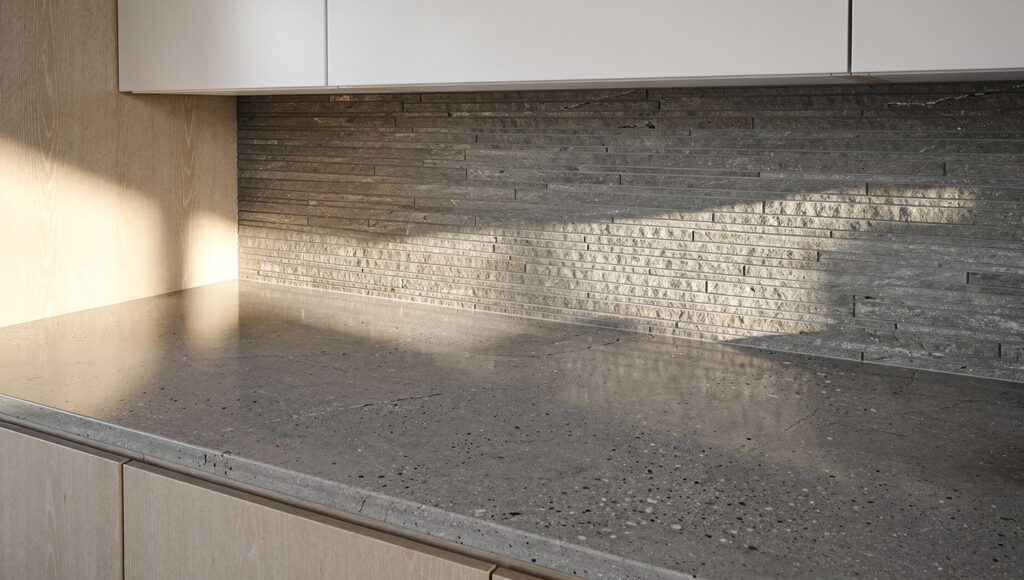
The countertop is the largest horizontal surface in the kitchen and the material that determines how the wood tones and hardware read from across the room.
The matte countertop rule:
Every Japandi kitchen countertop is honed, brushed, or leathered finish — never polished. A polished stone countertop reflects overhead light and creates the visual noise that the entire cabinet system is designed to eliminate. Honed stone absorbs light, producing the same matte quality as the cabinet surfaces beside it.
The correct countertop materials:
Honed Calacatta or Arabescato marble — warm white with soft gray veining. The most authentic and most expensive option. Marble is porous and requires sealing and careful maintenance. For households willing to commit to the maintenance, nothing reads as more resolved in a Japandi kitchen.
Honed or leathered quartzite — similar appearance to marble with significantly better durability and lower maintenance. Rift-cut white oak cabinets paired with quartzite countertops and a simple textural backsplash create the complete Japandi kitchen specification.
Concrete-effect quartz — the most practical option. The honed quartz surface requires no sealing, resists staining, and produces the warm gray mineral quality of concrete at lower cost and with zero maintenance.
Poured or pre-cast concrete — the most authentic and most demanding. Genuine concrete countertops develop hairline surface variation over time that is the material’s honest character. They require annual sealing and cannot be exposed to acidic foods without etching.
The backsplash specification:
The backsplash in a Japandi kitchen is either a continuation of the countertop material — a full-height slab that eliminates the horizontal grout line — or a simple, minimally textured tile in the same warm stone tone as the counter. No subway tile. No geometric pattern. No contrasting color. The backsplash should disappear into the material field rather than announcing itself as a design element.
The Specification Table: Japandi Kitchen Cabinet System
| Element | Most Authentic | Mid-Range | Budget Approach |
|---|---|---|---|
| Upper cabinet door | Custom rift-sawn white oak flat-panel | Third-party oak veneer on IKEA box | IKEA AXSTAD matte white with aftermarket hardware |
| Lower cabinet door | Custom walnut or rift-sawn oak flat-panel | Third-party walnut veneer on IKEA box | IKEA AXSTAD matte gray-green |
| Hardware | Unlacquered brass bar pull | Matte black bar pull | IKEA aftermarket matte black replacement |
| Countertop | Honed Calacatta marble or quartzite | Honed concrete-effect quartz | Home Depot concrete-effect quartz |
| Backsplash | Full-height countertop slab | Stacked natural stone tile | Honed matte ceramic in warm gray |
| Open shelf | Solid rift-sawn white oak | Oak veneer shelf with solid edge | IKEA BOASTAD solid oak shelf |
| Grain direction | Rift-sawn — straight vertical grain | Rift-sawn veneer | N/A for painted finish |
| Hardware finish | Unlacquered brass or matte black | Matte black | Matte black only |
Frequently Asked Questions
What is the difference between flat-panel and shaker doors for a Japandi kitchen?
A flat-panel door — a single uninterrupted panel with no frame or rail — is the most authentically Japanese cabinet door form and the correct choice for a Japandi kitchen. It reads as a continuous material plane rather than a constructed object. A shaker door adds a single shadow line frame around a recessed panel — acceptable in a Japandi kitchen when the frame is narrow (2 inches maximum) and the panel recess is shallow (3/16 inch maximum), but more Scandinavian-transitional in character than purely Japandi. Both work. Every other door style does not.
What wood should Japandi kitchen cabinets be made from?
Rift-sawn white oak is the most versatile and most authentic Japandi kitchen cabinet wood available in the US market. The rift-sawn cut produces straight vertical grain lines that read as calm and architectural rather than the busier cathedral grain of plain-sawn cuts. American walnut is the premium alternative — richer, deeper, more grounded — and works best in the two-tone system as the lower cabinet material paired with warm white upper cabinets. Both species should be in matte or natural oil finish — never lacquered or high-gloss.
How do I achieve a Japandi kitchen on a budget?
The IKEA SEKTION cabinet system is the most accessible platform for a Japandi kitchen at budget price points. The correct approach: configure the SEKTION boxes in the standard system, then upgrade three elements — replace the door fronts with third-party flat-panel oak veneer options from suppliers like Semihandmade or Plykea, replace all hardware with matte black bar pulls, and upgrade the countertop to a honed concrete-effect quartz. These three modifications produce a kitchen that reads as custom Japandi from any viewing distance at a fraction of full custom cabinet cost.
The Finished Kitchen: Material Before Everything
The Japandi kitchen is not a kitchen with Japandi objects in it. It is a kitchen where the architecture itself — the cabinet door form, the wood grain direction, the hardware material, the countertop finish — produces the visual silence that the aesthetic requires.
A flat-panel rift-sawn white oak door in a matte finish does not ask for attention. It simply is the material it is made from. That honesty — present at every cabinet face, every drawer front, every open shelf — is what makes a Japandi kitchen feel calm before a single ceramic or dried stem is placed on the counter.
The objects follow the architecture. The architecture begins with the cabinet.

