
Every December the same thing happens to a calm room. Eleven months of restraint, of bare surfaces and one branch in one vessel, and then a box comes down from the loft and the whole thing disappears under tinsel, red baubles, and a light show. By the second week it does not feel festive. It feels loud.
Japandi Christmas is not a smaller version of a normal Christmas. It runs on the same principle the rest of the style runs on: the room is already right, and the season is a small, deliberate shift rather than a layer applied on top. Most Japandi Christmas guides miss this and hand you a shopping list of minimalist-shaped objects, ceramic deer and matte baubles and wooden reindeer. That is still decorating by accumulation. It just costs more.
This is the method instead. What to change, what to make, what to buy, and what to leave alone.
The Japandi Christmas Rule
Takeaway: Christmas arrives through light, scent, and one living element. Everything else is subtraction.
Christmas in a Japandi room arrives through three things only: light, scent, and one living element. Everything else is subtraction.That sounds austere until you notice it is exactly how the season actually feels. The reason December is atmospheric is not the ornaments. It is that the light goes low and warm, the house smells of pine and citrus and spice, and something green and alive comes indoors from a cold place. Those three are the holiday. The rest is packaging.
So the test for any object: does it change the light, the scent, or bring something alive into the room? If it does none of those, it is a decoration in the literal sense, and a Japandi room does not have room for it. This is the same discipline that governs the Japandi living room, applied to a season that usually suspends it.
The practical consequence is that a Japandi Christmas costs almost nothing and takes about an hour. There is no box in the loft.
The Tree, Reduced
The tree is the one large seasonal object a Japandi room can hold, and it holds it best when it is barely decorated.
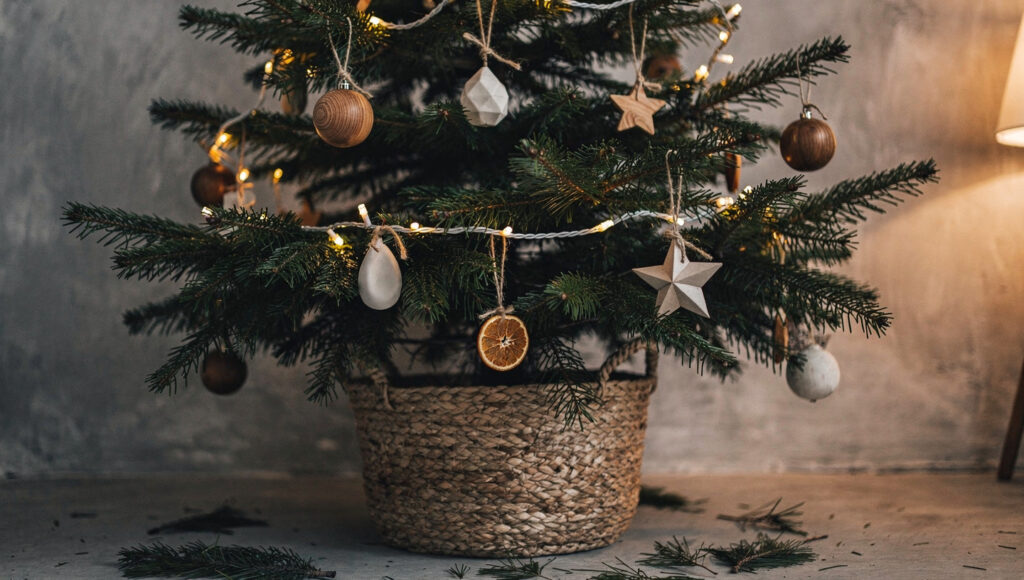
Choose a real tree over an artificial one if you possibly can. This is not a sustainability point, it is a material one. A real fir has irregular branch spacing, a genuinely organic silhouette, and it does the scent job on its own with no help. An artificial tree is a plastic object with symmetrical branches, and plastic ages badly and reads wrong in a room built on natural materials. If storage rules out a real tree, a slim or pencil fir is the compromise, and it should still be sparse.
Then under-decorate it, deliberately. The Japandi tree wants the branches visible. Warm white lights, wound loosely rather than densely. A small number of ornaments in natural materials — wood, unglazed ceramic, paper, dried citrus — all in one narrow tonal range. Space them unevenly and leave clear branches between them. A tree with fifteen ornaments and visible negative space reads composed. The same tree with sixty reads like every other tree.
Skip glitter entirely, along with anything with a mirror finish. Specular highlights are exactly what the oiled, matte material palette of a Japandi room avoids, and a glitter ornament next to an unglazed vessel makes the vessel look like a mistake.
The base matters more than people expect. A woven basket or a raw wooden crate hides the plastic stand and grounds the tree in the material language of the room. That single swap does more than any ornament.
The Palette: Verified Codes, Not Red and Green
Takeaway: Red and green are saturated complements at maximum contrast — the loudest possible pairing for a low-contrast room. One muted note instead.
The whole reason a normal Christmas breaks a calm room is chromatic. Traditional red and green are saturated complements sitting at maximum contrast, which is the loudest possible pairing you can put into a low-contrast neutral space. It is not that they are ugly. It is that they are the visual opposite of the room’s operating principle.
The Japandi Christmas palette stays inside the warm neutral range the room already uses and lets one earth tone carry the season. Every code here is verified against the manufacturer.
| Role | Code | Note |
|---|---|---|
| Base white | White Dove OC-17 or Alabaster SW 7008 | Unchanged — the room is already right |
| Warm neutral | Accessible Beige SW 7036, Pale Oak OC-20, Natural Cream OC-14 | You may already have these |
| Seasonal note — green | Saybrook Sage HC-114 or Evergreen Fog SW 9130 | Muted grayed sage, not pine green |
| Seasonal note — warm | Cavern Clay SW 7701 or Baked Terra Cotta 1202 | Clay, not red |
| Dark anchor | Iron Ore SW 7069 or Wrought Iron 2119-10 | Small objects only in a dim room |
Pick one seasonal note. Not both, and never both plus the traditional colors. The single note is the whole point. The full framework sits in the Japandi color palette guide, and the specific codes live in the Japandi paint colors hub.
Light Is the Decoration
Takeaway: Overhead off. Warm white only, never cool white. Real flame at 1800K. This is the whole holiday.
This is the change that does the most and costs the least, and it is where a Japandi Christmas genuinely beats a conventional one.
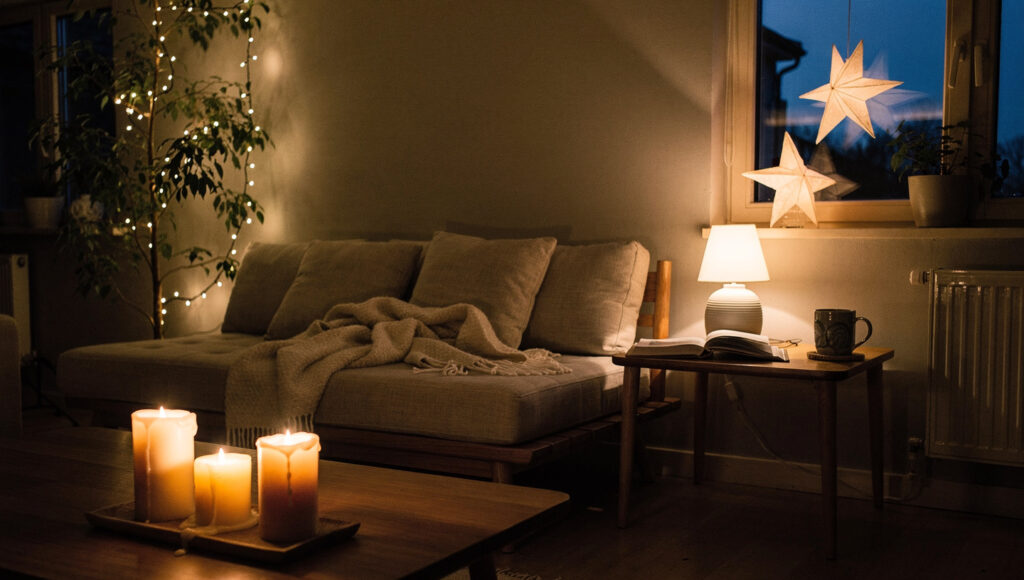
Turn the overhead light off in the evening and leave it off through the season. Work from low, warm, multiple sources instead: table lamps at 2700K or below, ideally dimmed. This is the same lighting discipline the style uses year round, simply pushed further as the daylight shrinks.
For the tree and any garland, warm white only. Look for bulbs labeled warm white or soft white, and avoid cool white entirely, which reads blue and clinical and will fight every warm neutral in the room. Wind them loosely and let some branches stay dark. Dense lighting flattens a tree into a glowing cone; sparse lighting gives it depth.
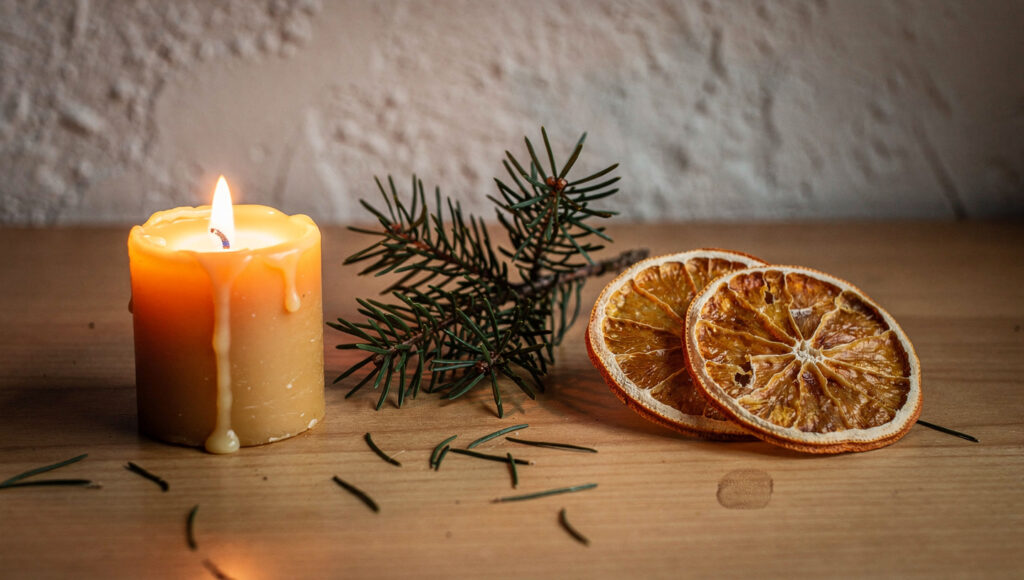
Then add real flame. A beeswax or unscented pillar candle burns near 1800K, the warmest light in the house, and it is the single most seasonal thing you can do without buying decor. Grouped in threes at uneven heights on a wooden tray, candles are a centerpiece that costs almost nothing and disappears completely when the season ends.
Paper is the one traditional Japandi Christmas object worth having. A paper star or a rice paper lantern diffuses light softly, references both halves of the style honestly, and folds flat for storage. It is the rare seasonal object that is also a light source, which is exactly why it earns its place. The year-round version of this thinking is in the Japandi living room lighting guide.
Bring the Outside In
The living element is the third pillar, and it should come from outside rather than from a shop.
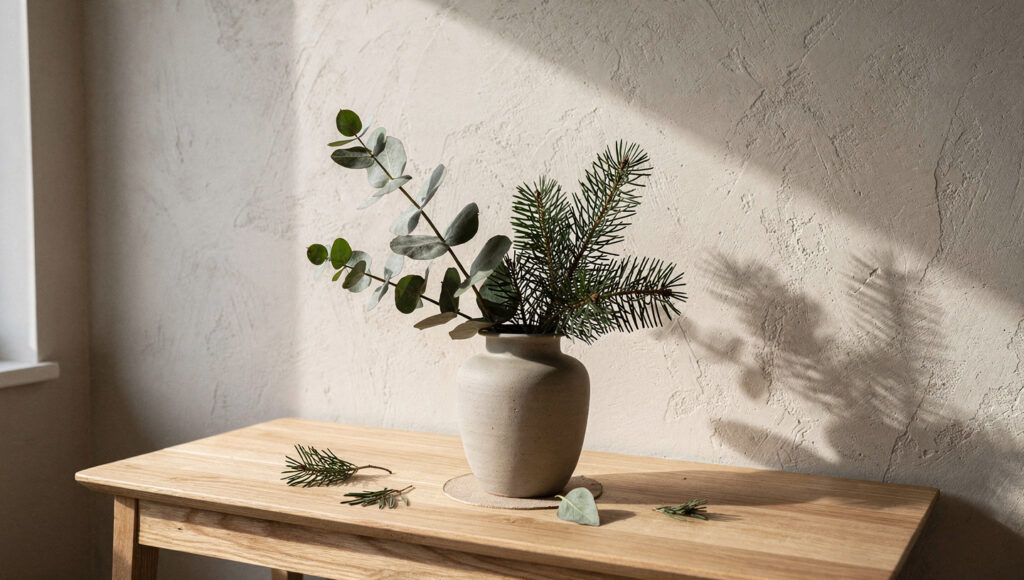
Cut greenery is better than any bought decoration. A few sprigs of fir, a branch of eucalyptus, olive, or pine, arranged in a matte ceramic or stoneware vessel, gives you the scent, the color, and the organic form in one object. Follow the ikebana principle the rest of the style follows: asymmetry, one strong line, wide clear space around it. Three stems leaning off-axis beat a full arrangement.
A wreath works if it is honest. An unsprayed eucalyptus or fir wreath on a plain door, with no ribbon, no berries, and no glitter, is a Japandi object. A wreath with a plaid bow is not. If you make one, a wooden ring or a plain metal hoop as the base keeps it structural rather than fussy.
Dried citrus is the one edible decoration that fits. Sliced oranges dried in a low oven, hung with jute twine on the tree or strung as a simple garland, are the right color, the right material, and they do the scent job. They also cost nothing and go in the compost in January.
For scent, skip the artificial fragrance entirely. Simmer a pot of water with orange slices, cinnamon sticks, and cloves. It fills a house more convincingly than any candle and there is no object left over.
The Table
A Japandi Christmas table is where restraint pays off most, because the food is the event and the table should get out of its way.
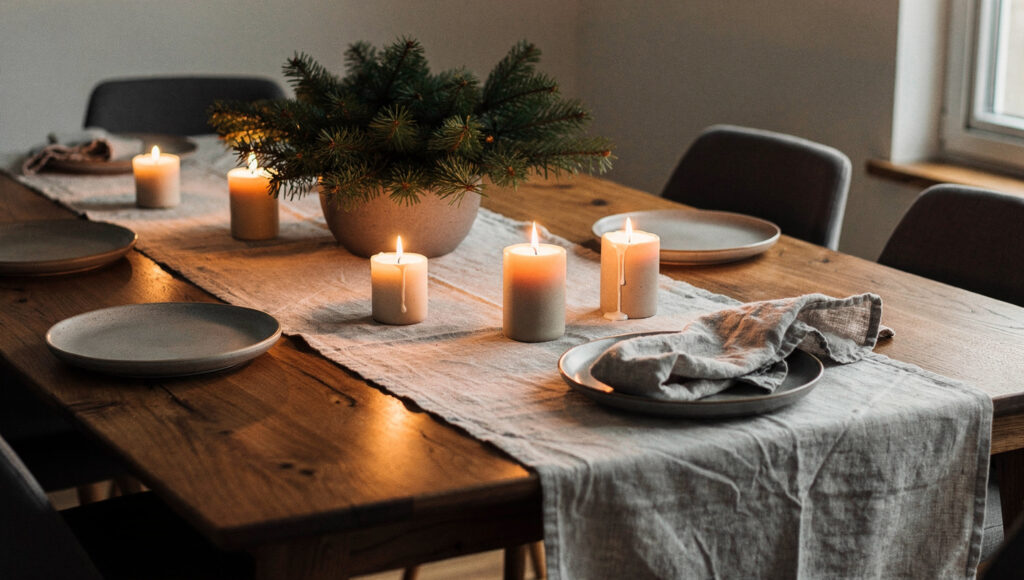
Start with a washed linen runner or cloth in oat or undyed natural. Linen is the material the whole style rests on, it creases honestly, and it will be in use long after the season. Add unglazed ceramic or stoneware plates, or simply the ones you own. Wooden serving boards. Nothing needs to be bought for this.
The centerpiece is low and organic. Cut greenery in a matte vessel, or candles in plain holders at uneven heights, or both if the table is long. It must be low enough to see over, which is a functional rule that most festive tables ignore.
Then stop. No crackers, no confetti, no place-card holders shaped like reindeer, no metallic charger plates. The room does the work, the food does the rest, and the table stays a table.
What to Skip, and Why
The list is longer than the list of things to add, which is the correct ratio.
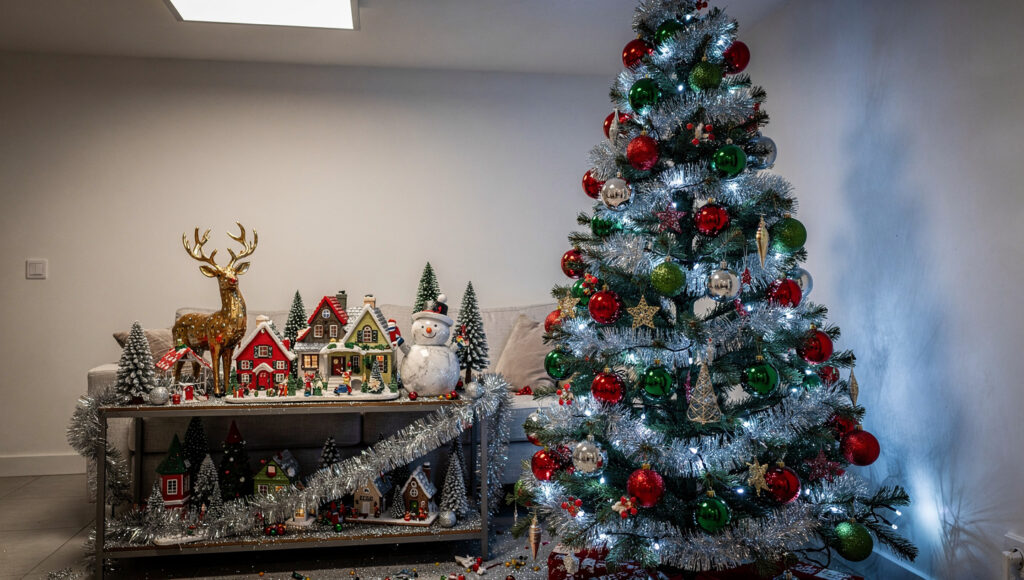
Skip red and green together. Skip tinsel and garland in synthetic materials. Skip glitter and anything with a mirror finish, for the specular-highlight reason above.
Skip the ceramic deer, the wooden reindeer, the marble snowman, the tabletop village. These are the objects that minimalist Christmas guides sell you, and they fail the test: they change nothing about light, scent, or life in the room. A minimalist-shaped ornament is still an ornament.
Skip inflatables, obviously, and skip cool white lights, which is the most common and most damaging error in the whole list.
Skip the fake pine scent. And skip buying an artificial tree to save money, because it is a large plastic object you will store for eleven months and look at for one
The Whole Thing, in Order
If you do five things, do these.
Turn the overhead light off and light the room from two or three low warm sources. Get a real tree, wind warm white lights loosely, and hang fifteen natural ornaments with clear branches between them. Cut three stems of greenery and put them off-axis in a matte vessel. Group three candles on a wooden tray. Simmer oranges and cinnamon on the stove.
That is Christmas. It took an hour, it cost the price of a tree and some candles, and on the second of January it is gone without a trace.
Frequently Asked Questions
What colors should a Japandi Christmas be?
Keep the base exactly as it is, warm white and warm neutrals, and add one seasonal note only. Either a muted grayed sage such as Saybrook Sage HC-114 or Evergreen Fog SW 9130 for a green direction, or a clay tone such as Cavern Clay SW 7701 or Baked Terra Cotta 1202 for a warm one. Traditional red and green are saturated complements at maximum contrast, which is the loudest possible pairing to introduce into a low-contrast neutral room. That is why a conventional Christmas breaks a calm space, and why one muted note does not.
How do I decorate a Japandi Christmas tree?
Choose a real fir if you can, for the irregular silhouette and the scent, and set it in a woven basket or wooden crate rather than showing the plastic stand. Wind warm white lights loosely so some branches stay dark, which gives the tree depth. Then add a small number of ornaments in natural materials only — wood, unglazed ceramic, paper, dried citrus — all in one narrow tonal range, spaced unevenly with visible clear branches between them. Around fifteen ornaments on a full tree is usually right. Skip glitter and mirror finishes entirely, since specular highlights fight the matte material palette the rest of the room uses.
Can I have a Japandi Christmas with kids?
Yes, and it is often easier than a conventional one, because the three pillars are all things children respond to more than they respond to ornaments. Low warm light, the smell of oranges and cinnamon simmering, and a real tree that they helped cut greenery from all land better than a plastic village. The one honest adjustment: handmade ornaments made from clay, paper, or wood are the right material and the right activity, and a slightly crowded tree made by a six-year-old is a better room than a perfectly spaced one made by you.

