
This post contains affiliate links. If you purchase through these links, Homeoration earns a small commission at no extra cost to you — it helps keep this content free.
A sofa is not a decorative decision. It is the architectural anchor of a living room — the piece that every other decision orbits around, the surface that determines whether the room reads as considered or assembled by accident.
In a Japandi living room, the sofa carries more visual weight than any other element. Get it right and the room settles. Get it wrong and no amount of careful lighting, correct paint color, or considered planting will compensate.
- Sofa or couch, and does it matter?
- The Four Non-Negotiable Specifications
- The Fabric Decision: Linen vs Bouclé vs Wool Blend
- The Leg Specification in Detail
- The Japandi Sofa by Room Size
- The Complete Japandi Sofa Buying Guide by Budget
- What Never Belongs in a Japandi Living Room
- Frequently Asked Questions
- The Finished Room: One Sofa, Every Decision
- Shop This Look
Sofa or couch, and does it matter?
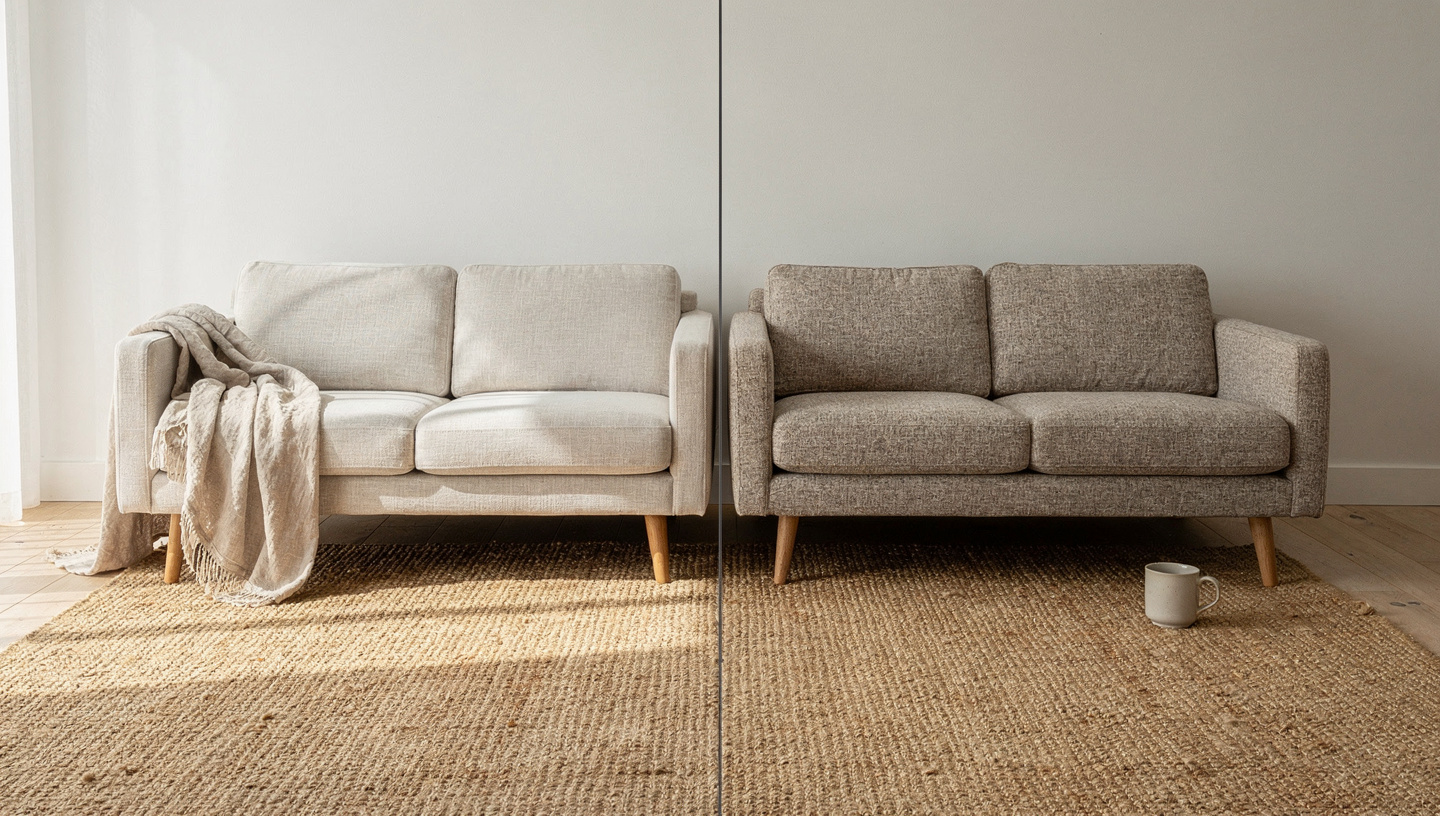
The two words are used interchangeably in the US, couch in casual speech and sofa in the showroom, and for a Japandi piece either is correct.
It is worth knowing because retailers use them inconsistently. Searching only one term will hide half the market from you, and the piece you want may well be listed under the word you did not try. Run both.
What matters is not the label but the proportions, and those are identical whichever word appears in the listing: a deep seat, a low total height, a back that does not tower, and a grounded base on solid wood legs. A tall, high-backed couch on bun feet is not a Japandi sofa no matter which of the two words the seller chose, and a low, deep, oak-legged couch is one even if the listing never says sofa.
One practical note: “couch” listings skew slightly toward the budget end of the US market and “sofa” toward the mid and upper end, which is a marketing convention rather than a quality signal. Judge the specifications below, not the vocabulary.
The Four Non-Negotiable Specifications
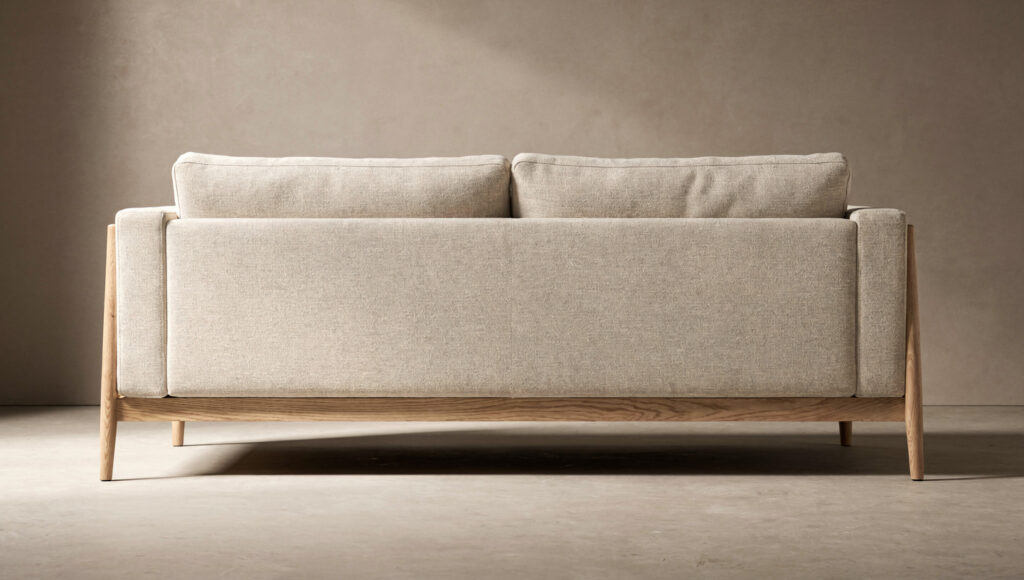
Before any brand or price consideration, four specifications determine whether a sofa qualifies as authentically Japandi. A sofa that fails any one of these four is not the right sofa regardless of how it is marketed.
Specification 1 — Seat depth: 25 inches minimum, 28–30 preferred
This is the most important dimension and the most commonly violated. A sofa with a 22-inch seat depth is for sitting upright — for conversations at a dining table height. A Japandi living room sofa is for the full spectrum of living — reading, resting, curling up. That requires depth.
The 25-inch minimum is non-negotiable. The 28–30 inch range is ideal. When you sit in the showroom or look at the product specifications, this number determines more about the sofa’s suitability than any other single measurement.
Specification 2 — Total height: 28–32 inches maximum
Japandi furniture sits close to the ground. This is the Japanese influence — the tradition of low furniture that keeps the visual weight of the room earthbound and maximizes the sense of vertical space above the furniture line.
A sofa taller than 32 inches reads as too upright — too formal, too Western in its proportions. A sofa at 28–30 inches reads as deliberate and grounded. The height also affects how the sofa relates to the coffee table — a lower sofa requires a lower table, and a lower table is more Japandi in character.
Specification 3 — Leg material: solid wood only
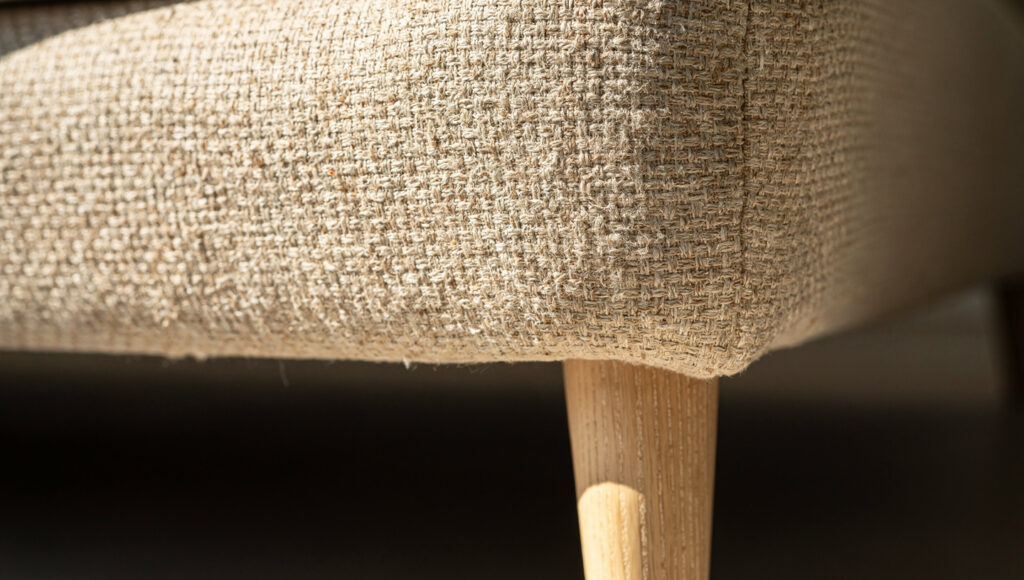
The legs of a Japandi sofa are visible architecture. They should be solid wood — white oak, walnut, or ash — with a tapered form that reduces toward the floor. No chrome, no hairpin legs in metal, no plastic feet hidden under fabric skirts.
The wood leg contributes the material warmth that makes the sofa belong to the Japandi material language of the room. A linen sofa on chrome legs is a Scandinavian sofa. A linen sofa on solid white oak tapered legs is a Japandi sofa.
Specification 4 — Upholstery: natural fiber only
Linen, bouclé, wool blend, or performance linen. These are the four acceptable Japandi sofa upholstery materials. Each one ages differently and beautifully — linen softens and develops character with washing, bouclé maintains its looped warmth and texture, wool blend provides the most practical durability.
Synthetic velvet, faux leather, and polyester blends are categorically wrong for a Japandi sofa. They produce a visual harshness under natural light that no amount of careful styling corrects. The material is the message — synthetic fabric says the room was furnished for appearance rather than lived in for quality.
The Fabric Decision: Linen vs Bouclé vs Wool Blend
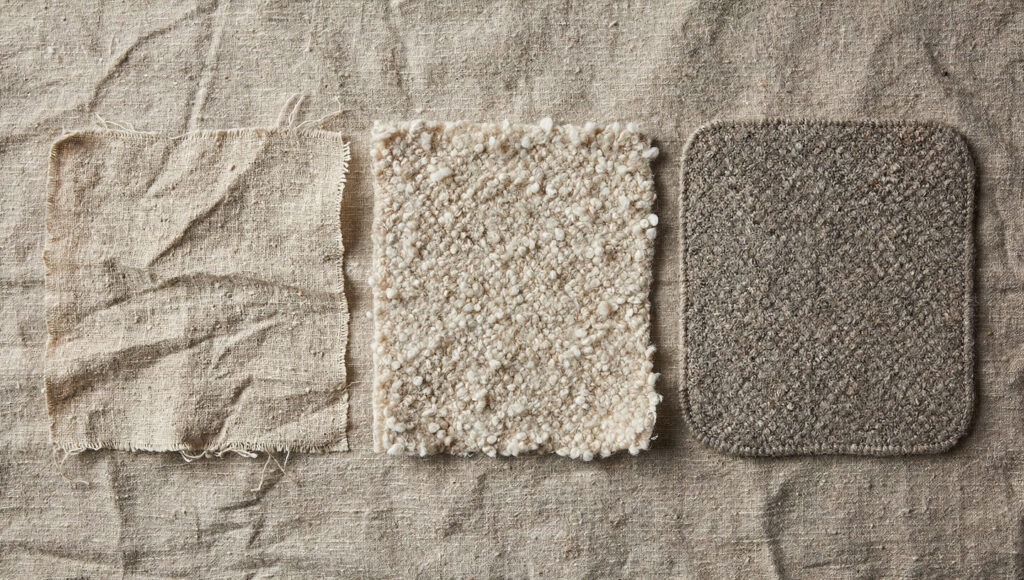
The fabric choice determines the character of the sofa and its relationship to the rest of the room. Each of the three acceptable materials makes a different architectural statement.
Linen — the most wabi-sabi choice
Linen is the fabric that improves with use. It softens with every wash, develops a natural crease that is the visual evidence of a material genuinely lived with, and carries the warm oat or flax tones that harmonize most directly with the Japandi neutral palette.
The practical consideration: linen marks. Pets, children, and daily living leave traces on linen upholstery. This is not a flaw — it is the wabi-sabi quality of a material that records the life lived on it. If that philosophy is genuinely embraced, linen is the correct choice. If it will produce anxiety, choose bouclé or performance linen instead.
Best linen sofa tone: undyed natural, warm oat, warm flax, or stone. Never bright white — bright white linen against warm greige walls creates too much contrast and draws the eye to the sofa rather than letting it settle into the room.
Bouclé — the warmest visual choice
Bouclé’s looped surface catches light in thousands of individual points simultaneously — it generates visual warmth at a distance in a way that flat fabrics cannot replicate. A charcoal bouclé sofa in a dark room reads as warmer than a linen sofa in the same color because of the textural light variation.
The practical consideration: bouclé pills with heavy friction over time. High-traffic households with pets should verify the bouclé weight — heavier bouclé weaves resist pilling significantly better than lightweight options. Look for a bouclé with at least 60% wool content for durability.
Best bouclé tones for Japandi: oat, warm stone, warm gray, charcoal. The charcoal bouclé is the correct choice for Dark Japandi living rooms — it merges with the dark walls while contributing the textural warmth the palette requires.
Wool blend — the most practical choice
Wool blend upholstery provides the closest thing to bouclé warmth with significantly better practical durability. It resists marking, cleans more easily than linen, and does not pill the way lightweight bouclé can.
The practical consideration: wool blend sofas are harder to find in the low-profile Japandi silhouette. Many wool blend sofas are designed for traditional or contemporary interiors with higher profiles and heavier proportions. When a wool blend sofa hits the correct Japandi specifications — seat depth over 25 inches, total height under 32 inches, solid wood legs — it is the single most durable and most practical Japandi sofa choice available.
The Leg Specification in Detail
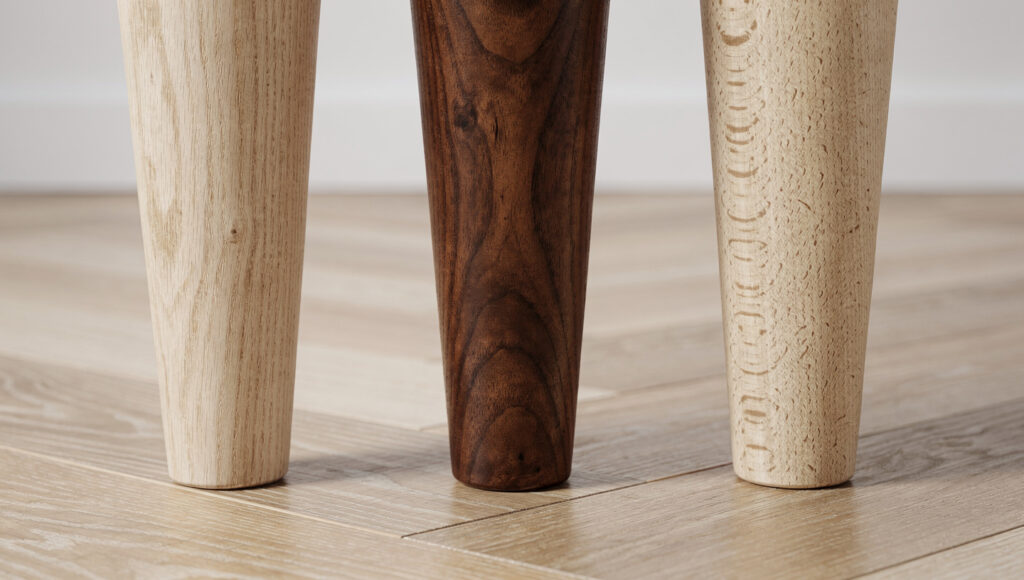
The leg of a sofa is the point of material dialog between the sofa and the floor. In a Japandi room where the floor is visible — light oak herringbone, natural stone, wide-plank pale wood — the sofa leg contributes to or disrupts the material language of the entire lower plane of the room.
White oak legs are the most versatile Japandi sofa leg choice — warm grain, light tone, compatible with every warm neutral palette and every floor material in the Japandi vocabulary. If the room has white oak furniture elsewhere, white oak sofa legs create material continuity.
Walnut legs are the correct choice for rooms with deeper furniture tones or dark Japandi palettes. The rich chocolate-brown of walnut legs against a charcoal bouclé sofa and dark limewash walls produces the most resolved dark material composition.
Leg height matters as much as material. Too short — under 4 inches — and the sofa appears to sit directly on the floor, which can read as heavy. Too tall — over 8 inches — and the sofa loses its grounded, low-profile Japandi character. The 5–7 inch leg height is the Japandi standard.
Floor clearance is a practical specification with aesthetic consequences. A sofa with 4 inches of floor clearance allows vacuuming beneath it, prevents dust accumulation, and — critically — allows the floor plane to read as continuous rather than interrupted. A sofa that appears to float slightly above the floor makes the room feel larger.
The Japandi Sofa by Room Size
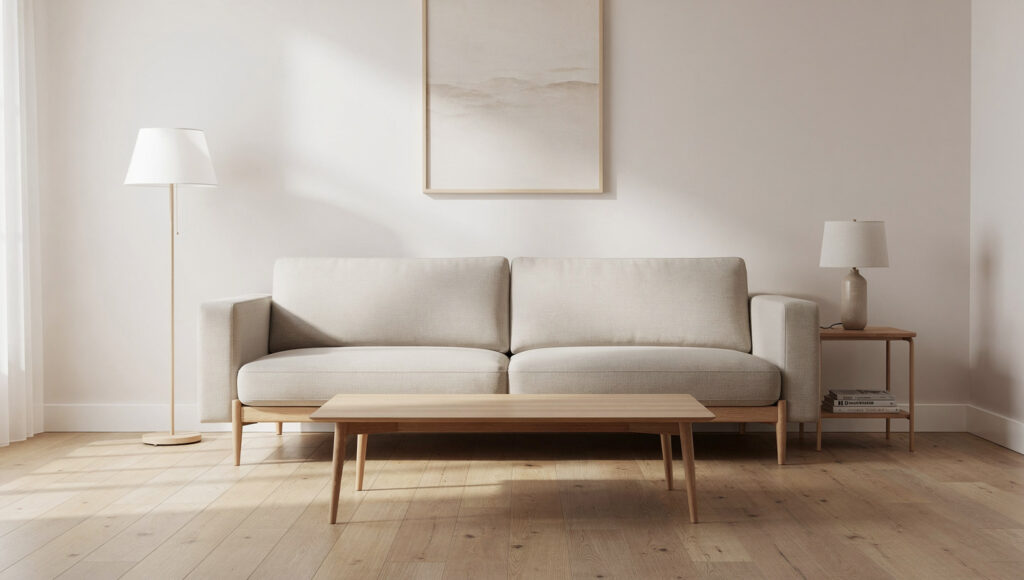
The size of the sofa relative to the room determines whether the space reads as considered or overfurnished. Japandi design is intolerant of furniture that crowds — the negative space around the sofa is as important as the sofa itself.
The clearance rules:
- 24 inches minimum of clear floor on each side of the sofa — this allows natural traffic flow and prevents the sofa from appearing to touch the walls
- 36 inches minimum between the back of the sofa and the wall behind it — this creates the floating furniture effect essential to Japandi spatial planning
- 18–24 inches between the front of the sofa and the coffee table — close enough for comfortable use, far enough to allow the rug and floor to breathe
For rooms under 200 square feet:
A two-seat sofa or a compact three-seat sofa at 72–80 inches wide is the maximum. A sectional in a small room destroys every clearance rule simultaneously and should never be used in a Japandi small space.
For standard US living rooms (200–350 square feet):
An 84–96 inch three-seat sofa is the correct scale. At this width the sofa anchors the room without dominating it and allows proper clearances on both sides.
For open-plan spaces (350+ square feet):
An 84–96 inch sofa or a modular configuration can work, but the floating principle applies with even greater strictness. In a large open plan, a sofa pushed against the wall reads as furniture without a room — it needs to float away from the perimeter to define its zone within the connected space.
The Complete Japandi Sofa Buying Guide by Budget
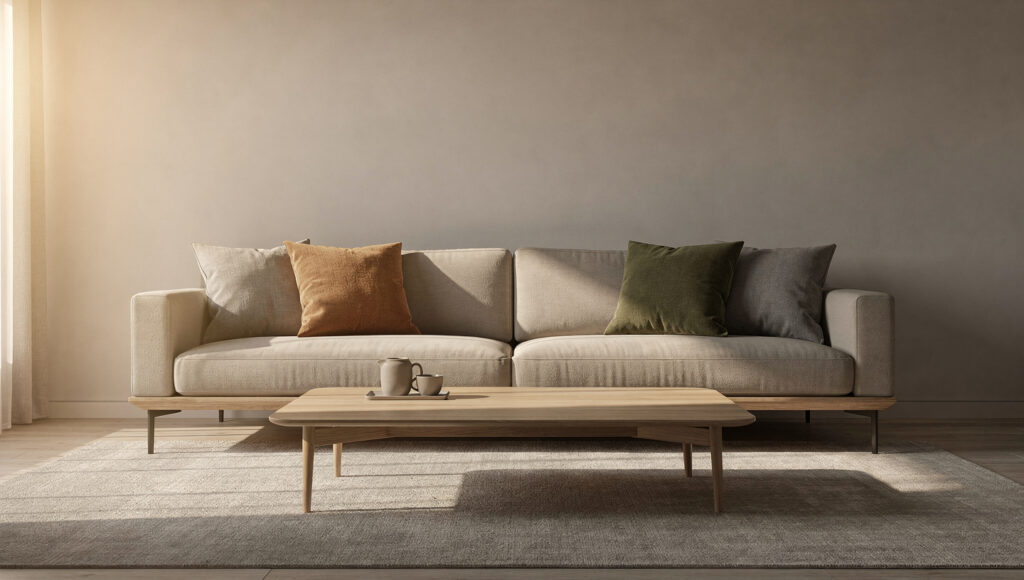
Every sofa below meets the four non-negotiable specifications — minimum 25 inch seat depth, maximum 32 inch total height, solid wood legs, natural fiber upholstery.
Under $800 — The Accessible Entry
At this price point the options narrow considerably. Most sofas under $800 fail the seat depth requirement — they are designed for visual appeal rather than genuine seated comfort at Japandi depth.
The most reliable sub-$800 option is the IKEA SÖDERHAMN — a modular sofa system that achieves the deep-seated, low-profile Japandi silhouette at an accessible price. The SÖDERHAMN seat depth is 27.5 inches — the correct Japandi range. Its total height is 30 inches. The legs are short and plastic in the standard configuration — replace them immediately with aftermarket solid oak furniture legs (search “SÖDERHAMN replacement oak legs” on Amazon, approximately $35–55 for a set of four). The upholstery range includes several linen-blend options in warm neutral tones.
$800–$1,400 — The Mid-Range Standard
This price range contains the most consistently Japandi-proportioned sofas available in the US market.
The Article Sven Sofa at approximately $1,299 is the benchmark — 25.6-inch seat depth, 30-inch total height, solid wood tapered legs, available in oatmeal bouclé and multiple linen-adjacent fabric options. It is the most frequently recommended Japandi sofa in US interior design publications for good reason. The proportions are correct. The material is correct. The leg is correct.
The West Elm Shelter Sofa at approximately $1,199–$1,599 offers a slightly different profile — slightly higher back, more Scandinavian in character — but meets the Japandi specifications with its deep seat, natural fabric options, and solid wood legs. Works particularly well in living rooms where the sofa needs to provide a stronger visual back structure.
$1,400–$2,500 — The Investment Tier
At this price point the material quality improves significantly and the sofa becomes a genuinely long-term investment — a piece that improves rather than degrades with use.
The Castlery Harris Sofa at approximately $1,599–$1,899 is the most architecturally resolved Japandi sofa available in the US direct-to-consumer market. Solid oak legs, performance linen in warm neutral tones, seat depth of 26 inches, total height of 30 inches. The performance linen upholstery is a significant practical advantage — it achieves the visual warmth of standard linen with significantly improved stain resistance.
The Floyd Sofa at approximately $1,800–$2,200 is the most modular option at this tier. The Floyd system allows the sofa configuration to be adjusted as the room or household changes — additional seats, different orientations — without purchasing a new sofa. For households where flexibility matters, the modularity at this quality level is worth the premium.
$2,500 and above — The Heirloom Tier
Above $2,500 the sofa becomes a piece that is chosen once and kept for decades. At this tier, the specifications are consistently met and the decision shifts from finding a sofa that qualifies to finding the material expression that is most precisely right for the specific room.
The Ethnicraft N701 Sofa at approximately $3,800–$4,500 is the most authentically Japandi sofa at this tier — solid oak frame, removable and washable linen covers, modular configuration, and a design heritage that connects directly to the Scandinavian craft tradition that informs the Japandi aesthetic. It is the sofa that designers specify when budget is not the primary constraint.
What Never Belongs in a Japandi Living Room
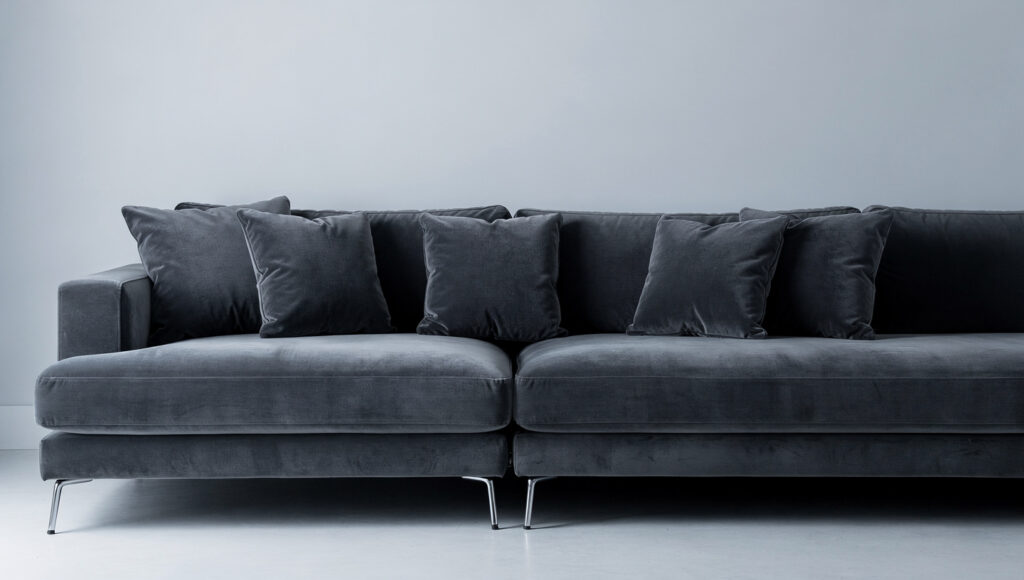
Understanding what disqualifies a sofa clarifies every positive specification.
The gray sectional — the dominant sofa choice in US living rooms for the past decade — fails the Japandi specification on almost every dimension simultaneously. It is typically too high in total profile, too wide for proper clearances in standard rooms, upholstered in synthetic fabric, and mounted on chrome or plastic feet. None of this is wrong in itself — it is simply a different design language. It is not Japandi.
Matching cushion sets — four identical cushions on a sofa — represent the opposite of the wabi-sabi asymmetry that Japandi requires. Three cushions, two sizes, one accent color. That is the complete Japandi cushion system. Four matching cushions in coordinating fabric read as styled for a catalog rather than lived in by a person.
Visible recline mechanisms — reclining sofas and motion furniture are categorically incompatible with Japandi design. The visible mechanical elements — the handle, the footrest housing, the reclining back — destroy the clean architectural silhouette the sofa is required to present.
Skirt-front sofas — sofas where fabric extends from the seat cushion to the floor, hiding the legs entirely — read as traditional rather than Japandi. The visible leg is part of the sofa’s material character. A sofa without a visible leg has no material dialog with the floor.
Frequently Asked Questions
What makes a sofa Japandi?
Four specifications define a Japandi sofa: a seat depth of minimum 25 inches for genuine resting comfort, a total height of 32 inches or below for the characteristic low-slung profile, solid wood tapered legs in white oak or walnut that contribute the material warmth of natural timber, and upholstery in a natural fiber — linen, bouclé, or wool blend — that ages visibly and beautifully. A sofa marketed as Japandi that fails any one of these four specifications is not the right sofa.
What is the best sofa fabric for a Japandi living room?
Linen is the most authentically wabi-sabi choice — it softens with use and carries the warm oat or flax tone that harmonizes most naturally with the Japandi neutral palette. Bouclé delivers the highest tactile warmth and visual depth, particularly in rooms where the sofa needs to generate warmth without introducing color. Performance linen is the most practical choice — it achieves the visual quality of standard linen with significantly better stain resistance. All three are correct. Synthetic velvet, faux leather, and polyester blends are not.
How deep should a Japandi sofa be?
A minimum of 25 inches seat depth and ideally 27–30 inches. This depth allows the full range of Japandi living — reading, resting, and genuine relaxation — rather than the upright seated position that shallower sofas produce. The 27–30 inch range is what separates a sofa designed for genuine comfort from one designed for visual proportion alone. When evaluating sofas in person or online, the seat depth specification is the single most important number to verify before any other consideration.
How much should you spend on a Japandi sofa?
The specifications matter more than the price, but the price ranges do cluster meaningfully. Under $800 the options narrow sharply because most sofas at that level fail the seat depth requirement, and the reliable route is a deep-seated modular base with the legs replaced. Between $800 and $1,400 sits the largest group of correctly proportioned sofas in the US market, and this is where most people should buy. Above $2,500 you are buying frame construction and materials that improve rather than degrade over a decade. The single most expensive mistake is not overspending, it is buying a shallow-seated sofa at any price, because no amount of styling corrects a 22-inch seat.
Can you put a Japandi sofa against the wall?
Ideally not, and this is one of the few placement rules worth following strictly. Japandi spatial planning treats the sofa as a floating object that defines a zone rather than a piece pushed to the perimeter, which is why the guidance above allows 36 inches minimum between the sofa back and the wall behind it. That gap is what makes the room read as arranged rather than lined up. In a genuinely small room where floating is impossible, keep at least a few inches of clearance so the sofa does not physically touch the wall, and make sure the rug still extends under the front legs. A sofa flush against a wall on a rug it does not touch reads as furniture waiting to be moved.
The Finished Room: One Sofa, Every Decision
The sofa is the first decision and the last one that needs to be made. Once the correct sofa is placed — low, deep-seated, natural fiber, solid wood legs — the room tells you what it needs next.
The rug anchors beneath it. The coffee table settles in front of it. The throw finds its position on one arm. The two cushions sit asymmetrically. The one accent cushion rests where it feels right.
None of those subsequent decisions require the same effort as the sofa. The sofa does the architectural work. Everything else is the room responding to it.
Buy the specifications first. Find the sofa that meets them. Let the room follow.
Shop This Look
The modular pick — Cloud Couch Modular Sectional Sofa · Deep-seated, very low profile, reconfigurable. The most Japandi-proportioned sofa available on Amazon.
The wide three-seater — Cloud Couch 119.2″ 3-Seater · The same deep, low silhouette in a single wide piece. Suits rooms of 250 square feet and up where a sectional would crowd the clearances.
A note on height — both sit lower than the 28 to 30 inch range described above, closer to 25 inches. That is a deliberate deep-lounge proportion rather than a fault, but it does mean pairing them with a genuinely low coffee table, around 15 to 16 inches, or the table will sit above your seat line.
The leg upgrade — Solid Oak Replacement Furniture Legs, set of 4 · Turns a plastic-footed budget base into the correct material composition. The single cheapest change with the biggest visual return.
The cushion system — Stonewashed Linen Cushion Covers in warm oat · Two in oat, one in sage or terracotta. Three cushions, two sizes, one accent. Never four matching.
The throw — Chunky Merino Wool Throw in natural · Draped over one arm, never folded.
The rug — nuLOOM Rigo Hand-Woven Jute 8×10 · Front legs of the sofa on the rug. Size up from what seems appropriate.
Fabric protection for linen — Upholstery fabric protector spray · Worth applying before the sofa is used if you chose linen and have pets or children.
Felt floor protectors — Felt furniture pads for wood legs · Solid oak legs on a wood floor will mark it within a year without them.
Article Sven, Castlery Harris, West Elm Shelter, Floyd, and Ethnicraft N701 are named in the guide above as reference specifications. They are sold direct rather than through Amazon, so they are not linked here.

