
There is a version of this conversation where faux plants are a compromise — the choice of someone who wanted a real plant and settled for something less.
That version is wrong.
In a Japandi room where proportions are exact, where the right plant at the right scale in the right position is part of the architectural composition, a living plant that grows unpredictably, leans toward light, drops leaves in winter, or dies during a two-week absence is the actual compromise. The premium faux tree — real wood trunk, PE leaves with honest color variation, asymmetric canopy — is the resolved solution.
- The Quality Standard: What Separates Premium From Cheap
- The Five Species That Work in a Japandi Room
- The Matte Leaves Rule
- The Potting Method: Making Faux Trees Indistinguishable
- Placement: Where Faux Plants Work Hardest
- The Specification Table: Faux Plant Quality Standards
- Frequently Asked Questions
- The Finished Plant: A Decision, Not a Compromise
The Quality Standard: What Separates Premium From Cheap
The cheap faux plant fails in natural light. The identical leaves, the bright uniform color, the plastic sheen — these properties are invisible in a product photograph taken under studio lighting. They become obvious the moment the plant is placed in a room with actual sunlight raking across it.
Natural light reveals the three qualities that distinguish a cheap faux plant from a premium one.
Quality standard 1 — Leaf material: PE over silk
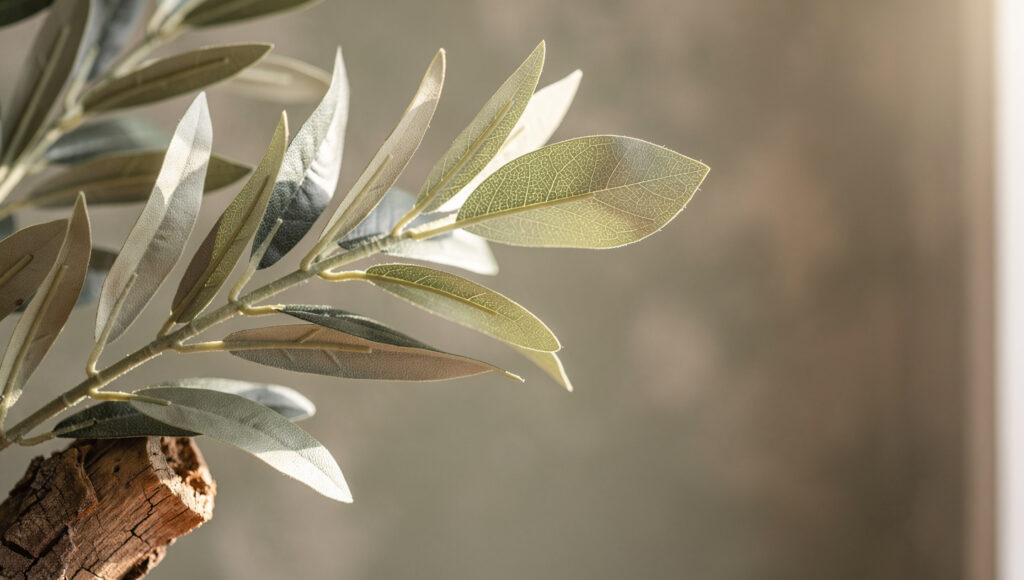
Polyethylene leaves — PE — are the material standard for premium faux plants. PE is molded from real plant specimens, which means each leaf captures the exact vein structure, surface texture, and slight irregularity of the original. Held against a window, a PE leaf shows the same translucency and vein shadow as a real leaf.
Silk leaves — used in lower-cost faux plants — are flat, uniformly colored, and entirely without surface texture. They look correct in photographs. They look synthetic in rooms.
The test before purchasing: zoom into the product photograph and look at the leaf surface. If every leaf is the same color, the same angle, and the same size, they are silk or low-grade plastic. If there is visible color variation — some leaves slightly yellower, some slightly darker, some catching light differently — they are PE or high-grade silk worth evaluating further.
Quality standard 2 — Trunk and branch material: real wood
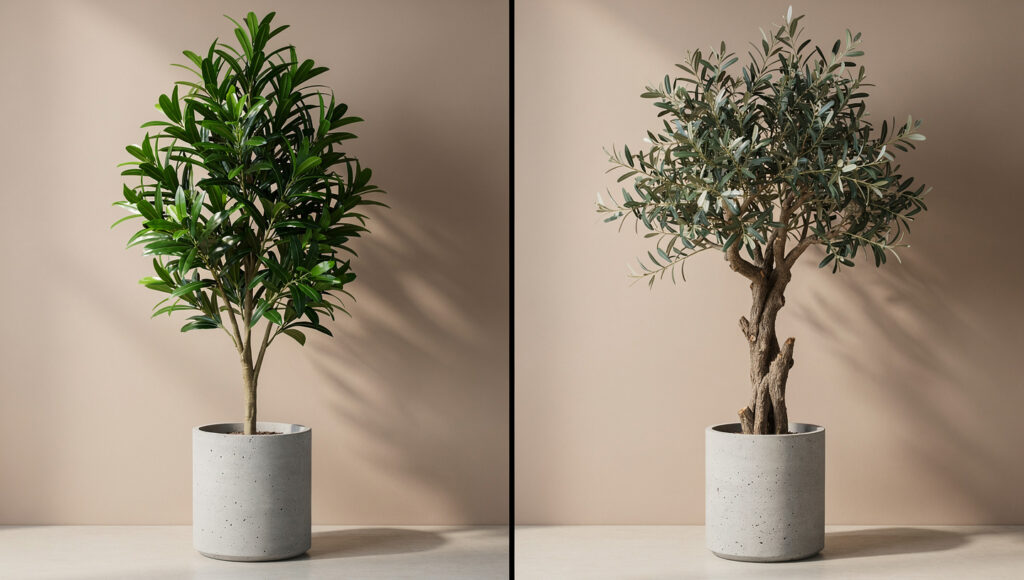
The best faux trees use genuine dried natural wood for their main trunk and primary branches, with synthetic material only for the smaller stems and leaves. The real wood trunk produces a surface texture — the bark variation, the slight irregularity at branch joints — that synthetic trunks cannot replicate regardless of how well they are painted.
We tested four faux olive trees across different price points for a studio room arrangement. The two trees with real wood trunks read as living plants from across the room. The two with synthetic trunks read as faux plants from the same distance, despite having identical PE leaf quality. The trunk is the element that the eye evaluates first from a distance — it carries more of the plant’s perceived authenticity than the leaves do.
Quality standard 3 — Form asymmetry
A living tree does not grow symmetrically. It leans slightly. Its canopy is denser on one side. Individual branches extend at irregular angles. This organic irregularity is what makes a living plant read as alive.
A cheap faux tree is perfectly symmetrical — branches radiating evenly from a central trunk at uniform angles. This regularity is the most immediately readable quality of an artificial plant even before leaf material or trunk texture is evaluated. The eye recognizes geometric regularity as manufactured.
Premium faux trees are deliberately asymmetric — branches at varied angles, canopy denser on one side, occasional gaps in the foliage. When purchasing, look for this asymmetry in the product photograph. If the tree looks like it was made on a lathe, it will look like it in the room.
The Five Species That Work in a Japandi Room
Not every plant species translates into a convincing faux version. The plants that work are those whose natural form has enough inherent irregularity that minor synthetic imperfections read as organic rather than manufactured.
Species 1 — The Faux Olive Tree
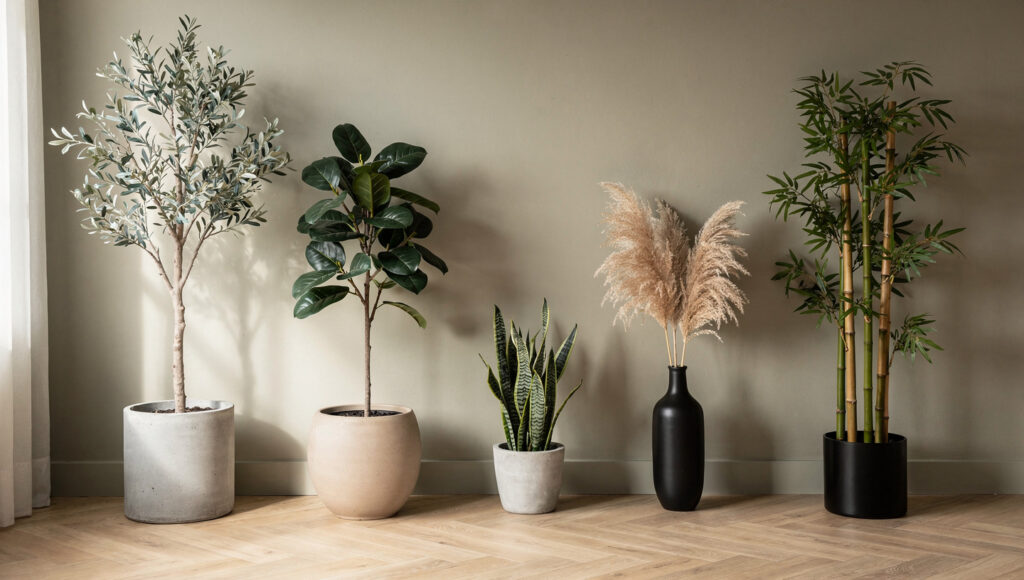
Artificial olive trees create a Mediterranean-inspired atmosphere and are widely used in modern homes, restaurants, and cafes. The olive tree is the most Japandi of all faux species because its natural form is precisely the architectural quality the aesthetic requires — sparse canopy, irregular branching, small matte leaves, visible gnarled trunk character.
The key quality indicator for faux olive trees: the trunk. A genuine olive tree has a twisted, irregular trunk with visible bark texture and character. A premium faux olive replicates this with a real dried wood base. Any faux olive with a straight, smooth, visually uniform trunk is immediately readable as synthetic regardless of how good the leaves are.
Correct height for a Japandi living room: 5–6 feet. At this height the olive tree reads as an architectural element in the corner of the room. Below 4 feet it reads as a shrub. Above 7 feet it competes with the ceiling in standard US ceiling heights.
Species 2 — Ficus Audrey
The Ficus Audrey — smooth pale bark, matte deep green oval leaves, upright architectural growth — translates exceptionally well into faux form because its leaf surface is relatively simple for PE molding to replicate convincingly.
The quality indicator: bark color and texture. A genuine Ficus Audrey has smooth pale beige-gray bark with visible horizontal lenticels — the small pore marks that run across the trunk surface. Premium faux versions replicate these. Cheap versions have a uniformly painted smooth trunk that reads immediately as plastic.
Species 3 — Snake Plant (Sansevieria)
The snake plant is the most forgiving faux species because its natural form is already geometric — vertical upright leaves with precise patterning. This regularity means that a lower-quality faux version still reads as plausible because the real plant itself has a somewhat regular appearance.
The correct faux snake plant for a Japandi room: upright variety in a matte stone or concrete planter, not the bird’s nest spreading variety. The vertical lines of a tall upright snake plant add height to a room in a way that the spreading variety cannot.
Species 4 — Dried botanicals
Dried pampas, eucalyptus branches, and cotton stems are not faux plants — they are real plants that have simply completed their life cycle. They require no maintenance, do not lose their form, and carry the wabi-sabi quality of beautiful impermanence that no synthetic material replicates.
For a Japandi room, one or two dried botanical arrangements — a stem of pampas in a slim ceramic vase, a branch of dried eucalyptus in a concrete cylinder — are often more resolved than a full faux tree. They are genuinely natural materials, honestly in the state they are in.
Species 5 — Faux bamboo
Bamboo, pine, and dracaena are gaining traction for specific design niches like Japandi and industrial loft styles. A faux bamboo stem arrangement in a matte black ceramic planter is the most Japanese of all faux plant choices — it references the bamboo motif that appears throughout traditional Japanese interior design. The quality standard for faux bamboo is straightforward: the nodes where segments connect must be visible and correctly proportioned. Cheap faux bamboo has nodes that are too small or too regularly spaced. Premium versions replicate the organic variation in node height and diameter that makes real bamboo distinctive.
The Matte Leaves Rule
This is the rule that matters most in practice and is almost never mentioned in product descriptions.
Every faux plant in a Japandi room must have matte leaves. No exceptions.
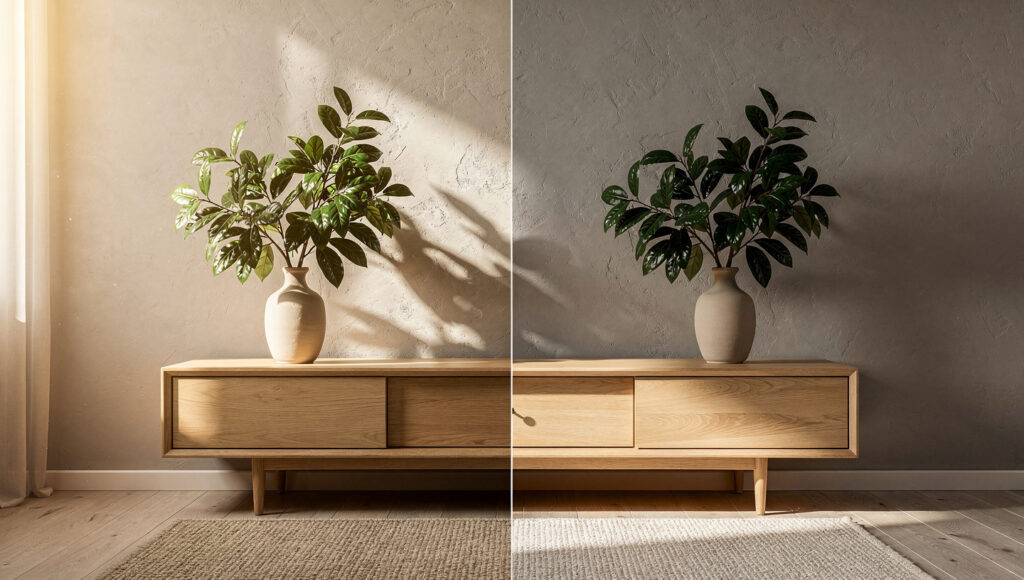
A Japandi room is built on surfaces that absorb light rather than reflect it — matte paint, matte ceramic, natural wood without lacquer, linen without sheen. A faux plant with glossy leaves introduces a light-reflecting surface that fights every other material decision in the room. In natural light, glossy faux leaves produce a plastic sheen that is immediately and unmistakably synthetic.
Matte PE leaves absorb light the way real leaves do. They do not create highlights. They do not reflect the window. They read as organic because their surface behavior matches the surface behavior of every other natural material in the room.
The matte test when purchasing online: zoom into the product photograph and look for highlights. If there are bright specular highlights on the leaf surface — small bright spots where the studio light is reflected — the leaves are glossy and will read as plastic in your room. If the leaves appear evenly toned without highlights, they are matte.
For species with naturally glossy real leaves — rubber plants, fiddle leaf figs, peace lilies — the faux version’s glossy finish is technically accurate. But in a Japandi room it is still incorrect. The room’s material language requires matte surfaces. If the species you want has naturally glossy leaves, the faux version of that species does not belong in a Japandi room regardless of its quality.
The Potting Method: Making Faux Trees Indistinguishable
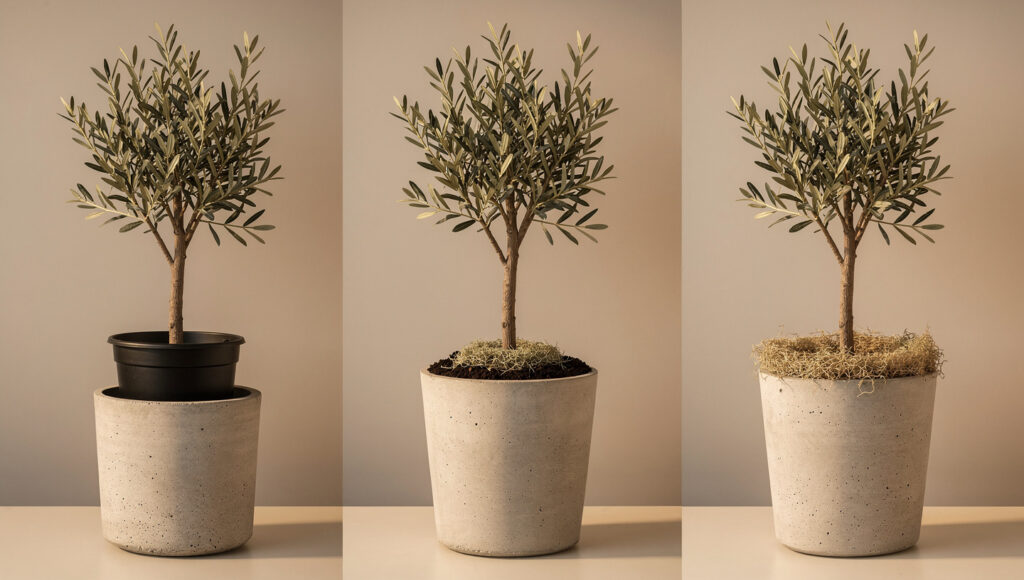
A premium faux tree placed directly in its original black plastic nursery pot communicates one thing: this is a faux tree in its original packaging. The nursery pot is the element that makes an otherwise convincing faux plant obvious.
The potting method eliminates this entirely.
Step one — choose the correct planter
The planter must be one size larger than the faux tree’s nursery pot. If the nursery pot is 10 inches in diameter, the decorative planter should be 12–14 inches. The gap between the nursery pot and the planter wall is what the subsequent steps fill.
For Japandi rooms: raw concrete, aged terracotta, or matte black ceramic. All with sufficient depth that the nursery pot sits below the planter rim by at least 2 inches.
Step two — elevate the tree
Place the faux tree inside the decorative planter. If the top of the tree’s base sits below the planter rim, place a sturdy base — a sealed cardboard box, a stack of books, a piece of cut foam — inside the planter beneath the nursery pot to raise the tree until its base is approximately 1 inch below the planter rim.
Step three — fill and stabilize
Stuff the gap between the nursery pot and the planter wall with crumpled newspaper, old cloth, or lightweight packing material. This stabilizes the tree against wobbling and fills the visible gap. Pack it firmly enough that the tree cannot shift in any direction.
Step four — top dress with real materials
This step is what makes the method work. Pour real potting soil over the filled gap until the surface appears to be continuous natural earth. Then layer dried Spanish moss over the soil surface, tucking it around the base of the trunk.
When a visitor looks down at the planter, they see real soil and real moss. The tree appears to be growing from genuine earth in a considered planter. The illusion is complete from every angle at every viewing distance.
We have placed a tree prepared this way in rooms with guests who have a genuine interest in interior plants. In every case they have assessed the tree without identifying it as faux unless they touched it — and some have still doubted after touching the PE leaves.
Placement: Where Faux Plants Work Hardest
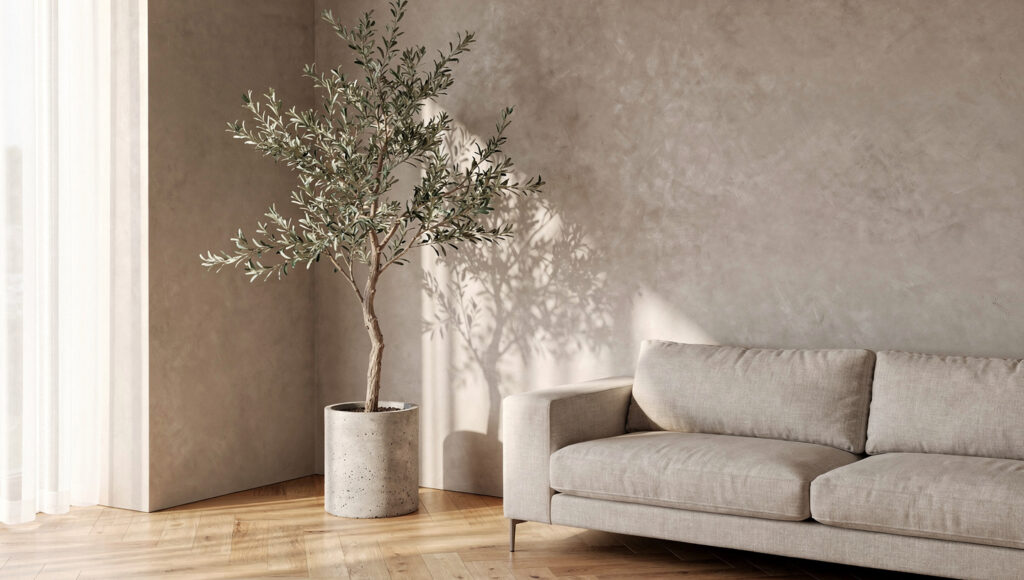
A faux plant placed badly reads as a prop. A faux plant placed correctly reads as a room decision.
The corner placement principle
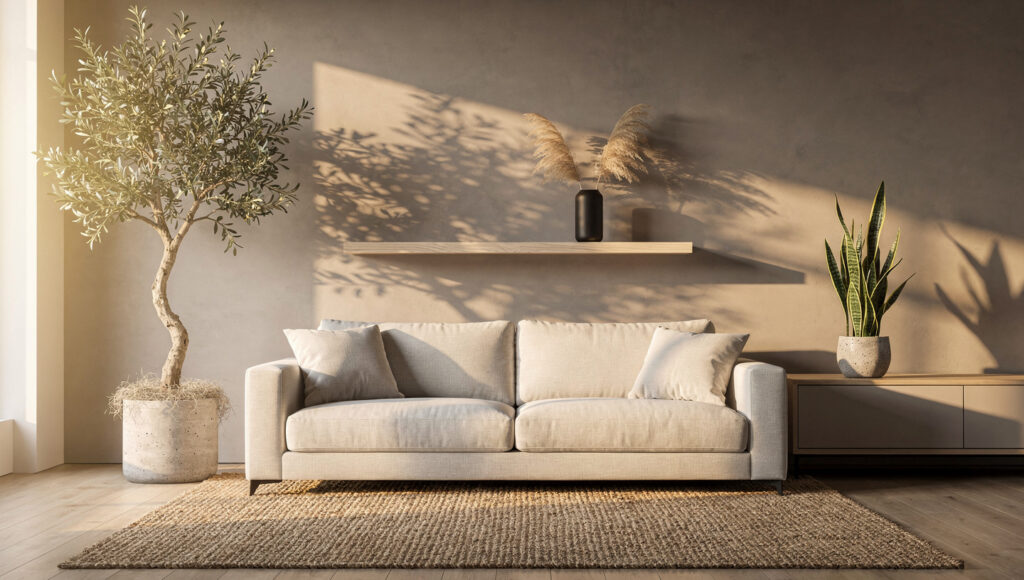
The most resolved position for a large faux tree in a Japandi room is in the corner where two walls meet. This placement does three things simultaneously. It fills the corner — the compositional dead zone in any room where two walls create an awkward meeting — with organic form. It allows the tree’s canopy to extend into the room without blocking traffic flow. And it creates the leaf shadow effect on the adjacent walls when light falls from the side — the organic shadow pattern on a limewash wall is one of the most beautiful effects a plant can produce in a Japandi room, and a premium faux tree with PE leaves produces it identically to a living one.
The light position
Natural light should fall across the faux tree from the side — not from directly above, not from directly in front. Side lighting reveals the three-dimensional quality of the canopy and creates the shadow variation between leaves that makes the tree read as dimensional rather than flat.
A faux tree placed directly under a skylight — light falling from above — looks like a display prop. The same tree with morning light coming from a window at 45 degrees looks like it belongs in the room.
What to avoid
A faux plant on a shelf reads as a decorative object rather than an architectural element. Scale matters absolutely — a faux plant placed on a surface communicates that it is an object on a surface. A faux plant on the floor communicates that it is a plant in the room. The floor is where Japandi plants live.
The Specification Table: Faux Plant Quality Standards
| Quality Factor | Premium Standard | Acceptable | Avoid |
|---|---|---|---|
| Leaf material | PE molded from real specimens | High-grade silk with texture | Flat silk, polyester, plastic |
| Leaf finish | Matte — no specular highlights | Semi-matte | Glossy — any light reflection |
| Trunk material | Real dried natural wood | High-quality cast resin with bark texture | Smooth painted synthetic |
| Form symmetry | Deliberate asymmetry | Slight natural variation | Perfect bilateral symmetry |
| Color variation | Multiple tones per leaf | Two tones minimum | Uniform single-tone leaves |
| Height for living room | 5–7 feet | 4–5 feet | Under 3 feet for floor placement |
| Planter pairing | Raw concrete, terracotta, matte black ceramic | Natural woven basket | Original nursery pot, glossy ceramic |
| Top dressing | Real potting soil + Spanish moss | Decorative gravel + moss | Fake grass mat, no dressing |
Frequently Asked Questions
What faux plants look most realistic in a minimalist home?
The most convincing faux plants for a minimalist or Japandi home are those with PE leaves molded from real specimens, real dried wood trunks, deliberate asymmetric form, and matte rather than glossy leaf surfaces. Faux olive trees, Ficus Audrey, and upright snake plants translate best into convincing artificial form. The potting method — real soil and Spanish moss over a correctly sized decorative planter — is the final step that makes any quality faux plant indistinguishable from a living specimen at normal viewing distances.
Are faux plants acceptable in a Japandi or wabi-sabi interior?
Yes — with one important distinction. A premium faux tree with real wood elements, PE leaves, and honest imperfection in its form is more compatible with Japandi’s material philosophy than a cheap synthetic plant regardless of whether either is living or artificial. Wabi-sabi values materials that carry honest character. A real dried wood trunk on a faux olive tree carries that character. A smooth painted plastic trunk does not. The evaluation criterion is material honesty, not whether the plant is living.
How do I make a faux plant look real in a room?
Four steps produce complete convincingness. Choose a premium PE leaf plant with real wood elements and asymmetric form. Place it in a correctly sized raw concrete, terracotta, or matte ceramic planter using an elevated base to position the tree at the correct height. Fill the gap around the nursery pot with crumpled material to stabilize it. Top dress the surface with real potting soil followed by a layer of dried Spanish moss. Position the plant in a corner with natural side lighting falling across it. No visitor evaluating the room from a normal standing distance will identify the plant as artificial.
The Finished Plant: A Decision, Not a Compromise
The correct faux plant in the correct planter in the correct position contributes the same quality to a Japandi room as a living plant — organic form, material warmth, the specific grounding quality of something natural in a composed space.
The incorrect faux plant — glossy leaves, symmetric form, smooth plastic trunk in its original nursery pot — contributes the opposite. It reads as an object placed in a room by someone who wanted a plant and did not quite commit to the decision.
The difference between these two outcomes is specification, not price. A $150 faux olive tree with real wood trunk, PE leaves, and asymmetric form, potted correctly in a $45 concrete cylinder, outperforms a $400 faux tree with synthetic trunk and glossy silk leaves in a decorative planter at every viewing distance in every lighting condition.
Buy the specification. The room will know the difference even when your guests cannot.

