
Disclaimer: This post contains affiliate links. If you purchase through these links, Homeoration earns a small commission at no extra cost to you.
The hallway is the most overlooked room in every home. Most people treat it as a passthrough—a place to dump coats, drop keys, and move on. I used to be guilty of this myself; my entryway was just a graveyard for shoes and mail. But that chaos was the first thing I saw every time I came home, and it instantly spiked my stress levels.
Your entryway is the first interior space anyone sees. It sets the emotional tone for the entire home in the first three seconds. A cluttered, poorly lit hallway tells every visitor—and tells you, every single day—that this is a home that hasn’t been thought about. A calm, considered Japandi hallway tells a completely different story before a word has been spoken.
The good news is that hallways are the easiest room in the house to transform. They are small. They have limited surfaces. Every decision matters more, and every improvement is immediately visible. This guide covers the furniture, lighting, storage, and exact dimensions that make a Japandi entryway feel like a deliberate beginning rather than an afterthought.
What Makes a Hallway Truly “Japandi”?
A Japandi hallway is not just a “minimalist” hallway. Minimalist hallways often feel cold and unwelcoming—the exact opposite of what an entryway should do.
The Japandi difference comes from the Scandinavian half of the equation. Hygge—the Danish concept of warmth and comfort—prevents Japanese minimalism from tipping into austerity. In practice, this means natural materials that feel warm to the touch and lighting that glows rather than illuminates.
The Japanese half contributes ma—the concept of intentional negative space. In a Japandi hallway, the empty wall above the console table is not wasted space; it is breathing room. The floor visible on either side of the rug is part of the composition.
The 5 Elements of a Japandi Hallway
Every successful Japandi entryway contains five elements in a specific relationship. You do not need more than these five. You should not have fewer.
1. The Console Table (The Anchor)
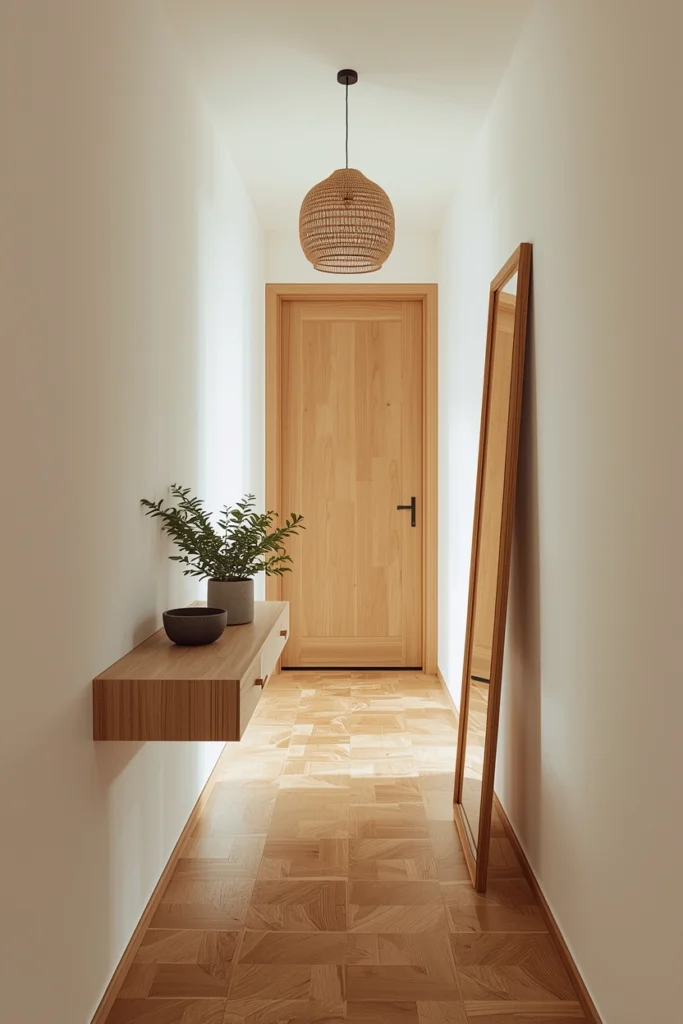
In a Japandi entryway, the console should be low-profile, natural, and entirely unfussy—solid white oak or walnut with clean lines and no ornate detailing.
- The Width Rule: Your console should be no wider than two-thirds of the hallway width. Wider than that, and the hallway feels enclosed.
- The Depth Rule: A console shallower than 10 inches is purely decorative. Deeper than 14 inches blocks traffic flow. The 10–14 inch depth range is the Japandi standard.
Top Picks for 2026:
- West Elm Anton Console Table: Narrow profile, solid wood, clean lines.
- CB2 Mara Console: Slightly warmer walnut finish, perfect for smaller hallways.
- IKEA HEMNES Console: A budget entry point (customize it with matte black hardware for a Japandi upgrade).
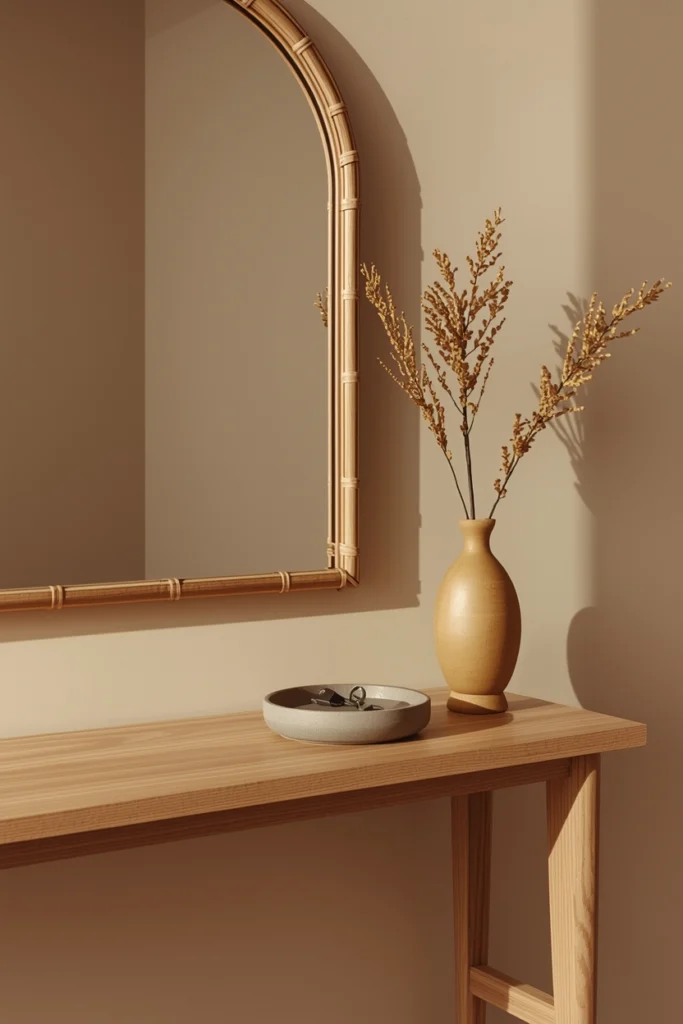
2. The Asymmetrical Mirror
The mirror serves two functions: practical (checking your appearance) and spatial (making a narrow hallway feel twice as wide). The frame should be natural wood, rattan, or raw bamboo. Avoid chrome or bright brass.
- Placement: Center it above the console with 6–8 inches of wall visible beneath the frame. This gap prevents the arrangement from feeling stacked and heavy.
- Size: The mirror should be roughly 60–70% of the console width. A mirror that is the exact same width creates a rigid, symmetrical look. Slightly narrower introduces the organic asymmetry that wabi-sabi favors.
3. Concealed Storage
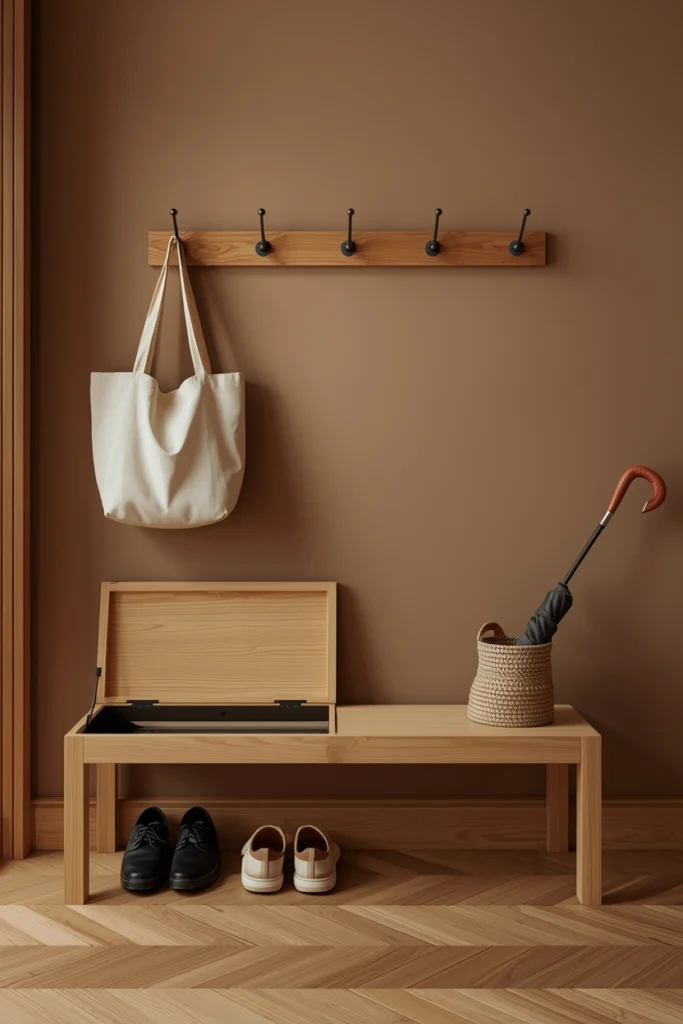
A Japandi hallway that looks beautiful but cannot hold a coat or umbrella is not Japandi—it is a furniture catalog. The philosophy demands purpose. Storage here must be hidden or contained.
Open coat hooks are beautiful only when they hold two or three items and are made from solid wood or matte black iron. For shoes, use a low bench with concealed storage beneath, or a simple wooden rack that holds a maximum of three pairs. Everything else goes in the closet.
Storage Options:
- Pottery Barn Aubrey Storage Bench: Clean lines with hidden lid storage.
- Article Burl Bench: Solid wood, low profile, perfect Japandi proportions.
4. Layered, Warm Lighting
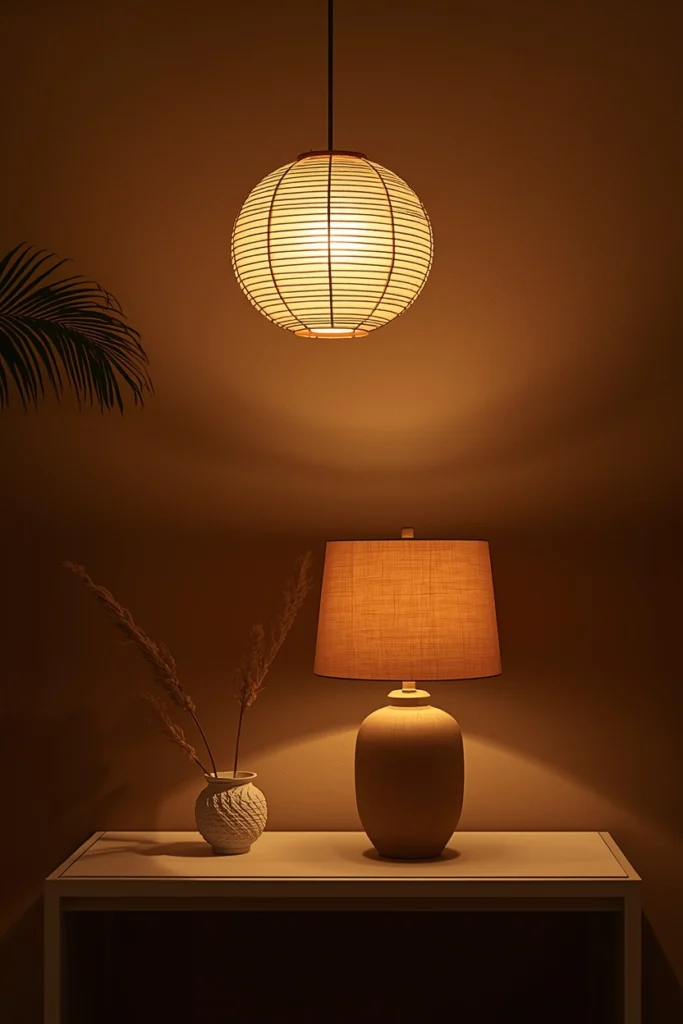
Hallways almost universally suffer from the same mistake: a single overhead fixture that creates harsh downward shadows. A Japandi hallway needs layered lighting, even in a small space.
- Primary: A pendant or flush-mount fitting in natural materials like washi paper, rattan, or wood. The goal is diffused, warm light (2700K bulbs) that glows.
- Secondary: A small table lamp on the console surface. This drops the light source to eye level, which is dramatically warmer. A handmade ceramic lamp base with a linen shade is the standard.
5. One Considered Object
This is the detail that separates Japandi from generic minimalism. After you have the console, mirror, storage, and lighting—one additional object is allowed.
Not three. Not a collection. One.
It might be a tall ceramic vase holding a single dried architectural stem, a small bonsai, or a handmade ceramic tray holding exactly three items: a candle, a key, and nothing else. It should be chosen for its material quality and its silence.
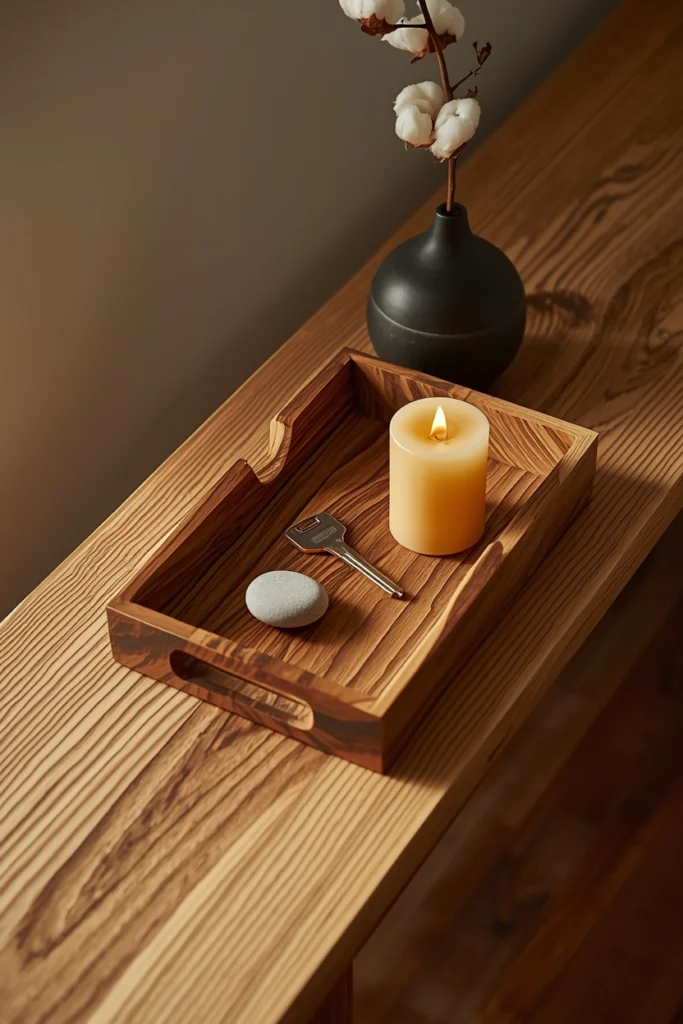
The Japandi hallway formula: white oak console (10–14 inches deep) + natural wood mirror (60–70%console width) + concealed storage bench + washi pendant and ceramic lamp + one considered object. That is the complete system.
Japandi Hallway Color & Paint Rules
The color system for a hallway follows the same principles as the rest of the home, but with one modification: hallways typically have less natural light, which changes how undertones behave. (For exact paint codes and wood pairings, read our Complete 2026 Japandi Color Palette Guide).
- Warm Whites: Benjamin Moore White Dove performs beautifully in hallways with good natural light.
- Warm Greige: Sherwin-Williams Accessible Beige is more reliable for dark hallways. It adds warmth without making a narrow space feel smaller.
- The Dark Anchor: A single dark wall at the far end of a hallway creates a sense of depth and destination. Sherwin-Williams Cavern Clay or Benjamin Moore Wrought Iron on the end wall creates a visual pull.
- The Ceiling Rule: Always paint the ceiling the same color as the walls or one shade lighter. Never use stark white in isolation—it creates a “box effect” that makes the hallway feel like a tunnel.
Solutions for Small & Apartment Hallways
Most homes have hallways that are genuinely small. The Japandi philosophy is perfectly suited to these constraints because it was never about space; it is about intention.
- Float the Furniture: Use a wall-mounted console with no legs. Keeping the floor visible beneath it is the single most effective trick for making a small hallway feel larger.
- Keep the Floor Clear: No shoes on the floor, no bags, no leaning umbrellas. In a 36-inch-wide hallway, one pair of shoes on the floor reduces the perceived width by nearly 20%.
- Apartment Lighting: If you have zero natural light, aggressively layer warm artificial light. The darkness of an apartment corridor actually works in your favor—it creates a mood of intimacy and arrival.
Frequently Asked Questions
What furniture do I need for a Japandi hallway?
The essential furniture is three pieces: a slim console table in natural wood (10–14 inches deep), a mirror in a natural wood or rattan frame, and a storage bench or shoe cabinet with concealed storage. Everything beyond these three is optional.
How do I make a narrow hallway feel bigger with Japandi design?
Use a floating wall-mounted console to keep the floor clear, hang a mirror that spans 60–70% of the console width, and paint the walls and ceiling in a consistent warm neutral to eliminate the visual box effect.
What plants work in a Japandi hallway?
Choose architectural, low-maintenance plants. A single snake plant in a matte stone pot, a small bonsai, or a tall dried pampas stem in a ceramic floor vase. One considered plant with clear space around it is always more powerful than five competing for attention.
The Finished Hallway: A Beginning That Matters
Most people spend hours on their living room and fifteen minutes on their hallway. But the hallway is what every person—including you—experiences first.
A Japandi hallway does not need to be large. It does not need to be expensive. It needs to be considered. Five elements, ruthlessly edited, in a space that has been given permission to breathe. The moment you walk through the door and the hallway says calm before you have made a single conscious decision—that is Japandi working exactly as it should.
Shop This Look
- The Console: FATORRI Console Table in white oak. Narrow profile, solid wood, exactly the right depth.
- The Budget Pick: FATORRI Console Table. Upgrade with matte black hardware for a Japandi finish.
- The Mirror: Natural Rattan Arch Mirror. Organic frame material, perfect proportion.
- The Bench: Article Burl Storage Bench Solid wood, low profile, lid storage.
- The Pendant Light: Washi Paper Pendant Lamp. The most authentic lighting choice available at any budget.
- The Ceramic Lamp: Handmade Stoneware Table Lamp. Warm linen shade, perfect for the console.
- The Hook Rack: Solid Oak Wall Hook Rail. Three to four hooks maximum.
- The Tray: Olive Wood Catchall Tray. For keys, a candle, and nothing else.

