
The kitchen has a biophilic advantage that no other room in the home possesses: its plants have a job to do.
In every other room, a biophilic plant is a visual and sensory element — it contributes form, texture, oxygen, and the specific quality of having something alive in the space. In a kitchen, a herb plant on the windowsill contributes all of those things and also contributes basil for tonight’s pasta and rosemary for the roast on Sunday. The functional justification for the kitchen’s biophilic plant layer removes the design-decision barrier that slows plant commitment in other rooms. The plant earns its place every time you cook.
This dual function is what makes the biophilic kitchen the most practically compelling application of the three-layer framework across the entire home.
- The Herb Garden: The Kitchen's Unique Biophilic Advantage
- Wood in a Kitchen: What Survives Contact with Heat and Moisture
- Stone: The Kitchen's Most Durable Natural Material Layer
- Cabinetry: The Biophilic Kitchen's Largest Material Surface
- Light and Ventilation: The Sensory Pattern Layer in a Kitchen
- The Biophilic Kitchen Styling System
- Frequently Asked Questions
- The Finished Kitchen
The Herb Garden: The Kitchen’s Unique Biophilic Advantage
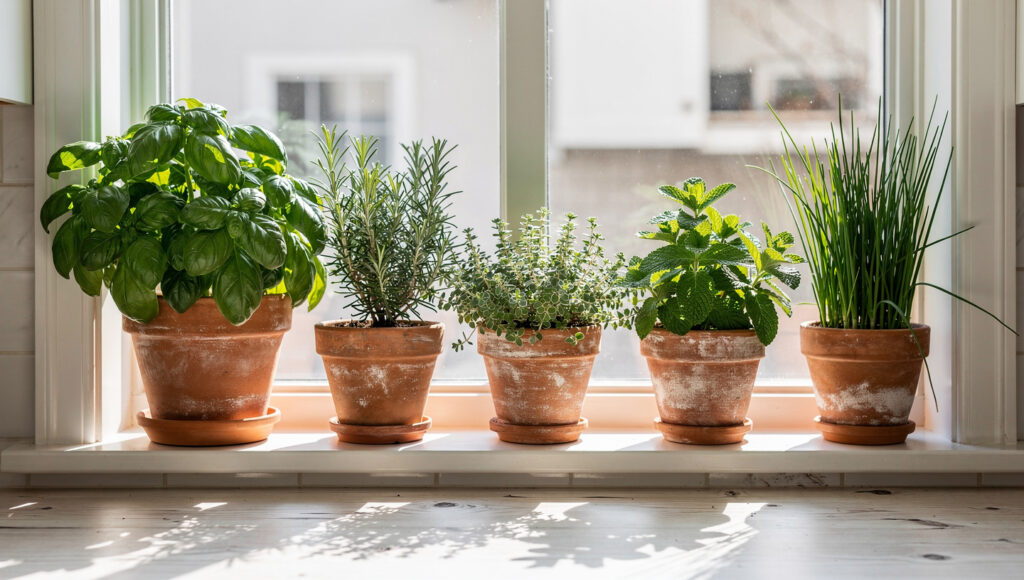
The herb garden is not the only biophilic element available in a kitchen, but it is the first one to address because it is the element unique to this room — the living plant layer that simultaneously serves the space’s primary function of food preparation.
The correct herb selection for a US kitchen windowsill in 2026:
Basil, rosemary, thyme, mint, and chives represent the five most practical windowsill herbs for a biophilic kitchen. Each tolerates indoor growing conditions differently, and understanding those differences is what separates a herb garden that thrives for a year from one that struggles through February and dies by April.
Basil requires the most sunlight of the five — a minimum of six hours of direct or bright indirect light daily. A south or west-facing kitchen window in a US home is the correct placement. A north-facing window will produce a leggy, pallid basil that uses more bench space than it provides culinary value.
Rosemary and thyme are the most drought-tolerant of the group — both Mediterranean in origin, both accustomed to drying between waterings. These are the correct herbs for households where watering frequency is inconsistent, which describes the majority of working households across the US. They will survive a forgotten week of watering that would kill a basil plant.
Mint is the most aggressive grower of the five and the one most frequently planted in a shared pot to disastrous effect — mint will consume every resource in a shared container and crowd out every other plant within two growing seasons. Mint belongs in its own pot, always, ideally a slightly larger pot than seems necessary, positioned where its spread is contained by the pot’s walls rather than a neighbor plant’s resistance.
Chives are the most tolerant of partial shade and the most cold-tolerant — they will continue producing through a US winter in an east-facing window when basil has long since given up. For households in northern US climate zones where winter light is genuinely limiting, chives are the reliable biophilic kitchen plant that other herbs cannot promise to be.
The terracotta pot specification: kitchen windowsill herb gardens should use terracotta pots specifically because the porous material allows roots to breathe and prevents the overwatering that kills more indoor herbs than underwatering does. The specific aesthetic benefit of terracotta in a kitchen aligns directly with the wabi-sabi material language of this site’s entire design framework — the chalky patina that develops on aged terracotta is the visual evidence of a material being genuinely used, which is more appropriate in a kitchen than in any other room.
Wood in a Kitchen: What Survives Contact with Heat and Moisture
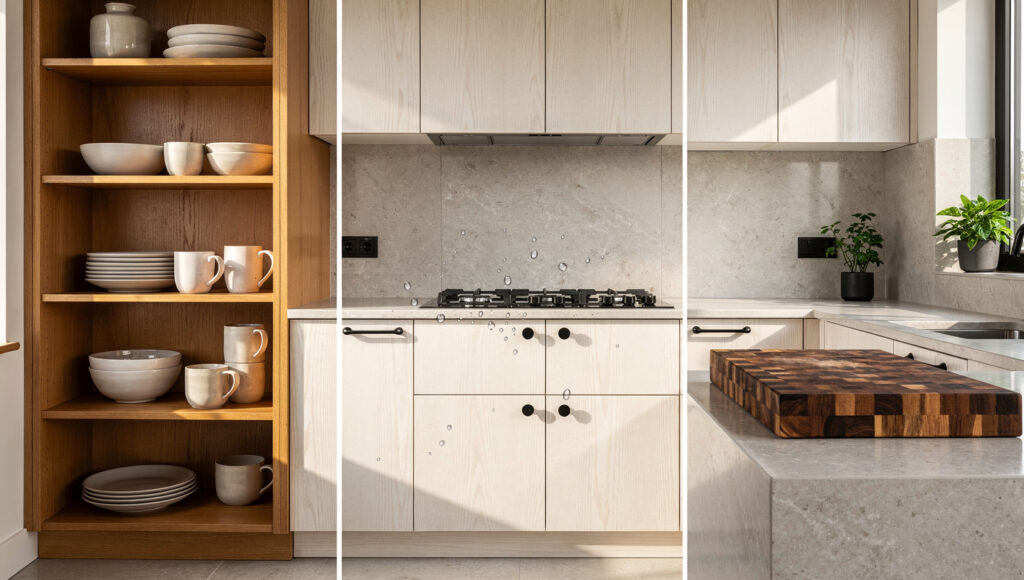
Wood in a kitchen is a more complex specification than wood in a bedroom or living room, because a kitchen subjects its materials to heat, steam, water, food acids, and cleaning products that no other room replicates. The competitor guides that say “use natural wood” without material-specific guidance leave the reader to discover these constraints through expensive failures.
Where wood works in a kitchen without additional treatment:
Open shelving, away from the direct steam zone above the stovetop, is the most forgiving wood position in a kitchen — it experiences no direct heat and minimal moisture contact. Solid white oak or walnut shelving with a natural oil or wax finish is appropriate here. The finish requires re-application approximately once per year.
Cabinet doors and drawer fronts — away from the sink and stovetop splash zones — are the second most appropriate position. Flat-panel doors in rift-sawn white oak with a hardwax oil finish resist the humidity variation of a kitchen significantly better than a penetrating oil alone. The hardwax oil creates a surface film that repels water while allowing the wood to breathe — it is the correct finish for kitchen cabinet doors in the US climate range, where winter heating creates significant humidity swings.
Where wood requires more careful specification:
The counter surface directly beside the sink — the highest moisture zone in any kitchen — is where wood countertop failures most commonly originate. Butcher block or solid wood countertops beside a sink require a penetrating oil finish reapplied at minimum every three months, and a strict habit of immediately drying water that sits on the surface. This is a legitimate maintenance commitment, and one worth making consciously rather than discovering after installation.
Where wood should not be used:
The counter surface behind the stovetop — the backsplash zone immediately above cooking burners — is not appropriate for wood in any finish. The combination of direct heat, steam, and fat splatter creates conditions no wood finish survives over time. Stone, tile, or a sealed plaster finish belongs in this position. The stovetop counter surface itself should be stone or a stone-effect quartz for the same reason.
The cutting board as the most touched natural surface in the kitchen:
The cutting board sits outside these zone considerations entirely and is the single easiest biophilic material upgrade available in any kitchen regardless of cabinet and countertop specification. A solid end-grain walnut or maple cutting board at working size — 12×18 inches minimum for functional daily use — provides more daily tactile contact with genuine natural material than any other object in the kitchen. The end-grain surface develops a patina of use over years of cutting that is, without any design intervention, the most visible wabi-sabi process in the entire home.
| Wood Application | Correct Position | Best Finish | Maintenance Frequency |
|---|---|---|---|
| Open shelving | Away from stovetop steam | Natural oil or wax | Annually |
| Cabinet doors | Away from sink and stovetop | Hardwax oil — creates surface film | Every 2–3 years |
| Butcher block counter | Adjacent to prep zone, not sink | Penetrating food-grade oil | Every 3 months minimum |
| Counter beside sink | Not recommended | N/A | N/A |
| Cutting board | Anywhere on counter | Food-grade mineral oil | Monthly oiling |
Stone: The Kitchen’s Most Durable Natural Material Layer
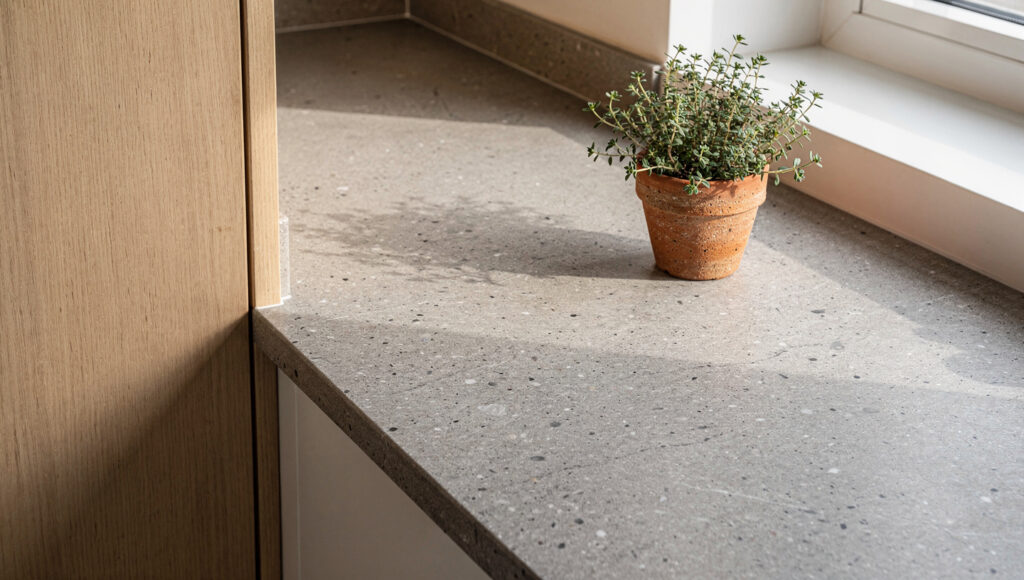
Stone is the biophilic material that performs best under kitchen conditions — it tolerates heat, resists moisture, and ages in a way that records the kitchen’s history honestly rather than failing under it.
The honed finish specification for a biophilic kitchen:
Honed stone — matte surface, not polished — is the correct finish for a biophilic kitchen for the same reason it is correct throughout this site’s material framework: it absorbs light rather than reflecting it, which keeps the countertop in the same matte material register as the wood cabinets, the ceramic vessels, and the terracotta herb pots. A polished stone countertop introduces a reflective surface that competes visually with every matte element in the kitchen, and under the strong overhead task lighting most US kitchens use, it produces glare that working on the surface for hours makes genuinely uncomfortable.
The three correct stone options for a US biophilic kitchen:
Honed Calacatta or Carrara marble is the most authentically natural choice — genuine mineral variation, genuine warmth, and a surface that is permeable enough that it absorbs stains from coffee, red wine, and acidic foods without sealing. The US households that choose honed marble for a kitchen counter and maintain it correctly develop a surface with genuine patina over years of use. The US households that choose it without understanding the sealing and care requirements often regret it within the first year. The material is correct for a biophilic kitchen. The commitment it requires is specific and non-negotiable.
Honed quartzite — not to be confused with engineered quartz — is a natural stone that visually resembles marble while offering significantly better durability and lower maintenance. It requires sealing annually but resists staining far more effectively than marble. For households where the kitchen is in heavy daily use, honed quartzite is the more honest recommendation than marble.
Concrete — poured in place or pre-cast — is the most directly natural, most technically demanding, and most genuinely biophilic countertop material available in US kitchens. Concrete is mixed from natural aggregates, cures rather than being manufactured, and develops hairline surface variation over time that no manufactured material replicates. It requires annual sealing and cannot be exposed to highly acidic foods without etching. In return, it provides a surface whose character is entirely individual — no two concrete countertops are identical, which is the property that makes it most directly wabi-sabi in material character.
Cabinetry: The Biophilic Kitchen’s Largest Material Surface
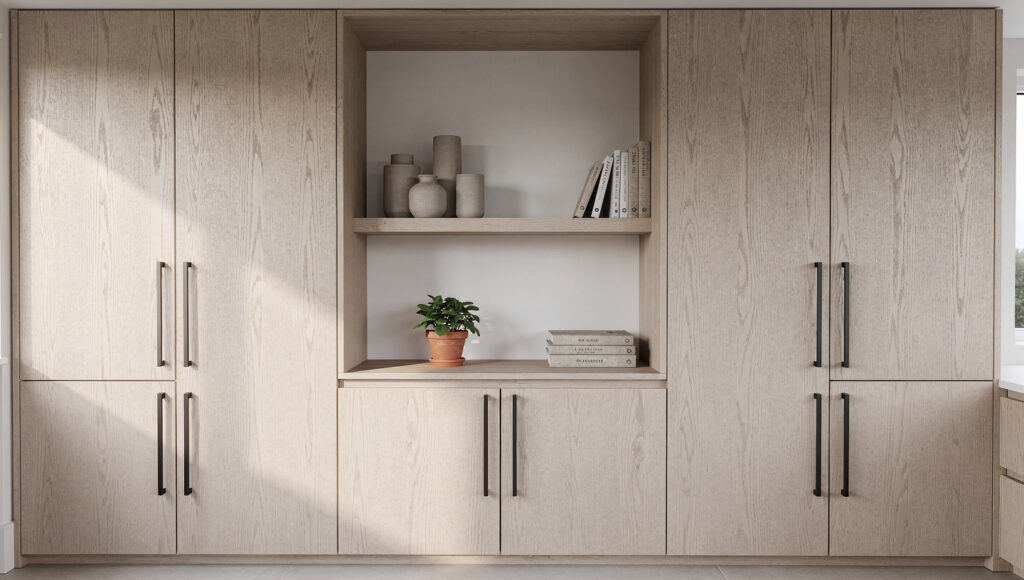
Cabinet doors occupy more visual surface area than any other element in a kitchen — more than the countertop, more than the floor, more than any appliance. The material decision on cabinet doors is the highest-leverage biophilic decision in the room, which makes it also the decision with the most serious consequences when it is wrong.
The flat-panel white oak cabinet door — covered in depth in the Japandi Kitchen Cabinets guide on this site — is the correct biophilic cabinet specification. Rift-sawn grain, matte hardwax oil finish, visible medullary ray fleck. This post adds the biophilic specific rationale: the wood grain on a cabinet door provides the natural visual texture that the kitchen’s other surfaces — stone, tile, ceramic — do not. In a room where every other horizontal surface is stone or steel, the vertical wood grain of cabinet doors provides the organic, irregular pattern that connects the space to the natural world at the room’s most prominent visual plane.
The open shelf section: a minimal biophilic kitchen incorporates subtle natural touches — a single statement piece of live-edge wood, a carefully curated selection of herbs on the windowsill, or cabinetry in soft, nature-inspired neutrals paired with abundant natural light. One section of open wood shelving within an otherwise closed cabinet run is the recommended implementation for the biophilic kitchen — it breaks the continuous closed cabinet plane with an honest display of ceramic vessels, small plants, and stacked natural fiber or wood kitchen objects.
Light and Ventilation: The Sensory Pattern Layer in a Kitchen
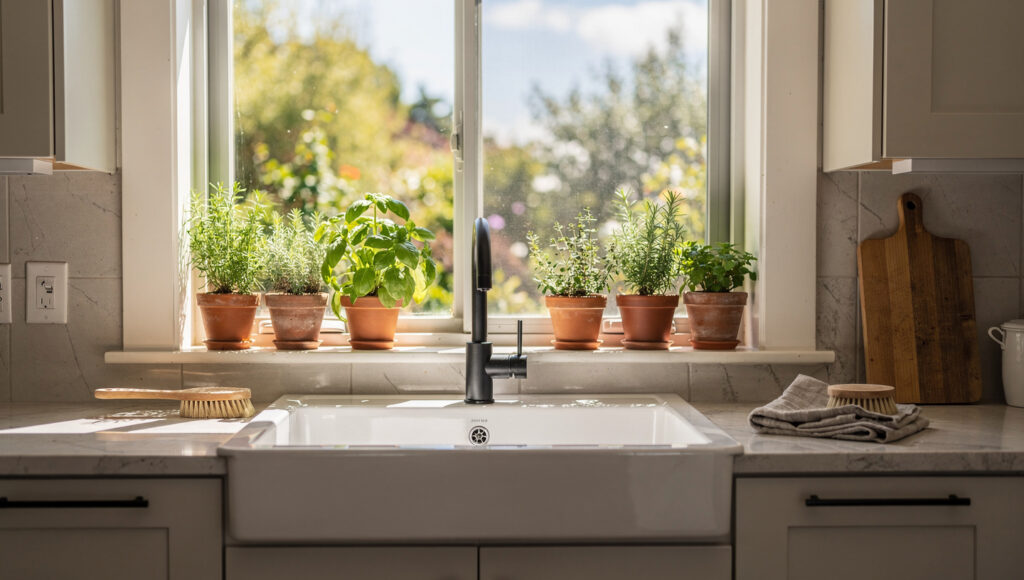
The sensory pattern layer of the biophilic framework in a kitchen has two components that no other room shares: the relationship between the window above the sink and the experience of washing produce and preparing food, and the ventilation system that connects the kitchen’s air to the outdoors.
The sink window. Positioning the sink beneath a window is the oldest and most common kitchen layout in US residential design for a reason that is directly biophilic in character — the person standing at the sink for the longest part of kitchen preparation time has a view to the outside world rather than a view to a wall. Where a kitchen renovation is possible, this placement should be protected or established. Where the sink position is fixed and does not face a window, a small mirror angled to reflect the nearest window toward the sink position provides the closest available alternative.
Ventilation as the biophilic air connection. A range hood that vents to the exterior — rather than a recirculating filter unit — creates a genuine air exchange between the kitchen and the outdoor environment during cooking. This is the sensory pattern layer operating through air rather than light: the outdoor air that enters the kitchen to replace the exhausted cooking air carries the temperature and quality of the actual outdoor environment. A recirculating range hood removes cooking odors but does not produce this connection. For households where ductwork permits, an exterior-venting hood is the biophilic ventilation specification.
The Biophilic Kitchen Styling System
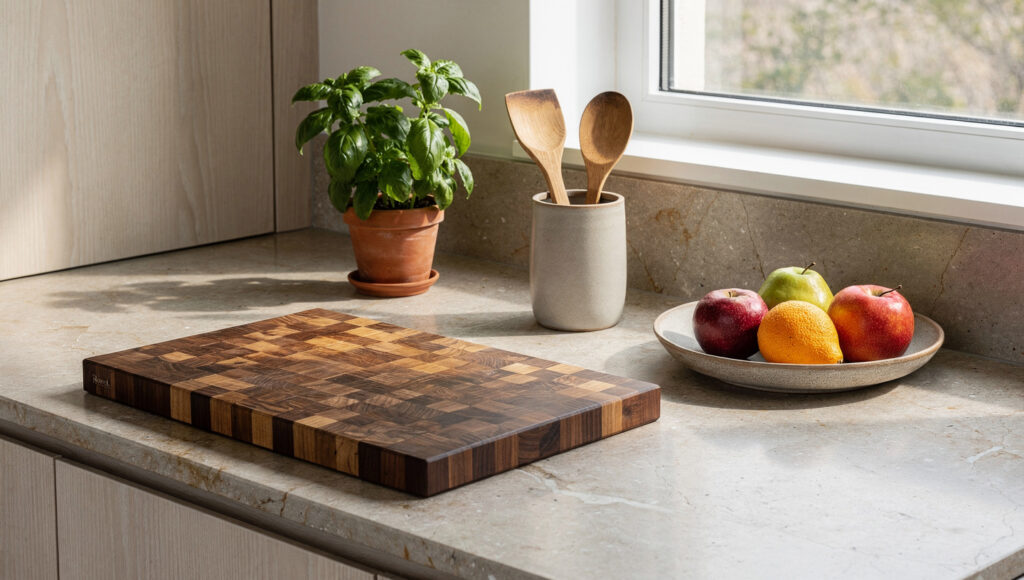
The kitchen counter is the surface most likely to accumulate objects in any household — appliances, mail, chargers, produce, tools — and the surface where that accumulation is most visually damaging to the biophilic effect.
The correct biophilic kitchen counter edit follows the same three-object maximum established throughout this site’s styling system. The objects that earn a permanent counter position in a biophilic kitchen: one end-grain cutting board at working position, one terracotta herb pot at the window, one ceramic or natural material container for cooking utensils. A ceramic bowl for daily produce — the fruit bowl — is the fourth permissible counter object and the only one that varies its contents daily, which is itself a biophilic quality: the bowl’s contents change with the season, connecting the kitchen to the growing cycle of the food it holds.
Frequently Asked Questions
What plants are best for a biophilic kitchen?
Culinary herbs are the most appropriate biophilic kitchen plants because they serve a functional daily purpose alongside their visual and sensory role. Basil, rosemary, thyme, chives, and mint are the five most practical options for a US kitchen. Basil requires six or more hours of direct light daily — a south or west-facing window. Rosemary and thyme tolerate less frequent watering than other herbs and are the most appropriate choice for busy households. Mint must always be planted in its own separate pot or it will crowd out every neighboring plant within two seasons.
What is the best countertop material for a biophilic kitchen?
Honed stone is the most appropriate biophilic kitchen countertop material — it absorbs light rather than reflecting it, matching the matte finish of every other natural material in the room. Honed quartzite offers the best balance of natural character and practical durability for most US households. Honed marble is the most genuinely natural choice and develops the most honest patina over time, but requires sealing every six months and cannot be exposed to highly acidic foods without etching. Concrete is the most technically biophilic material — genuinely natural, genuinely individual — and the most demanding in terms of care.
What wood finishes work in a kitchen environment?
Hardwax oil is the correct finish for wood cabinet doors in a kitchen — it creates a surface film that repels water while allowing the wood to breathe, performing better through the humidity swings of US climate than a penetrating oil alone. Butcher block or solid wood countertops should be finished with a food-grade penetrating mineral oil reapplied every three months. Wood shelving away from stovetop steam can use a standard natural oil or wax finish, reapplied annually. No wood finish is appropriate for the backsplash zone directly above cooking burners.
The Finished Kitchen
A kitchen that connects to the natural world does not require a renovation. It requires a windowsill with three terracotta herb pots, a cutting board whose grain shows honest use, a countertop that absorbs light rather than performing it, and one wood shelf that holds ceramics and invites the eye to land somewhere natural between the tasks of cooking.
The herbs earn their place at every meal. The cutting board earns its place at every prep session. The stone earns its place by aging with the kitchen rather than against it. These are not decorative decisions wearing the language of biophilic design. They are honest material choices that happen to be the most beautiful version of the same choice.

