
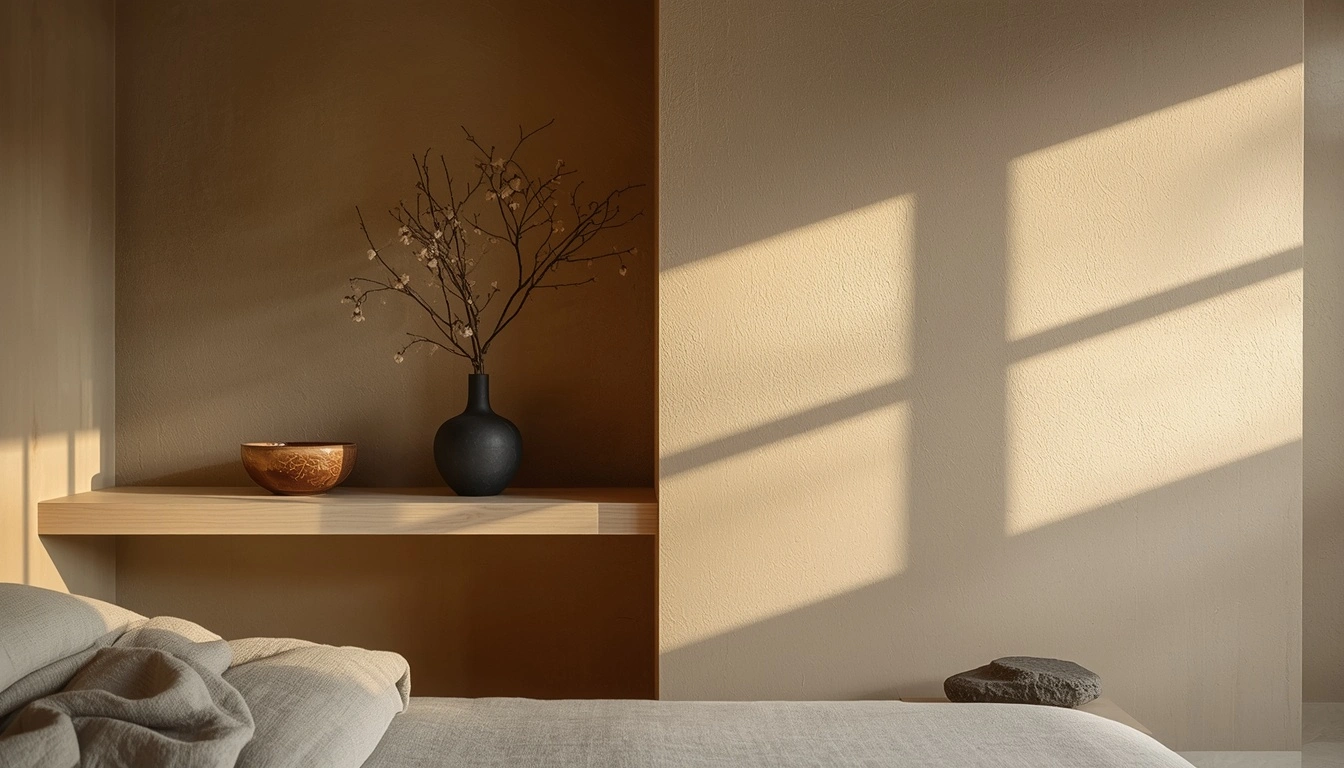
If you have spent any time exploring calm, minimal interior design, you have almost certainly encountered both terms. Japandi. Wabi-sabi. They appear together constantly — in the same Pinterest boards, the same interior design guides, the same product descriptions for the same handmade ceramic bowls and stonewashed linen throws.
The overlap is real. But the two are not the same thing, and understanding the distinction will make every design decision you make more intentional — and more likely to produce a room that actually feels the way you want it to feel.
This is the shortest explanation of the difference that is also the most complete one.

Subscribe to Homeoration!
Get decor ideas, room inspirations & seasonal styling tips.
By subscribing you agree to receive emails & accept our Privacy Policy.Table of Contents
What they share
Before the distinction, the common ground — because it is substantial and it is the reason the two terms get conflated constantly.
Both Japandi and wabi-sabi originate from Japanese design philosophy. Both prioritize natural materials over synthetic ones. Both resist the idea that more objects make a room better. Both produce spaces that feel calm, considered, and deeply human rather than staged and impersonal. Both are, at their core, a rejection of the high-gloss, everything-new, perfectly matched aesthetic that dominated Western interior design for most of the twentieth century.
If you are drawn to one, you will almost certainly be drawn to the other. If your home has elements of one, it likely has elements of the other without you having named them. The Venn diagram of the two aesthetics is large. But the circles are not the same circle.
What wabi-sabi actually is
Wabi-sabi is a Japanese philosophy — not a design style. This distinction matters more than it might seem.
The word combines two concepts. Wabi is the beauty found in rustic simplicity, in things that are modest and unpretentious, in the particular peace of solitude and restraint. Sabi is the beauty that comes specifically with age — the patina on old brass, the way linen softens over years of washing, the crack in a ceramic bowl that has been repaired rather than replaced.
Together they form a sensibility that honors impermanence, imperfection, and incompleteness. A wabi-sabi object is not beautiful despite its flaws. It is beautiful because of them — because the flaw is the evidence of time, of use, of a life actually lived in the object’s company.
Wabi-sabi asks a single question of every object in a room: does it carry honesty? An irregular handmade ceramic carries honesty. A mass-produced ceramic that has been manufactured to look handmade does not. A linen curtain softened by years of sunlight carries honesty. A polyester curtain printed to look like linen does not.
The philosophy extends beyond objects to the structure of rooms. Wabi-sabi spaces are comfortable with incompleteness — a shelf that is not quite full, a wall that is intentionally bare, a room that is still becoming rather than having arrived. The sense of arrival, of the perfectly finished room, is what wabi-sabi most directly resists.
What Japandi actually is
Japandi is a design style — a specific visual and material aesthetic that emerged from the fusion of Japanese minimalism and Scandinavian design. It has a definable look, a reproducible palette, and a set of principles that can be applied systematically to produce a room that reads as Japandi.
The Japanese half contributes: restraint, negative space, natural materials, the concept of ma (intentional emptiness as a design element), and the wabi-sabi philosophy of imperfect natural materials.
The Scandinavian half contributes: warmth, the hygge concept of cozy functional comfort, the tradition of exceptional craft and honest materials, and the specific palette of warm neutrals and natural wood tones that defines Nordic design.
The fusion produces something neither tradition achieves alone. Japanese minimalism without Scandinavian warmth can feel austere — too disciplined, too empty, too cool. Scandinavian design without Japanese restraint can feel over-layered — too many textiles, too much hygge, too comfortable in a way that tips toward clutter. Japandi sits exactly between them. Warm enough to feel human. Edited enough to feel calm.
The specific differences — side by side
Philosophy vs aesthetic
Wabi-sabi is a philosophical stance toward the world — a way of seeing and valuing things that extends far beyond interior design into how you relate to time, impermanence, and imperfection. You can live a wabi-sabi life without making a single design decision.
Japandi is an interior design aesthetic — a specific visual language with definable rules about color, material, proportion, and furniture. It is the application of certain ideas (including wabi-sabi ideas) to the design of physical spaces.
Age and imperfection
Wabi-sabi specifically honors age and imperfection. The crack in the ceramic. The faded fabric. The worn edge of a wooden table. These are not flaws to work around — they are the evidence of time that makes an object beautiful. A room can only become more wabi-sabi as it ages.
Japandi incorporates wabi-sabi materials and objects but does not require them. A brand new white oak desk in a perfectly ordered Japandi home office is entirely correct Japandi design. It would not be a wabi-sabi object until it had accumulated the marks and patina of years of use.
Completeness
Wabi-sabi is comfortable with incompleteness. A room that looks unfinished — a bare wall, a half-empty shelf, an object placed without apparent intention — can be deeply wabi-sabi. The incompleteness is the point.
Japandi rooms are edited but complete. The negative space in a Japandi room is intentional and resolved — the empty wall above the console is designed to be empty, not accidentally so. The difference between intentional emptiness and incompleteness is a subtle but important one.
Color
The Japandi palette is specific and warm — greiges, warm whites, natural wood tones, one muted accent. It can be reproduced with specific paint codes from Benjamin Moore or Sherwin-Williams.
Wabi-sabi has no palette. Its colors are the colors of natural materials in their natural state — the gray of weathered wood, the brown of oxidized copper, the cream of undyed linen, the black of raku glaze. These colors exist in the materials themselves rather than being applied to surfaces.
Where they live in a room
Japandi is the architecture of the room — the furniture selection, the paint color, the proportion of objects to space, the overall composition.
Wabi-sabi lives in the objects — the specific handmade ceramic on the shelf, the imperfect linen throw, the dried stem that is slowly losing its color. These are the wabi-sabi elements within a Japandi framework.
How Japandi and Wabi-Sabi work together
The most beautifully resolved Japandi rooms are almost always wabi-sabi in spirit. The two do not compete — they complement each other at different scales of the design.
Japandi operates at the room level. It determines the color, the furniture, the spatial composition, the overall feeling of calm that greets you when you walk in. These are the architectural decisions.
Wabi-sabi operates at the object level. It determines which ceramic goes on the shelf, why that specific dried stem rather than fresh flowers, why the throw was left unwashed so its texture has deepened. These are the curatorial decisions.
A room can be Japandi in its architecture and wabi-sabi in its objects. This combination — a considered, edited Japandi framework filled with objects that carry the honest marks of time and natural imperfection — produces the most human and most livable version of either aesthetic.
The practical implication is this: when designing a Japandi room, make the architectural decisions first using the Japandi framework — color, furniture, proportion, lighting. Then populate the room with objects using wabi-sabi as your curatorial philosophy — choosing handmade over machine-made, aged over new, honest over performative.
The result is a room that is both visually resolved and spiritually inhabited. Which is, ultimately, what both traditions are reaching toward.
Frequently Asked Questions
Can a room be both Japandi and wabi-sabi?
Yes — and the best ones are. Japandi provides the architectural framework: the color palette, the furniture edit, the spatial composition. Wabi-sabi provides the curatorial philosophy for the objects within that framework: choosing handmade ceramics over factory ones, aged wood over new, natural imperfection over manufactured finish. The two operate at different scales and are entirely compatible.
Is wabi-sabi a design style or a philosophy?
Wabi-sabi is a Japanese philosophy — a way of finding beauty in imperfection, impermanence, and natural aging — that extends far beyond interior design. When applied to interiors it influences material choices and object curation but is not a reproducible aesthetic the way Japandi is. You cannot buy a wabi-sabi room. You can only accumulate one slowly, through time and intentional choice.
Which should I start with — Japandi or wabi-sabi?
Start with Japandi. It gives you a concrete framework — specific paint colors, furniture proportions, material rules — that produces a calm, considered room through systematic decisions. Then let wabi-sabi influence the objects you choose to live within that framework. Over time, as the linen softens and the ceramic develops patina and the wood carries the marks of use, the room becomes increasingly wabi-sabi without any deliberate effort.
The Finished Thought
Most rooms that feel genuinely at peace contain both — even when their owners have never heard either word.
The Japandi framework is what makes the room legible — what makes it feel considered and calm the moment you walk in. The wabi-sabi objects are what make it feel inhabited — what make it feel like a life is actually being lived inside it rather than curated for an audience.
You do not have to choose between them. You have to understand that they are solving different parts of the same problem — and that the room that solves both is the one you will never want to leave.
Subscribe to Homeoration!
Get decor ideas, room inspirations & seasonal styling tips.
By subscribing you agree to receive emails & accept our Privacy Policy.