
(Disclaimer: This post contains affiliate links. If you purchase through these links, Homeoration earns a small commission at no extra cost to you—it helps keep this content free.)
Windows are the most under-considered element in most Japandi rooms. The furniture gets chosen carefully. The paint color gets tested for three days. The bedding gets researched across four brands. And then a pair of curtains gets ordered in ten minutes because the window needed covering and the options were overwhelming.
The result is a room that is almost right. The palette is warm, the furniture is considered, the bedding is linen — and then there is a window treatment that does not quite belong. It is either too heavy, making the room feel smaller and darker. Or too thin, making it feel exposed and unfinished. Or the wrong material entirely — polyester or synthetic silk that reflects light in ways that fight every other surface in the room.
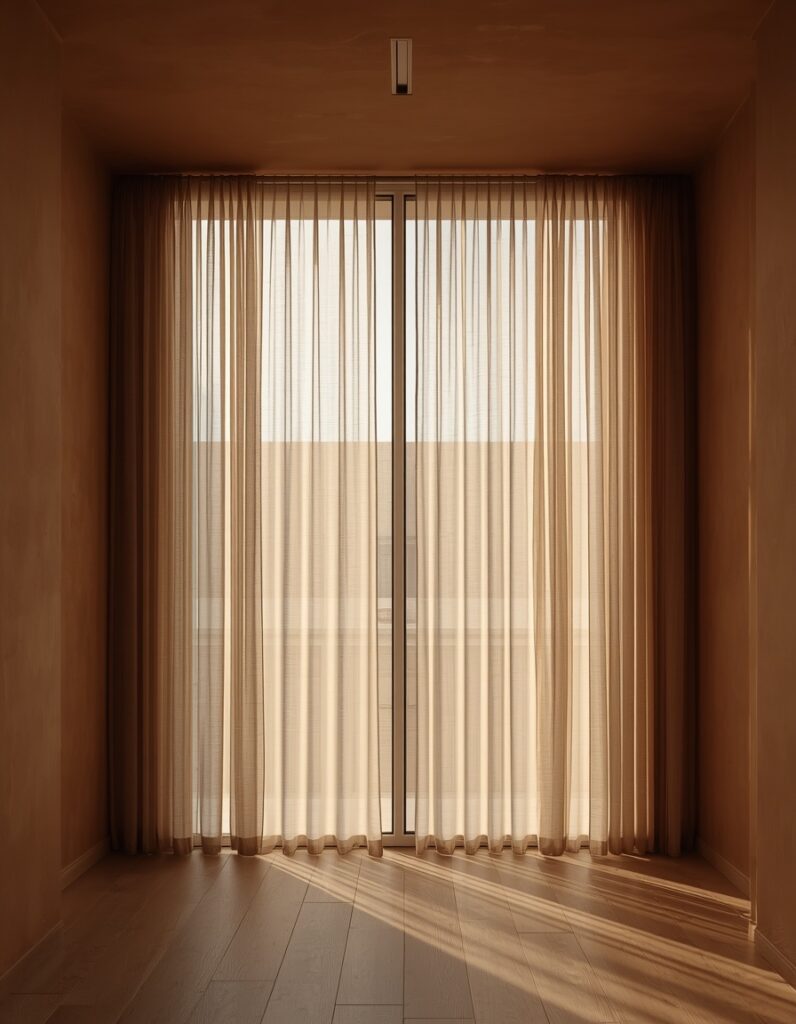
Window treatments in a Japandi room are not an afterthought. They are the element that determines how natural light enters the space — and natural light is the most important design material in any interior. Get the window treatment right and the room changes at every hour of the day. Get it wrong and the best furniture in the world will not compensate.
This guide covers everything — the materials, the specific products, the hanging methods, the hardware, and the room-by-room decisions that make a Japandi window treatment feel like it grew out of the room rather than being placed in front of it.
The two roles every Japandi window treatment must play
Before any material or product decision, the function of the window treatment determines everything else. In a Japandi room, every window treatment must perform two roles simultaneously — and most window treatments only perform one.
Role one: light diffusion. Japandi design is built on natural light — specifically the quality of natural light that has been filtered, softened, or diffused before it enters the room. Direct, unfiltered sunlight is too harsh for a Japandi interior. It creates high contrast shadows, bleaches warm neutrals toward cool, and flattens the tonal complexity that makes natural materials look beautiful. A Japandi window treatment filters the light rather than blocking it — turning direct sun into the kind of warm, even, all-directional glow that makes a room feel like it is lit from within.
Role two: privacy and completeness. A bare window in a Japandi room creates visual incompleteness — the eye travels to the window and finds nothing resolved there. Even in rooms where privacy is not a concern — a top-floor apartment, a rural property — a window treatment completes the room’s composition. The fabric at the window is the vertical element that frames the natural light and gives the wall its full depth.
Most window treatments perform one role well and the other poorly. Blackout curtains provide privacy but block light entirely. Sheer polyester panels diffuse light but provide no privacy and look cheap against natural materials. The Japandi solution is almost always layering — two treatments on one window, each serving one role, working together to serve both.
The Japandi window treatment hierarchy
There is a clear hierarchy of window treatment choices in Japandi design — from the most authentically Japandi at the top to the least compatible at the bottom. Understanding this hierarchy makes every decision faster.
Tier 1 — Sheer linen panels
The most Japandi window treatment available at any price point. Sheer linen panels filter natural light into the warm, diffused glow that makes a Japandi room feel like it is inhabited by light rather than illuminated by it. The natural weave of linen creates a slightly irregular texture that changes as the light passes through it — brighter where the weave is looser, dimmer where threads cross. This organic variation is exactly what the wabi-sabi philosophy values in a material.
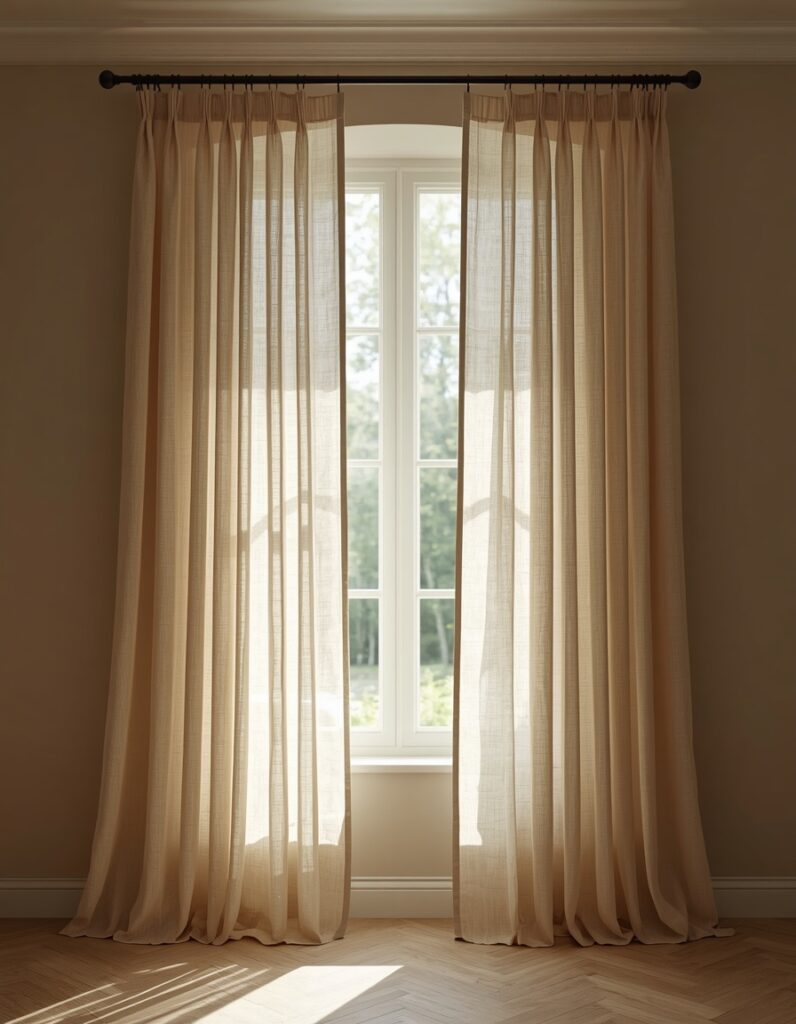
Sheer linen should be hung as close to the ceiling as possible — from a ceiling-mounted rod or from hooks installed 2–4 inches below the ceiling line. The panels should pool slightly on the floor — 1–2 inches of fabric resting on the floor — or break just at the floor. Never hang sheer linen panels to window height only. The full ceiling-to-floor drop is what transforms a window covering into an architectural element.
Color: always undyed, natural, or warm white. Never bright white — bright white linen panels look synthetic against natural light. Never gray — gray linen panels make a room feel darker in the wrong direction. Natural linen in its undyed state has a warm oat or cream tone that harmonizes with every warm neutral in the Japandi palette.
Tier 2 — Bamboo and woven grass shades
The most Japanese of the window treatment options — bamboo roller shades and woven seagrass Roman shades reference the traditional Japanese shoji screen aesthetic directly while providing more privacy and light control than sheer linen alone.
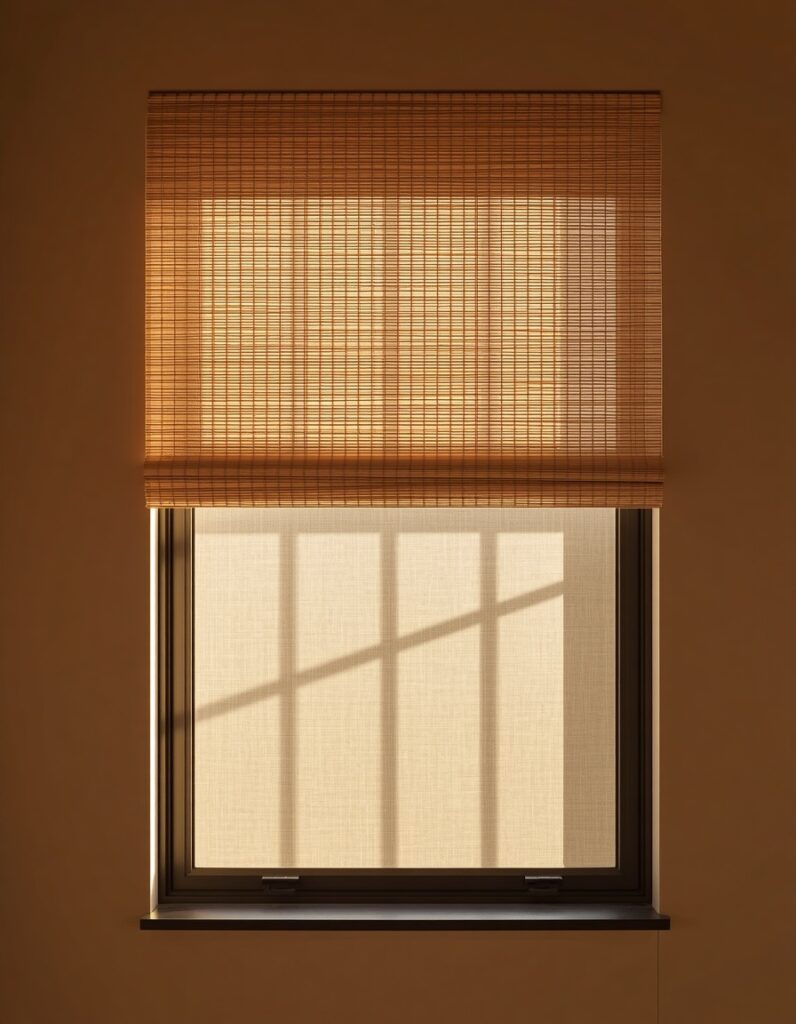
Bamboo shades filter light differently from linen — they block more direct light while allowing it to pass through the gaps between the woven strands in small, defined points rather than the even diffusion of linen. The effect is warmer and more dramatic — a bamboo shade in afternoon sun creates a grid of warm light points on the opposite wall that is one of the most beautiful light effects available in interior design.
They work best in combination with sheer linen panels — the bamboo shade provides privacy and the shading function, the linen panel softens the edges and provides the full ceiling-to-floor composition.
Tier 3 — Linen Roman shades
For windows where a panel aesthetic is not appropriate — smaller windows, kitchen windows, bathroom windows — a linen Roman shade in the same natural undyed tone as the rest of the room’s palette provides the privacy and light control function in a compact, clean form.
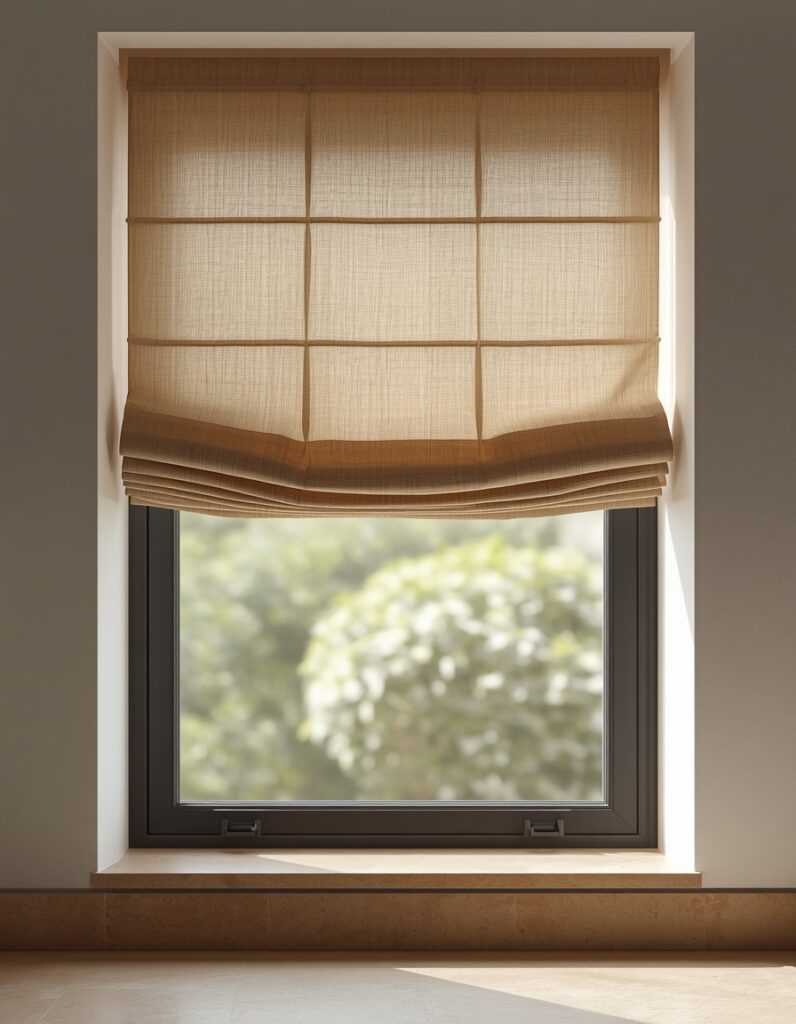
The Roman shade should be in 100% linen — never linen-look polyester. The material matters because linen folds differently from synthetic fabric when the shade is raised — it stacks in the irregular, slightly imperfect folds that are characteristically beautiful rather than the uniform accordion folds of synthetic Roman shades.
Tier 4 — Cellular and honeycomb shades
For rooms where energy efficiency is a priority — particularly in climates with extreme temperature variation — cellular honeycomb shades in warm white or oat provide excellent insulation with a clean, minimal profile that does not compete with the Japandi aesthetic.
They are not as authentically Japandi as linen or bamboo — the cellular structure is clearly manufactured rather than natural. But they are honest in their function and unobtrusive in their appearance. Paired with a sheer linen panel on the same window they become invisible behind the linen and do their thermal job without compromising the room’s aesthetic.
What to avoid entirely:
- Polyester or synthetic sheers — they reflect light rather than diffusing it, look cheap against natural materials, and never move the way linen does in air currents
- Heavy velvet or blackout curtains — wrong weight, wrong material, wrong effect for Japandi spaces (the exception is bedrooms where blackout function is needed — see bedroom section below)
- Patterned fabrics — any print, stripe, or weave pattern that reads as decorative rather than textural breaks the Japandi palette immediately
- Plastic or vinyl blinds — incompatible with natural materials at any level of the Japandi aesthetic
Hardware — the detail that determines everything
The curtain rod, bracket, and ring hardware in a Japandi room follows the same material rules as every other hardware decision in the space.
Matte black is the most commonly used Japandi curtain hardware — it functions as the visual anchor that the Japandi palette requires, provides clean contrast against warm white or greige walls, and reads as considered rather than decorative.
Unlacquered brass is the wabi-sabi hardware choice — it will oxidize and develop a natural patina over time, meaning the rod itself becomes more beautiful as it ages. Particularly appropriate in rooms where the overall aesthetic leans toward the wabi-sabi end of the Japandi spectrum.
Natural wood — a wooden curtain rod in white oak or walnut — is the most Japanese of the hardware choices, adding warmth and organic material to the window arrangement. Works best in bedrooms and living rooms where the wood tone can relate to nearby furniture.
What to avoid: chrome, nickel, or polished gold. These finishes reflect light in ways that create visual noise against the matte, absorbed-light quality of Japandi surfaces.
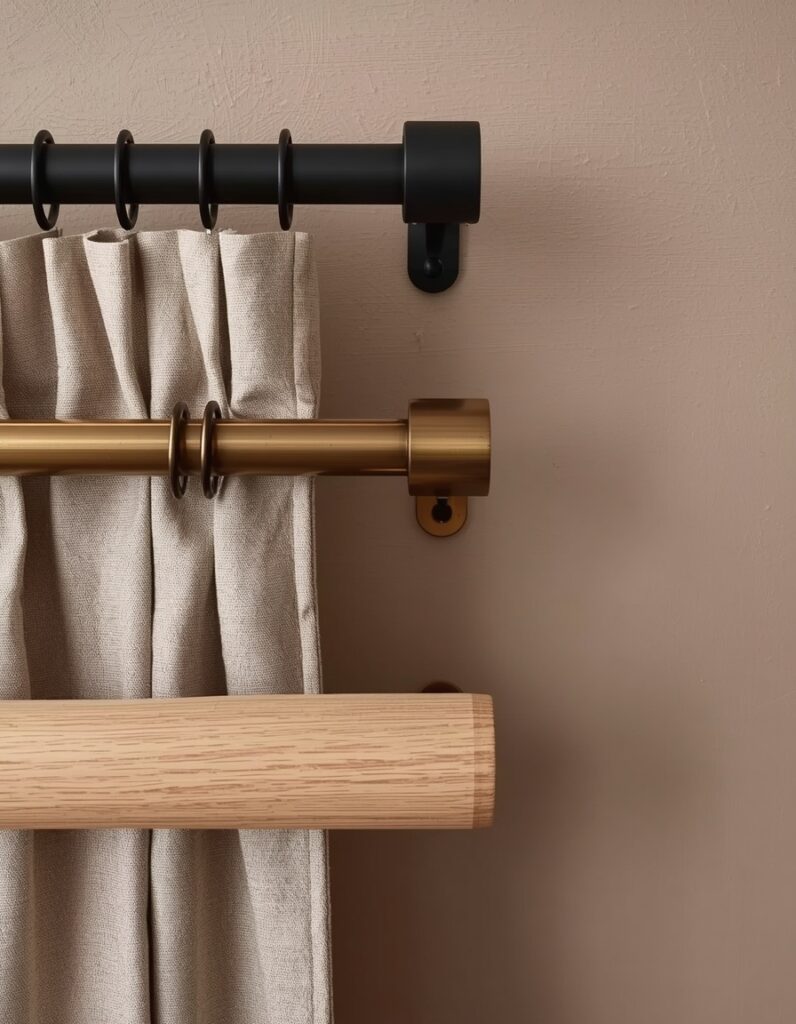
The mounting rule: always mount the rod or track as close to the ceiling as possible — ideally at ceiling height or 2–4 inches below. This visual trick makes ceilings appear higher, windows appear larger, and rooms appear more spacious. A rod mounted at window height instead of ceiling height makes a room feel shorter and a window feel smaller. It is the single most common curtain installation mistake in US homes.
The width rule: extend the rod 6–12 inches beyond the window frame on each side. When the curtain panels are open during the day they should sit entirely clear of the glass — bunched against the wall rather than overlapping the window. This maximizes the light entering the room and reveals the full window when natural light is desired.
Room-by-room recommendations
Living room
The living room window treatment is the most architecturally significant in the home — visible from every seating position, affecting the quality of light in the most-used room.
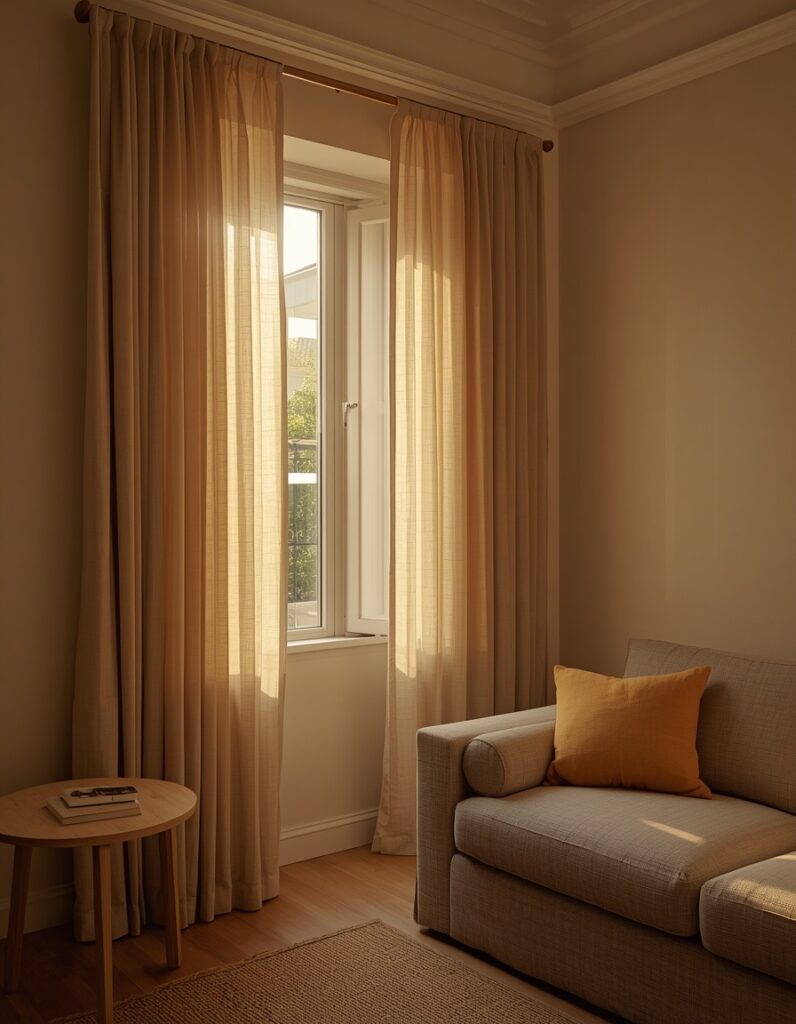
Primary recommendation: ceiling-mounted sheer linen panels in undyed natural linen, ceiling height to floor with a 1-inch pool. Matte black or unlacquered brass rod and rings. No secondary treatment — in living rooms where privacy is not a primary concern, sheer linen panels alone create the most beautiful light quality.
For living rooms where privacy is needed: sheer linen panels as the primary treatment with bamboo roller shades on a separate track behind them. The bamboo shades pull down for privacy and the linen panels remain drawn to soften the room’s appearance from the street.
Bedroom
The bedroom is the one Japandi room where blackout function is genuinely appropriate — sleep quality is directly affected by light levels and blackout window treatments are a legitimate sleep hygiene investment.
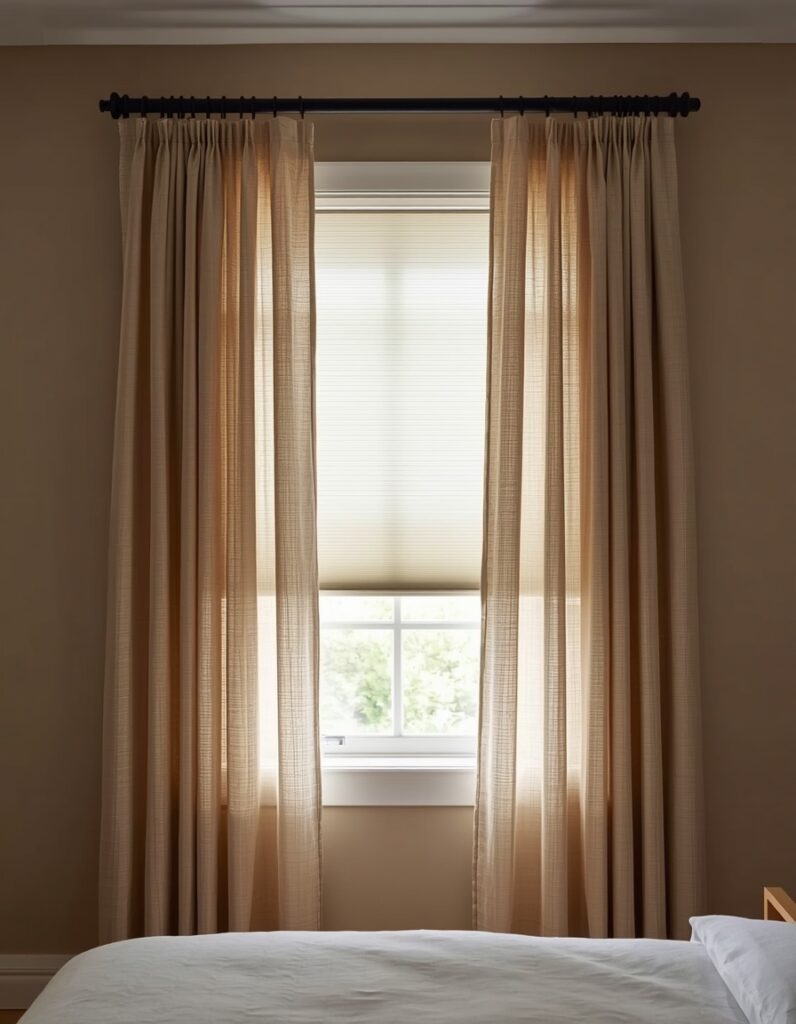
The Japandi solution: blackout cellular shades mounted inside the window frame (invisible from the room when not in use) paired with sheer linen panels on a ceiling-mounted rod in front. The cellular shade provides the blackout function. The linen panel provides the aesthetic. During the day both are open — the room reads as having only the linen panels. At night the cellular shade comes down for complete darkness behind the linen.
This layered approach eliminates the visual problem of heavy blackout curtains in a Japandi bedroom without compromising the sleep function.
Kitchen
Kitchen windows require the most practical of the Japandi window treatment options — a surface near cooking and water needs a treatment that is easy to clean and unobtrusive enough that it does not compete with the cabinetry and countertop materials.
Primary recommendation: a natural linen Roman shade mounted inside the window frame. Clean, compact, easy to operate, and invisible when fully raised. In a Japandi kitchen where the two-tone cabinet approach is used, the window treatment should match the upper cabinet color — warm white or natural linen — to maintain visual continuity above the counter line.
Home office
The home office window treatment affects focus and productivity as much as aesthetics — the relationship between the desk, the window, and the light source determines whether the working environment is sustainable for long hours.
Following the positioning principle from the Japandi home office guide — desk perpendicular to the window rather than facing it or turning your back to it — the window treatment in a home office should provide modulation rather than blocking. A bamboo shade that can be raised in the morning for maximum light and lowered partially in the afternoon to reduce glare without darkening the room is the most functional Japandi home office window treatment.
Bathroom
The bathroom is the most overlooked window in the home for treatment decisions — most people default to a plastic roller blind or frosted glass and never think about it again. In a Japandi bathroom the window treatment is an opportunity to introduce one of the most beautiful light effects available in the entire home.
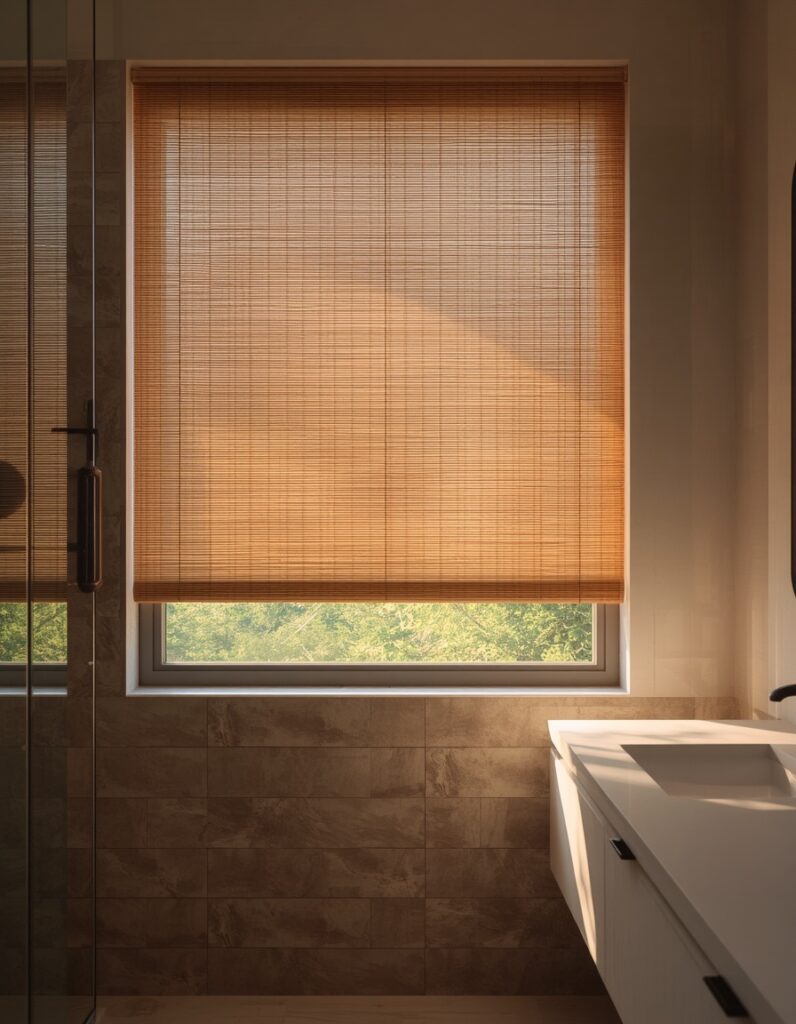
Natural light filtered through a woven bamboo shade in a bathroom creates a warm, spa-like quality that no artificial lighting system can replicate. The light passes through the bamboo weave in small warm points that scatter across stone tile and white oak vanity surfaces — the equivalent of candlelight but from the sun.
The priority in a bathroom window treatment is moisture resistance. Linen Roman shades are not appropriate for bathrooms with high humidity or direct water exposure near the window — the fabric can mold or warp. The correct Japandi bathroom treatment is either a bamboo shade (natural bamboo resists moisture better than linen) or a waterproof cellular shade in warm white behind a linen panel placed far enough from the window that it never contacts water.
Privacy is always a consideration in bathrooms. An inside-mounted bamboo shade that reaches full sill coverage when lowered provides privacy while maintaining the natural material aesthetic. For ground-floor bathrooms or those overlooking neighbors — a bottom-up shade mechanism allows natural light from the upper portion of the window while maintaining privacy in the lower section. This is the most functional Japandi bathroom window solution available.
Guest room
The guest room window treatment serves a slightly different function from every other room in the home — it must work for a visitor whose sleep schedule, light sensitivity, and privacy preferences are unknown. A sheer linen panel alone is beautiful but provides no blackout function for a guest who sleeps until 9am in a sun-facing room.
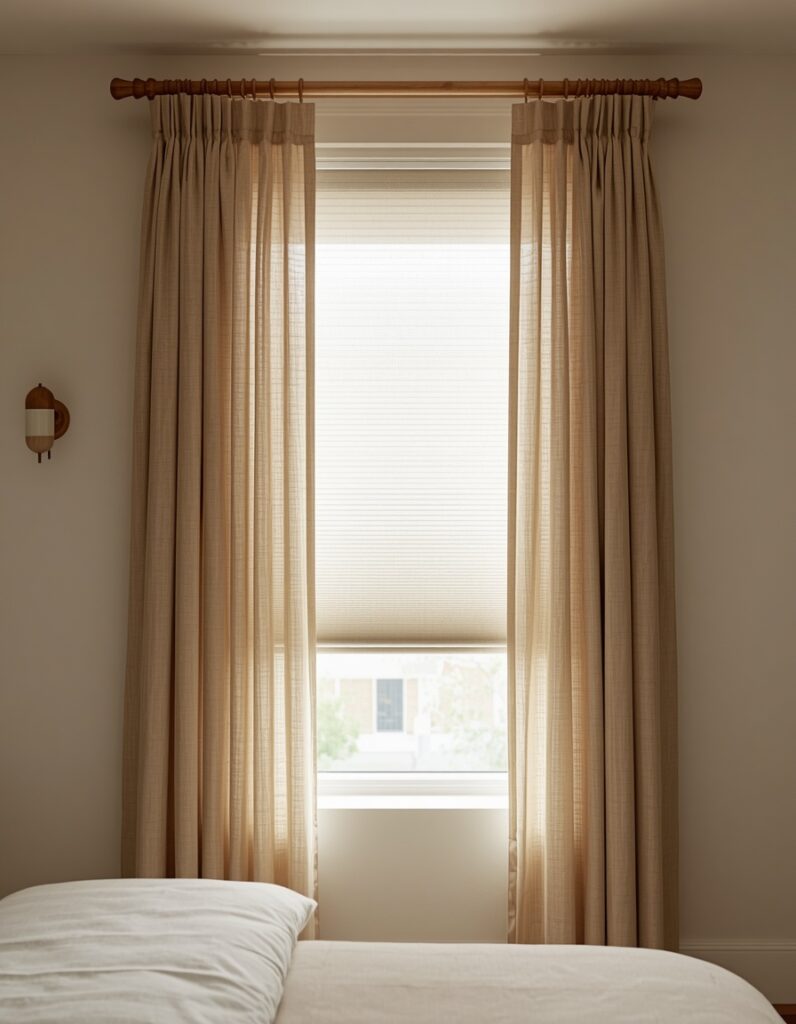
The Japandi guest room window treatment follows the same layered approach as the primary bedroom — sheer linen panels on a ceiling-mounted rod in front, blackout cellular shade inside the window frame behind. The guest sees only the linen panels and experiences the Japandi aesthetic. When they need darkness they have full blackout capability without any visual compromise.
The specific consideration for a guest room is ease of operation. The blackout shade mechanism should be intuitive — a cordless lift or a clearly labeled pull cord. A guest should not need instructions to achieve a dark room at midnight or to open the shade at sunrise. Simplicity of operation is a hospitality decision as much as a design one.
For guest rooms that also serve as a home office or multipurpose space, the bamboo shade option works better than cellular — it provides a useful middle state between full light and full dark that serves multiple room functions throughout the day.
The Japandi window treatment formula
Living room: sheer linen panels (ceiling to floor) + bamboo shade if privacy needed · matte black or unlacquered brass hardware · ceiling-mount rod extending 8 inches beyond frame each side
Bedroom: sheer linen panels (ceiling to floor) + blackout cellular shade inside frame · natural wood or matte black hardware · ceiling-mount rod
Kitchen: natural linen Roman shade (inside mount) · matte black hardware · no panel required
Home office: bamboo shade (inside mount) · matte black hardware · no panel required
Hallway: sheer linen panel (ceiling to floor) if window present · matte black hardware · single panel rather than pair for asymmetric wabi-sabi quality
Bathroom: bamboo shade (inside mount, full sill coverage) · matte black hardware · no panel — moisture risk
Guest room: sheer linen panels (ceiling to floor) + blackout cellular shade inside frame · matte black or natural wood hardware · cordless operation for guest ease
Frequently Asked Questions
What curtains work best in a Japandi room?
Sheer linen panels in undyed natural or warm white are the most authentically Japandi curtain choice available. They filter natural light into a warm diffused glow, move naturally in air currents, and age beautifully over time as the linen softens. They should be hung from ceiling height to the floor — never window height — on a matte black or unlacquered brass rod mounted as close to the ceiling as possible.
Are bamboo shades Japandi?
Yes — bamboo woven shades are among the most Japandi window treatment options available because they directly reference the Japanese shoji screen aesthetic, use a natural material that ages honestly, and create a distinctive warm light quality when the sun passes through the woven strands. They work best in combination with sheer linen panels — the bamboo shade handles privacy and light control, the linen panel handles the room’s aesthetic composition.
How do I get privacy in a Japandi bedroom without heavy blackout curtains?
The most effective Japandi bedroom privacy solution is a two-layer system: blackout cellular shades mounted inside the window frame (completely hidden behind the curtains when not in use) paired with sheer linen panels on a ceiling-mounted rod in front. During the day only the linen is visible — the room reads as having a single elegant window treatment. At night the cellular shade provides complete blackout while the linen panels soften the window’s appearance.
The Finished Window
The window is not a hole in the wall that needs covering. In a Japandi room it is the primary light source — the element that determines the quality of every other material in the space.
Sheer linen at ceiling height is not a curtain. It is a light filter — the difference between a room that feels illuminated and a room that feels inhabited by light. Between a room that looks designed and a room that feels lived in.
Hang it from the ceiling. Let it pool slightly on the floor. Choose the hardware last and choose it in matte black or honest brass. Then open the window one morning and watch what the light does when it has been given the right material to pass through.
That is when the room becomes complete.
Shop This Look
Sheer linen panels — Solino Home Natura Flax Linen Sheer. Order one panel wider than your window on each side.
Bamboo Roman shade — Cordless Woven Wood Roman Shades. Premium woven bamboo, custom sizing, ships in 7–9 days.
Linen Roman shade — Lily Cordless Relaxed Roman Window Shades The most authentically Japandi Roman shade in the US market. Natural linen, beautiful fold.
Matte black curtain rod — Matte black curtain rod. Always buy ceiling-mount brackets.
Unlacquered brass rod — Unlacquered brass curtain rod Will develop natural patina — the wabi-sabi hardware choice.
Blackout cellular shade — Chicology cordless cellular shade in white Inside mount, invisible behind linen panels, excellent blackout function.
Curtain rings with clips — Matte black curtain rings with clips. Clip-on rings allow easy panel removal for washing.

